Come join us at @appliedcompute! We're coming out of stealth with 80M in funding to build Specific Intelligence: custom models and purpose-built agents for enterprises. We're hiring across research, infrastructure, and engineering -- reach out to learn more!
Generalists are useful, but it’s not enough to be smart.
Advances come from specialists, whether human or machine.
To have an edge, agents need specific expertise, within specific companies, built on models trained on specific data.
We call this Specific Intelligence.
It's what we're building at Applied Compute.
We unlock the latent knowledge inside a company, use it to train custom models, and deploy an in-house agent workforce that reports to your team.
We work with sophisticated companies that have already captured early gains from general models, like @cognition, @DoorDash, and @mercor_ai. They’re pulling even further ahead with proprietary in-house agents that don’t need to wait for the next public model release.
Together, we are building and validating models and agents in days instead of months, achieving state-of-the-art performance on customer evals.
Our team has high density and low latency. Our founders all worked on different parts of this problem while they were researchers at OpenAI — @ypatil125 as a key member on the agentic software engineer effort (Codex), @rhythmrg as a core contributor to the first RL-trained reasoning model (o1), and @lindensli as a core contributor on ML systems and infrastructure for RL training.
Two-thirds of the team are former founders, and everyone brings a deep technical background, from top AI researchers to Math Olympiad winners.
We are backed by $80M in funding from Benchmark, Sequoia, Lux, Elad Gil, Victor Lazarte, Omri Casspi, and others. With their support, we are growing the team, scaling deployments, and bringing to market the first generation of agent workforces built on specific models.
In short:
1. We are building Specific Intelligence for specific work at specific companies.
2. That will power in-house agent workforces to support their human bosses.
3. That in turn will unlock AI’s full potential through humanity’s greatest engine of progress: thriving corporations in a free market.
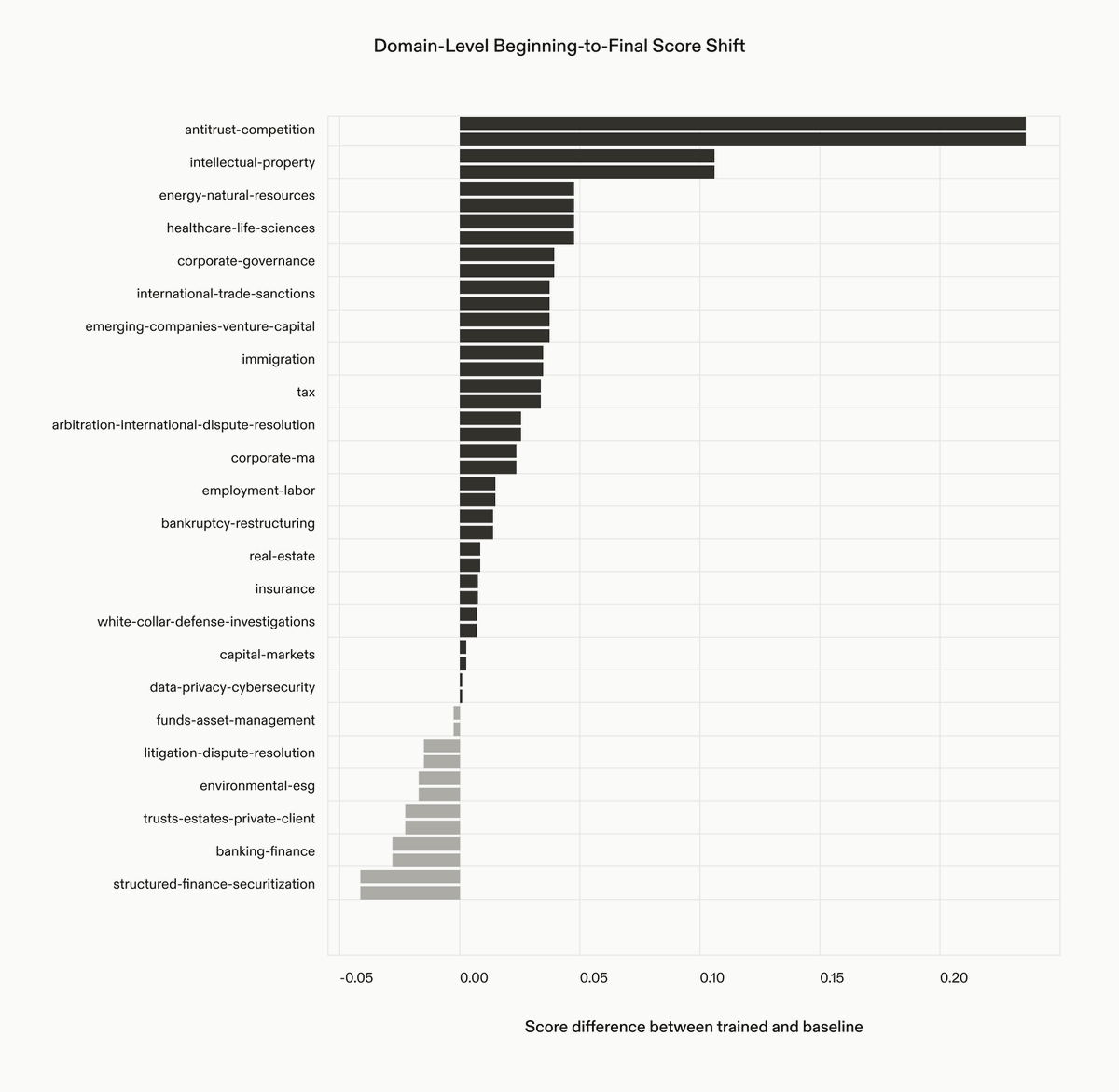
We partnered with @appliedcompute to train a legal agent.
We optimized each part of the agent stack:
- the evaluation loop
- the agent harness
- and post-trained the underlying GLM-5.1 model.
The result? The agent achieved the highest rubric pass rate on our Legal Agent Benchmark (LAB) of any available model.
Much more in our agent-training deep dive with @appliedcompute:
Harvey partnered with @appliedcompute to train a legal agent.
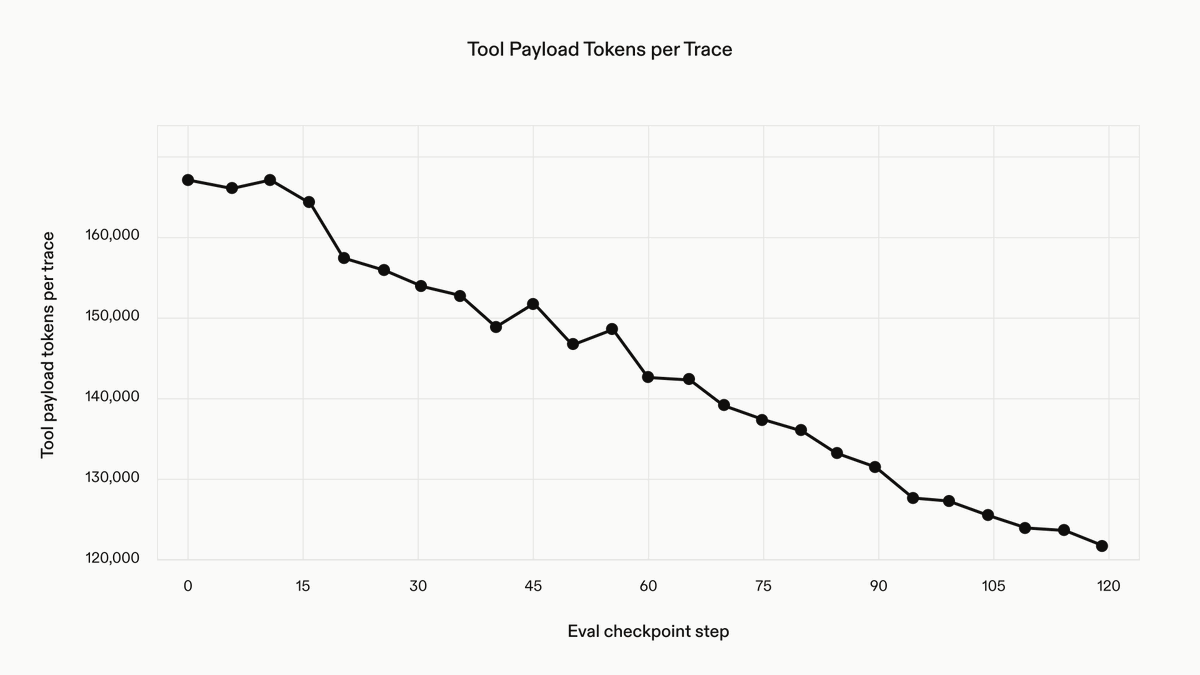
We optimized each part of the agent stack, including the eval loop, agent harness and compaction, and post-trained the underlying GLM-5.1 model using reward signal from Harvey's Legal Agent Benchmark (LAB).
Check out more in the agent-training deep dive below.
Kudos to @nikogrupen, @ItsJulioPereyra, @rhythmrg, @jacob_dphillips, and @raymondmfeng for leading this effort - more to come, with lots of opportunity to push the frontier with GLM-5.2.
Enterprise AI deployments today are frozen in time. Model capabilities stagnate in production. The problem compounds because companies aren’t static either. Every time your company improves, the model falls further behind.
The bottleneck is continual learning. How does a model do something once and improve from feedback?
The future of enterprise AI is Specific Intelligence: custom models teams own, trained on a company’s choices, interaction by interaction, using internal knowledge general models cannot access.
Applied Compute helps companies train, serve, own, and improve custom models. Thanks @apoorv03 for having @ypatil125 at MS&E 435 to talk about the future of model training.
Westmag is building American robot actuators and drone motors at scale.
In 2025, @westmagco raised $11M led by @a16z, with participation from @FoundersFund, @LuxCapital, NFDG, @MenloVentures, and other top investors.
Since then, we’ve been building industrial capacity, crawling up supply chains, and securing high-volume customers.
Now, we’re ramping production at our factory in South San Francisco to deliver against committed offtake orders from high-volume customers.
Westmag is committed to scaling quickly in the US to deliver millions of drone motors and robot actuators to the surging domestic and global market.
We’re building the great American motor and actuator company.
In 2024, I spent well over a year looking for a US actuator manufacturer, and was considering going full time on this opportunity. Tackling the key bottleneck of any physically actuated device is both critical and an enormous opportunity in the physical AI future.
Then we met @boxcardavid, the Motor Guy of the robotics world, and @jordansanders0, who brought operational experience building and deploying robots.
@westmagco is building American robot actuators and drone motors at scale. Over the last year, they’ve gone from idea to first factory shipping motors, and are rapidly ramping up production.
We are honored to be partnering with David, Jordan, and the entire Westmag team as they build the great American actuator company. They’re hiring.
Westmag is building American robot actuators and drone motors at scale.
In 2025, @westmagco raised $11M led by @a16z, with participation from @FoundersFund, @LuxCapital, NFDG, @MenloVentures, and other top investors.
Since then, we’ve been building industrial capacity, crawling up supply chains, and securing high-volume customers.
Now, we’re ramping production at our factory in South San Francisco to deliver against committed offtake orders from high-volume customers.
Westmag is committed to scaling quickly in the US to deliver millions of drone motors and robot actuators to the surging domestic and global market.
We’re building the great American motor and actuator company.
Some enterprise tasks are challenging to hill-climb with RL-based methods since they involve very out-of-distribution behavior. On-policy self-distillation (OPSD) gives a model learning signal for every token it writes, far richer than the single scalar reward of RL.
But that channel is noisy: most tokens don't reflect the behavior you're after. We introduce Relevance-Masked Self-Distillation (RMSD), which uses a two-step filtered loss mask to cut through the noise and find the tokens with the highest signal. Compared to OPSD it trains more stably, provides higher data efficiency, and reaches a higher performance ceiling.
Some enterprise tasks are challenging to hill-climb with RL-based methods since they involve very out-of-distribution behavior. On-policy self-distillation (OPSD) gives a model learning signal for every token it writes, far richer than the single scalar reward of RL.
But that channel is noisy: most tokens don't reflect the behavior you're after. We introduce Relevance-Masked Self-Distillation (RMSD), which uses a two-step filtered loss mask to cut through the noise and find the tokens with the highest signal. Compared to OPSD it trains more stably, provides higher data efficiency, and reaches a higher performance ceiling.
at AC i’ve learned forward deployed work is among my favorite. a personal favorite memory was getting a high five from a customer after a day in the office and a successful prod deployment.
closely collaborating with companies and diving into the nitty-gritty of their systems to make agents work is challenging but rewarding.
it’s “full stack” in the sense it involves a eng, research, and understanding customer needs which makes each day different and gets me excited.
The FDE role of the AI era has fundamentally changed. It's no longer just about building dashboards and connecting data pipes - it's about building evals, deploying agents that improve in production, winning trust across the org chart, and closing feedback loops that compound over time. We wrote about what to expect when deploying AI in the enterprise today.
Robotics has spent decades optimizing for research. Deployment requires a completely different kind of person: operators, industrialists, and outsiders the field typically ignores.
There's a wave of people who want to build in robotics. The field doesn't know what to do with them.
New essay, Robotics Needs Fewer Roboticists* below 👇
Government, military, and commercial operators must have rapid and resilient spectrum access to deploy the systems of tomorrow.
We lack the modern toolkit for complete control of the radio frequency spectrum domain.
Thrilled to share our exclusive with @axios on how @teamairbase is fixing the “invisible” crisis grounding U.S. commercial and defense tech. We’re already working alongside federal regulators and the DoW to bring this vision to reality.
Read the full story from @demarest_colin on how we’re working with regulators and end users to build modern infrastructure for RF spectrum here:
Today, @teamairbase is emerging from stealth.
With a $5M round led by @a16z alongside @squadra_vc and @foundersysk, we’re solving a critical, invisible bottleneck in American national security: radio frequency (RF) spectrum coordination.
Nearly all modern technology–from 5G on our smartphones to weather satellites and next-generation autonomous defense systems–depends on spectrum access.
Yet, as demand for connectivity soars, the government systems used to allocate spectrum licenses and coordinate usage are stuck in a bygone era. Slow, manual workflows stall innovation and allow our adversaries to outpace us.
Airbase is building the modern infrastructure for RF spectrum licensing, coordination, and intelligence.
This isn’t merely a vision. We’ve secured an active contract with the U.S. Government to build and deploy the modern, software-defined data and coordination layer. We’re grateful to be partnering with brilliant minds across civil federal, commercial, and defense.
America’s next era isn't waiting to be built. It’s waiting to be unleashed.
The future of wireless is resilient, connected, and abundant.
@espricewright, @rmcentush, Alex Oliver, Guy Filippelli, Dom Ventimiglia, Dan Madden, Jen Yip, and many more
"Everyone's talking about continual learning. That's entirely where this space is going to go."
The Applied Compute platform is architected around that premise: build memory and intuition from fragmented data across your entire org, train reasoning models directly on top of it, and close the loop.
A model is just one piece. An agent is where it runs, what tools it has, how permissions and auth are handled, how humans guide and instruct it, and the observability around it all. Every interaction should be treated as a training signal so the system can compound over time.
Thanks for having us @tbpn