@TimeEnoughLV@Anc_Aesthetics Waiting for a boomer to leave so you can finally get the promotion and 20 years later never happened because boomers are harder to get rid of than cockroaches. The young's know your weak ass let them walk all over you entire career and just resent for voting for them entire time
After Uni and law school I moved to London and paid very expensive rent whilst working a job that took up to 70 hours a week and sometimes more.
I worked hard and was, “succesful”.
By the time I had paid off my small student debts and saved a deposit the Blair bubble had formed and every pay rise was massively outstripped by property inflation. I kept thinking it might slow down but as we kept looking round every house had doubled in value in about 5 years. Peers just a year of two ahead of us seemed to have gotten rich already and were trading up. Luckily I decided I didn’t want to wait for prices to come back down and got a small house in non descript corner of Lewisham in about 2002. I remember the worry about having a 95% mortgage and slogging my guts out every day.
I had been told there was this thing called a “property ladder” and having worked hard for nearly a decade and having been told year how well I was doing I expected to move up it. But every year the property raced away from me and the houses in the nice street with 4 bedrooms kept rising out of reach.
£400k, £500k, £700k.
My pay was going up £10k a year and I thought I was doing well. I wasn’t. It was pointless.
So eventually we had kids and wanted a bigger place. Still working very very hard. Moving to an American law firm to work even harder. And we gave up on London. We sold up rented one of the nice houses for a year. Thought the price might drop. Asked the landlord in the middle of the property “crash”. £850k now. And this was Lewisham. Nothing Special. One day a local lad - Jimmy Mizzen I remember his name - got killed by a thug at the shop at the end of the road. Meanwhile the Labour govt and then the Tory govt came up with every scheme they could to prop prices up.
So eventually we start to look further out around Kent. And finally find a massive house that happened to be back in my home town of Dover. Couldnt believe how big it was and that we could afford it. Again a massive mortgage by hey ho. Well it was where I went to school. Actually the real home town is up the road in the more salubrious Walmer. So we were Downwardly mobile. Duppies rather than yuppies. But still we finally got the house and the garden.
Not that we were in it much. Both working full time jobs and now with a massive commute. I would stay in London 2 or 3 nights a week so I could work late. 5 am commutes on other days. Coming home at midnight trains. The Platfomr to change at Ashford so cold in winter. Luckily I had worked enough 2 am shifts and met enough deadlines to be trusted to work a day and sometimes even two a week at home. And when in London cheap travellodges in the grimmer corners of zones 1 and 2 and 3: Tower Hamlets. Barking. Deptford. Hackney. Wood Green.
Living the Dream.
Actually to be fair it’s been pretty good. I felt more for my peers. May sister who was just year too late to get a place and eventually moved to Liverpool and bought up her kids in a too small house there instead. Friends who told me once their own stories of missing out on London. It seeming just a bit too much at the time. The twinge of regret in their eye.
All this time all our taxes have only ever gone up.
At some point we lost child benefit. We were pregnant with R2 I think. No 15 years heads-up as with pension reforms. Then I found myself paying 60% tax on a bonus. Then 60% marginal rates for a bit. For a while we had a nanny so Mrs R who could also work hard in London. Paying more tax on that and fiddling around with forms. Tax on everything. Hidden changes everywhere. The year we bought our place in Dover we paid so much stamp duty that I didn’t make any money at all above the higher rate tax band. It was a 100% marginal rate that year.
Still got a mortgage to go. Ill pay for kids Uni. I won’t bother saving much for a pension.
Anyway. I’m just really really pleased to know that whilst I slogged my guts out the govt just gave this foreigner a £2m house in Hampstead
Trump just stood at the White House podium and trashed his own country.
American cities: 'rusty and disgusting.' China's cities: 'flawless' and 'immaculate.'
He went to China and came back as Xi's spokesman.
mala gaonkar thinks investors are overestimating how easily ai can replace financial data firms.
gaonkar founded surgocap partners, which managed $6 bn in 2026. she still likes the businesses that own the live data trading desks rely on.
take a currency trade. the desk needs a live price to clear it, and its compliance team already uses that same feed.
plus most of the time the AI models themselves need that data too.
The Boston Symphony used to run on 100 musicians and 6 administrators. According to Heather Mac Donald, it now has about 100 of each.
She says that's the real story behind the fight over what an orchestra is for.
Mac Donald: "Feeding and keeping occupied all of these human resources consultants and whatnot costs a fortune, which results in ticket prices going up."
Her fix is the part I keep coming back to.
Mac Donald: "If you want a diverse audience, how about you lower your ticket prices? How about even making it free to schoolchildren?"
Instead, she says, the staff needed something to do, so they started shaping the programming. This summer, one of Tanglewood's closing humanities programs was about mass incarceration and systemic racism.
Mac Donald: "Classical music is seen simply as a jumping-off point to get to what really matters."
On the other side is conductor Andris Nelsons, who wanted the orchestra's plan to name the core repertoire and the orchestra's own sound as its mission.
That's the irony. The cheapest way to bring new people to Tchaikovsky is to let them hear Tchaikovsky. A free ticket for a 12-year-old does more for the audience of the future than another panel discussion.
When the people running the music outnumber the people playing it, the music stops being the point.
Crypto had its Waterloo with the 2026 election, and the damage is coming to the surface. 10/10's price collapse. The constant frauds. The North Korean hacks.
It is grim.
My friend Omid is also right - most of the people in this space don't believe in it. They were here for a quick buck, furiously grabbing dollar bills off the ground in a frenzy of greed while lying passionately to their followers that it was about the ideals from their yacht as they sail away with the cash.
Those people are going to be gone. There will be a void left behind.
That is where real things will be built.
Crypto will also never be a single thing again. It was unnatural; what industry includes JPM's Onyx, Bitcoin, Damien Hirst's art, and Cumrocket? That's not an industry. That's a conspiracy theory.
It's going to break apart. The institutional crowd will build systems that are not the decentralized ideal that Omid wants, but are significant upgrades on the current infinitely dense centralization that they suffer from. Is it perfect? No. Is it better? Yes.
The cypherpunks are going to go their own way too. Zcash? Aleo? Aztec? The privacy crowd is going to do some interesting things, and my prediction here is that moves towards shielded assets, FX, and a return to basics, not to onboarding RWAs in the traditional sense, as the inherent tension there is unsolved.
Then we are going to have the artists, the designers, the creatives. Are they coming back at all? It's not clear to me. Hopefully someone will build something where they can, but as of now, I think the cultural moment has passed.
Crypto is dead. I am for it; the industry as it existed was built on an edifice of lies and is collapsing upon itself.
What emerges next is what I am interested in.
COVID Created A False Sense Of Housing Wealth And Reality Is Beginning To Set In
American homeowners are sitting on approximately $35 trillion in housing equity, equivalent to roughly 106% of U.S. GDP, near historical highs. Yet home sales relative to the number of homeowners have fallen to approximately 4.3%, near their lowest levels in decades. This extraordinary divergence reveals a housing market where enormous amounts of wealth exist on paper, but relatively few buyers are willing or financially capable of purchasing properties at current valuations.
How COVID Distorted Housing Values
The pandemic created an extraordinary environment for housing. Mortgage rates collapsed to 2.65%, fiscal stimulus expanded household purchasing power, remote work reshaped demand, and historically limited inventory intensified competition. National home prices surged approximately 42% between early 2020 and mid 2022.
Those who sold during that period converted historically elevated valuations into actual cash. But millions of homeowners who watched neighboring properties sell for extraordinary prices began treating those transactions as permanent benchmarks for their own wealth.
The problem is that the economic conditions supporting those valuations no longer exist.
Mortgage rates have climbed above 7%, dramatically reducing purchasing power. A $500,000 mortgage that cost approximately $2,015 monthly at 2.65% now costs around $3,424 at 7.28%, nearly 70% more for the exact same loan.
Yet many sellers continue expecting prices established when financing was substantially cheaper.
Why the Market Hasn’t Corrected More Aggressively
The primary reason is mortgage lock in. Millions of homeowners secured mortgages near 3%, giving them little financial incentive to sell and replace those loans at today’s rates.
This has simultaneously restricted housing supply and crushed transaction volumes, allowing elevated valuations to persist despite deteriorating affordability.
But there’s an important distinction between what homeowners believe their properties are worth and what buyers can actually afford to pay.
A home is ultimately worth what a qualified buyer is willing and able to pay, not what a neighbor received during an unprecedented period of monetary stimulus and historically cheap financing.
The Coming Repricing
Historically elevated valuations relative to household purchasing power cannot remain disconnected indefinitely. Some normalization can occur through rising wages, economic growth, and lower borrowing costs, but meaningful price corrections become increasingly plausible when demand weakens and sellers lose their ability to wait.
This is where unemployment becomes critical.
As job losses increase, households experience financial pressure, relocations become necessary, estates are liquidated, and more homeowners may be forced to accept prevailing market prices rather than wait for their preferred valuations.
Meanwhile, prospective buyers facing employment uncertainty may become even more reluctant to make the largest financial commitment of their lives, regardless of whether mortgage rates decline.
That combination could finally break the standoff between buyers and sellers.
The equity to GDP ratio does not have to mechanically return to its historical average through falling prices alone. But the underlying affordability imbalance eventually requires adjustment.
And that adjustment will not necessarily be uniform. Communities with declining populations, weaker employment prospects, and increasing housing supply could experience substantial depreciation, while desirable areas with limited inventory remain comparatively resilient.
The greatest misconception homeowners may be carrying forward from COVID is that extraordinary pandemic valuations represent a permanent measure of their wealth. Those who sold realized those prices. Those who haven’t may eventually discover that the market they remember no longer exists.
For decades we told women that to have value in this world, they had to act more like traditional men. We also told them to put off family. Put off love. Being self-focused and finding success professionally is what truly matters…
I believe that’s very anti-women. Sadly, people will call me anti-women for saying this.
🔥 INTERESTING: Sam Bankman-Fried misses out on a $37 billion windfall in Anthropic’s IPO.
2021: Sam Bankman-Fried puts $500M into Anthropic.
2022: FTX collapses, and customer lose $8B. SBF gets 25 years.
2024: The FTX estate sells the stake for about $1.34B.
2025: US government sells the Anthropic shares it seized from SBF's co-conspirators, Caroline Ellison and Nishad Singh, for $627M.
Today: At Anthropic's $83 IPO price, SBF's old stake alone would be worth about $37B, more than 4x what FTX customers lost.
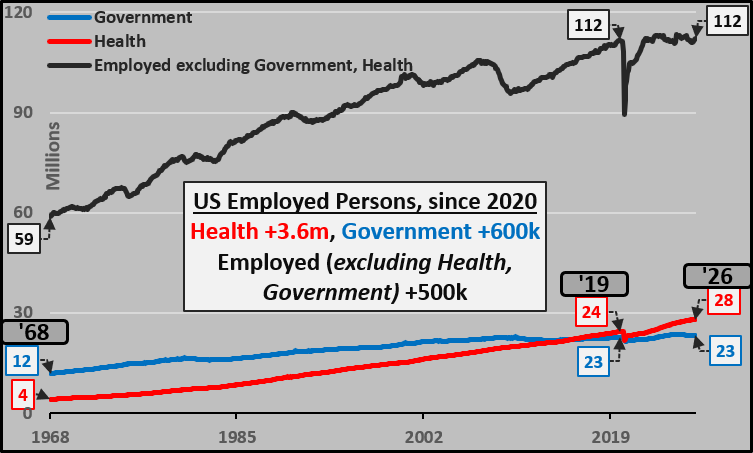
Since YE 2019, US Federal Government spent $17 trillion, 461 billion in deficit spending...and the real economy (excluding government and healthcare employed persons)...grew...DRUMROLL PLEASE...534 thousand. Again, $17.5 trillion resulted in the growth of 534 thousand employed persons outside of health and government. This is a failure of epic proportions.