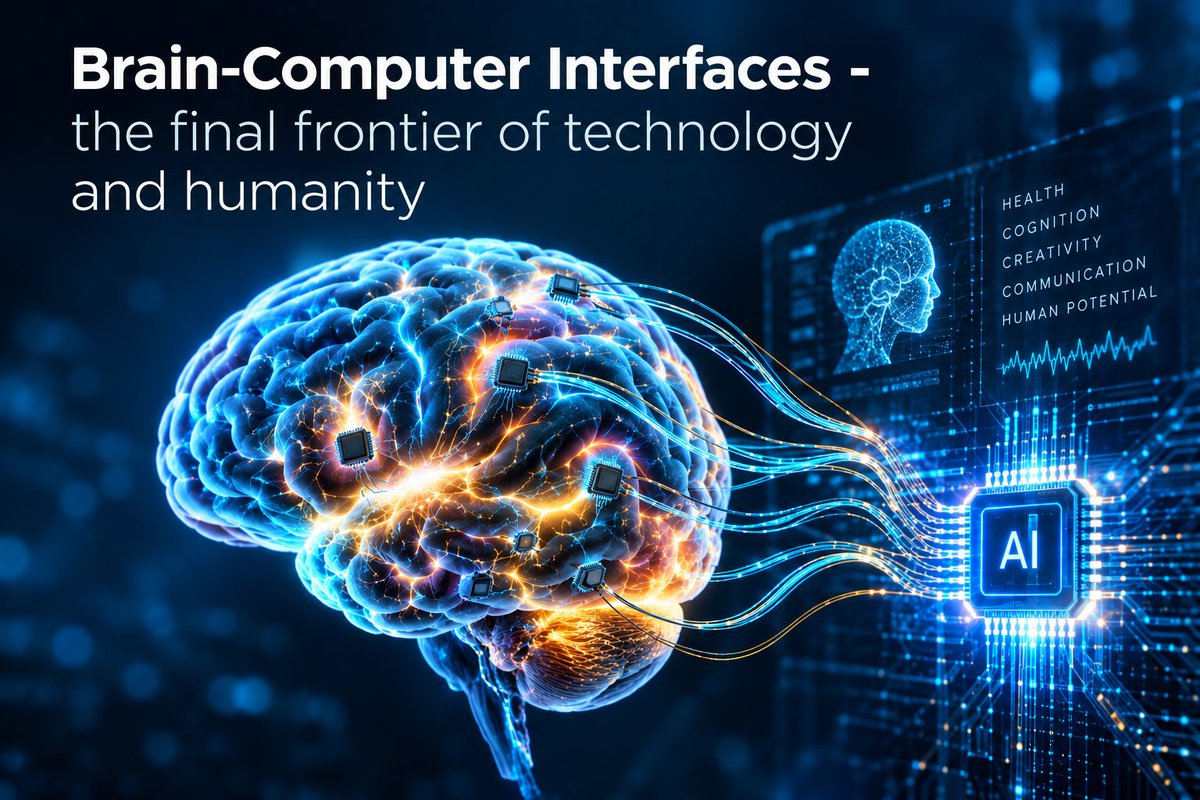
Brain-Computer Interfaces - the final frontier of technology and humanity
For all of human history, our body has been the only interface between our mind and the world.
Every thought we have ever shared has had to squeeze through a handful of muscles. We speak at roughly 150 words per minute. We type at around 40. Our brains can think far faster than either.
That reduced speed was fine when the other side of the conversation was another human.
It is not fine when the other side is an AI that can read an entire book in seconds.
The bottleneck between humans and AI is no longer the AI. It is us - or, more precisely, our bodies.
For millions of people living with paralysis, ALS or the consequences of stroke, that bottleneck is already absolute: the mind is intact, but trapped.
BCIs can change that. And that is where this field must start.
But the same technology that can restore a voice or enable a paralyzed person to move again could eventually widen the channel for everyone.
To get there, a BCI has to be extraordinarily safe - and it has to beat your thumbs, your voice and every other “archaic” form we use express ourselves. That is a very high bar.
But I believe we will clear it. And soon.
I also believe BCIs could fundamentally change the AI conversation itself.
Most of today's safety debate focuses on how to control AI through regulation. But there is another path: increase the bandwidth between human brains and AI. Make AI more human. And enhance ourselves so that we can live with AI not simply as a tool outside us, but as a real extension of our own brains and minds – you could call it our exocortex.
And why now?
Precisely because AI gives us the tools to unlock one of the largest and most untapped sources of information we have: our neural data.
BCI today feels to me a lot like AI around 2018.
That is why I am thrilled that my neuroscience fund, @reMindCapital, led the round in @bridgeneurotech, founded by @will_biederman.
Read Will's post on why he started Bridge: link in the comments.
I am also sharing a fascinating piece I recently read on the future of BCIs in the comment section.
And stay tuned. More BCI news from me very soon. Follow me and turn on notifications so you don’t miss the big news coming over the next weeks and months.
I believe this will be one of the most important - and most exciting - journeys of our lifetime.
I will die on this hill: you simply cannot be a great founder and great investor at the same time.
The way you think about everything in life as a great investor is orthogonal to being a great founder.
You don’t have an unbiased objective view of the world as a founder.
Elon Musk was asked by an interviewer what he does when he makes a wrong decision.
He said he doesn't make decisions based on being right. He makes decisions based on expected value. Which means he expects to be wrong frequently. He said if you're not wrong at least 30% of the time you're not making enough decisions.
He described SpaceX's approach to rocket design. Instead of spending years perfecting a design on paper and then building it, they build it fast, launch it, watch it explode, and use the explosion as data for the next version. The explosions aren't failures. They're the fastest way to generate the information needed for success.
He said most companies fail not because they make bad decisions but because they make too few decisions. They spend so long trying to be right that the opportunity passes. A wrong decision made quickly generates data. A delayed decision generates nothing.
Then he said the part that made the interviewer go quiet. He said the biggest mistakes of his career weren't the times he was wrong. They were the times he was right but too slow. The times he knew the answer and waited for more confirmation before acting. The delay cost more than any wrong answer ever did.
The world sees Elon as a risk taker. He sees himself as someone who moves fast enough that the cost of being wrong is always lower than the cost of being slow. That's not the same thing as courage. It's math.
Terence Tao says the math behind today’s LLMs is actually simple. Training and running them mostly uses linear algebra, matrix multiplication, and a bit of calculus, material an undergraduate can handle. We understand how to build and operate these models.
The real mystery is why they work so well on some tasks and fail on others, and why we cannot predict that in advance. We lack good rules for forecasting performance across tasks, so progress is largely empirical.
A key reason is the nature of real-world data. Pure noise is well understood, perfectly structured data is well understood, but natural text sits in between, partly structured and partly random. Mathematics for that middle regime is thin, similar to how physics struggles at meso-scales between atoms and continua.
Because of this gap, we can describe the mechanisms but cannot yet explain capability jumps or give reliable task-level predictions. That mismatch, simple machinery versus hard-to-predict behavior, is the core puzzle.
----
Video from 'Dr Brian Keating' YT Channel (Link in comment)
Money didn't emerge from barter markets. It emerged from death, conflict, and marriage, centuries before markets existed. 📜
@NickSzabo4's latest essay "The Fabric of Desires" traces Bitcoin's deepest roots.
Read the full piece on the JAN3 Blog. ⬇️
https://t.co/67ddYfoYyI
- Drafted a blog post
- Used an LLM to meticulously improve the argument over 4 hours.
- Wow, feeling great, it’s so convincing!
- Fun idea let’s ask it to argue the opposite.
- LLM demolishes the entire argument and convinces me that the opposite is in fact true.
- lol
The LLMs may elicit an opinion when asked but are extremely competent in arguing almost any direction. This is actually super useful as a tool for forming your own opinions, just make sure to ask different directions and be careful with the sycophancy.
Unfortunately it’s more fundamental than that.
Almost all the stuff on the bottom went down in cost due to increased automation and offshoring.
Meanwhile, the stuff on top is domestic labor intensive.
Knowledge is having the right answers.
Intelligence is asking the right questions.
Wisdom is knowing when to ask the right questions.
—Professor Richard Feynman