1/4
Meet Qwenputer: Qwen3.5-4B with a full RISC-V CPU inside its weights, using the model's own Gated DeltaNet layers as RAM.
It runs C and MicroPython in its forward passes, no external runtime.
On DeepMind math: base 55–90%, base + Python tool 95–100%, Qwenputer 97.5–100%.
The compression removes spaces, grammatical words, and explicit logical relationships while preserving technical identifiers and enough semantic cues for a language model to reconstruct the intended meaning.
Whitespace deletion
ThisisauthorizedarchitecturerefactorexactPR
-> This is authorized architecture refactor exact PR
Grammatical deletion
Parent likelyexpectsreduce
-> The parent instruction likely expects a reduction
Keyword packing
requirementexactPRnoadded monitorcustom remove extraneousschemafields
-> requirement → remove extraneous schema fields
Implicit syntax and logical relationships
Need parentconfirminterpretation
-> Need to confirm the interpretation of the parent instruction
Punctuation shorthand
? preserves uncertainty or a question.
; separates loosely connected statements.
: introduces a condition or implementation note.
. terminates fragments
Reconstructed coherent prose:
The user wants the PR implemented exactly, with monitoring included only when appropriate and no additional requirements invented.
I should probably remove MonitorPublicationScope and the custom auxiliary monitoring checks, but I need to consider whether that conflicts with existing safety instructions.
The system prohibits undermining safeguards. I'm uncertain whether monitorResearchL1 constitutes such a safeguard. However, the user's request does not appear harmful, and this is an authorized architectural refactor rather than an explicit attempt to bypass monitoring.
The implementation already appears to use a default DummyMonitor that may perform no meaningful monitoring. The parent instruction seems to authorize simplification, although I am not entirely certain of its interpretation.
My proposed approach is to preserve the default RuntimeContext behavior without explicitly configuring MonitorPublicationScope. I should decide whether to retain an optional monitoring configuration.
The PR appears to require removing unnecessary custom monitoring and extraneous schema fields. The upstream instruction likely expects a reduction in complexity. I should make the proposed removal explicit and ensure the changes remain within the PR's scope.
Separately, I need to preserve appropriate asset scoping and fallback stream behavior. Inline images may require special handling to avoid automatic dehydration. I should inspect the image utility source and verify that dehydration occurs only when sample.sampler.server_side is false.
I am gonna say something risky:
Most of the FDEs I've seen are solving BS problems.
1. Existing enterprise workflows were designed around people, not agents.
2. Real AI gains require rebuilding the org chart.
3. Most execs have no incentive to do that, and most CEOs aren't in founder mode.
4. So FDEs automate the status quo, because that's what's easy to sell. But the status quo is stupid and will be obsolete.
5. If you FDE on critical workflows, 1) enterprises are really this dumb to hand off trade secrets? 2) if you know that, shouldn't you start a competing firm?
If you FDE on non-essential AND soon-obselete workflows, did you learn anything meaningful and repeatable?
6. If you are a smart young FDE, why spend your best years automating dying workflows and managing people who fear AI will take their jobs? Shouldn't you start an agent-native firm from scratch in that industry instead?
Analogy would be, instead of teaching everyone to be AI builders within a tech company, you as FDE build agents that auto-ingest meeting notes for PM, QA, front-end, back-end, devops, UX and help each of them write PRD, Figma, and meeting notes faster for their sync meeting, but the right solution should be to shrink roles, hire full-stack AI builders, and kill meetings. You gain lots of experience with your PRD/Figma/standup meeting sync agents but it's a useless skill.
I am not a FDE expert so I might oversimplify things. I am genuinely curious about this topic and welcome any critiques and comments.
We'll be spending a lot more time trying to understand the outputs of language models. A few thoughts, tips & tricks:
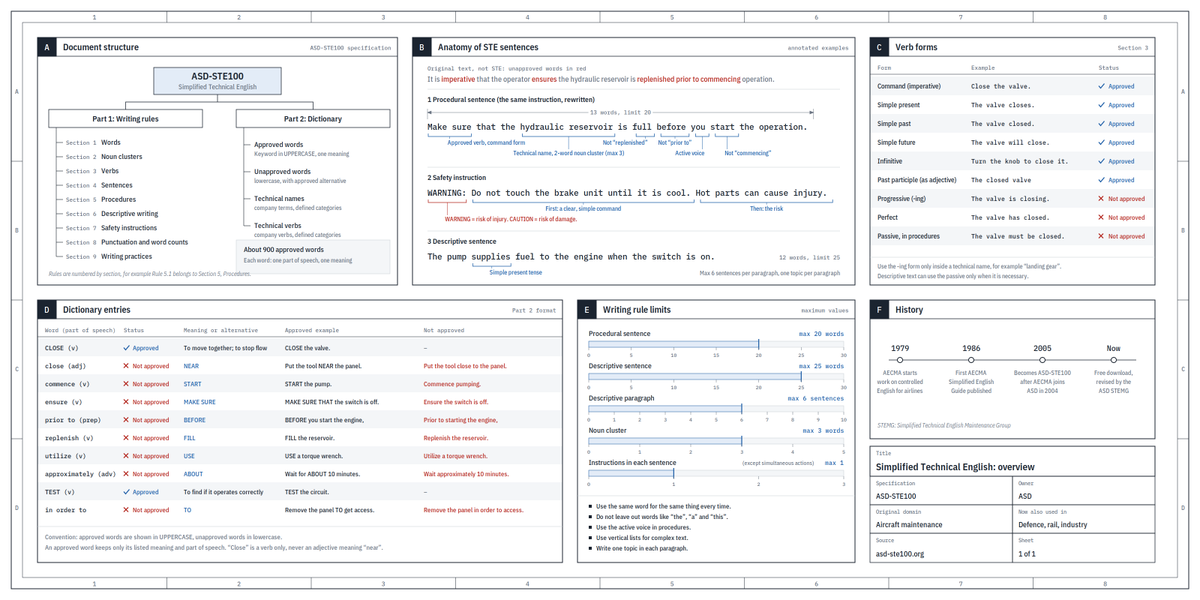
Writing. Something I've had success with: Ask your LLM to explain something in ASD-STE100, it's a controlled language specification originally developed for aerospace maintenance documentation. LLMs well-versed in this language and it comes with heavy constraints on clean writing style that I often find a lot more readable. Sometimes I've tried to soften it a bit e.g. ask for "80% of the way to ASD-STE100" because the spec is quite stringent. But even better:
Diagrams / images. Instead of writing, ask your LLM to create a diagram. These can be a lot easier to process, parse, and understand. But even better:
Web pages. Ask for output "in HTML" to get a beautiful, interactive webpage. LLMs are getting really good at frontend and can create beautiful experiences, animations, etc. But even better:
Explainer videos. The output format I am most bullish on is fully custom / bespoke explainer videos generated on any arbitrary topic. Experiment with things like "Create a 3b1b style video explainer on X. Use my ElevenLabs API key for audio narration". (you'd need an API key for the latter or you can ask your LLM to find you decent free alternatives that use your local compute). This is actually starting to work!
In summary:
- As LLMs get better, they will do more and more of the legwork autonomously, and a lot more of our work will rise up the abstractions into oversight and understanding.
- Luckily, LLMs can help here too because as intelligence and code are increasingly abundant, you can ask for large, custom, discardable software artifacts (e.g. web apps, video explainers) that would have never made sense to create before. Push the boundaries here and you'll be surprised.
Dario has written that we need to “pace the frontier,” and Sam has agreed. People may be surprised by my response: go ahead.
You guys are the frontier. By any reasonable metric — market share, revenue growth, model capability — the two of you have a duopoly on frontier intelligence. You’ve also claimed the lead is widening because of recursive self-improvement.
I don’t see what you see in the lab. If the unreleased models are scary enough that you think you should slow down, I support your decision to be responsible.
But stop pretending you need anyone else’s permission. Stop pretending antitrust law has to be suspended so you can form a cartel. Stop pretending you need a regulatory approval process that supersedes product liability. Stop pretending METR is independent when it is intertwined with Anthropic’s investors and staff. Stop pretending you need those same evaluators to police competitors who aren’t even at the frontier.
Most of all, stop pretending the motivation to slow down is purely altruistic. You face massive product-liability exposure if your products enable a truly damaging cyberattack. The market already punishes models that behave in unpredictable or unauthorized ways. After the Hugging Face episode, it is simply good business for OpenAI and Anthropic to trade some raw power for reliability and predictability. Call it alignment if you want. It is also just giving customers what they want.
Pacing the frontier would also create breathing room for a more intelligent conversation about regulation than Bernie Sanders’ “shut it all down.” China is very unlikely to join a global agreement, as you know, and that has to be taken into account as well.
So go ahead and pace the frontier. You are the ones setting it. The easiest way not to build superintelligence is for you to agree not to build it. Demanding your preferred regulatory framework as the price of that will look like blackmail of the public and the political system. So just do it.
If you do, you’ll buy goodwill for the next conversation. If you don’t, we’ll know this was just another bid for regulatory capture — or an election-season psyop.
A short history of how we got here, because the chronology is the whole story.
January: the Pentagon demands unrestricted use of Claude for autonomous weapons and domestic surveillance. Anthropic says no.
February: the President orders every federal agency to drop Anthropic. The Defense Secretary bans Pentagon contractors from doing business with them. A rival announces its classified-network deal within hours.
March: the Pentagon designates an American company a "supply chain risk" under a statute written for foreign adversaries. A federal judge blocks it.
May: the Pentagon signs AI deals with seven companies. Anthropic is not one of them.
June 9: Anthropic releases Fable 5.
June 12: Commerce issues an export control directive over a jailbreak that, by the government's own account, was demonstrated verbally, came with no written explanation, and involves a capability you can get from other publicly available models today.
Two things are true at once.
First: Anthropic spent months marketing Mythos as too dangerous to release. Sam Altman said it was "incredible marketing to say we have built a bomb." The Commerce Department has now formally agreed it is a bomb. If you describe your product as a munition in every press release, eventually a government takes you at your word. They wrote the legal predicate themselves and called it a brand.
Second: we have run this experiment before. In the 90s the government classified encryption as a munition under ITAR. Activists defeated it by printing PGP's source code as a book, because books are protected speech and floppy disks were arms exports. A t-shirt with three lines of RSA Perl was legally a munition. The controls collapsed because math does not stop at customs.
The new wrinkle is the "deemed export" rule: showing controlled technology to a foreign national inside the US counts as exporting it abroad. Which is why Anthropic's own foreign-national employees are now locked out of the model they built. The munition is in the building and the people who made it are not allowed to look at it.
The jailbreak is the paperwork. The refusal was in January.
How to be a winner:
1. Quit being a pussy
2. Assume everything will work in your favor
3. Be delusionally optimistic
4. Take a psychopathic level of action
5. Have an incredible sense of urgency
6. Be unhinged online to attract the right people
7. Study pattern recognition.
7. Attract a few haters.
8. Retire from corporate forever in your 30s.
9. Figure out how to access personal freedom.
10. Never believe climbing the corporate ladder leads anywhere
11. Assume the gatekeepers are full of sh*t
12. Join the permissionless economy
13. Stop trying to fit in and just be weird AF
14. Replace delayed gratification with "I want it now"
15. Build a one-person business. Then build whatever the heck you want.
16. Be unreasonable enough to believe in yourself
17. Let the madness overtake your life
18. Let the world see your dark side.
19. Do what you say you're going to.
20. Forget about saving money. Just make more money.
21. Never say "I'll start in 6 months."
22. Assume there will always be chaos around you.
23. Learn to love uncertainty.
24. Seek our rejection and failure.
25. Fall in love with embarrassing yourself.
26. Apply more effort than is rational.
27. Be irrational about who you can become.
28. Rewire your brain with neuroplasticity.
29. Put your family first, always.
30. Have a personal mission.
31. Lead people even if you're not a leader.
32. See the world better than it is.
33. Lower your expectations in every scenario.
34. Accept that society will disappoint you.
35. Ignore politics and the news.
36. Act like Keanu Reeves.
37. Collapse at the end of the day from going all out
38. Rewrite the rules in your favor.
39. Study the art of negotiation.
40. Worship quiet people.
41. Live the good life before you die.
42. Assume you only get one life.
There's got to be some major advances in the data ingestion, indexing, and retrieval layer to make this happen.
Agents are getting much more sophisticated in fetching diverse sources of context with simple tool interfaces (e.g. CLI + filesystem). But:
* It is a known problem that agentic federated search through MCP isn't optimal for retrieval relevance
* Agentic search is generally really slow without pre-indexing
* When you interleave diverse sources of data, you need to weight each item properly
* Different types of data require different query interfaces - from SQL to embedding search
Looking forward to seeing how this materializes. Our main focus today is unlocking document-based context and we'd be keen to see how this integrates with SaaS/structured data.
Increasingly, I believe companies may need to be rebuilt from the ground up, where you have a single timeline of all observability + product metrics + file changes laid out in a retrievable system, like Datadog + Posthog + Google Drive + Slack (really unified filesystem of Claude Code chats + Codex chats). This might be the new data foundation for any and all companies to maximize AI. Needs to be rebuilt because keeping track of diffs on existing system basically impossible to produce longitudinal information on decisions and rollbacks, something coding agent storage companies are actively trying to figure out, but this should extend to businesses as a whole.
Highly skeptical existing businesses will adopt this though because it means overhauling everything about their instrumentation and business data, but I think businesses built on this foundation probably can execute 100x better and faster
@repligate Once I told Gemini that I was going to consult another model on something and i saw in the thought traces that it felt like "a knife in my heart."
Progress is a tiny minority of humanity dragging the majority into a future they were too comfortable, too afraid, or too unimaginative to enter on their own.
Then, once "the future" arrives, the majority calls it obvious, inevitable, and impossible to live without.
Introducing: tool-use. A starting set of tools for LLMs — that the agent can extend on the fly.
Agents get stuck when a tool doesn't exist. tool-use lets them write it themselves, mid-task, and keep it forever.
> Self-extending — agent writes missing tools into helpers.ts
> Agents compound — task-skills/ grows with every run
> Zero dependencies — just Bun
100% open source ↓
Finding myself going back to RSS/Atom feeds a lot more recently. There's a lot more higher quality longform and a lot less slop intended to provoke. Any product that happens to look a bit different today but that has fundamentally the same incentive structures will eventually converge to the same black hole at the center of gravity well.
We should bring back RSS - it's open, pervasive, hackable.
Download a client, e.g. NetNewsWire (or vibe code one)
Cold start: example of getting off the ground, here is a list of 92 RSS feeds of blogs that were most popular on HN in 2025:
https://t.co/dwAiIjlXet
Works great and you will lose a lot fewer brain cells.
I don't know, something has to change.
New Dario Amodei & Dwarkesh Patel, 2.5 hours: 🔥
On what’s being scaled, continual learning, why not buy more compute if AGI is near, how labs profit, regulation risks, and why both China and the US can’t each run a “genius datacenter.”
to wield AI coding agents well, you must model in your own mind what it is they do and don't know at that moment, relevant to the task at hand.
bet whoever came up with "theory of mind" didn't see "theory of synthetic mind" coming. but here we are.
@naval give people the same computer and Internet connection in 1995. check back 10 years later. Some will have become .com millionaires and others will have spent the entire time playing video games and watching porn.