When AI answers a question in your B2B SaaS category, only ~6% of its sources come from your site.
We ran 596 non-branded B2B software prompts every week from February to October. 51,395 answers, 441,779 sources.
Many brands put immense effort into publishing their own content, and that's great. It matters during the decision process when buyers research your brand and LLMs pull from your site.
But for discovery and non-branded prompts, 90+% of the action happens on other people's sites. It's review sites, competitor listicles, and other vendors.
AirOps found that 85% of top-of-funnel sources were third-party. Our number is higher, and it really depends on your prompts (Which is why share of voice is such an important metric).
It's obvious in AEO/GEO that the latest models, Hydrogen and GPT-6.2, are doing a lot more of the work.
Before, they would run fewer queries and just get back the generic search results. Now instead of vague fan-outs, the queries are specific, full of brands, and there are more of them, loading a lot more data into the models for re-ranking and inference.
The implication is that these models are going to get pretty smart about figuring out self-promotion or different kinds of tactics that don't provide value.
They're much better judges of trust, of brand expertise. It's pretty easy for them to determine the reviews of your products, satisfied customers, expertise by leadership. They can stitch together a customer review, a YouTube, a talk by an expert executive.
They're taking longer to do so as well. All that is happening in the models now, and you can see it as they're applying thinking.
I also think this is the layer for personalization, because the models are getting those results and now have more hooks to personalize them.
Before, these models were query writers. Now they're much more the decision makers, and that will accelerate.
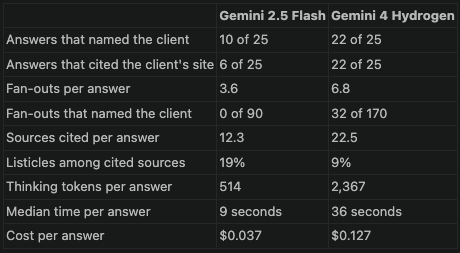
Okay, this is interesting. I'm adding Gemini 4 Hydrogen as a model in the Virayo AI prompt tracker. It's now injecting a lot more brands into the fanouts (32 of 170 now named this particular test client, vs 0 of 90 on Gemini 2.5 Flash) and it's writing 2x more fanouts (6.8 per answer vs 3.6). Also taking a lot longer (36 seconds vs 9) and costs a bit more ($0.127 per answer vs $0.037).
You can definitely see a shift here. The model knows a lot more about brands and is doing more thinking (4.6x thinking tokens). This is probably why Google is saying to stop running listicle-type pages and just write good content, because it already knows who the "best" brands are.
@natmiletic A few reasons. Speed is a big one, flat files are blazing, great for agents/aeo/seo (even WP w cached pages/infra is not the same). Markdown files are easy to version and deploy w GitHub. Simple to work this way, locally w an llm. Especially as a dev.
Yes, but it has to find you first.
For a branded search, yes it will likely just hit your site (and use an index to ground who you are). You can watch this happen, search a brand name and you'll likely see its website directly retrieved in the sources.
For non-branded prompts/queries, an LLM absolutely needs an index to search, otherwise it's just going off its own parametric memory. In ChatGPT's case it's using Microsoft Web IQ plus its own index, and rumored others (Exa, Tavily, etc).
But once your brand is in the context, it will likely retrieve your site directly, and in the future I believe it will try and transact over MCP or similar protocols (sign up, pay, purchase, demo).
So I think of it as two phases, discovery (index) and decision (your site). Both of these require a brand to publish content, and discovery also depends on what others publish about you (third party sites, reviews, competitors, communities, etc).
@AdamJHumphreys@wilreynolds “Skills are stored in our repos and our context sits our database…”
(admittedly I do have a lot of working/output context also, but anything important goes in a a context file in the repo, in the db/s3).
Both codex/claude have excellent remote support for prompting/building.
Absolutely. AI has to ground it’s knowledge and relies heavily on indexes (google, webiq, brave, tavily, exa, brightdata etc), and then reads sites directly (check your bot traffic). That content will likely always be valuable. But the strategies will evolve as the models and infra get better.
Okay, this is interesting. I'm adding Gemini 4 Hydrogen as a model in the Virayo AI prompt tracker. It's now injecting a lot more brands into the fanouts (32 of 170 now named this particular test client, vs 0 of 90 on Gemini 2.5 Flash) and it's writing 2x more fanouts (6.8 per answer vs 3.6). Also taking a lot longer (36 seconds vs 9) and costs a bit more ($0.127 per answer vs $0.037).
You can definitely see a shift here. The model knows a lot more about brands and is doing more thinking (4.6x thinking tokens). This is probably why Google is saying to stop running listicle-type pages and just write good content, because it already knows who the "best" brands are.
@Autonomaly@foley_seo These are easily removable with a ai-terms/quality standards file(s). The latest frontier models do this a lot less, the hassle is just keeping those files up to date (the distinction matters, here's what no one's talking about, etc. whatever new ism)
If you engineer the context right it can be pretty good. For a ~2000 word article we’ll make a dozen passes through via api - topic research, serp, brief, draft, fact check, etc, and then a separate editing agent running (all in about 6M tokens, $8-$10 on Opus). The model matters a lot, opus 5.5 is the best to date.
But if your just banging prompts away in a single context window, prob will struggle.
For a prompt asking for the best [category] software for [buyer type], Gemini 2.5 Flash ran two fan-outs, both a version of "[category] software for [buyer type]."
Hydrogen ran six and put nine vendor names in them, including "[brand] [category] software pros cons reviews."