The failure to show the smallest amount of empathy to people who their breakdowns impact is another indicator of how big air is broken. Over charge, overbook, and dehumanize by cramming people into every space to squeeze a few extra pennies out of their EPS.
Due to @AmericanAir incompetence, we’ve had to drive to different airports, pay for rental cars, meals, and lost an entire day of our short getaway. Not once has @AmericanAir offered to cover a meal, rental car or asked if they could do anything to make the delay easier.
Love how if you have to make adjustments to your plans @AmericanAir charges you all sorts of fees, but they screw up and they refuse to help you out. No wonder they consistently get rated so low by their customers.
To many in society Christmas is about presents, food, and days off from work. The real reason for Christmas is CHRIST!
> 2,000 years ago a baby was born. He didn’t have money, fame, status, political power but HE would become KING!
With a word of love, mercy, and 12 disciples HE would forever change our sinful world, with a His teaching, words, and love.
This sweet baby saved the world. God has sent His only son, to take the sin of the world upon himself. This is the greatest gift of all. It can’t be bought from a store. Jesus gave us the gift of life that us sets us free from the world, our shame, and guilt.
God is real. Jesus is our Lord and Savior. You love and honor your earthly father. Join me in praising our Heavenly Father for this season is the greatest time of all.
God loves you. Jesus loves you. Love conquers ALL!
Jesus died so that you could have a relationship with God. He wants to help you, love you, comfort you, guide you and redeem you if you’ll let Him.
I pray this Christmas you let God's gift into your heart and light. If you’re in a dark place let God’s light shine ✨ bright. He is will you.
Merry Christmas family and happy birthday King Jesus. ❤️
At a recent event, I got asked for my best pieces of career advice.
Here are the 10 pieces of advice I shared:
(things I wish I knew at 22)
1. Build a reputation for reliability.
You can get pretty damn far by just being someone that people can count on to show up and do the work. Being reliable is entirely free.
2. Be the person who can figure it out.
Early on, you'll be given a lot of tasks you have no idea how to complete. There's nothing more valuable than someone who can just figure it out. Do some work, ask key questions, get it done. People will fight over you.
3. Work hard first (and smart later).
It's trendy to say that working smart is all that matters. Wrong. If you want to accomplish anything significant, you have to work hard. Work hard early—take pride in it. Then you can start to build leverage to work smart.
4. Build storytelling skills.
World-changing CEOs aren't the smartest in their orgs. They are exceptional at: (1) Aggregating data and (2) Communicating it simply & effectively. Data in, story out. Build that skill and you'll always be valuable.
5. "Swallow the frog" for your boss.
This is one of the greatest "hacks" to get ahead early in your career. Observe your boss, figure out what they hate doing, learn to do it, and take it off their plate. Easy win.
6. Be a "yes" person early in your career.
Saying "yes" expands your luck surface area. It may mean you're a bit overwhelmed at times, but the benefits from the increased luck outweigh the downsides of feeling stretched.
7. Wake up early and work out.
When you wake up early and work out, you do a hard thing to start your day that sets the tone. You start to self-identify as a winner. That has ripple effects all across your life. There's no such thing as a loser who wakes up at 5am and works out.
8. Dive through cracked doors.
I recently had an experience to bring this to life: A young guy saw on my story that I was at a coffee shop working. He messaged me asking if he could come by and ask a question. I said ok. He got there an hour later and we hit it off. Turns out he lived far away and made it work. I'd always bet on people with that kind of energy. If someone cracks open a door that may present an opportunity, dive through it.
9. Show up early, stay late.
Showing up early and staying late is a free way to materially increase your luck surface area. The most interesting side conversations come up before meetings start or after they end. When you're in the room, you're more likely to get pulled into a follow-up call, coffee, or discussion. It pays off handsomely in the long run.
10. Do the "old fashioned" things well.
Look people in the eye, do what you say you'll do, be early, practice good posture, have a confident handshake. It sounds silly, but these things are all free and will never go out of style.
***
Embrace those 10 pieces of advice and you'll stand out and be on the right track.
If you enjoyed this, share it with others and follow me @SahilBloom for more in the future!
🎁 TICKET GIVEAWAY 🎁
Like & retweet for a chance to win four tickets to @BuschGardensVA Christmas Town! 🎄☃️
The winner will be selected on Friday (12/15) at NOON!
#HappyHolidays#GoHoos
At the end of every year, I conduct a Personal Annual Review.
It's a transformative exercise that everyone should try.
7 simple questions that may change your life:
(bookmark this + download the PDF template)
1. What did I change my mind on this year?
Finding the truth is more important than being right.
In fact, the most successful people legitimately enjoy being wrong. They embrace new information as “software updates" to their brain.
My Personal Annual Review starts here:
What "software updates" did I have this year?
If you can't think of anything, that's a bad thing.
2. What created energy this year?
I have a framework I call the Energy Calendar:
The idea is that you reflect on your calendar from a day or week and color code the events according to whether they created energy (green), drained energy (red), or were neutral (yellow).
The Energy Calendar is a great, visual way to course correct on a weekly/monthly basis if there are specific activities that are highly positive or negative for your energy.
Examine this on a macro annual scale:
Review your calendars from the year. What activities, people, or projects consistently CREATED energy in my life? Write them down.
Did I spend ample time on the Energy Creators or did they get neglected?
Goal: Spend more time on these in 2024!
3. What drained energy this year?
Continue your macro scale calendar examination, but with a focus on the negatives:
Review your calendars from the year. What activities, people, or projects consistently DRAINED energy from my life? Write them down.
Did I allow the Energy Drainers to persist or did I cut them in real time?
Goal: Spend less time on these in 2024.
4. Who were the boat anchors in my life?
Boat anchors are people that hold you back from your potential. They literally create a "drag" on your life.
Boat anchors are people who will:
• Belittle your accomplishments.
• Laugh at your ambition.
• Tell you to be more realistic.
• Harm the quality of your environment.
Identify who they are.
Goal: Minimize or eliminate the energy you give them in 2024.
5. What did I not do because of fear?
“We suffer more in imagination than in reality.” - Seneca
We have to get closer to our fears in order to fight back against them.
Fear distorts reality—this forces you to confront and reflect on it.
Deconstruct the fears that held you back:
• What was the downside of taking action?
• What was the upside from taking action?
Goal: Get closer to your fears in 2024.
6. What were my greatest hits and worst misses?
Your natural bias skews how you see your year:
• The optimist sees all hits.
• The pessimist sees all misses.
Take a balanced view. Write them all down.
Reflect on why the hits hit and the misses missed.
7. What did I learn this year?
“When you stop learning you start dying." - Albert Einstein
It's easy to lose sight of growth in the trenches—zoom out to reclaim perspective.
Take your time on this one. Reflect on the other questions from the exercise.
Write down what you've learned.
***
The Personal Annual Review is a life changing exercise.
Experience + Reflection = Growth
Download a beautiful (and free!) Personal Annual Review template to conduct your own here: https://t.co/PhTlBGvBrk
What I thought would make me happy:
• Fast car
• Fancy watch
• Expensive clothes
What actually makes me happy:
• Free time
• Quiet walks
• Hard workouts
• Time with loved ones
Find what actually makes you happy—then prioritize it.
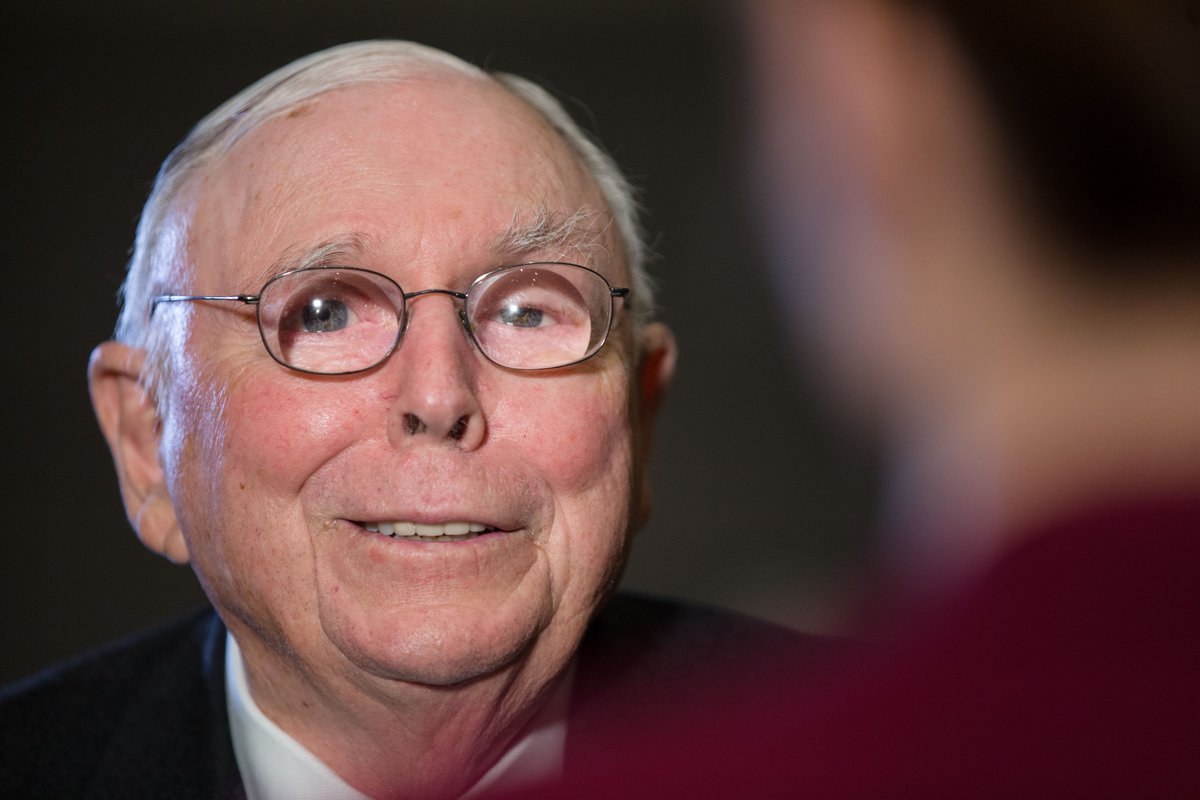
One week ago, the world lost a legend.
Charlie Munger was a treasure trove of wisdom—and most of it had nothing to do with investing.
10 of his most powerful insights for a life well lived:
(Note: Long post, bookmark for future)
1. The Most Valuable Riches Take Time
"The desire to get rich fast is pretty dangerous."
While this quote has traditionally been applied to investing (given it was his primary arena of public success), I believe its true meaning extends well beyond dollars and cents.
Whatever "rich" you're going after...
• Strong, durable relationships
• Physical strength or endurance
• Mental health and mindfulness
• Financial success
...know that it won't happen overnight.
It will take a long time—probably longer than you've ever imagined—but the most valuable "riches" of life are always worth waiting for.
Keep your compass pointed in the right direction, stay the course, and get "rich" slow.
2. Avoid the Second Arrow
"Generally speaking, envy, resentment, revenge, and self-pity are disastrous modes of thought...Life will have terrible blows, horrible blows, unfair blows, it doesn’t matter. Some people recover and others don’t. There I think the attitude of Epictetus is the best. He thought that every mischance in life was an opportunity to behave well. Every mischance in life was an opportunity to learn something and that your duty was not to be immersed in self-pity, but to utilize the terrible blow in a constructive fashion. That is a very good idea."
In 1953, a 29-year-old Charlie Munger faced a series of crushing blows, losing his 9-year-old son to leukemia, his wife to a divorce, and his money to the medical bills.
Very few people could have recovered from that series of events.
But recall the Parable of the Two Arrows:
The Buddha once asked his student, "If a person is struck by an arrow, is it painful?" The student nodded, yes.
The Buddha then asked, "If a person is struck by a second arrow, is that even more painful?" The student again nodded, yes.
The Buddha then explained, "In life, we cannot always control the first arrow. However, the second arrow is our reaction to the first. The second arrow is optional."
Charlie Munger was struck by the first arrow (harder than most of us can imagine), but he stared into the darkness and realized that the second arrow was optional.
When we encounter the inevitable challenges of life, we can all do the same.
3. Develop Real Knowledge
"The first rule is that you can’t really know anything if you just remember isolated facts and try and bang ’em back. If the facts don’t hang together on a latticework of theory, you don’t have them in a usable form...You may have noticed students who just try to remember and pound back what is remembered. Well, they fail in school and in life. You’ve got to hang experience on a latticework of models in your head."
There are two types of people:
• People who know how to talk about the thing.
• People who know the thing.
You encounter plenty of Type 1s: You hear them talking at every cocktail party and networking event. They wax poetic on a variety of topics, but when pressed for detail, they crumble. The knowledge is all on the surface. They know how to talk about the thing, but they don't know the thing.
You encounter few Type 2s: Those with real, deep knowledge are rarely the loudest in the room. They are generally too busy developing their depth or acting on it to be found talking about it.
The goal is to be Type 2 in a few domains—and to spend time with more Type 2s in the domains where you aren't one.
4. Live What You Want to Receive
"How to find a good spouse? The best single way is to deserve a good spouse...To get what you want, you have to deserve what you want."
The most important relationship advice I've ever received:
Make a list of the values you want to find in a partner, then go out and actually embody those values yourself.
You can't hope to attract a set of values that you yourself aren't embracing.
Similarly, as a parent, you can't hope to teach a child a set of values that you aren't walking with.
Live what you want to receive.
5. Invert, Always Invert
"All I want to know is where I’m going to die, so I’ll never go there."
Two thousand years ago, Stoic philosophers engaged in a seemingly peculiar daily exercise: they would sit quietly and imagine—in excruciating detail—all that could go horribly wrong in the days, weeks, and months ahead.
They referred to it as premeditatio malorum—the pre-meditation of evils.
The premise: Through the preparation of the mind for the potential worst-case scenarios, we can more aptly avoid such outcomes.
Complex problems are sometimes better solved backwards.
When you encounter a challenging life problem, rather than attempting to solve it forwards, invert and solve it backwards:
• What do you NOT want to happen?
• What actions, behaviors, or conditions would create that undesirable outcome?
• How can those traps be avoided?
Proceed accordingly.
6. Avoid the Ostrich Effect
"I think that one should recognize reality even when one doesn’t like it; indeed, especially when one doesn’t like it."
An ostrich will bury its head in the sand to avoid danger.
How many of us are metaphorically burying our heads in the sand in the face of new information that challenges our worldview?
If you want to be right more than you want to uncover the truth, you're in for a long, hard life. Avoiding knowledge because it doesn't confirm your existing beliefs is a dangerous game that will ultimately lead to your downfall.
Always question your strongly held beliefs. Learn the other side of the argument just as well as your own.
7. Never Mimic the Herd
"Mimicking the herd invites regression to the mean."
As Jeff Bezos said, "Being yourself is worth it, but don’t expect it to be easy or free. You’ll have to put energy into it continuously."
The fight against normalcy is the most important fight of your life.
No one can compete with you, at being you.
8. Create a "Too Hard" Pile
"I just try to avoid being stupid. I have a way of handling a lot of problems—I put them in what I call my ‘too hard pile,’ and just leave them there. I’m not trying to succeed in my too hard pile."
There are no style points in life.
The "too hard pile" is a useful tool for avoiding the stupidity that comes from attempting to tackle the big, complex, scary problem when there's a small, simple, obvious one right in front of you.
A few applications from my own life:
You don't need the fancy equipment and complicated workouts, you just need to show up and move your body in simple ways, every single day.
You don't need the latest, greatest new alternative investments and cutting edge tax strategies, you just need to invest in simple, low-cost index funds and hold them forever.
You don't need the 100 supplements and latest fad diets, you just need to eat 90%+ whole, unprocessed foods.
Avoid things that seem too hard and handle the easy, consistently, instead.
9. Success Follows Interest
"Another thing that I found is an intense interest of the subject is indispensable if you are really going to excel. I could force myself to be fairly good in a lot of things, but I couldn’t be really good in anything where I didn’t have an intense interest."
Most people focus too much on being interesting and not enough on being interested.
Being interested is how you become interesting.
When you pursue your genuine interests, you are prone to deep focus, which cultivates a depth that is impossible to fake.
Success always follows interest.
10. Wisdom Compounds
"Spend each day trying to be a little wiser than you were when you woke up. Day by day, and at the end of the day, if you live long enough, like most people, you will get out of life what you deserve."
Small things become big things.
In the wise words of Mahatma Gandhi, "Live as if you were to die tomorrow. Learn as if you were to live forever."
***
Goodbye to a Legend
In a beautiful piece reflecting on Charlie Munger's life, Wall Street Journal columnist Jason Zweig shared an interaction he had with Munger last month:
I asked what he might want for an epitaph of no more than 10 words. His reply was immediate and full of epistemic humility: "I tried to be useful." Not "I was useful." That would be for other people to judge. But "I tried." That much he knew.
It struck me as perhaps his most important wisdom of all.
To be useful—as a parent, spouse, child, sibling, colleague, friend, or leader—is our highest calling.
We will fall short in various ways along the journey, but we can all strive for this goal.
Here's hoping that at the end of our days, we may all be able to proudly proclaim: "I tried."
If you're still here, I hope you found some new inspiration in these words. If you did, share it with others and follow me @SahilBloom for more in the future.
I can’t tell you how often I’ve heard the advice to work on your weaknesses.
But why do that when you can spend your time and energy on getting better at the things you love and are good at instead?