Firmly rooted in the Word of Jesus, reading the Gospel every day, never stop dreaming of a land where there is peace and fraternity, nor stop looking at the world with wonder, nor stop facing the future with the light of hope. Do not let anything or anyone steal your hope.
@Erling Will miss your presence @Erling now that the World Cup is over so I’ll follow you here.. love the rosary you got on there! Take care and have a good one!
New research reveals that walking at 3 mph on a steep incline burns up to 70% more calories than running at the same speed on flat ground.
Skip the joint-pounding stress of flat-ground sprints. Studies show that maintaining a steady 3 mph pace on a 16–18% incline actually outperforms traditional running in several key ways. The uphill effort recruits far more muscle fibers—especially in the glutes, hamstrings, quads, and core—as your body fights gravity with every step. This constant resistance dramatically raises the metabolic demand, pushing energy expenditure higher without the repetitive impact of jogging.
Beyond the impressive calorie burn, incline walking delivers a superior cardiovascular workout. Your heart has to pump harder to supply oxygen to working muscles under increased gravitational load, which builds aerobic fitness more effectively than level walking. Interestingly, this approach also allows your body to tap into a higher percentage of fat as fuel compared to high-intensity flat running, all while being much gentler on knees, ankles, and hips.
For anyone looking to maximize fat loss, boost endurance, and get better results with less wear and tear on the body, trading sprints for steep incline walking might be the smartest upgrade you can make in the gym.
[American Council on Exercise. (2022). Caloric expenditure and metabolic demand of incline walking. ACE Scientific Reports]
Charlie Munger literally explained how "Inversion Thinking" helped him become a billionaire:
1. He solves every problem backwards. Munger calls it inversion, and he uses it constantly. Most people ask how do I succeed at this. He asks the opposite: what would guarantee failure here, and then he simply avoids that. He says it works like algebra. Some problems you cannot solve forwards, but invert them and the answer falls out easily.
2. As a young weather forecaster, he asked how he could kill pilots. Stationed in the Air Corps ferry command, drawing weather maps alone in a hangar at night, he didn't ask how to forecast well. He asked: how would I most easily kill these pilots? He worked it through in reverse and found only two answers. Send them into icing their plane couldn't handle, or send them somewhere they'd run out of fuel before any airport was clear. He became fanatical about avoiding exactly those two things.
3. He points out that inversion could have saved Kobe Bryant. The two ways he found to kill a pilot, icing and getting caught out with nowhere to land, are flight risks a disciplined person simply refuses to take. If someone around Kobe had thought that way, Munger says, he'd still be here. It was so stupid, in his words, to die that way. The whole point of inversion is that the fatal error is usually obvious once you go looking for it on purpose.
4. His grandfather taught him the same trick as a boy. When Munger went swimming, his grandfather told him to swim as long as he wanted, but stay near the shore. It sounds simple enough to laugh at, but it's inversion in one sentence: don't optimize for the best swim, eliminate the way you drown. Munger insists the man was genuinely wise.
5. The military gave him a second trick: bracketing. In ROTC he was taught to fire mortar shells one long, one short, then correct to land the next one on target. He says he never fired a real shell in his life, but he has used that bracketing method to size decisions ever since. When he needs to know how big or small to make something, he brackets it high and low and closes in. Kapow.
6. His best inversion turned $125,000 into $600,000. As a young lawyer he had a client whose ranch land the Edison Company wanted an easement through. The client's famous, pompous appraiser valued it at $125,000, using the standard two-dimensional method: comparable sales, price per acre, acreage. Munger, who wasn't even an appraiser, saw the flaw. The land was hilly.
7. He forced the problem into three dimensions and the answer changed completely. Hilly land gets developed by lopping off the tops of hills and filling the valleys. The transmission towers would freeze the grade and make that impossible, doing enormous damage the flat, two-dimensional appraisal never captured. The old appraiser refused to change a thing, so Munger told his client to fire the twit, hired one who could think in three dimensions, and got $600,000 out of honest engineers who also thought that way.
8. The more due diligence someone does, the weaker a thinker they usually are. This is his sharpest line. Munger says endless analysis is often just a way of soothing an inner insecurity, and it doesn't actually work. The genuinely capable thinkers understand a situation fast and act. The armies of young lawyers billing by the hour to comb through every purchase order are, more often than not, papering over the fact that they can't see the answer.
9. You don't need certainty. You need to be about 96% sure. Munger is blunt that waiting for 100% is a mistake, because in most cases 96% is all you're ever entitled to, and the rest is wasted motion. The skill is knowing when you already have enough to act, and having the nerve to move on it.
10. He and Buffett closed a multibillion-dollar oil deal in about two days. When Occidental needed money fast to buy Anadarko, Munger didn't fly anywhere or run endless analytics. He and Buffett talked by phone, and after decades together, he says, one grunt speaks a volume. It was obvious: the Permian Basin is America's best oil, layer after layer with nothing comparable, and they'd get an 8% preferred dividend from a reputable operator plus upside. A no-brainer, he says, as long as you don't insist on making it hard.
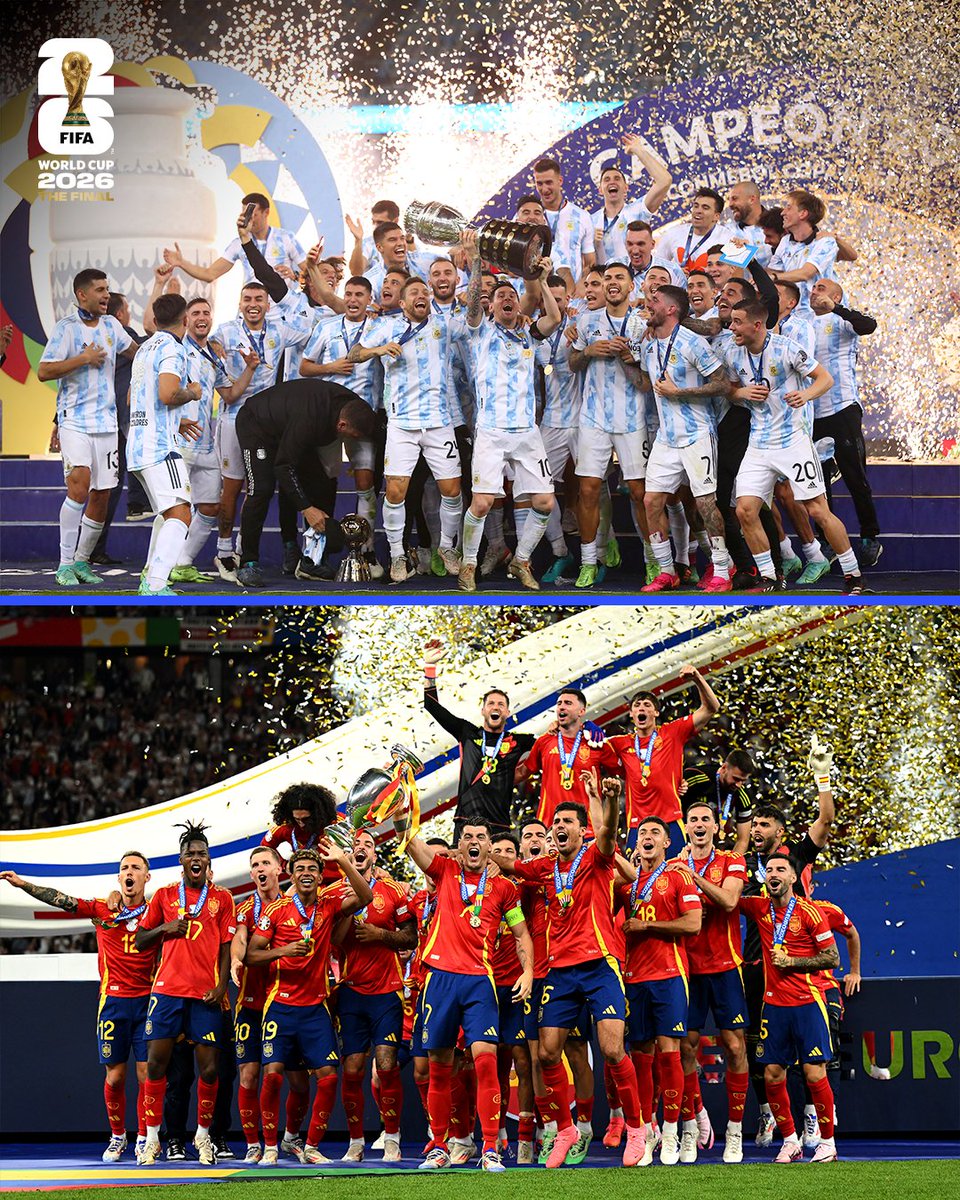
A @FIFAWorldCup Final first 👀
This is the first time that the reigning European and South American champions are set to face each other at a FIFA World Cup Final.
God favors smallness, a sign of his discreet love, by which he leaves us free to accept or reject him. His love makes its presence felt even among the weeds, acts in a hidden and invisible way like the smallest of all seeds, and leavens the dough without making a sound. #GospelOfToday (Mt 13:24–43)
David Beckham on England’s 2-1 defeat to Argentina after Lionel Messi inspired the comeback.
🗣️ “I’ll be honest I exploded when England scored. I was on my feet celebrating because I genuinely thought we had one foot in the World Cup final. Then I looked at the pitch and one thought hit me… ‘Messi is still playing.’”
“And that’s the mistake everyone makes. They celebrate too early against a man who has spent nearly twenty years destroying dreams. The scoreboard said England were winning. Messi’s face said, ‘This game isn’t over.’”
“I know Leo better than most because he plays for my club. I’ve watched him train, I’ve watched him prepare, I’ve watched him win. But even knowing how special he is, what he produced tonight still left me speechless.”
“England had the lead, the momentum and the crowd. Then Messi completely took over the match without even needing to score. Two assists. Two moments of pure genius. He ripped England’s belief apart and dragged Argentina into another World Cup final.”
“At 39 years old, he made some of the best defenders in world football look like they were chasing shadows. That’s frightening. Most players are retired by that age. Messi is still deciding World Cup semi-finals.”
“As an Englishman, this is heartbreaking. As a football man, I have to be honest I’ve never seen anything like him. You can have the perfect game plan, the perfect tactics and the perfect lead, but if Lionel Messi decides the story isn’t finished, he’ll rewrite the ending himself.”
“I celebrated England’s goal… and ten minutes later I was watching the greatest player I’ve ever seen tear our World Cup dream into pieces. That’s how ruthless he is. That’s why every generation will remember his name.”
“I wanted England in the final more than anything. But when Lionel Messi reaches this level, you stop watching a footballer… you’re watching football history being written right in front of your eyes.”
Jeff Bezos just described AI in three words that make most of the economy temporary.
Bezos: “AI is real and it is going to change every industry. In fact it’s a very unusual technology in that regard in that it’s a horizontal enabling layer.”
Horizontal enabling layer.
Not a product. Not a platform. Not a feature.
A layer. Underneath everything.
Everyone is asking which AI company wins.
Bezos is telling you that is the wrong question entirely.
A horizontal layer does not produce winners. It produces a new floor. Everything standing on the old one either gets rebuilt or gets erased.
This has happened exactly twice in modern history.
Electricity. The internet.
Both times the same pattern.
The new layer appeared. The old economy kept running above it. Revenue held. Careers continued. Everything looked normal.
Then quietly and permanently the entire structure reorganized around the new substrate.
The people who did not move were not outcompeted.
They were made structurally irrelevant.
Not because they were wrong. Because the ground they stood on stopped being ground.
Bezos is telling you it is happening a third time.
Not with a product. Not with a platform.
With intelligence itself becoming infrastructure.
A horizontal layer does not compete with the expert. It makes expertise free.
It hands a 22 year old with zero credentials the same cognitive output you spent a decade and a quarter million dollars learning to produce.
For $20 a month.
That is not disruption. Disruption replaces a product with a better product.
This dissolves the scarcity your entire career was priced on.
Not because the work disappeared. Because the wall around it did.
Every profession that exists because knowledge is hard to acquire.
Every company that profits because analysis takes time.
Every industry that survives because complexity locks outsiders out.
All of it rests on a single assumption.
That cognition is scarce.
AI does not challenge that assumption. It retires it.
The people who understand this are already rebuilding. Quietly. Deliberately. While everyone else argues about whether the thing underneath them is real.
Bezos did not give you a prediction.
He gave you a position on a map.
You are either above the new layer or beneath it.
Boredom activates the brain’s default mode network.
Crucial for creativity and fostering a sense of self.
Boredom is a luxury in a world with constant overstimulation.
Joe Rogan spent 3 hours with James Nestor learning why millions breathe themselves into anxiety.
Your breath trains your body to panic—even when nothing's wrong.
6 signs it’s happening to you—and how to retrain your breathing: 👇
1. You hold your breath while reading a text.
How social media is making everyone more ADHD-like:
"The more time you spend immersed in social media, the barrage of information, you are constantly being interrupted, and most of these interruptions are intentionally designed to attract your attention."
"The more people practice thinking that way or being in the world that way, yes, it's harder to sustain attention for long periods of time."
"You train yourself to overreact to any new distraction. The core elements of some of the executive functions that are impaired in ADHD, we are all becoming more ADHD-like."
"A kid who has ADHD, their life expectancy is about 10 years shorter than their non-ADHD peers. That is the same extent of cutting off life as having diabetes or having major depression."
"ADHD measurably derails education, disrupts social relationships, impacts your likelihood of your earning potential. It's having measurable, detrimental, significant impacts on people's lives."
Dr. John Kruse on @hubermanlab
Jensen Huang just made the case that the smartest person in the room is now the most replaceable person on earth.
Huang: “The definition of smart is somebody who’s intelligent, solve problems, technical. But I find that that’s a commodity. And we’re about to prove that artificial intelligence is able to handle that part easiest.”
The skill you built your entire identity around was the first thing the machine replicated.
Not the hardest part. The easiest.
Huang: “People who are able to see around corners are truly, truly smart. And their value is incredible. To be able to preempt problems before they show up, just because you feel the vibe.”
Huang: “That vibe came from a combination of data, analysis, first principle, life experience, wisdom, sensing other people.”
The vibe is not intuition. It is decades of failed bets, human friction, and first-principles thinking compressed into a single read no model can replicate.
You cannot prompt your way to it. You earn it by surviving things that had no instructions.
Huang: “I think long term the definition of smart is someone who sits at that intersection of being technically astute, but human empathy and having the ability to infer the unspoken, around the corners, the unknowables.”
Every institution you ever passed through graded you on the one thing the machine now does for free.
The thing they never tested you on is the only thing that still matters.
Huang: “And that person might actually score horribly on the SAT.”
The SAT did not measure intelligence. It measured obedience to structure.
The future does not reward what you can solve inside a framework someone handed you. It rewards what you can see when no framework exists.
The machine did not replace human intelligence.
It revealed that what we spent a century calling intelligence was never intelligence at all.
The people who memorized the answers are about to work for the people who sensed the questions before anyone thought to ask.
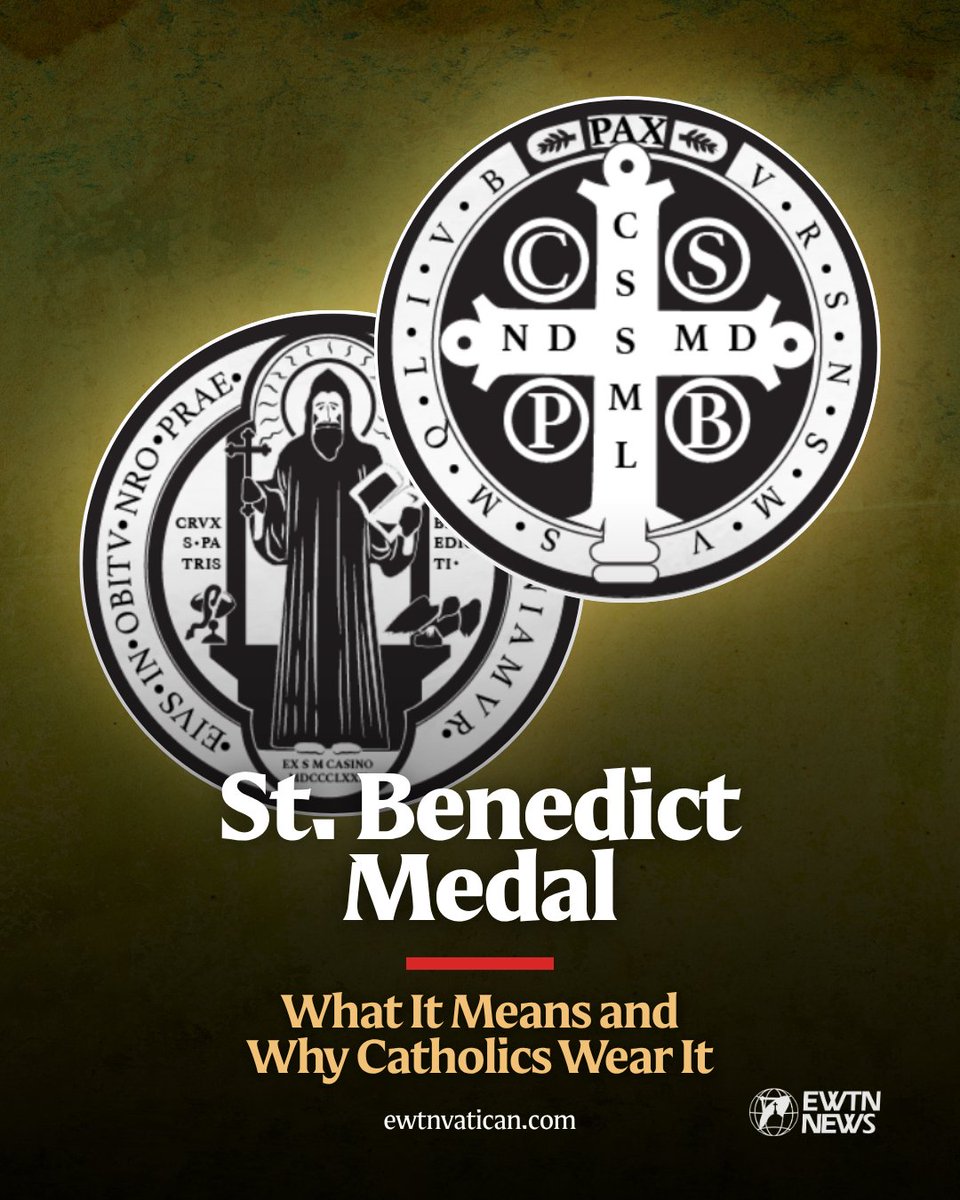
July 11 is the Feast of St. Benedict — and millions of Catholics around the world wear his medal. But do you know what it actually means?
Known as the "devil-chasing medal," the St. Benedict Medal is one of the most powerful sacramentals in the Catholic Church. Its power comes not from the object itself, but from Christ, who works through the faith of the one who uses it.
The Front:
St. Benedict holds a cross. At his side are a broken cup—after monks tried to poison him, it shattered when he blessed it—and a raven carrying away a poisoned loaf, another failed attempt on his life. Around the edge is the inscription:
Eius in obitu nostro praesentia muniamur
"May we be strengthened by his presence in our hour of death."
The Back:
A large cross bears the initials of the famous prayer:
C.S.P.B. – Crux Sancti Patris Benedicti
"The Cross of our Holy Father Benedict."
C.S.S.M.L. – Crux Sacra Sit Mihi Lux
"May the Holy Cross be my light."
N.D.S.M.D. – Non Draco Sit Mihi Dux
"May the dragon not be my guide."
Around the border is the exorcism prayer:
V.R.S. – Vade Retro, Satana!
"Begone, Satan!"
N.S.M.V. – Numquam Suade Mihi Vana!
"Never tempt me with your vanities!"
S.M.Q.L. – Sunt Mala Quae Libas.
"What you offer is evil."
I.V.B. – Ipse Venena Bibas!
"Drink your own poison!"
At the bottom is a single word:
PAX — Peace.
The medal was formally approved by Pope Benedict XIV in 1742. It became widely known after the miraculous healing of a young man named Brunone, who later entered the Benedictine Order and eventually became Pope St. Leo IX.
St. Benedict, pray for us! 🙏









![Rainmaker1973's tweet photo. New research reveals that walking at 3 mph on a steep incline burns up to 70% more calories than running at the same speed on flat ground.
Skip the joint-pounding stress of flat-ground sprints. Studies show that maintaining a steady 3 mph pace on a 16–18% incline actually outperforms traditional running in several key ways. The uphill effort recruits far more muscle fibers—especially in the glutes, hamstrings, quads, and core—as your body fights gravity with every step. This constant resistance dramatically raises the metabolic demand, pushing energy expenditure higher without the repetitive impact of jogging.
Beyond the impressive calorie burn, incline walking delivers a superior cardiovascular workout. Your heart has to pump harder to supply oxygen to working muscles under increased gravitational load, which builds aerobic fitness more effectively than level walking. Interestingly, this approach also allows your body to tap into a higher percentage of fat as fuel compared to high-intensity flat running, all while being much gentler on knees, ankles, and hips.
For anyone looking to maximize fat loss, boost endurance, and get better results with less wear and tear on the body, trading sprints for steep incline walking might be the smartest upgrade you can make in the gym.
[American Council on Exercise. (2022). Caloric expenditure and metabolic demand of incline walking. ACE Scientific Reports]](https://pbs.twimg.com/media/HNfMrJYWgAAKJFG.jpg)