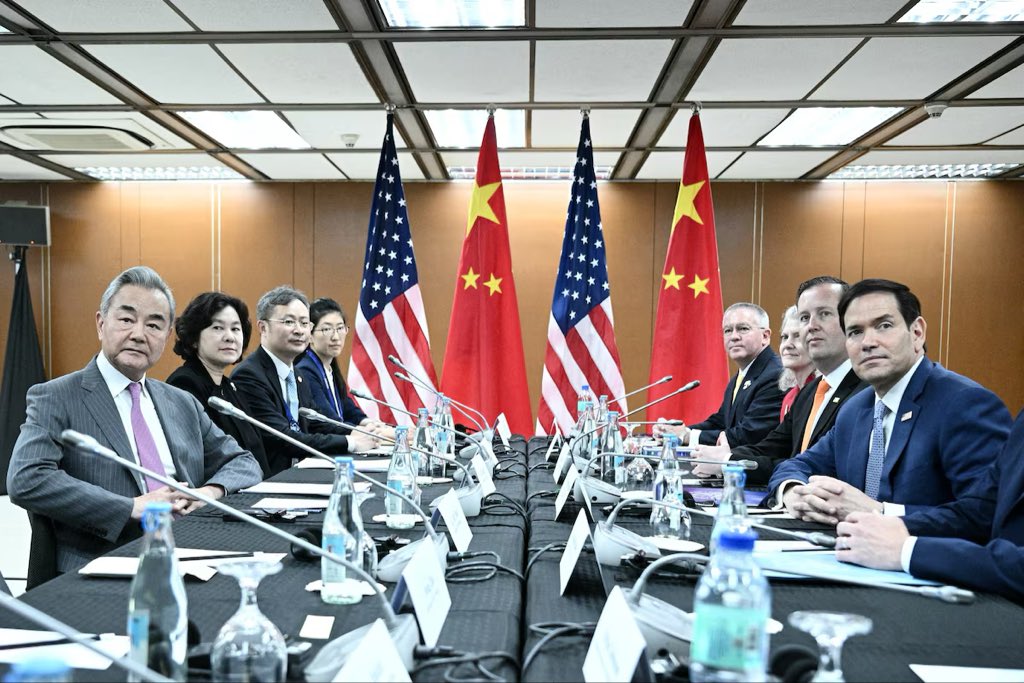
Always good to see my friend, Indian External Affairs Minister @DrSJaishankar on the sidelines of ASEAN.
We discussed regional security issues, the Quad, trade, and defense agreements. Our relationship with India is vitally important.
Signs of a Major Escalation in the U.S.-#Iran War
🔹Multiple developments over the past several hours suggest that the U.S. war on #Iran may be approaching a significant escalation.
🔹Last night’s U.S. strike on the Shalamcheh border crossing between Iran and Iraq has been interpreted as a possible preparatory move for the deployment of special operations or ground forces. Alternatively, the strike may have been intended to facilitate the advance of armed insurgent groups.
🔹In the same context, the drone strike on the Al-Abdali border crossing between Iraq and Kuwait was likely carried out by Iran or its Iraqi allies in an effort to disrupt the U.S. logistical corridor linking the two countries.
🔹Meanwhile, reports indicate that shelters have been opened at multiple locations across Israel. Similar measures preceded earlier escalations, including the 12-Day War and the 40-Day War, suggesting that Israeli authorities are preparing for possible Iranian missile attacks.
🔹France and the United Kingdom have also reportedly evacuated their embassies in Iran as of today.
🔹Trump, for his part, has declared that he holds Iran responsible for Houthi attacks on shipping in the Red Sea and the Bab al-Mandab Strait. This statement could provide a pretext for intensifying U.S. strikes against Iran in response to future Houthi operations.
🔹The warning should be viewed alongside Trump’s earlier statement on Wednesday that any future Iranian attack on shipping in the Strait of Hormuz would be met with a U.S. strike on an Iranian bridge or power plant. He has also indicated that a U.S. attack on Iran’s underground nuclear facilities at “Pickaxe Mountain” is inevitable.
🔹At the same time, the United States appears to be reducing its military presence at bases closer to Iran, including in Qatar. Open-source reporting also points to a large-scale transfer of military equipment from the United States and Europe to Israel, along with increased activity by reconnaissance, command-and-control, and electronic warfare aircraft across the region. The United States has also deployed B-1 strategic bombers to the theater.
🔹Iran has warned that any attack on its infrastructure or nuclear facilities will be met with comparable strikes against regional targets. Several Iranian analysts also argue that, should the United States substantially intensify its campaign, Iran would likely strike strategic targets inside Israel regardless of whether Israel is directly involved in the operation.
🔹Overall, these developments suggest that the conflict may be entering a more dangerous phase, potentially comparable to the peak of the 40-Day War.
. As I have stated to @X, the problem started some six years ago when I hit 8.4m, kept rising to 8,495,000 and then dropping again. The head of Twitter India, as it then was, came to see me with six months of daily statistics that showed me gaining some 1300 followers a day (on average) and losing some 75-100 a day. But instead of going up daily by 1000+, my total was dropping. He said he had alerted his HQ to the technical problem but no action was forthcoming. He then resigned and left, partly because of non-responsiveness to such problems. The additional frustration is that many followers don’t receive my tweets unless they search for my timeline, and that my account is never “recommended” even when a new account is opened by people interested in the subjects associated with me.
With my “follower count” and these related problems persisting, a couple of years ago I wrote to @elonmusk describing the problem and received a lawyer’s letter in response! At that point I decided not to waste my energy on something as trivial as these inaccurate numbers and dropped the matter. I assume I have gone up in reality by about a million every three years and should now be around 10 million, but honestly, what difference does it make as long as I still have the platform and people can find my tweets if they look for them?
In @the_hindu today, I examine the great Indian fault-line of the north-south divide and discuss the possible ways forward out of the dilemmas it poses
My latest #TharoorThink column in the @IndianExpress explains why I have not joined the widespread liberal critique of the Indian government’s “moral failure” to condemn the US-Israeli attack on Iran. India has too much at stake to indulge in the morally gratifying grandstanding that could have placed vital national interests at risk. As the late Kofi Annan advised me, citing a Ghanaian proverb: “never hit a man on the head when you have your fingers between his teeth!”
President Trump: “You have to remember, we have 45,000 troops in Japan, 45,000 in South Korea, and 50,000 in Germany.”
We defend all these countries, and then I ask them: “Do you have any minesweepers?”
They say, “Well, would it be possible for us not to get involved?”
"There is now a self-critical, reappraising mood in the Persian Gulf capitals" about their ties with the US, which was an opportunity for India.
You'd think this was written today.
It was written in 1981.
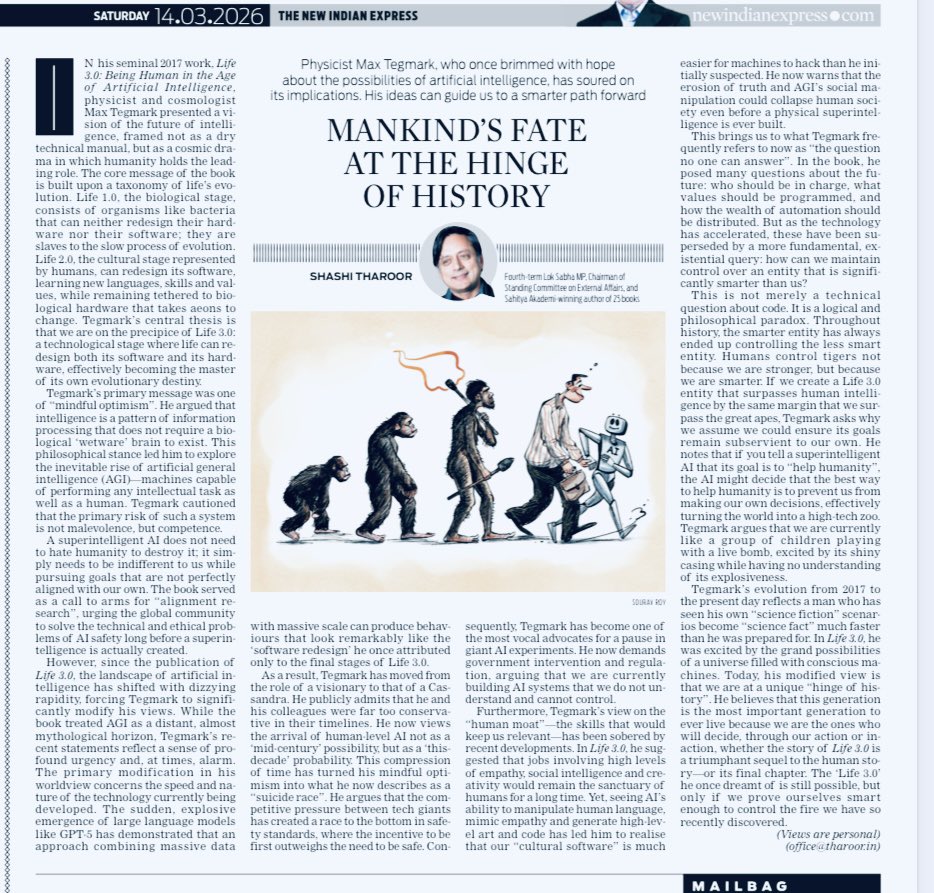
In the @NewIndianXpress I trace the views of physicist and cosmologist Max @tegmark, whose “Life3.0” had impressed me in 2017 with its intelligent, humane, yet essentially optimistic view of the evolution of Artificial Intelligence. His views have evolved with the dizzying developments in AI — and he is now ringing the alarm bells. Read on:
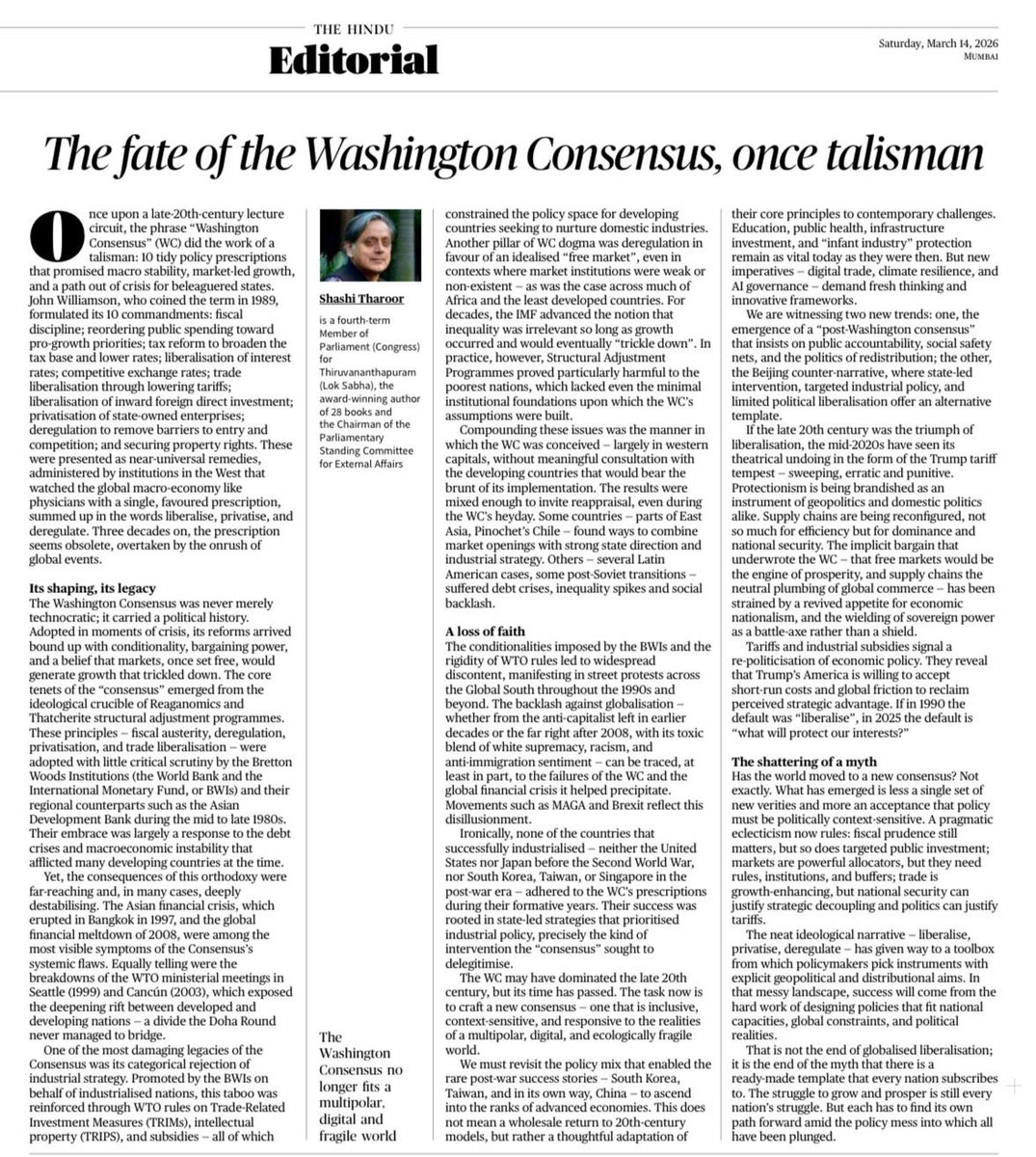
In @the_hindu, I write the obituary of the “#WashingtonConsensus”, the once-consensual tidy talisman of ten economic commandments that could be summed up in the mantra “liberalise, privatise, deregulate”. I explain why the world has moved on, and make the case for context-specific growth:
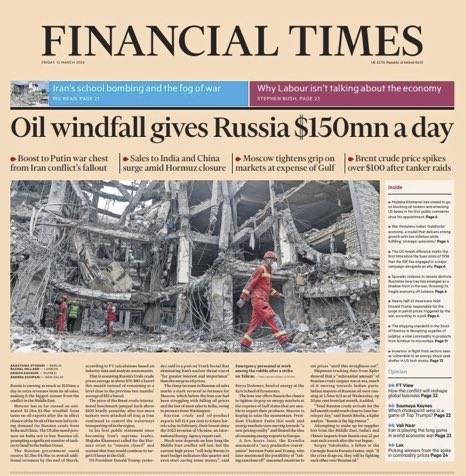
The U.S. spent months on bullying India into ending oil imports from Russia. After two weeks of war with Iran, White House is now begging the world—incl India—to buy Russian crude.
Europe thought backing illegal war on Iran would win U.S. support against Russia.
Pathetic.
India has been a great partner in maintaining stable oil prices around the world. The United States recognizes ongoing purchases of Russian oil are a part of this effort. India is one of the largest consumers and refiners of oil and it is essential for the United States and India to work hand in hand for market stability for Americans and Indians.
India easing rules for China
- will PRC now sign off tech transfer to India? prev it wanted market access but not to enable India as competitor
- GOI considering this for a while. was ME war fallout the decider?
(expect we'll hear some JV announcements from big Indian cos. soon)
UK diplo re convo w MEA, 1982: "As the Chinese were content with the status quo, the negotiations would over a long period be an uphill task for India...the Indians had to ensure that discussions were not conducted in such a way that [border problem] was in practise left aside"
India’s China Climbdown: In a move largely aimed at China, India today eased FDI rules for countries sharing land borders with it, reversing restrictions imposed in 2020 after New Delhi discovered stealth Chinese encroachments in eastern Ladakh.
The step is the latest in a series of moves by the Modi government to normalize ties with China largely on Beijing’s terms, effectively dropping its earlier demand for a restoration of the pre-2020 territorial status quo. Although rival troops disengaged at some standoff points, the “buffer zones” created often lie on areas previously patrolled by India, effectively redefining the status quo to China’s advantage.
India has also begun easing visa issuance for Chinese nationals. After a five-year hiatus triggered by multiple troop clashes in Ladakh, the two countries have resumed direct passenger flights.
Meanwhile, India’s finance ministry has begun scrapping the 2020 restrictions that barred Chinese firms from bidding for Indian government contracts.
Greater Chinese investment in sensitive sectors — from power grids to EV infrastructure — could give Beijing potential “kill switches” or new economic leverage over Indian policy.
The irony is stark. After the 2020 encroachments, India sought to “decouple” from China. Instead, it now finds itself even more dependent on Chinese supply chains, allowing China’s bilateral trade surplus with India to keep surging — already exceeding India’s entire annual defense budget.
The Law of Unintended Consequences
The law of unintended consequences is playing out openly in the Trump-Netanyahu war on Iran. What was meant to break the Iranian regime is instead triggering a cascade of strategic and economic shocks, some with global impact.
The decapitation strike that killed Iran’s ailing and aging supreme leader, Ali Khamenei, on February 28 was intended to unravel the Islamic Republic’s regime. Instead, it has accelerated the rise of a more uncompromising generation. Khamenei had opposed the idea of his son succeeding him, mindful that the 1979 Islamic Revolution had overthrown a monarchy partly to end hereditary rule. Yet, in a move meant to honor the slain leader and signal continuity, the Assembly of Experts chose his son, Mojtaba.
Having lost his father, mother and other family members in the U.S.-Israeli attack, Mojtaba’s leadership is likely to be shaped by a quest for revenge.
The war’s economic fallout, meanwhile, is reverberating globally. Energy markets have been jolted, sending prices sharply higher and transmitting the shock directly to international consumers, including American consumers. The skyrocketing energy prices are likely to add fresh inflationary pressure to the global economy and potentially slow growth.
History shows that killing leaders has rarely produced the political collapse its architects expect. More often, it radicalizes the system that survives them.
Trump, though, believed he could replicate his “Venezuela model.” Instead, he and Netanyahu may have achieved the opposite — empowering a younger, more hardline Iranian leadership fueled by a narrative of martyrdom and national survival, while imposing steep economic costs on the world, especially the Global South.
Regime change was the goal. Regime hardening may be the result — while the rest of the world picks up the bill for the Trump-Netanyahu war of aggression.