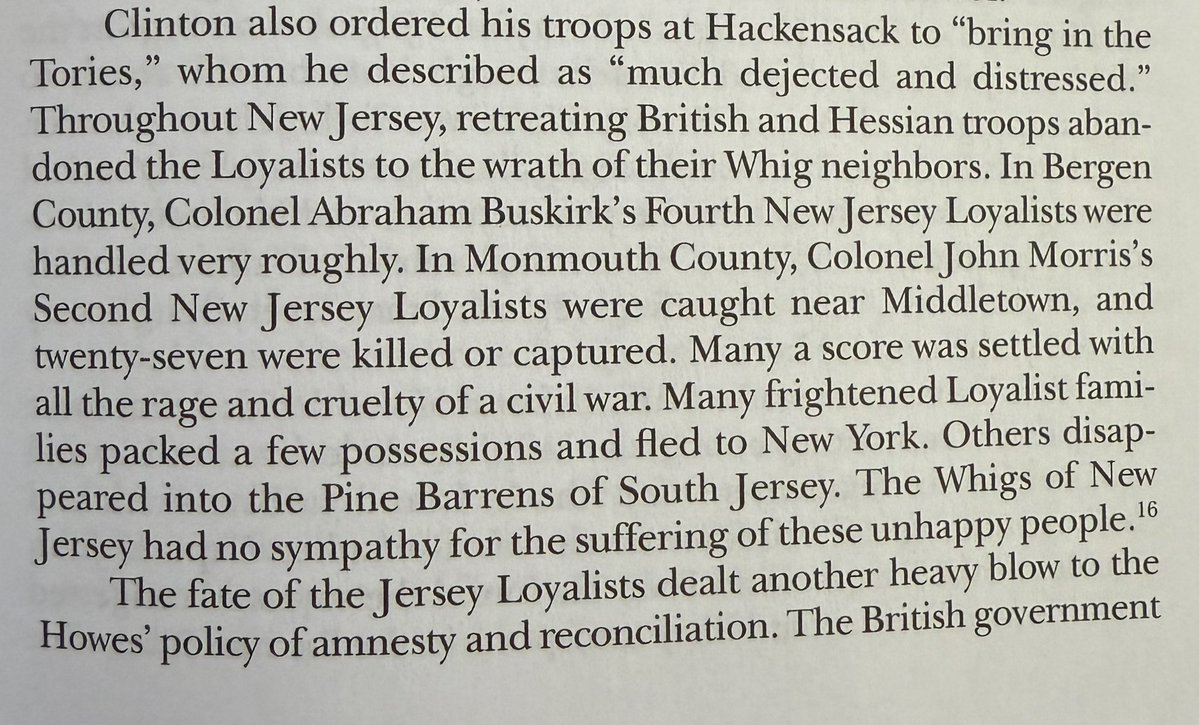
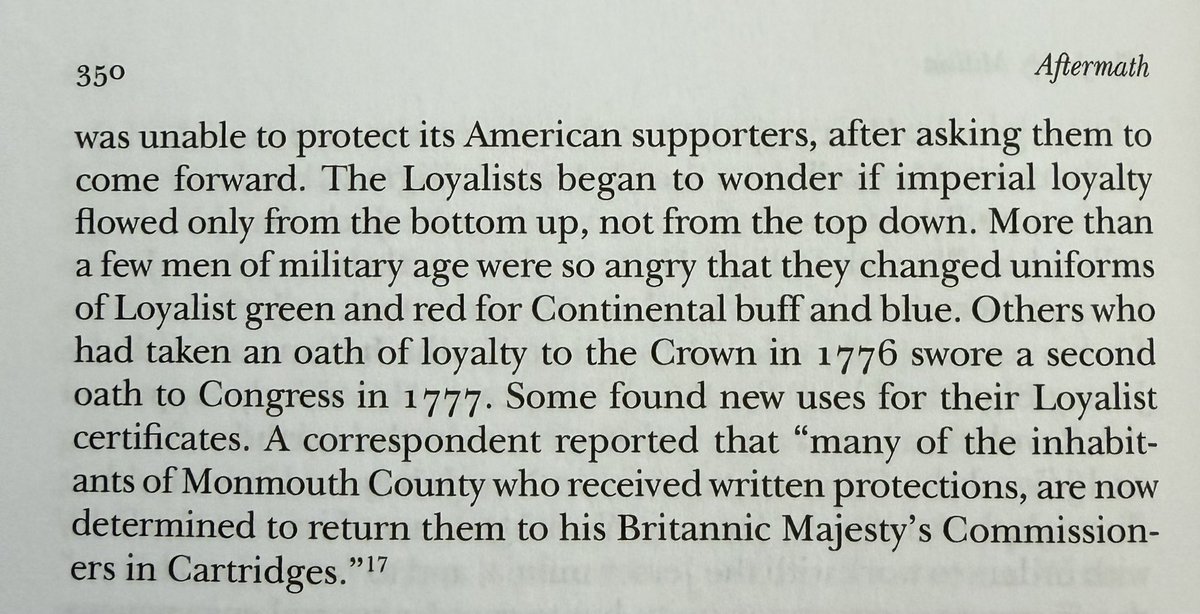
After Washington’s audacious victories at Trenton and Princeton in 1776-77, the Patriot militia arose in New Jersey, and harassed the British under Gen’l George Clinton into retreating to Perth Amboy and the Hudson. This was very bad news for New Jersey’s Tories.
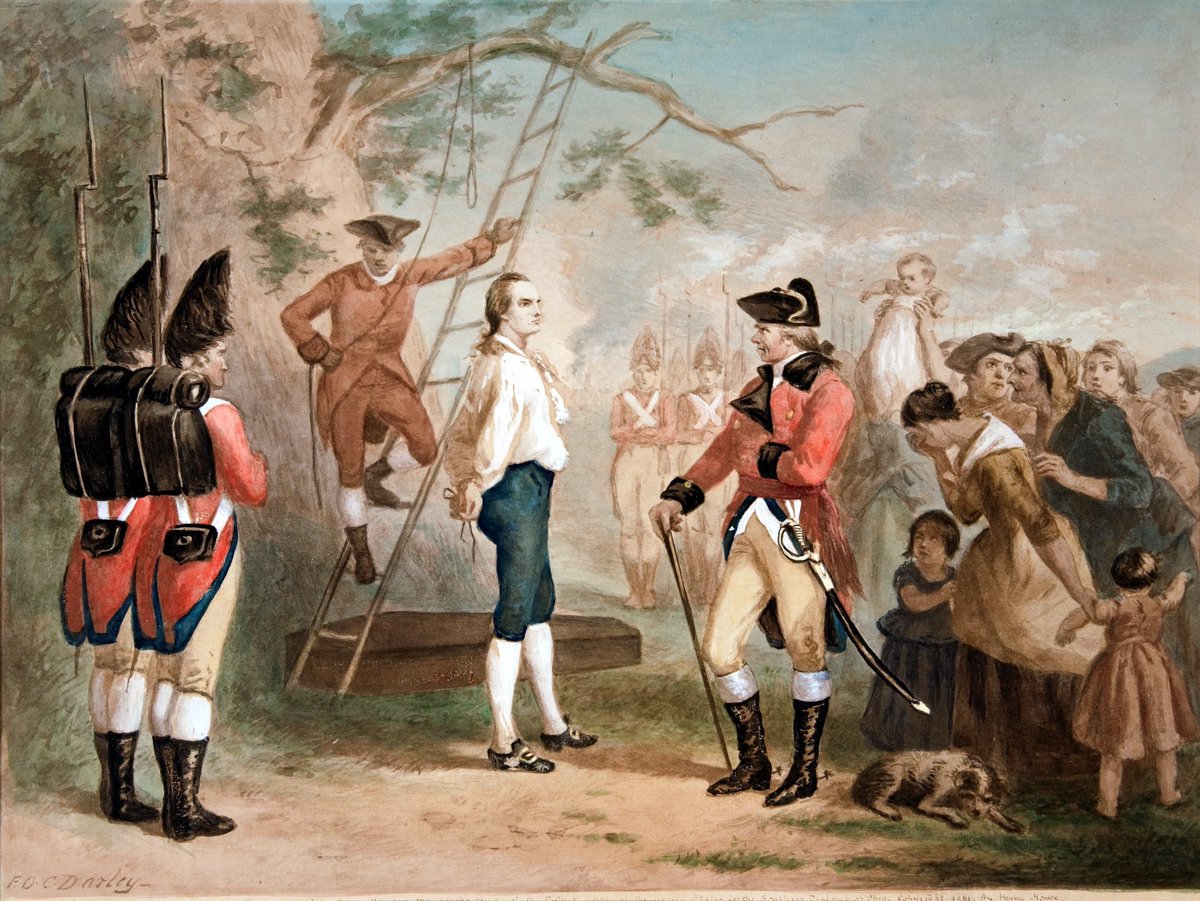
On this morning 250 years ago, the British hanged a 21-year-old American schoolteacher as a spy, and in trying to make him disappear quietly, they accidentally made him immortal. His name was Nathan Hale, and it is worth sitting with just the last few hours of his life.
He had been caught the night before, behind British lines on Long Island, carrying notes on enemy positions hidden in his shoes. There was no real trial. A man out of uniform with military intelligence on him was a spy by the rules of war, and the sentence for spying was death by hanging, no ceremony, no honor. General Howe ordered it done in the morning.
What we know of that morning comes mostly from the enemy, from British officers who were there, and it is the small human cruelties that stay with you. Hale asked for a clergyman to attend him in his final hours. The request was refused. He asked for a Bible. That too was denied. He was a devout young man about to die, and they would not give him even that comfort. A British officer named Montresor, watching, was troubled enough by the young man's composure to later make sure his story was told.
In his last moments Hale was allowed to write a couple of letters, one to his mother, one to a fellow officer. He wrote them, and then the British provost marshal, a notoriously brutal man named Cunningham, took those letters and destroyed them in front of him. The reason given was chilling in its pettiness: so that the rebels should not know they had a man in their ranks who could die with such firmness. They did not just want to kill him. They wanted to erase him.
Then they marched him to the gallows, and there, according to the accounts that survived, this young schoolteacher who had failed at the one dangerous mission he ever attempted, stood calmly and spoke about duty and country with a steadiness that unnerved the men sent to kill him. The famous words attributed to him, that he only regretted having but one life to lose for his country, may be polished or borrowed from a play he loved. But everyone who was there agreed on the essential truth beneath the wording: he met his death without flinching, and he made even his executioners remember him.
And that is the irony that redeems the whole sad morning. Cunningham burned the letters so no one would know how bravely Hale died. It did not work. The story got out anyway, carried by the very enemies who watched it, and a young man the British tried to erase became one of the most enduring symbols of the Revolution, honored two and a half centuries later, on this exact day, as the first American to die spying for his country. They denied him a Bible and a chaplain and burned his last words, and still they could not make him small.
“Since this often seems to come up in discussions of the radical style, I’ll mention one other gleaning from my voyages. Beware of identity politics. I’ll re-phrase that: have nothing to do with identity politics. I remember very well the first time I heard the saying ‘The Personal Is Political.’ It began as a sort of reaction to the defeats and downturns that followed 1968: a consolation prize, as you might say, for people who had missed that year. I knew in my bones that a truly Bad Idea had entered the discourse.”
Christopher Hitchens, Letters to a Young Contrarian
OTD in 1528, the 240+ survivors of the Narváez expedition set sail from the Gulf coast near Talahassee on five immense rafts, destination Mexico. They carry “fresh” water in immense canteens made from the skin from the hind legs of horses. Their food is a heap of corn looted from nearby villages in the middle of each raft. Their sails are made from old clothing. Seeing no ships beyond the barrier islands, they head west along the Gulf coast.
https://t.co/1f0e0hj2Wj
People, and especially French people, who thought it was important to explore the Mississippi River by canoe in the early 1670s are a little put out that there isn't more widespread celebration of Louis Jolliet's birthday today.
OTD in 1671, Governor Joseph West of Carolina and his council declare war on the Kussoe nation, after they align with the Spanish. The Carolinians strike first, and sell captives into slavery in the West Indies, the first of many such transactions.
https://t.co/pPE7DfHXa1
@DavidAFrench@Noahpinion We stopped teaching about the importance of assimilating immigrants as a matter of ideology in the 1970s, and stopped teaching civics because social studies was deemed more important.
Few people understand how fully degraded search became after 2020. In the before times, results were driven by user experience which fed algorithmic determination of credibility. Then Google flipped to prioritize "stakeholder" content. It was part of the general anti-populist revolution and clearly reflected a deep-state push.
At the same time, publicly available tools to examine the traffic of any site were made to vanish. This is all part of pushing messaging to the public and massively marginalizing creative and offbeat content. Today, the results of search reflects someone else's views of how you should think and not actually what the people are proven to want.
This gigantic change was never announced. Nor did the status quo ante return after lockdowns were over. The internet of today is completely unlike the internet of 2019. Now with AI driving most results, ruling class orthodoxies are ever more ascendent.
The moment you receive a jury summons, you are invited to hold more power than most people realize.
Here are 4 things every juror should know: https://t.co/KeIdn9AbVQ
How the big crypto bill fell apart.
The ambitions of the crypto industry and trad banking may be impossible to resolve amicably. I think crypto would have won the fight if DJT hadn’t been using meme coins to rake in a fortune while in office.
https://t.co/G1op6rqD1h