Larry Fitzgerald reveals what led his son Devin to choose Notre Dame over other schools 👀
“There were some unofficial visits we took where he had an unbelievable time, and he’d be like, ‘Dad, I really like this place... but the guys are undisciplined, they’re not focused…’ I didn’t say anything, but I would think, I’m so proud.”
What is the cost to get an article published in these open access CV journals?
JACC Advances $3024
JAHA $3810
JCF Intersections $3310
JHLT Open $2500
What the hell are we doing? Who is paying these fees for articles that cannot get accepted in major CV journals?
This graph tells a better story than the average.
Almost immediately after graduation, doctors start quitting, and it drops at a continuous pace for 25 years.
No plateau. Just continuous decay.
Looks as bad as some of the survival curves in oncology!
20% are gone in 5 years! 5 years!!
They train for 7 years after college and quit in less than that. They get out as soon as they can!
That says one thing clearly - Graduating doctors are realizing that this is not what they signed up for
The gaslighting during med school and residency fades fast in private practice. Doctors are not dumb.
🏌️🏆 PGA Championship winner, Aaron Rai on why he uses iron covers: “I grew up in very much a working-class family, and golf has always been a very expensive game. I started from the age of 4 years old, and my dad used to pay for the equipment, pay for my memberships, my entry fees. And it wasn't money that we really had, to be honest, but he'd always buy me the best clubs.
When I was about seven or eight years old, (my dad) bought me a set of Titleist 690 MBs, and they were like 800-1,000 pounds back then, just for a set of clubs for a kid. I cherished them. When we used to go out and practice, he used to clean every single groove afterward with a pin and with baby oil.
Although on the PGA Tour, we get given equipment, and we get given everything that we need, it's more out of principle. The value of not losing perspective of what I have and where I am. The covers are going to stay, I'm sorry."
In 2025, JAMA Cardiology celebrated its 10th year, receiving >2,700 submissions and achieving an Impact Factor of 14.1. Read the full “JAMA Cardiology Year in Review, 2025,” by Robert O. Bonow, MD, MS, and Barbara Casadei, MD, DPhil.
https://t.co/LyktiRAEty
The keynote everyone's still talking about. 🎤
Dr. Will Flanary, a.k.a. @DGlaucomflecken — ophthalmologist, comedian, and SCA survivor — brought humor, honesty, and a powerful reminder of what it means to be both a doctor and a patient to #HRS2026.
▶️ Watch the full keynote on https://t.co/0BghdRTKLW.
It was a privilege to welcome Dr. Clyde Yancy to Kansas City for a city-wide discussion on contemporary medical therapy for heart failure and the evolving challenge of sudden cardiac death risk.
Few leaders have had as much influence across the modern eras of heart failure care as Clyde. The field has moved from an era largely defined by neurohormonal blockade and device-based prevention to one now shaped by rapid implementation of comprehensive, multi-drug GDMT. Across that arc, trials such as MADIT-II, SCD-HeFT, and DANISH helped define our thinking around sudden cardiac death prevention, while event rates have continued to shift as patient cohorts, background therapies, and competing risks have evolved.
That history made the discussion timely. As therapies improve, the question is no longer simply whether we have effective treatments. It is whether we can reliably deliver them, optimize them, and still recognize where residual risk remains.
Clyde and I have had the opportunity to work together on IMPLEMENT-HF, focused on improving defect-free heart failure therapy at discharge and 30 days after hospitalization. I was fortunate to lead the manuscript published in 2025, with Clyde as senior author, and the work reflects a core principle we both believe in: hospitalization is not just a marker of risk, but an opportunity to change the trajectory of care.
We also took a deeper dive into the SCD PROTECT study. Even in a contemporary cohort with high adherence to four-drug GDMT, event rates while patients were using a wearable cardioverter-defibrillator remained meaningfully elevated. That finding reinforces an important message: modern GDMT has transformed heart failure care, but residual arrhythmic risk persists, particularly during vulnerable transitions and early treatment windows.
On a personal level, this evening felt full circle. Clyde has been a mentor to me since 2010, when he came to Northwestern during my first year of fellowship. I was part of his first full graduating class of fellows under his leadership at Northwestern. I later left Chicago, where he was my Division Chair, to come to Kansas City and help build programs aimed at raising the bar for heart failure and cardiometabolic care across our region.
That is what made this event so meaningful. It was a true city-wide conversation, with representation from most health systems in Kansas City, including Saint Luke’s / BJC, the University of Kansas, HCA hospitals, including Centerpoint and Research, North Kansas City Hospital, and others across the region. I was especially proud to have Dr. Zubair Shah from the University of Kansas join the panel, a colleague and mentee since I first came to Kansas City in 2015.
Heart failure care advances when science, implementation, and community collaboration come together. Having Clyde with us in Kansas City was a reminder of how far the field has come, how much work remains, and how powerful mentorship can be when it comes full circle.
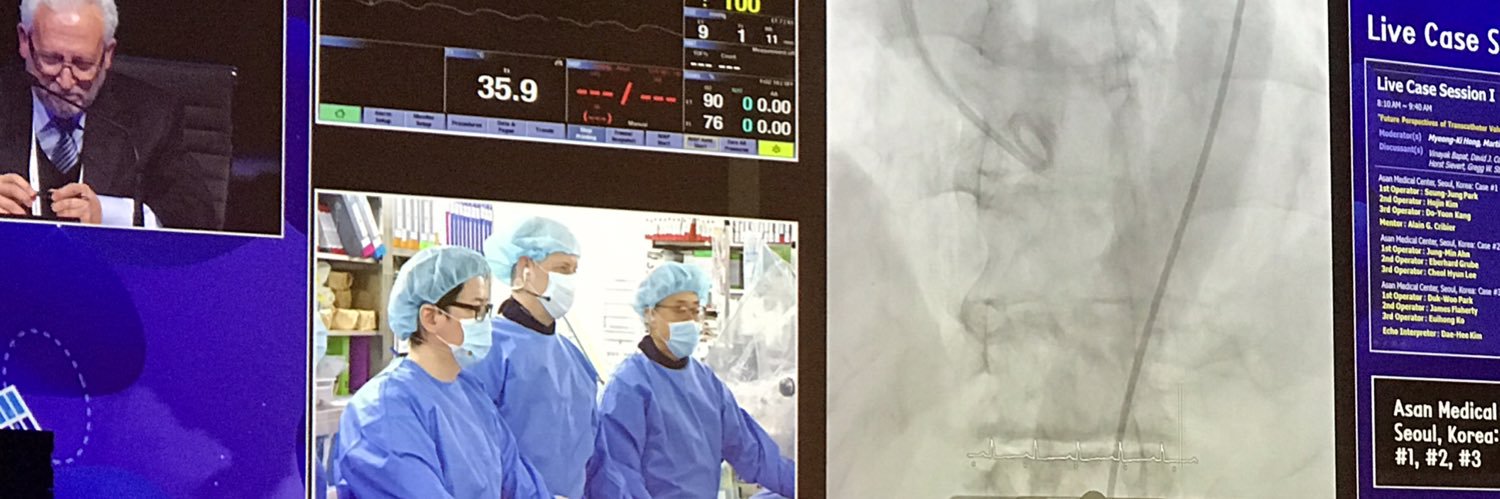
@dukwoo_park with an overview of #TCTAP2026 - one of my favourite data driven interventional meetings
2500 delegates, 13 live cases and 600+ faculty
Lots of new RCT data being shown
@summitmd_cvrf
I was up last night with a STEMI until 4:30. For my entire career I’ve gone to work the next day with whatever sleep I could get. Not anymore. Today, I slept in and did chart work from home. You can’t fly an airplane or drive a truck if you’ve been up all night. Why should it be different for docs?
As a pancreatic cancer doc, cannot understate the gravity of this moment. I get chills at the prospect that we will imminently have something else to offer our patients with real clinical impact. @AACR#AACR26@RevMedicines
Clyde W. Yancy, MD, MSc (@NMHheartdoc), and Robert O. Bonow, MD, give consecutive presentations in session, “Early Career, Big Impact: Building Your Future with AHA (Early Career Day Opening Session)” at #AHA25. @AHAScience
Had a great time seeing old friends at the Northwestern/WashU Heart Team Summit in St Louis. Thanks for the invitation to talk about the next-gen heart team empowered by #AI@jdflaherty - you put on a heck of a program!
@NMCardioVasc@MUSC_Cardiology@MUSChealth