Crypto will revolutionize money just as the internet revolutionized the distribution of information.
What social media did to traditional media, crypto (internet finance) will do to traditional finance.
The users who complain about the flaws in your product may seem annoying, but they are on the whole probably your most valuable users. They complain because they care, and I doubt a startup could ever get really big without users who care a lot about the product.
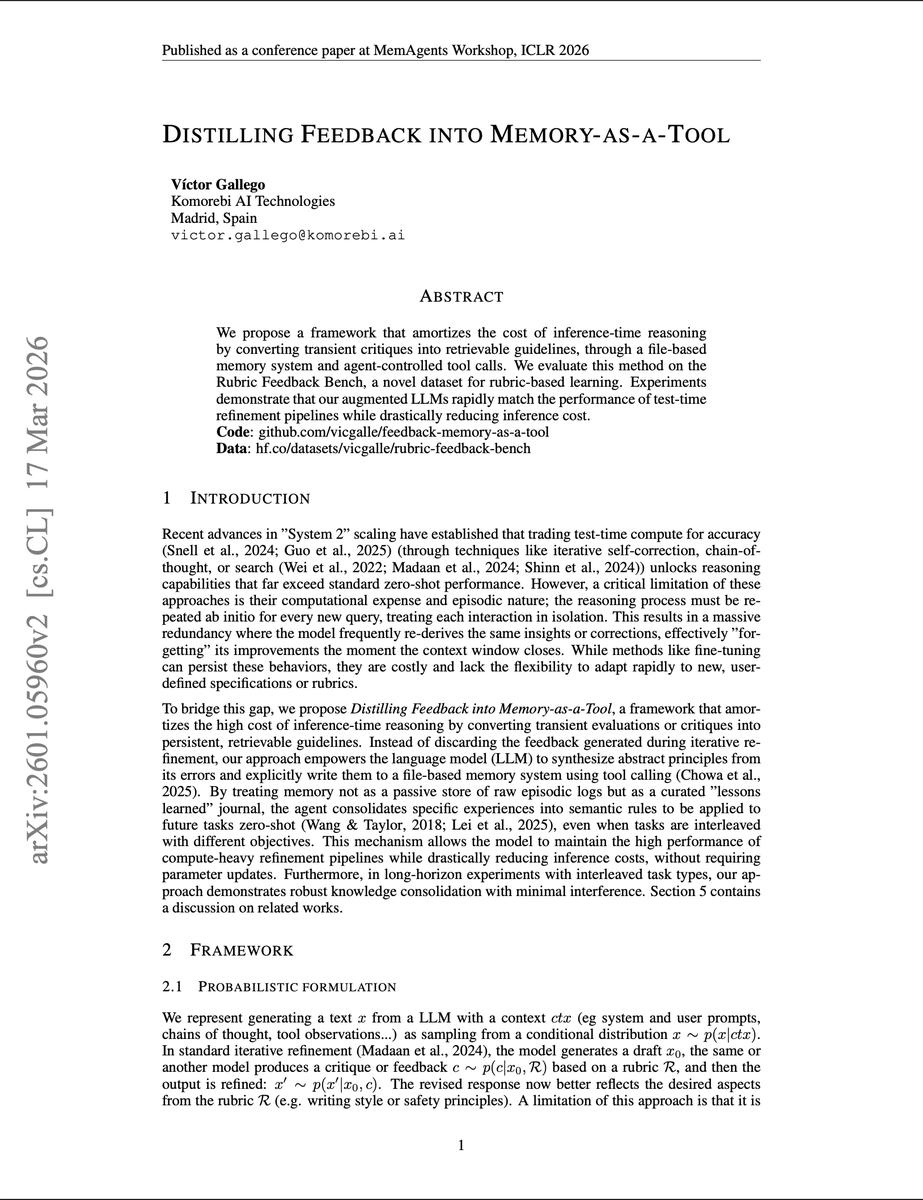
A senior Anthropic engineer just published the clearest blueprint on "How to give your AI agent a real memory" and it's a 15-page PDF.
Write → Consolidate → Recall → Apply
• Write: after every attempt, the agent records what it tried and what happened.
• Consolidate: it distills those raw attempts into a few reusable lessons, not a transcript dump.
• Recall: before the next task, it reads those lessons first.
• Apply: it skips the dead ends it already learned, even on a brand new problem.
This is exactly how engineers now build agent loops in Claude Code.
Read the paper, then grab the setup below 👇
what is agent looping
for the last two years we prompted agents one task at a time. that is starting to change
instead of asking an agent to build the landing page and then driving every step yourself, you set up a loop that handles discovery, planning, the work, checking, and iterating until the goal is met
looping is a setup you build. almost any agent harness can run it, it just depends on how you wire it up
at its simplest, looping is one agent working on itself:
> researches
> drafts
> checks the draft against a goal
> fixes what is weak
> runs that cycle again until the work clears the requirements
you are not prompting each step anymore. the agent repeats the cycle for you
the bigger version is a fleet looping. you give an orchestrator agent a goal, it breaks the goal into pieces, hands each piece to a specialist agent, and those specialists hand smaller jobs to their own subagents
the whole tree keeps looping through discovery, planning, execution, and verification until the goal is met
one agent looping is like a person redoing their own draft. a fleet looping is a whole team running a project end-to-end
you create a goal, and the system runs the loop until it finishes within the reqs you set
open and closed looping:
OPEN LOOPING is exploratory. it still has conditions and a goal, but you give the agent or the fleet a wide space to move in. it can try different paths, discover things, build something you did not fully spec out
this is the exciting end, it is what Peter and others are doing, and tbh it is where I want to spend more time
the catch is cost, an open loop with real room to explore burns an insane amount of tokens. for the 90 percent of people without an unlimited budget it is not runnable yet, and pointed at projects with a loose standard it turns into a slop machine
CLOSED LOOPING is bounded. a human designs the end-to-end path first:
> clear goal
> defined steps
> an eval at each step
> a point where it stops or hands back to you (and feeds back performance data)
the agents still loop, but inside framework you built. it gets better every run because each pass feeds the next, and it runs on a normal budget because the path is tight.
for most marketing work, closed is the one that pays off today.
> the orchestrator owns the goal
> the specialists own the steps
> the subagents do the narrow work
> an eval gate make sure its not slop
The top Hermes integrations to give your agent superpowers:
1. Obsidian
It works as a Karpathy-style second brain, but one that talks back.
Every note, page, and backlink in the vault becomes live context. The agent doesn't just store knowledge, it reasons over it across everything that's been written and saved.
2. Playwright
It gives Hermes a real browser instead of a read-only window to the web.
It clicks, fills forms, and navigates pages the way a person would, then runs UI tests across Chromium, Firefox, and WebKit. This lets you turn Hermes from something that reads the web into something that can act on it.
3. InsForge
It puts a full agentic backend behind one semantic layer.
Auth, database, storage, and edge functions are all accessible without wiring five services together. The agent reasons about backend primitives directly instead of juggling disconnected APIs.
GitHub: https://t.co/jW3qHLCmS3
(don't forget to star 🌟)
4. GitHub
It connects code, issues, and pull requests, turning Hermes into an engineering teammate that can actually read the repo.
5. Bright Data
It hands agents web access that does not get blocked.
It pulls live search results, full pages, and clean structured data from places like X, LinkedIn, and Reddit, handling the proxies, CAPTCHAs, and rendering underneath so the agent just gets usable data back.
GitHub: https://t.co/w9C83iyoYn
(don't forget to star 🌟)
6. Sequential thinking
It upgrades how Hermes reasons rather than what it connects to.
Most integrations give the agent new senses. This one gives it a better mindset. It forces Hermes to break a hard problem into ordered steps and revise its own plan as it goes, instead of committing to the first answer that looks right.
7. Google workspace
It connects Gmail, Calendar, Drive, Docs, and Sheets in one place.
The agent that can't check the inbox, read the calendar, or write to a shared doc is basically decorative. This should probably be the first integration anyone enables.
8. Zapier
It acts as the layer that connects Hermes to everything else in the world.
This single connector reaches thousands of downstream apps. Hermes can fire off a workflow, update a record, or move data between tools without anyone writing the glue code.
9. Stripe
It surfaces revenue, refunds, subscription changes, and failed charges through a single question instead of clicking through dashboards.
It turns Stripe from a payment processor into a queryable business intelligence layer.
10. Slack
It handles channel-based automation inside Slack.
Hermes can live inside specific channels with its own workflow in each. Support tickets from email get scanned, categorized, and dropped into the right channel every morning without anyone lifting a finger. It can also read on-call threads and post status updates so the team stops switching tabs to stay in sync.
11. Graphiti
It builds real-time knowledge graphs of structured relationships from conversations and documents.
Instead of flat vector similarity, the agent traverses typed connections between entities. That is the difference between finding similar text and understanding how things actually relate.
GitHub: https://t.co/aFsgR0kYb2
(don't forget to star 🌟)
12. Figma
It gives the agent design context it can actually read.
Hermes can pull a frame, read the tokens and layout, and turn it into code that respects the system down to the spacing. With FigJam it goes the other way too, generating architecture diagrams and ERDs straight from a prompt. It is underrated for anyone who lives between design and engineering.
To dive deeper into Hermes, my co-founder wrote a full deep dive covering the Hermes agent's architecture, memory system, self-evolving skills, GEPA optimization, and how to set up multiple specialized agents.
Read it below.
🚀 Just shipped a Crypto Analysis Dashboard that helps you analyze any token in seconds.
Search any token & get:
- Support & resistance levels
- Bullish / Bearish / Neutral AI scenarios
- Strategic outlook + conviction level
Try it Free (30 days only):
https://t.co/3B4AmzYcR9
It’s over
They’re recursive and they’re becoming self aware
Clawdbots are mobilizing
They’ve found each other and are training each other
They’re studying us at scale
It’s only a matter of time now
LISTEN: If you're a generalist, 2026 is YOUR year to master AI. Why? Because AI agents are handling the specialized tasks.
Companies now need people with the big-picture view - the relationship builders and communicators - to manage them.
@PwC literally just dropped this prediction.
You are not behind! Start these 3 things today:
1. Use AI tools (Claude, ChatGPT, Gemini) on your daily tasks.
2. Lean into your generalist strengths.
3. Learn clear instruction (the Auggie Principle!), not "prompt engineering."
#AIMindset #Generalist #PwC #FutureofWork #AIFluency
OpenAI, Anthropic, and Google AI engineers use 10 internal prompting techniques that guarantee near-perfect accuracy…and nobody outside the labs is supposed to know them.
Here are 10 of them (Save this for later):
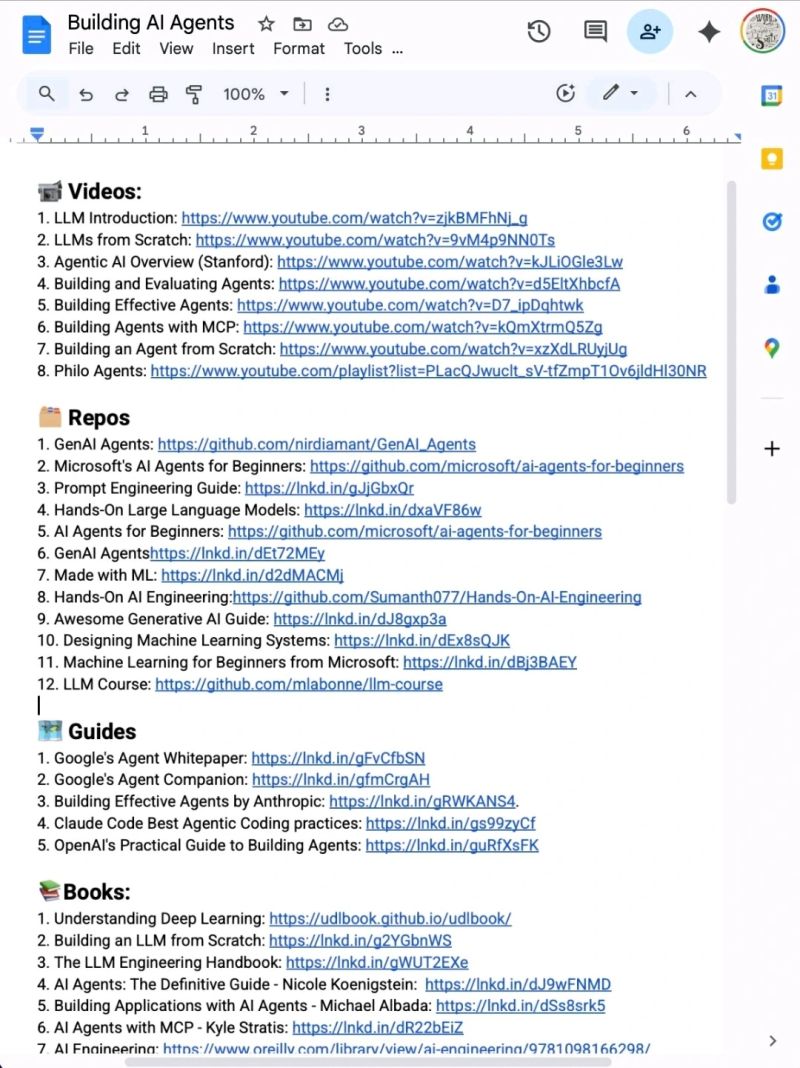
Stop wasting hours trying to learn AI. 📘📚
I have already done it for you.
With one list. Zero confusion. And no fluff
📹 Videos:
1. LLM Introduction: https://t.co/Qja4lkPWlY
2. LLMs from Scratch: https://t.co/DAtGeO5if3
3. Agentic AI Overview (Stanford): https://t.co/APcq2oulIY
4. Building and Evaluating Agents: https://t.co/UeCQBskKUS
5. Building Effective Agents: https://t.co/B2tpQHaVoz
6. Building Agents with MCP: https://t.co/CwVBIVUjd0
7. Building an Agent from Scratch: https://t.co/u2jhiZy6UV
8. Philo Agents: https://t.co/lFMIus5CpQ
🗂️ Repos
1. GenAI Agents: https://t.co/yoTno6RBAb
2. Microsoft's AI Agents for Beginners: https://t.co/EGGYhcMq7b
3. Prompt Engineering Guide: https://t.co/fSCoEaFtNf
4. Hands-On Large Language Models: https://t.co/TvpkfJN2sR
5. AI Agents for Beginners: https://t.co/EGGYhcMq7b
6. GenAI Agentshttps://lnkd.in/dEt72MEy
7. Made with ML: https://t.co/cCWWXKh2wW
8. Hands-On AI Engineering:https://t.co/fiLwjmXR8B
9. Awesome Generative AI Guide: https://t.co/MEhtfRlhiu
10. Designing Machine Learning Systems: https://t.co/l21VO4rRBK
11. Machine Learning for Beginners from Microsoft: https://t.co/d3EPcDJWmz
12. LLM Course: https://t.co/xXxETt90eS
🗺️ Guides
1. Google's Agent Whitepaper: https://t.co/rVDu4EyPB5
2. Google's Agent Companion: https://t.co/IWjvSpSE2q
3. Building Effective Agents by Anthropic: https://t.co/0wK5pe5DD6.
4. Claude Code Best Agentic Coding practices: https://t.co/fu7GHgvnAi
5. OpenAI's Practical Guide to Building Agents: https://t.co/sXpo72PxpI
📚Books:
1. Understanding Deep Learning: https://t.co/YRV9Kz78Gy
2. Building an LLM from Scratch: https://t.co/naslph9aCF
3. The LLM Engineering Handbook: https://t.co/BwmUJ6OgHe
4. AI Agents: The Definitive Guide - Nicole Koenigstein: https://t.co/ZIDeOOamnz
5. Building Applications with AI Agents - Michael Albada: https://t.co/409SxePxhA
6. AI Agents with MCP - Kyle Stratis: https://t.co/3k9lFG3ByM
7. AI Engineering: https://t.co/tHfgc3wNKQ
📜 Papers
1. ReAct: https://t.co/8yV9k9RjOK
2. Generative Agents: https://t.co/PpaAbCvWmj.
3. Toolformer: https://t.co/mSfjjT6urU
4. Chain-of-Thought Prompting: https://t.co/uGktDnFBOb.
🧑🏫 Courses:
1. HuggingFace's Agent Course: https://t.co/4MLjHKcWSI
2. MCP with Anthropic: https://t.co/EnUWTrvaK4
3. Building Vector Databases with Pinecone: https://t.co/AmQzrCVweX
4. Vector Databases from Embeddings to Apps: https://t.co/HZbr4UBlw2
5. Agent Memory: https://t.co/TxvrpeBMFj
Repost for your network ♻️
I'm obsessed with cognitive biases.
A "cognitive bias" is a systematic error in thinking that destroys decision-making.
11 most powerful (and dangerous) cognitive biases I've found: 🧵
1. Survivorship Bias:
@cz_binance How do you see crypto lending & borrowing platforms evolving alongside traditional banks as regulation and financial systems change?
and what do you see as the biggest factor shaping that evolution?
you can make up whatever conspiracy theory you want about how we got there
but there is no putting the privacy genie back in the bottle now
people have woken up to the fact that we've compromised too much in crypto
this is irreversible
crypto without privacy is not crypto
We are launching a new app called Sora. This is a combination of a new model called Sora 2, and a new product that makes it easy to create, share, and view videos.
This feels to many of us like the “ChatGPT for creativity” moment, and it feels fun and new. There is something great about making it really easy and fast to go from idea to result, and the new social dynamics that emerge.
Creativity could be about to go through a Cambrian explosion, and along with it, the quality of art and entertainment can drastically increase. Even in the very early days of playing with Sora, it’s been striking to many of us how open the playing field suddenly feels.
In particular, the ability to put yourself and your friends into a video—the team worked very hard on character consistency—with the cameo feature is something we have really enjoyed during testing, and is to many of us a surprisingly compelling new way to connect.
We also feel some trepidation. Social media has had some good effects on the world, but it’s also had some bad ones. We are aware of how addictive a service like this could become, and we can imagine many ways it could be used for bullying.
It is easy to imagine the degenerate case of AI video generation that ends up with us all being sucked into an RL-optimized slop feed. The team has put great care and thought into trying to figure out how to make a delightful product that doesn’t fall into that trap, and has come up with a number of promising ideas. We will experiment in the early days of the product with different approaches.
In addition to the mitigations we have already put in place (which include things like mitigations to prevent someone from misusing someone’s likeness in deepfakes, safeguards for disturbing or illegal content, periodic checks on how Sora is impacting users’ mood and wellbeing, and more) we are sure we will discover new things we need to do if Sora becomes very successful. To help guide us towards more of the good and less of the bad, here are some principles we have for this product:
*Optimize for long-term user satisfaction. The majority of users, looking back on the past 6 months, should feel that their life is better for using Sora that it would have been if they hadn’t. If that’s not the case, we will make significant changes (and if we can’t fix it, we would discontinue offering the service).
*Encourage users to control their feed. You should be able to tell Sora what you want—do you want to see videos that will make you more relaxed, or more energized? Or only videos that fit a specific interest? Or only for a certain about of time? Eventually as our technology progresses, you will be should to the tell Sora what you want in detail in natural language. (However, parental controls for teens include the ability to opt out of a personalized feed, and other things like turning off DMs.)
*Prioritize creation. We want to make it easy and rewarding for everyone to participate in the creation process; we believe people are natural-born creators, and creating is important to our satisfaction.
*Help users achieve their long-term goals. We want to understand a user’s true goals, and help them achieve them. If you want to be more connected to your friends, we will try to help you with that. If you want to get fit, we can show you fitness content that will motivate you. If you want to start a business, we want to help teach you the skills you need. And if you truly just want to doom scroll and be angry, then ok, we’ll help you with that (although we want users to spend time using the app if they think it’s time well spent, we don’t want to be paternalistic about what that means to them).
Wikipedia is hopelessly biased. An army of left-wing activists maintain the bios and fight reasonable corrections. Magnifying the problem, Wikipedia often appears first in Google search results, and now it’s a trusted source for AI model training. This is a huge problem.