I am delighted to announce the selection of Dr. Joseph Westlake as our new @NASASun Division Director!
After years of experience as a leader and developing key heliophysics instruments and spacecraft, Joe has a wealth of experience that will help us further our understanding of the Sun and its connection to our planet. Welcome aboard! https://t.co/zMkUTBqu0K
Flashlights and lasers in space? 💥
During a solar flyby, NASA’s Parker Solar Probe made a surprising discovery about high-speed particles accelerated by explosive events on the Sun:
Protons spread out like a flashlight beam 🔦
Heavy ions shoot out straight like a laser ⚡
This unexpected data is hinting at the power source behind solar storms that disrupt tech on Earth. More: https://t.co/QySdWGF3Do
Jesse, Steve, Laddy, and Vlad….such an incredible feeling to welcome you aboard Integrity after a nearly 700,000 mile journey. Forever thankful for your service to our crew and the nation.
The Artemis II crew had the rare chance to see a solar eclipse from space. 🚀🌘☀️
This video stitches together views from Orion's solar array wing cameras throughout the eclipse, showing the Sun as it disappears behind the Moon, revealing a glowing halo around the lunar disk.
@elonmusk and yet we still know so little about our star! Never seen the poles - still need to figure out how the magnetic field works to predict space weather. But our NASA Heliophysics team agrees - the Sun is everything!!!
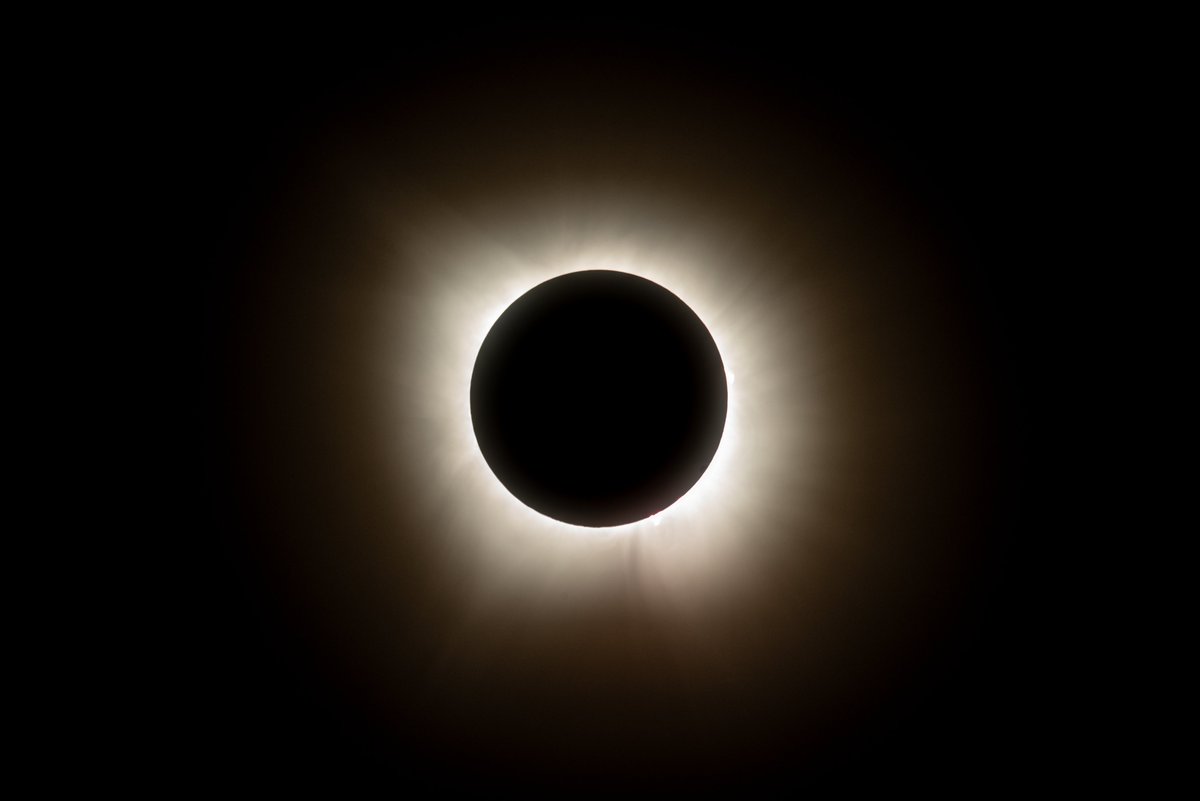
It’s been two years since the Great American Eclipse of 2024. MyRadar streamed it live from northern Maine.
Here’s @MatthewCappucci’s account:
“In my life, I’ve chased tornadoes, stood in the eyes of major hurricanes and gazed at epic displays of the aurora borealis — none rival the grandeur of a total solar eclipse. I’ve now traveled to four.
The scene is mind-boggling: day turns to night, stars and planets appear, the sun’s atmosphere shimmers and a 360-degree sunrise surrounds you.
Until you experience totality, it’s impossible to understand what it means, and why people like me invest considerable time and money into traveling to see it.
Being baptized by the moon’s shadow while staring at the solar corona is an experience that only an infinitesimal fraction a single percent of the world’s population will ever enjoy.
The corona, or the sun’s atmosphere, is arguably the most fantastical sight you’ll ever see. It’s a diaphanous plasma superheated to millions of degrees, and it spans millions of miles into space. The plasma is contorted by the sun’s magnetic field; during totality, you’ll be able to look directly at the corona and see it tracing magnetic field lines. Prominences, caused by enhanced solar activity, will look like interstellar spikes, reminiscent of hairlike protrusions fanning outward in the “solar wind.” This is the only time anyone — civilians or scientists — can directly observe the corona.
Totality is a spiritual experience. It’s a harmonic planetary alignment that seems simply too perfect to exist by chance: the sun is 400 times wider than the moon, but the moon is 400 times closer. By some miracle, a narrow sliver of Earth finds itself in the exact spot to witness the latter block the former for seconds on the minute.
Animals become confused; before totality, the light dims. Shadows become darker. Insects chirp loudly, and birds return to their nests. The air cools and the breeze dies. An ominous, ethereal presence seems to lurk nearby.
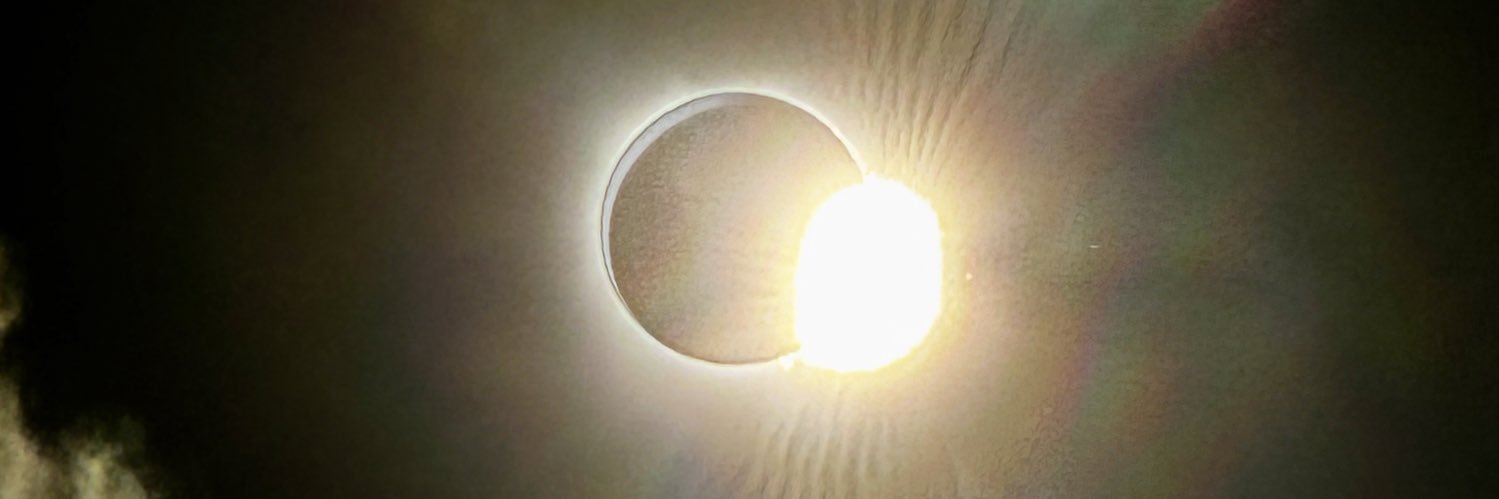
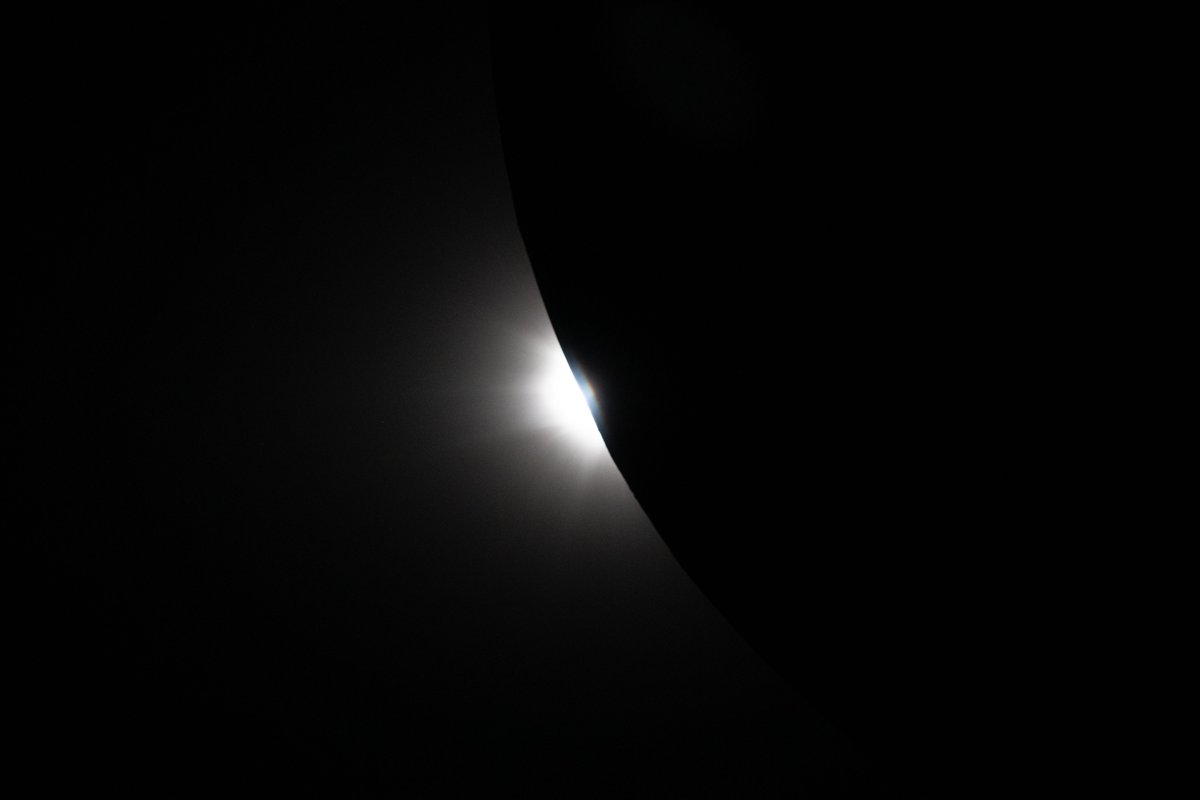
As the moon almost fully hides the sun, the last rays of sunlight poking through the valleys of the moon will form luminous pinpricks known as “Baily’s Beads.” After a moment, they’ll congeal into the diamond ring — a lone, final searing beacon of light. And then it’s totality.
Totality feels like an eternal instant. The rules of the universe seem to change; viewers are transported to a liminal space that, otherwise, we can never get to. For a brief moment in time, onlookers are the apex of an ideal alignment. The solar system is splayed out before them.
And then… it’s over. Life returns to normal. The light fades back in; the hustle and bustle of nature and humanity return.
I view totality like an old friend; I only get to spend a moment or two with said friend every couple years. It’s like a visitation from the departed.
The next total solar eclipse will occur on August 12, 2026 in Greenland, Portugal and Spain. I’ll be there.”
Two years ago today: Millions saw a total solar eclipse across America.
Two days ago: Just four people saw a total solar eclipse from Orion.
Would you rather see an eclipse from space or, in the words of Artemis Astronaut Victor Glover, from this "spaceship called Earth"?
Safety first!
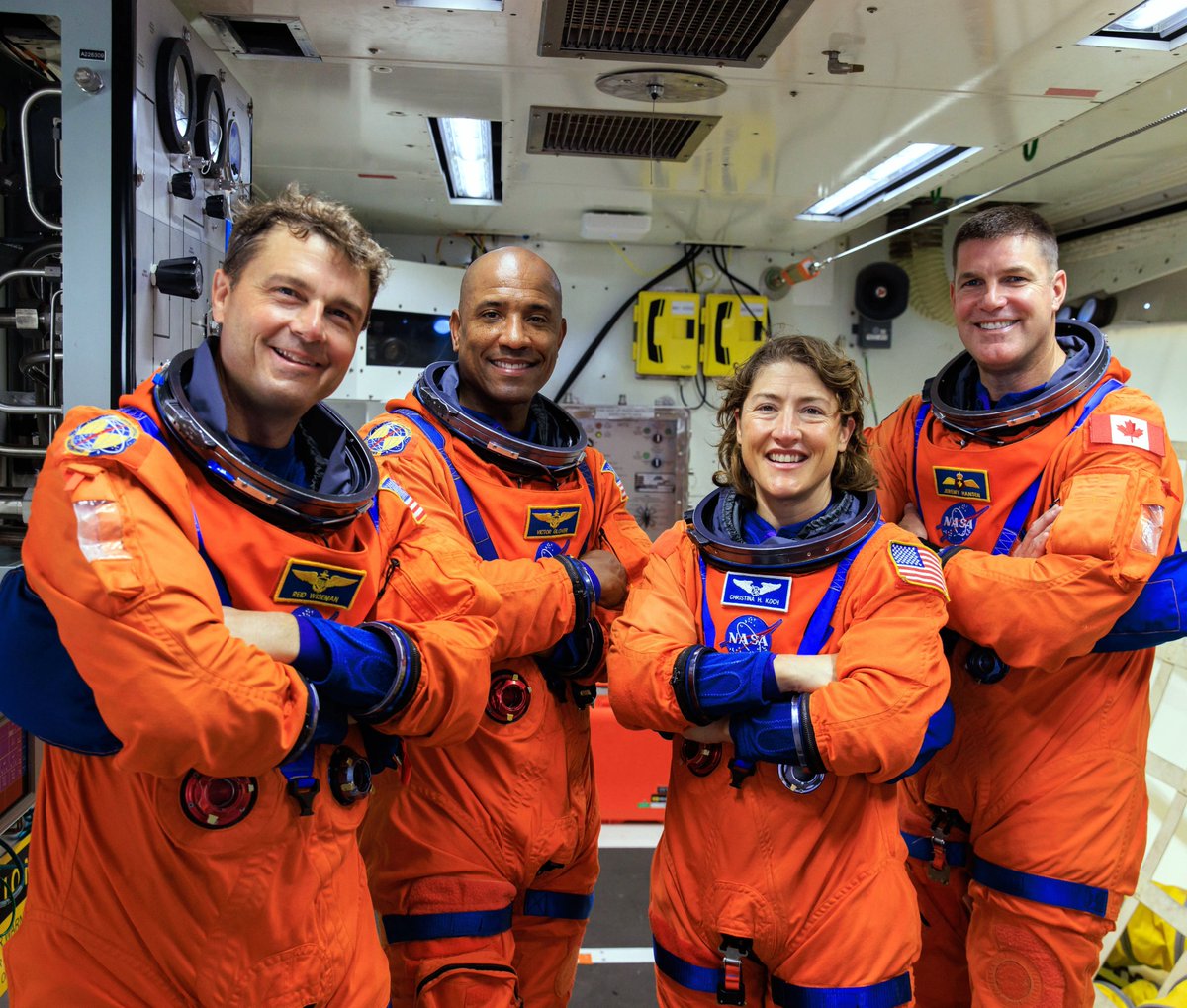
The Artemis II astronauts can be seen in their eclipse glasses, worn to protect their eyes when they experienced a solar eclipse on April 6. The Sun, the Moon, and the Orion spacecraft aligned — and Moon joy was had!
Even astronauts need to practice safety when viewing an eclipse. Here are some of the first images of the eclipse as captured by the Artemis 2 crew.
Watch their journey home live: https://t.co/2QmRPKXCKG
Your whole life you hear about the shoulders of giants.
Then one day you wake up and find you're the shoulders. Four broad new sets of shoulders just orbited the Moon.
Imagine how many more will stand upon them.
@NASA@csa_asc#Artemismission
THE ARTEMIS II ECLIPSE.
April 6, 2026.
Totality, beyond Earth. From lunar orbit, the Moon eclipses the Sun, revealing a view few in human history have ever witnessed. Photo: NASA
For those that ask why - here’s one of many good reasons for science and exploration of the Moon. It’s our history, unfettered by the constant changes of the Earth. Also… we’re going back to the friggin Moon (lol - love that kid)
The Moon is special in so many ways. Scientifically, it provides opportunities we simply don't have on Earth. It's near enough to reach with robotic explorers and humans. And for all of us on Earth, it's special because it's ours. 🩶
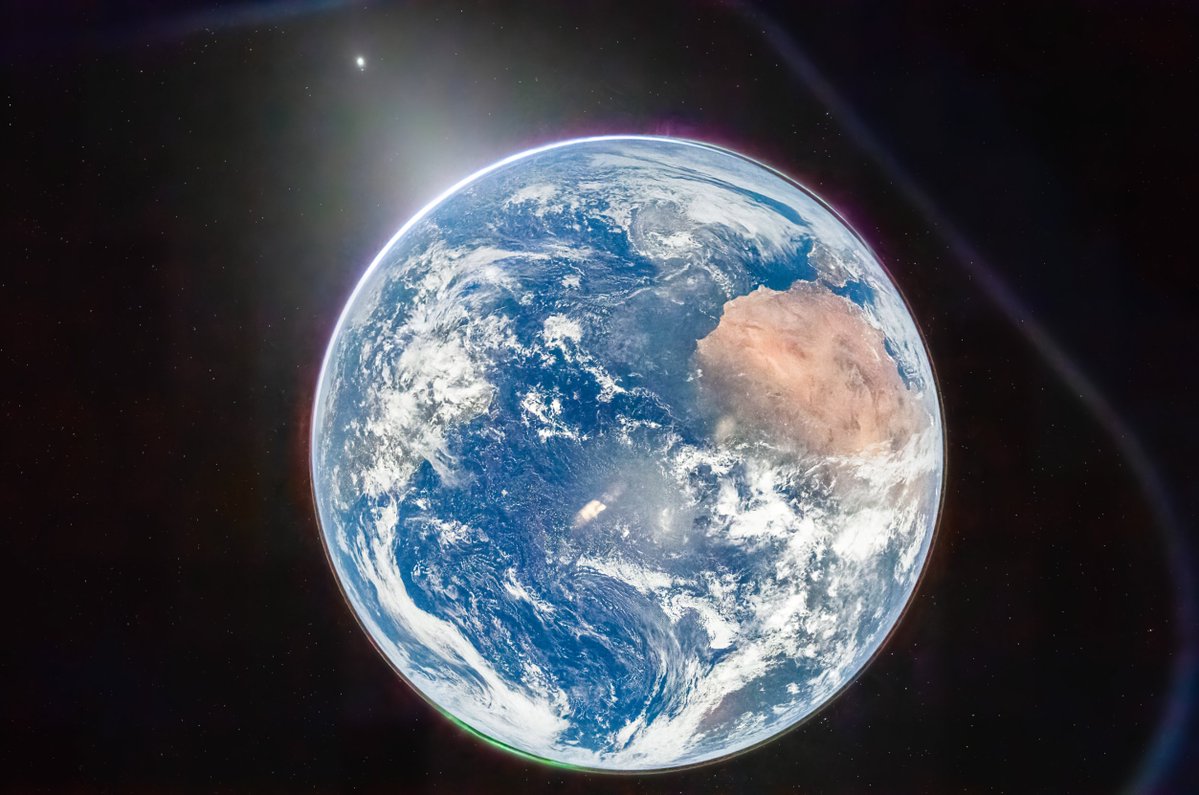
I tried my hand at processing the public jpeg of the recent Earth photo shared by the Artemis II crew.
Despite just using compressed data, I was able to correct some of the motion blur and smooth out some noise to make the photo a bit cleaner.
Should I do this for more photos?