Aside from enforceability problems, this proposal raises some interesting First Amendment questions. Government can generally compel factual, uncontroversial commercial disclosures, but they must be justified and not unduly burdensome. A warning aimed at preventing harm needs more than a purely hypothetical danger (Zauderer and NIFLA). Three things immediately stand out to me:
1. What is a “Chinese model”? What if its weights are publicly available and it runs locally on US hardware? What if it has been fine-tuned or abliterated to remove the censorship or political biases supposedly justifying the warning? What real harm remains? For that matter, what evidence establishes the alleged harm even from an off-the-shelf model?
2. Is national origin an adequate proxy for that harm? Country-of-origin disclosures can be constitutional, so singling out Chinese models isn’t automatically fatal. But NAM v. SEC offers some limits. The D.C. Circuit rejected compelled declarations that products had “not been found to be ‘DRC conflict free.’” It found the claimed humanitarian benefits speculative and cited evidence that the disclosure regime might actually worsen conditions by driving buyers away from Congolese suppliers. It also rejected the label’s implication of moral responsibility. In our AI example, disclosures could similarly backfire: pushing users away from certain models could benefit American frontier labs, reduce competition, and harm consumer welfare.
3. What would the label say? Unsubstantiated claims about danger, or thinly veiled rhetoric about Western versus Chinese values, would create a serious constitutional problem. The government would lose the benefit of Zauderer’s deferential treatment of factual, uncontroversial disclosures. In NIFLA, the Court rejected California’s attempt to use that exception to force pregnancy clinics to advertise state-sponsored services, including abortion, that they did not themselves provide. Even factually accurate information can fall outside the exception if it is effectively subjective advocacy on a controversial topic to mandate its disclosure. This, btw, is why US cigarette cartons don't have horrifying images of throat cancer on them; that's advocacy not facts; you're welcome zoomers.
Anyway, if you really want to do this—and there are plenty of reasons you shouldn’t—the constitutionally stronger approach would be to require providers to identify the model powering their chatbot or other customer-facing AI service, regardless of national origin. A simple factual disclosure, evenly applied and reasonably limited, would likely pass constitutional muster.
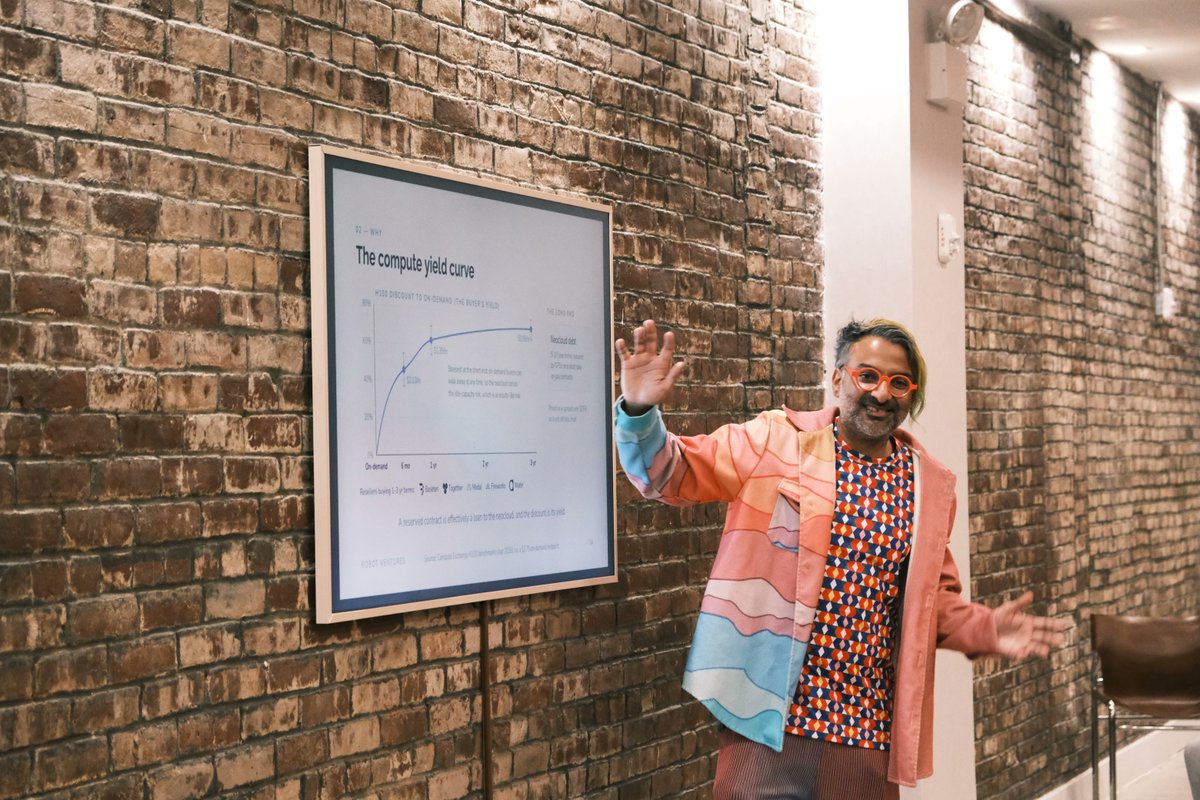
Photos 📸 from the compute maxxing salon we hosted are out! shoutouts to cohosts @silicondata and @JacobKerr17 as well as all the speakers, debaters and attendees! The room gathered a great mix of investors, neoclouds, compute traders and researchers.
Learnt so much from @0xhopydoc@stevehou's talk on the forward curve, as well as @tarunchitra@hrojantorse@jonah_b demystifying compute financing & debts' problems.