@gregreisdorf I still have the source code for it! I'd do it again too. That handshake led me to my career at Intel and I still work in games 20+ years later.
🚀 New ISPC v1.26.0 Release! 🚀
🔹 Improved ARM support & performance
🔹 New "generic" targets simplify ISPC design & ease new targets support
🔹 Better code generation for x86 & ARM
🔹 Lots of stability fixes
https://t.co/pzb96481pn
Intel Open Image Denoise 2.1 is out! It adds support for denoising 1- and 2-channel images, enables mixing data types for input features, improves performance on most discrete GPUs, and fixes several issues: https://t.co/CfvmPPH9YX #IamIntel
The Intel Software Developer Manual needs to be better organized, more consistent, and have erroneous descriptions fixed. Here is an attempt at revising the instruction listing with refined descriptions logically grouped instead of in alphabetical order.
https://t.co/udFEVRGVHv
Just released ISPC v1.21.0! Now with template function specialization support, optimized signed integer overflow rules aligned with C/C++, an enhanced ISPC Runtime, plus numerous stability and performance improvements. https://t.co/6hmLsNmvbR
Introducing ISPC v1.19.0! 🎉
* Function Templates! (technical preview)
* Support for Sapphire Rapids CPU targets
* Support for Intel Data Center GPU Max (Ponte Vecchio)
* Improved Arc GPU support.
Full Release Notes:
https://t.co/n3JOcnAFUq
🧵1/6
@pbrubaker@tom_forsyth@omershapira ISPC code has been run by 500+ million players in Unreal at this point. It has proven its value alongside other industry standard tools such as Clang and MSVC.
Intel's new Raptor Lake architecture (powering the 6GHz Core i9-13900KS and others) is insanely fast. Not just a record clock rate, but I'm also seeing an IPC improvement around 15% over Intel's previous generation in the code I'm running. Wow.
Intel is incredibly excited and honored to partner with Epic Games as a sponsor of MegaGrants. We can’t wait to see what developers create with the power of Lumen, Nanite, and #RayTracing on #IntelArc Graphics!
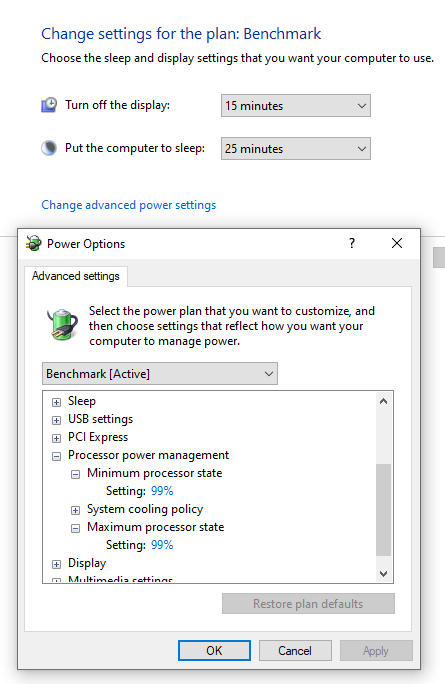
Benchmarking tips: make yourself a power plan that clamps CPU freq to min/max 99%; this disables turbo boost and generally speaking locks the frequency at base-ish, which helps get more stable measurements (works on desktops!).
I've only learned this this year from @rygorous 🤯