Caltech scientists have developed a new way to produce optical frequency combs at the chip scale, an advance that should make it easier to incorporate such combs in optical devices and more practical to use them outside the laboratory.
https://t.co/ezwOH0NSvN
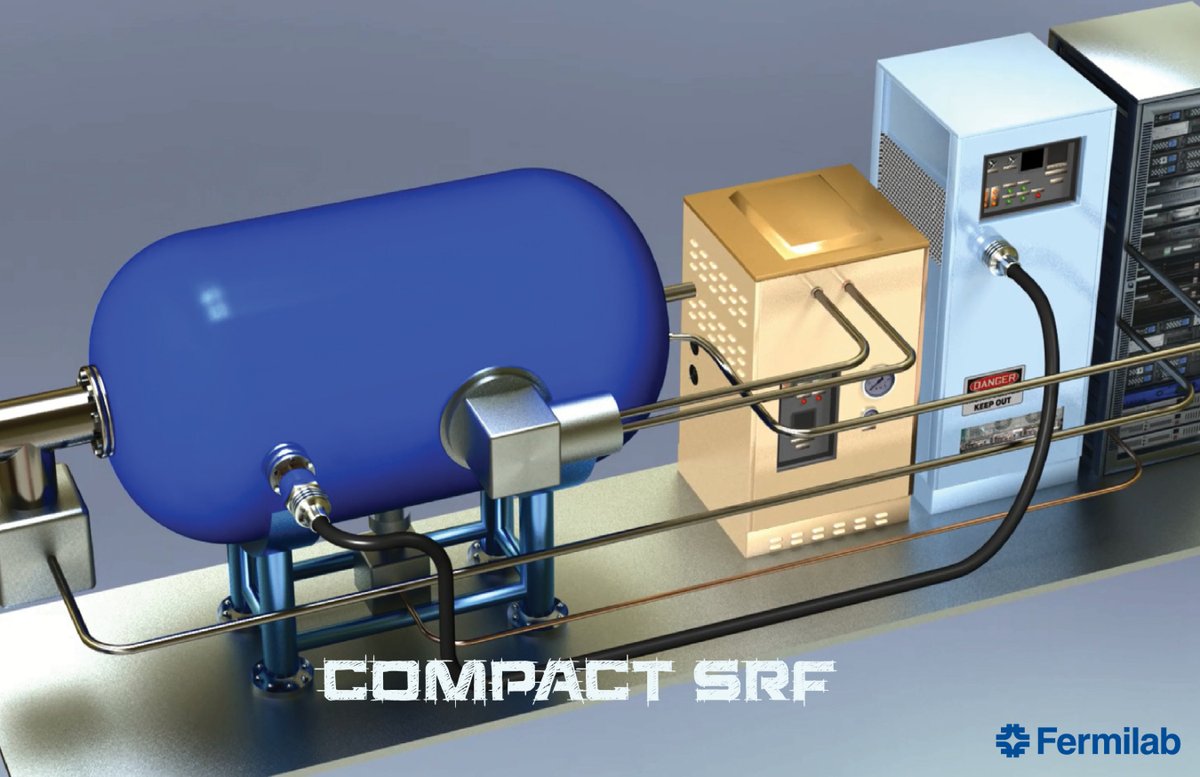
Physicists use accelerators to smash particles together and study the building blocks of the universe; they're also useful in medicine and industry. Building on decades of research, scientists @Fermilab are developing compact, portable accelerators: https://t.co/xY17BTD0fB
America and the world's brightest X-ray microscope—now 500x brighter. It can:
🔋 watch a battery charge atom by atom,
🛫 help us understand fracture in fighter jet alloys, and 🧬 speed up cancer-drug discovery.
Welcome to the new APS at @argonne! 🥳🔬⚡️
Paired with the new Aurora system at @argonne_lcf, I can't wait for the new discoveries, brought to you by @ENERGY.
We developed a multiepitope #DNA nanoswitch to monitor monoclonal #antibody bioavailability — a diagnostic platform spun out from our collaboration with Ulisse Biomed. Now published in Analytical Chemistry @an_chem#biosensing#nanotech https://t.co/XPZLGkI0nE
Structural biology is in an era of dynamics & assemblies but turning raw experimental data into atomic models at scale remains challenging.
@mhli41 and I present ROCKET🚀: an AlphaFold augmentation that integrates crystallographic and cryoEM/ET data with room for more! 1/14.
Geometry-Informed Neural Networks are evolving! Beyond faster training and improved shapes, GINNs surprised us with an emergent property – a structured latent space. 🧵
A mathematical model of fluid-structure interaction in the human heart represents all four cardiac valves and can be used to predict the impacts of medical interventions and for studies of cardiac pathophysiology. In PNAS Nexus: https://t.co/cE1KoPKuwX
High-speed video of micro-droplets being deposited from an evaporating thin film to leave behind a pattern of crystalline clusters https://t.co/XBXUIhHi3g
How does the angle of a nozzle influence the clogging of suspensions? Better to make it slender! Our study is out in @PhysRevResearch and could help guide the design of extrusion-based manufacturing systems https://t.co/Ygtsqz3FXj @UCSBengineering @PMMH_lab @umdme@UMDResearch
Delighted our latest finding! We discovered that abstract representations emerge in the human hippocampus when learning to perform inference. This change in neural geometry is due to disentanglement of discovered latent and observable variables. @Nature https://t.co/Kr7ClRd95I
Submegahertz nucleation of plasmonic vapor microbubbles near a solid vertical boundary: A comparison of spontaneously triggered periodic bubble nucleations excited at different frequencies #CoolVideo
Letter: https://t.co/U8CRP8BEAm
Object segmentation + object counting using @ultralytics 😍🔥💙
🔗 Code: https://t.co/R3L9sXIFGD
🔥 All you need to do is replace `https://t.co/5s3U1pVTaH` ➡ `https://t.co/cInPVkkAjy`
#ai#segmentation#yolo
In a fully classical continuous system, the second law of thermodynamics can be violated locally while being preserved on average https://t.co/bBpv45DRcY
Check out our new work with Tom Vogel, @AghnaMukherjee, Edouard Tarter, and Paolo Ermanni: https://t.co/ZbVRWjTFkg
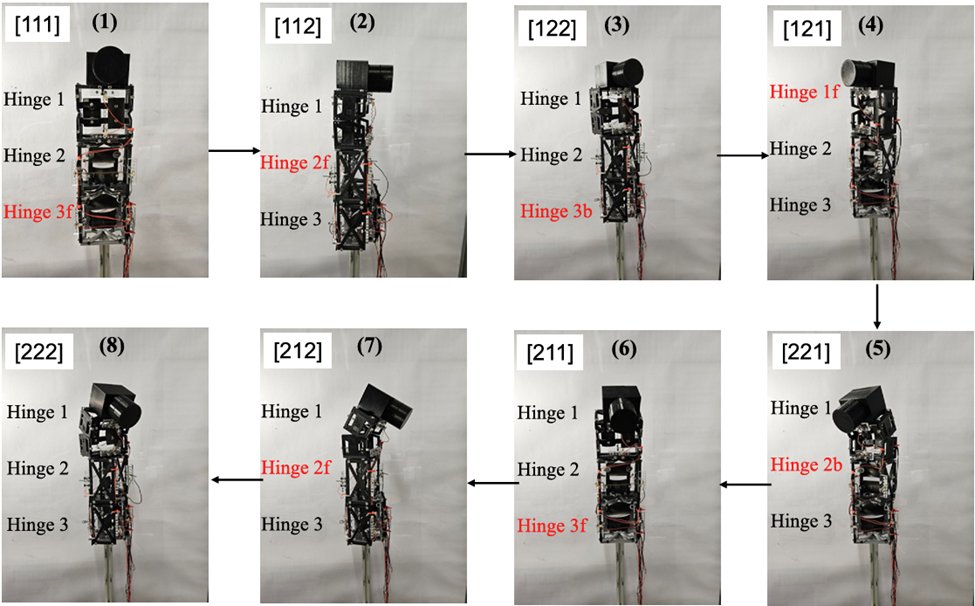
We show how to design bistable structures with improved stiffness using kinematics-based design. The approach is applied to the design of a reconfigurable boom!
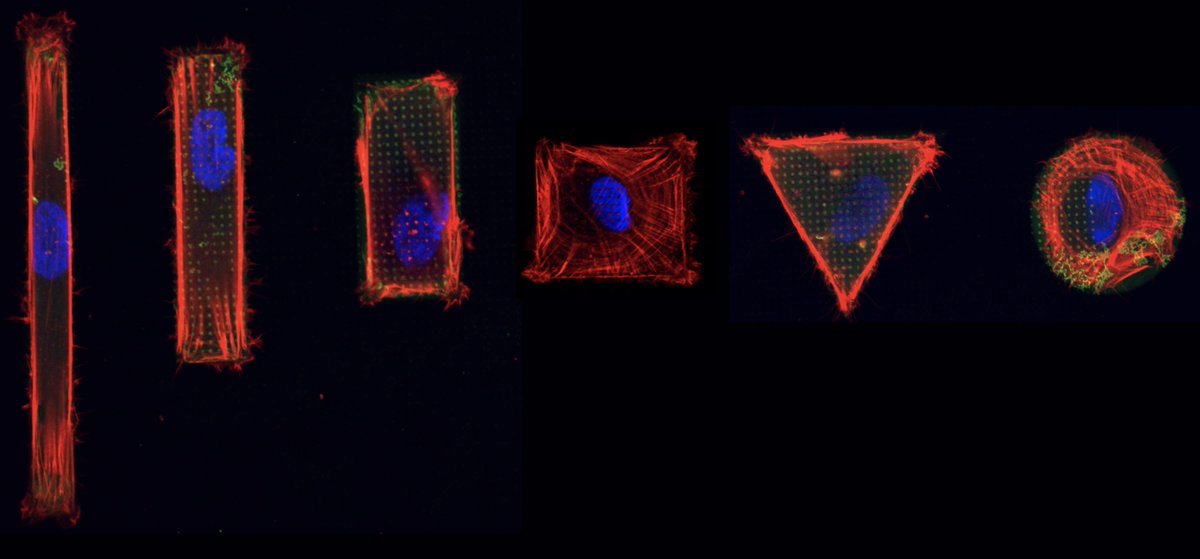
Our paper is out today in @acsnano! We integrate nano-scale physical and biochemical cues to precisely control cell behavior. This work was led by my talented PhD students Ali and @dhivyapushpa
https://t.co/fQh1CUv0Ib
@NANO_UCSD @UCSDJacobs@santorof14@BianxiaoC
Our project on Reinforcement Learning for versatile exoskeleton controllers is published in Nature. I hope there is more AI assistive technology to augment humans in the physical world.
The project is led by NCSU Hao Su's group and the paper is https://t.co/cW93ZxKWTY
Model-Free Reinforcement Learning (MFRL) has been alluring, especially with supercharged compute with physics on GPU.
However, the methods use 0-th order gradients, and are often not the best optimizers.
Can we do better than PPO in continuous control for robotics? Turns out yes! 🥳
tl;dr: Faster, better RL than PPO in continuous control 💪
https://t.co/fmFoMMWFAZ
The answer lies in using more information from the simulation. We are juicing the simulation on GPU as it is, why not use it for gradients as well?
This has been a driving question in a series of our works.
We first studied this problem in ICLR 2022 paper on Short Horizon Actor Critic
https://t.co/pTDtrA2gys
Naive gradient based methods are stuck in local minima and have exploding/vanishing gradients.
SHAC solved this problem truncated rollouts and model based value estimation, where the model is Differentiable Sim.
This boosted sample efficiency and wall-clock time immensely especially in high dimensional systems such as humanoids
Yet, given enough compute PPO often caught up.
Our follow up paper on on Adaptive Horizon Actor Critic at ICML 2024 discovers the cause and provides a fix.
https://t.co/fmFoMMWFAZ
However, we find that even when given ground-truth dynamics, not all gradients are useful due to sample error.
1st-Order Model-Based Reinforcement Learning methods employing differentiable simulation provide gradients with reduced variance but are susceptible to bias in scenarios involving stiff dynamics, such as physical contact.
We find that back-propagating through contact and long trajectories drastically reduces gradient accuracy.
Using this insight, we propose AHAC to dynamically adapt its roll-out horizon to avoid differentiating through stiff contact.
AHAC is a first-order model-based RL algorithm that learns high-dimensional tasks in minutes (wall clock) and outperforms PPO by 40%, even in the limit of data provided to PPO.
This work is led by @imgeorgiev alongside @krishpopdesu, @xujie7979, @eric_heiden and ample assistance from warp team at @NVIDIARobotics (@milesmacklin)