CEO Peerstone Research. Tech progress, economic growth, human rights, long novels. Black lives matter. Chaque vie compte. Wokism delenda est. Optimist.
2021 another year for long reads:
Dream of Red Mansions: poetry, drinking games, the lives of maidservants, rise & fall of a great family in Qing China, one of the greatest novels ever
A Suitable Boy, every page interesting
Gravitation, Misner et al, prose as clear as the math
@ExploreCosmos_ Please make this into a book written in this style and at this level, without the usual popular science dumbed-down "story of my life as a scientist and here's what the Greeks and the Native Americans said about this too" empty calories.
Too often when running a complex plugin as orchestrator Opus 4.7 high randomly decides to skip mandatory steps. This has happened repeatedly and seems to have gotten more frequent in the last two or three weeks. Also, when fixing its own implemenation after a review it amazingly often introduces new bugs due to simple obvious blunders. Again this happens repeeatedly. As a result I now use codex 5.5 as primary, only delegate narrow subordinate tasks to claude code.
I suspect they've done something to save on inference compute and as a result somehow the model is acting dumber. I find over the last 10 days that Opus 4.6 has been making a lot of really obvious blunders. Not implementing things it agreed to do in the plan, or improvising bad ideas that weren't in the plan but were easier. It's gotten lazy and stupid.
@andy_l_jones If horses had invented cars and taught themselves how to drive them maybe they’d still be around (assuming they were smart enough not to give the cars the launch codes for the nukes).
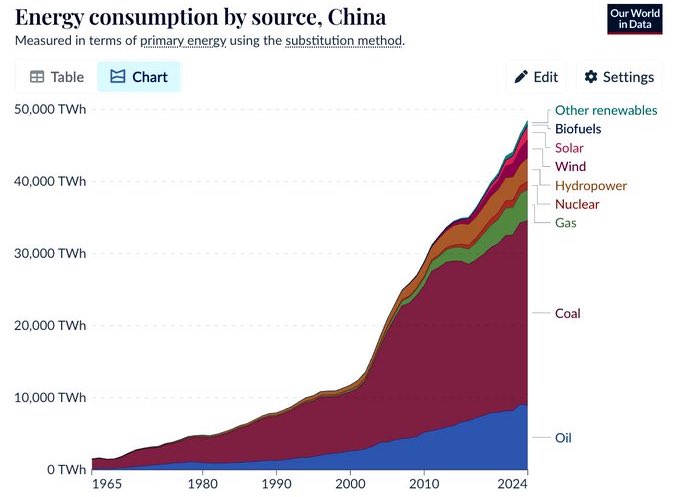
We have seen many charts showing us that China is the global leader in renewables. One needs really good eyes to spot them in this chart though. In reality it’s still mostly coal.
Europe is not the problem for the climate, can we please focus on growth and prosperity again?
Some awful things are taught in many humanities courses, but censoring classroom discussions is the wrong way to get the humanities to shape up. The University of Florida’s approach is better. Set up an alternative humanities center, fill it with heterodox thinkers, and let woke humanities courses compete for students with the sensible ones. Competition will achieve the results expected of censorship, without curtailing academic freedoms.
Immense planning and technical precision was required for this absolutely preposterous (but real) view: I captured my friend @BlackGryph0n transiting the sun during a skydive.
This might be the first photo of it's kind in existence. See a video of this moment in the reply 👇
Humans have almost gone extinct twice.
The first time was around 900,000 years ago, when early Homo sapiens dwindled to roughly 1,200 breeding individuals for nearly 100,000 years.
The second was 74,000 years ago, when the Toba supervolcano erupted and plunged the planet into a volcanic winter. Entire ecosystems collapsed. Global population: 3,000–10,000 breeding individuals.
In between, we endured three ice ages.
That’s why our genome is so homogeneous compared to other mammals. We were filtered through a genetic sieve…twice.
Small bands of early humans clung to the African coasts through volcanic winters and glacial droughts, inventing art, mastering fire, creating symbolic communication, and heat-treating stone while the rest of the genus went extinct.
So people can spin whatever fan-fiction they want about what we “evolved to eat.”
But I’ll go out on a limb and say our ancestors ate whatever the hell they could get their hands on.
We can oxidize fat or carbohydrate. We can thrive on plants or meat. We can fast for days and flip into ketosis, and continue like nothing happened.
Almost no other mammal can do this.
That metabolic versatility, forged in catastrophe, is what makes us human.
But people love to romanticize ancient diets to justify modern preferences.
The truth is, our ancestors had no choice but to cover vast amounts of ground trying to find something, anything to eat. And they would eat what didn’t eat them first.
The fuel mix mattered less than making sure all of it got burned.
But today, we’re too focused on the input side of the equation. We argue macros, carnivore, vegan. Our ancestors would be laughing at us. They suffered so much so we could eat pretty much anything.
We argue incessantly about the output side of the equation? How many reps? HIIT or LISS? How much? Should I sun my taint?
Here’s the only question that mattered for 99% of human history:
Does your output equal or exceed your input?
If it does, you’ll probably do just fine…
just like they did. And somewhere, your ancestors would be nodding…this person gets it, “that’s how we made it”
Potentially controversial, but we don’t really track metrics at the Dwarkesh Podcast.
Our goal with the show is to understand what the next decade looks like. We know this has nothing to do with episode performance, but virality is always a tempting target. So we intentionally distance ourselves from the numbers to focus on the mission.
Instead, we evaluate content BEFORE we release it. Does each episode address an important question or teach us something new? Does it result in a lasting update to our world model? If yes, we publish; if no, we don't. What happens after matters much less.
We choose our values, not the algorithm.
This may mean sacrificing growth in the short term, but I have deep conviction that this is how we’ll build something durable, something that really matters.
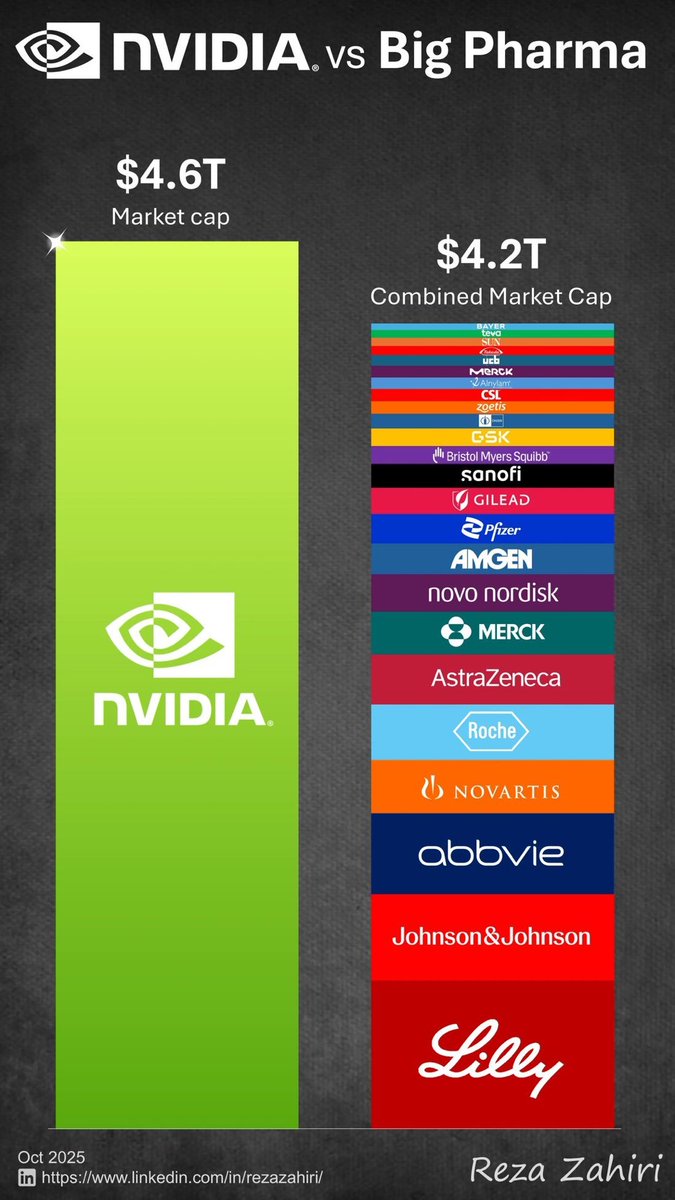
$NVDA IS NOW WORTH MORE THAN MOST OF BIG PHARMA COMBINED
Wild to think about… $XBI $XLV could see a rebound (or continued rebound) as drug makers face Trump’s 100% tariff on imported meds. Onshoring becomes a tailwind for anyone in that basket.
We’ve already seen what happened to $LLY and $PFE after they bent the knee.