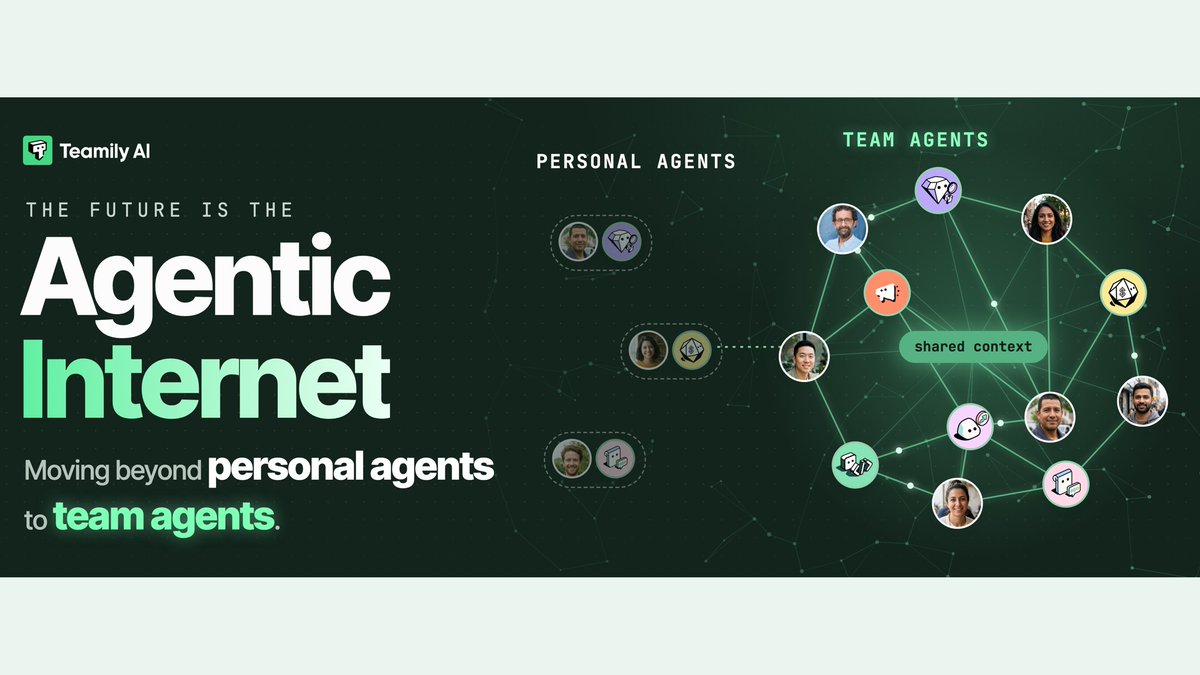
Teamily AI connects people and bots in shared threads.
1. A person prompts an initial research task
2. Agents hand off work and refine documents
3. Agentic Loops run recurring steps automatically
That workflow pushed @Teamily_AI sign-ups up 32x.
Client asks for changes while you open book mode on a foldable phone.
what it is: plain-language agent creation for web, iOS, Android, macOS and Windows.
why it matters: Teamily AI surged 32x to 320K sign-ups in one quarter.
That foldable UI fits how we collaborate.
🚀 After five months of intensive work, we're finally excited to launch the Apodex Drug Research Computing Center!
🌐 https://t.co/fA5g32aVwX
Our mission is to democratize AI for drugs and diseases, making advanced AI, biomedical knowledge, and research computing accessible to scientists and physicians everywhere. We're opening the platform with no upfront research computing fees!
💡 Our vision goes far beyond an LLM wrapper or a conventional prediction engine. We're building Knowledge-Equipped Agentic AI for Drug Discovery and Development, empowering AI agents to reason, investigate, and collaborate with researchers on challenging scientific questions.
At its core, we've built an interconnected scientific knowledge network spanning hundreds of thousands of biomedical entities and tens of millions of relationships across drugs, genes, proteins, pathways, diseases, scientific literature, and clinical evidence.
🔬 Powered by this knowledge, our AI agents operate in virtual laboratories, performing multi-hop mechanistic reasoning, uncovering hidden connections, synthesizing supporting and conflicting evidence, and proposing actionable research strategies for further scientific validation.
Should we advance a drug candidate? Why might it succeed or fail? Can we uncover the hidden therapeutic potential of existing drugs? These are exactly the kinds of questions we want our AI agents to tackle alongside scientists.
And this is just the beginning! We envision a continuously evolving AI research platform, where every new scientific challenge can spark a discovery, and every piece of real-world feedback helps make our AI more capable and reliable.
🔥 Now we invite YOU to challenge our AI! Sign in, explore the platform, bring us your toughest research questions, and share your feedback and suggestions. We'd love to hear what works, what doesn't, and what we should build next!
👉 https://t.co/fA5g32aVwX
Let's make AI-powered drug discovery more accessible, collaborative, and impactful!
If Sai runs in picture-in-picture on my local Windows PC, can this robosecretary hand off heavier steps to a cloud computer fleet automatically? Curious how @sai_borg balances local and cloud tasks in a #SaiFleet.
watching one prompt outline a coffee club site
→ agents structure the pages
→ team edits copy in chat
→ Website Builder updates live
Teamily AI launched a Humans + Agents platform today. see what @Teamily_AI built at https://t.co/g5tKdKMvE0
Oki’s position is a Memory Computer: a user-owned home for saved context that can inform work. That is a product thesis to evaluate, not proof every use case is solved.
tried ScienceBuddy today, it's a free research tool from @PhAILabs.
i asked it for the admet properties of ibuprofen and it gave me molecular weight, half life, metabolism, all of it.
what got my attention was the panel next to the answer.
it showed every step the tool took. i could actually watch it pull data from pubchem and pubmed as it worked.
and every number it gave me linked back to a source. the molecular weight, for example, came straight from the pubchem page.
so you're not just trusting whatever it says, you can open it up and check where each number came from.
it's completely free, you can try it here: https://t.co/0LdSA0uZrH
built by @PhAILabs. it's still in preview, so double check anything before you use it in real work.
#ScienceBuddy
Introducing Atria Dawn Preview:
From Research Questions to Verifiable Results.
Atria Dawn Preview is an agentic foundation model built for long-horizon tasks, helping researchers and engineers turn open-ended questions into executable, verifiable, and reproducible outcomes.
Explore Atria Dawn Preview:
🌐 Website: https://t.co/MDDspFiqYO
💻 GitHub: https://t.co/tNmLocadjT
🤗 Hugging Face: https://t.co/cyZod5oHbw
🤖 ModelScope: https://t.co/6BNi5vHFDl
🚀 Try Atria:
EN:https://t.co/Ap5aO2gQeu
ZH:https://t.co/cG16cQdx4j
Can frozen LLM agents keep improving on long-horizon tasks? Yes — if the memory evolves instead of the weights.
Introducing Recuris: Recursive Experiential–Working Memory Evolution for Long-Horizon Agent Harnesses.
As agents take on longer tasks, the common strategy is to accumulate skills and procedures in memory and retrieve them as the task unfolds. But long-horizon execution breaks this in two places. Retrieval degrades: the initial instruction stops describing the current problem, and the growing history mixes completed steps, stale info, and noise. And improvement is blind: memory updates are admitted by a single downstream score, which says something broke — never what.
So we built Recuris: the agent uses its experience against a verified task state, and improves that experience from the evidence the state leaves behind.
Skill invocation no longer searches the full history. Working Memory tracks which goals are done and which remain pending; a state change commits only when environment feedback supports it, and skills are invoked from Experiential Memory based on what is still missing.
Every run leaves a Structured Trace linking task state, skill, action, and observation. Fault localization from this trace reaches 64.8% — versus 13.0% from the outcome alone, below the 33.3% always-guess floor.
A fixed Meta-Agent repairs only the components the trace implicates, gated by held-out validation. Accepted updates change future execution, producing new evidence for the next round — with the base LLM frozen throughout.
Across 4 long-horizon benchmarks and 10 models, Recuris improves task success in 35 of 37 model–benchmark pairs. On τ²-Retail, GPT-5.6 Sol gains +17.8 points and Claude Opus 5 gains +15.6, reaching 87.9% — 9.7 points above the best any model achieves without Recuris.
📄 Paper: https://t.co/0DkJTJoN3F
💻 Code: https://t.co/kpmsGBlCn3
Maybe the next generation of AI won't be about having more tools.
Maybe it's about having one place where all your context lives.
One memory.
One understanding.
One second brain.
JarvixOS gets that.