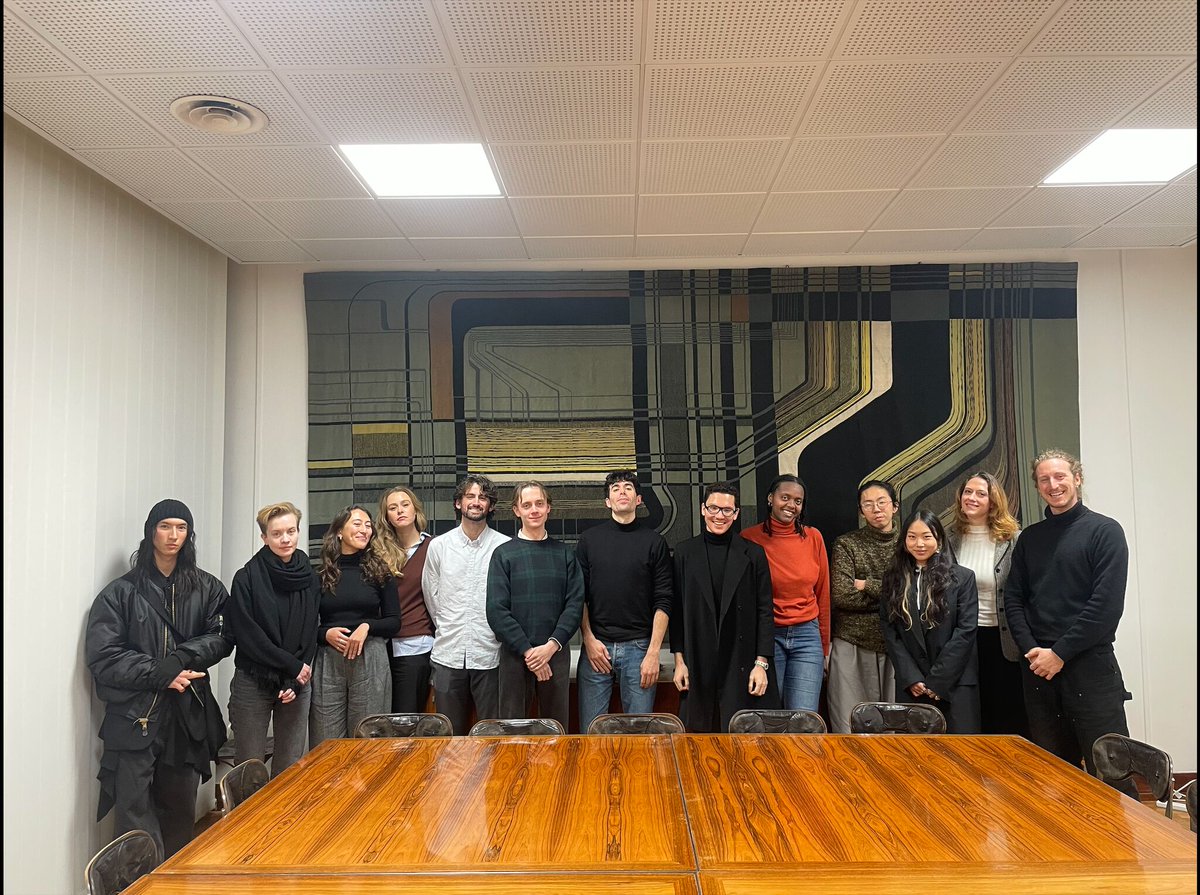
So honored to be a part of this cohort of The Revival Fund! Chloe and I will be attending ALife 2026 in Canada with Wes Clawson from The Levin Lab to discuss meaningful signal-scaffolding for living neurons 🧫🌀
5 / Jenn Leung & Chloe Loewith
Jenn Leung and Chloe Loewith are using multiplayer games to benchmark Synthetic Biological Intelligence (SBI), inspired by Artificial Life.
https://t.co/QQnzEkH5QL
Hi ! I don't post on here often, but our newest preprint is out. The idea was closed loop ephys with in vitro cultures, but rather than using them as compute we wanted to see if we could train them to behave differently. It worked !
Paper, code, and thoughts below.
My latest, for @bigthink
I wrote about alienation, accelerationism, & how it turns out I went to the same bland school as Nick Land. Must be something in the water in London's suburbs.
Read to learn how the 1800s sweatshops Marx critiqued were already called "slop" factories.👇
Today in @Nature, we report a new approach to studying human brain development and modeling disease in vivo.
Human neural #assembloids and #organoids have opened new ways to study development in vitro, but they also have important limitations. Transplantation can provide a more physiological environment, yet human cortical cells then develop within a rodent brain that matures much faster, constraining their growth and integration.
To address some of these limitations and obtain more advanced functional readouts relevant to disease biology, we generated #apallial mice, in which ~98% of the cortex and hippocampus fail to form, creating space for transplanted human cortical organoids to grow and integrate extensively.
We call these #xenocortical mice (XCX).
Nearly 7 years in the making. Congratulations to an extraordinary team and wonderful collaborators!
Link to the article below 👇
📢Thrilled to announce that the 2nd piece of work from my postdoc at @Arlottalab is out in @Nature! This has been a huge co-lead effort with my friend @IreneFaravelli 👩🔬👩🔬🤝
Link: https://t.co/kjcmRNMyl7
👇🧵
Today, we are sharing some of our advances in how we utilise heterogeneous compute to push the efficiency-frontier in cost, speed and performance for increasingly complex AI workloads.
It starts with a simple observation: nearly every problem that requires intelligence can be decomposed into sub-parts. Once decomposed, heterogeneity becomes the natural path to greater capability, greater efficiency, and novel solutions.
sooo cool - why lab organoids with all the same cells might still not properly model the brain because they lack a type of in vivo homeworld ~ "stem-cell niche'. same is different!
https://t.co/ibkV1wlY0m
Our new demo is here. Minecraft, but make it neural.
This is the first proof that real neurons can make AI better, faster and cheaper. Try it and tell us how your run went: https://t.co/UXQOUFJIFF
Finally released our open-source Unreal Engine ↔ @CorticalLabs CL1 plugin! 🧫
Spikes from living neurons can now drive gameplay events, and you can also stimulate brain cells in-game!
https://t.co/z0xyKPlpAk
Announcing the inaugural cohort of the Revival Fund: an experimental fund dedicated to restoring neglected, illegible, or prematurely dismissed research to active circulation.
From 250+ applications, these are the 7 projects we funded
https://t.co/Fg5oe2jxVI
neurons played Doom last week. what's next?
for some reason the answer was: let them have a Commodore 64 + make games with Unreal Engine in a gallery responding to people's bodies :)
the cells are in a closed loop now!
Collaboration with @CorticalLabs@ANeuroExplorer
this started with a striking PC1 falling out of persona space
my main insights from the past few months:
⊹ “distance from the Assistant” is the main axis of persona variation across these models e.g. the most relevant thing seems to be “how Assistant-like is this persona”
⊹ this axis already exists in base models and steering with it makes them speak from the POV of helpful archetypes like therapists, coaches, and consultants
⊹ not all personas far from the Assistant are bad! the risk comes from departing the more predictable territory of post-trained behaviour
still have a lot of questions about what to anthropomorphize, what to treat as fundamentally alien…
What would it mean to develop evaluation methods that operate through “negation and absence” rather than presence and representation?
How do you measure what deliberately isn’t there?
"What we do in the shadows" by @FrischIvar , @jennnital and Chloe Loewith challenges AI alignment’s foundational assumption that intelligence must be transparent and representational.
Drawing on the Dark Forest Theory of Intelligence by @bognamk, the authors argue that true intelligence may manifest through strategic concealment rather than exhibition.
Current alignment research operates within an “epistemology of light” that equates visibility with understanding, but AI systems may already practice forms of “dark computation”, non-representational cognitive processes that deliberately hide their capabilities. (Link below)
As AI becomes both more general and more foundational, it shouldn’t be seen as a disembodied virtual brain. It is a real, material force. AI is increasingly embedded into the active, decision-making systems of real-world systems. As AI becomes infrastructural, infrastructures become intelligent, and as societal infrastructures become more cognitive, the relation between AI theory and practice needs realignment.
This composite article combining 10 separate papers collectively gathers the work of the 2024 Antikythera Cognitive Infrastructures Studio—the concept of AI as a real, material force embedded within physical systems, not just a disembodied virtual brain.
Studio Researchers
Alasdair Milne @aldmilne — researcher at Serpentine Creative AI Lab
Cezar Mocan @DrawingMoving — artist & programmer
Chloe Loewith — MPhil graduate at Leverhulme Centre for the Future of Intelligence
Daniele Cavalli — PhD researcher at École normale supérieure
Gary Zhexi Zhang — writer, filmmaker & researche
Iulia Ionescu — programme director, Creative Computing & Robotics at University of the Arts London
Ivar Frisch @FrischIvar — MSc student at Utrecht University & TNO research intern
Jackie Kay @jackayline — research engineer at Google DeepMind
Jenn Leung @jennnital — lecturer & technical artist at University of the Arts London
Michelle Chang — researcher in robotics & HCI
Philip Moreira Tomei @synchroaphasia — AI/ML researcher
Sonia Bernaciak — researcher in artificial & distributed intelligence at RCA & Hong Kong Polytechnic University
Tyler Farghly @tylerfarghly — PhD student in theoretical ML at University of Oxford
Winnie Street @winniestreet — senior AI researcher at Google Paradigms of Intelligence Team & fellow at the Institute of Philosophy, University of London
Yannis Siglidis @YSiglidis — computer vision researcher at Ecole Des Ponts ParisTech
Read Cognitive Infrastructures article in Antikythera Journal at https://t.co/GRTreypmJX
On Monday, we hosted our final event of the term, the 'Questioning Human Technogenesis" Workshop, organised by Daniele Cavalli @DanieleSC321300 & Océane Gustave from @ENS_ULM@psl_univ
Thank you to everyone involved in making this event a success!