Crypto payment & neobank expert/ EX RedotPay/ helped scale to 80% of global crypto card volume/ Growth hacker in Web3/ Emerging markets → Mainstream adoption
I was one of the earliest people at @RedotPay
Let me explain exactly why you've never heard of it.
RedotPay didn't build for the English-speaking crypto Twitter crowd.
It built for everyone else.
Arabic. Hindi. Spanish. Bahasa. Tagalog.
Native content, native communities, native trust.
You won't find it in your feed because it was never meant for your feed.
The users aren't only crypto traders.
They're the unbanked. The underbanked.
People whose currencies are devaluing faster than they can save.
Crypto Twitter is loud. But it's a small room.
The real volume lives on Facebook groups in Lagos, TikTok reels in Manila, Instagram in Cairo.
Hundreds of thousands of people showing their RedotPay card working at a local store, paying a bill, sending money home.
80% of crypto card volume didn't come from people who know what a DEX is.
It came from people who just needed a better way to pay financially.
That's the market nobody was watching.
RedotPay was.
Stablecoins connecting local RTP networks has become one the fastest growing payment markets in the world. Probably only beat by the growth in Stablecoin backed card settlement.
@0xDani Neobanks won on speed but billions still can't pass KYC or don't have a local address.
That's the gap crypto neobanks are built to fill.
The future isn't just faster banking , it's banking that reaches the people traditional finance never bothered to serve.
@Octop3s GEO and SEO are just the start.
The bigger unlock is reaching users who aren't on CT at all and never will be.
That means localization and non crypto native user.
The brands that crack localization before GEO becomes crowded
will own markets nobody else is even looking at.
This is the most underrated insight in the crypto neobank space right now.
Wise built a $10B company on one idea:
let people hold the currency they actually need, not just the one the bank prefers.
First mover in crypto neobank with multi-currency stablecoin accounts will win a massive global market.
@devmajesty@KASTxyz This is exactly why customer support isn't a back-office function, it's the product.
A card that holds your funds with no resolution isn't a fintech.
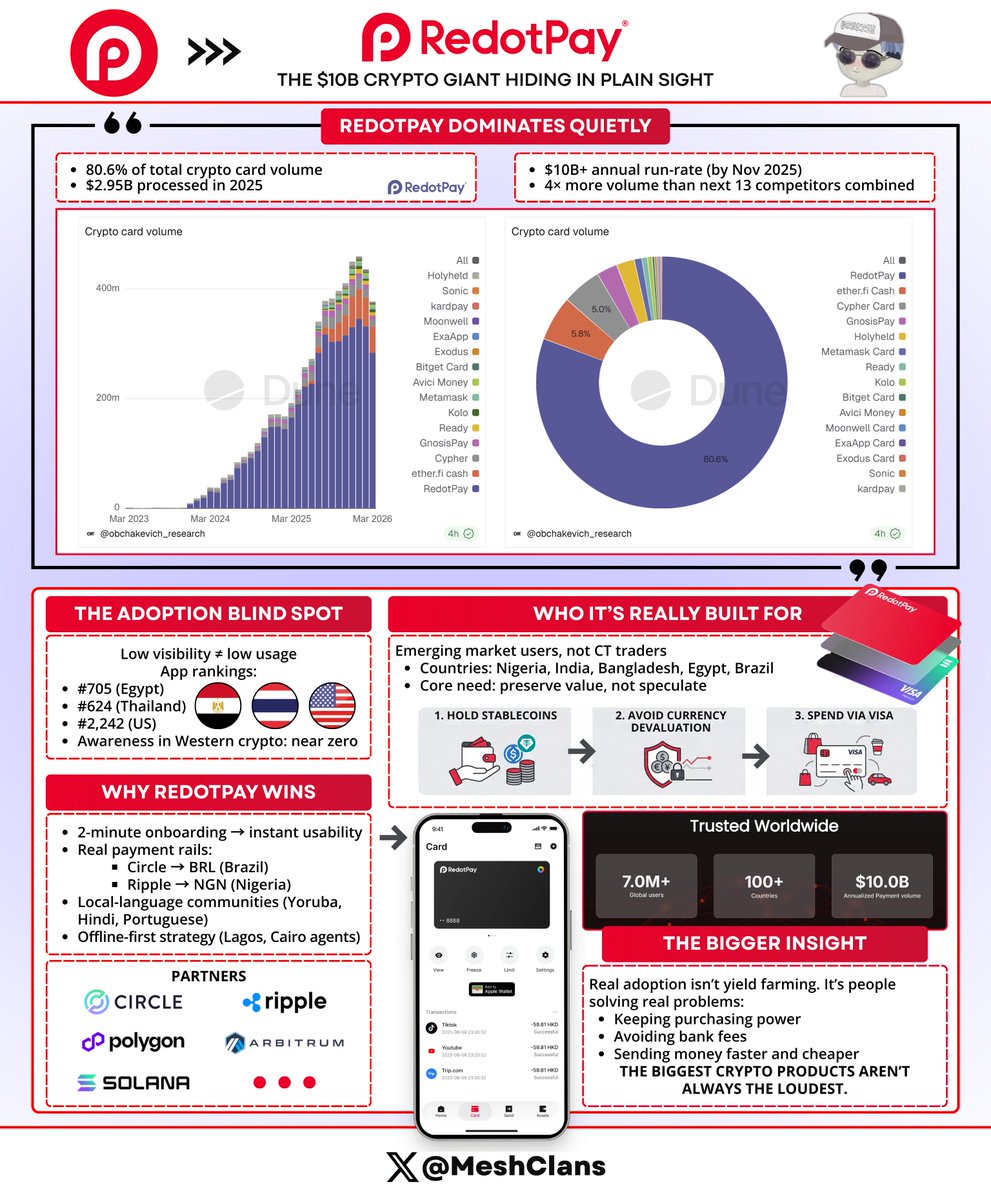
I wouldn't believe it if someone told me @RedotPay controls more than 80% of crypto card volume.
Mesh just dropped a deep dive into this.
TL;DR
→ Real-life use case
People in Bangladesh, Egypt, Nigeria, and Brazil don't have reliable banking. They hold USDT to protect savings from currency collapse and spend it via Visa for everyday purchases like groceries and bills.
→ Distribution
Instead of ads, RedotPay recruited local traders and community leaders as agents, earning 40% commissions on card activations. Channels include Telegram groups running in Yoruba, Hindi, and Portuguese, and none of it is visible on CT.
→ Infrastructure
RedotPay partnered with @circle for instant BRL payments in Brazil and Ripple for NGN transfers in Nigeria. It's super simple, as it takes about 2 minutes to download and start using the service.
→ Results
There's a total of $2.95B in card transactions in 2025, more than 4x what the next 13 competitors did combined. 98% of deposits are stablecoins, and spending happens multiple times per week in small amounts.
Always happy when crypto solves real problems in places where traditional banking doesn't work.
@Octop3s The 5usd strategy is good for emerging market, not so much for developed countries.
It explain why it is so successful in the first place, targeting people from unbanked regions.
RedotPay controls 80.6% of crypto card volume. Ask 100 people in crypto if they've used it, maybe 2 have even heard of it. I hadn't either until I saw this chart.
I spent some time digging into this anomaly, and what I found changed how I think about crypto adoption.
The data from @obchakevich_ 's Dune dashboard shows @RedotPay processed $2.95B in card transactions during 2025, over 4x what its next 13 competitors did combined, and they hit a $10B+ annualized run-rate by November 2025.
But here's the weird part the app ranks #705 in Egypt's Finance category and #624 in Thailand, while sitting at #2,242 in the US. I asked 30+ people in Western crypto circles about RedotPay. Two had heard the name. Zero had actually used it.
So how does a platform almost nobody on crypto Twitter knows about hit $10B+ in annual run-rate?
Turns out we've been looking at the wrong map.
RedotPay built for people in Bangladesh, India, Egypt, Nigeria, and Brazil who don't have reliable banking, and the actual use case is straightforward: hold USDT so your savings don't get destroyed when your local currency tanks, then spend it via Visa card for everyday stuff like groceries and bills.
They're not chasing airdrops or staking yields. They just want their money to hold value.
Instead of burning cash on Facebook ads, RedotPay recruited local crypto traders, community leaders, and OTC merchants as agents who earn up to 40% commissions when someone activates a card. The $100 physical card fee and $10 virtual card fee fund the whole thing, and most of their 2025 growth came from people searching for them organically through pure word of mouth in communities we never see.
Getting started takes two minutes: download app, send some USDT, spend anywhere Visa works.
Why is RedotPay so far ahead?
- Two-minute onboarding from download to spending, versus hours learning DeFi protocols
- Real infrastructure through partnerships with Circle (June 2025) for instant BRL payments to Brazil and Ripple (December 2025) for NGN to Nigeria, moving money in minutes instead of days
- Local communities built on Telegram groups in Yoruba, Hindi, and Portuguese, generating massive engagement in languages most of CT doesn't read
- Offline-first distribution with agents on the ground in Lagos and Cairo beating online ads every time
What people actually do with it:
- Deposits are 98%+ stablecoins (USDT/USDC)
- Spending happens in small amounts multiple times per week
- Real uses include buying food in Cairo, sending money to family in Lagos, and protecting savings from currency collapse in Nigeria
The numbers back it up: they hit 5 million users by August 2024, got to 6M+ users by November 2025 while adding 3M+ just last year, tripled their volume in 2025, and they're profitable.
They built it for specific people with specific problems we don't face, and actual adoption looks like a guy in Nigeria making sure his paycheck still buys groceries next month, a family in Egypt paying bills without bank fees, or someone in Bangladesh sending money home without losing 8% to Western Union.
Utility beats speculation when it comes to real volume. Needs drive actual scale. Sometimes the biggest things happen where we're not looking.
Makes me wonder what else is out there that we're completely missing.
@lenes_sol@ether_fi Insane charges here from Kast
R$8.98 purchase. Market rate: R$5.89/USD.
Should have paid $1.52. Kast charged $1.81.
That's an ~18.7% hidden fee in the exchange rate alone.
They took 18.7% and promised 2% back in tokens that don't exist yet.
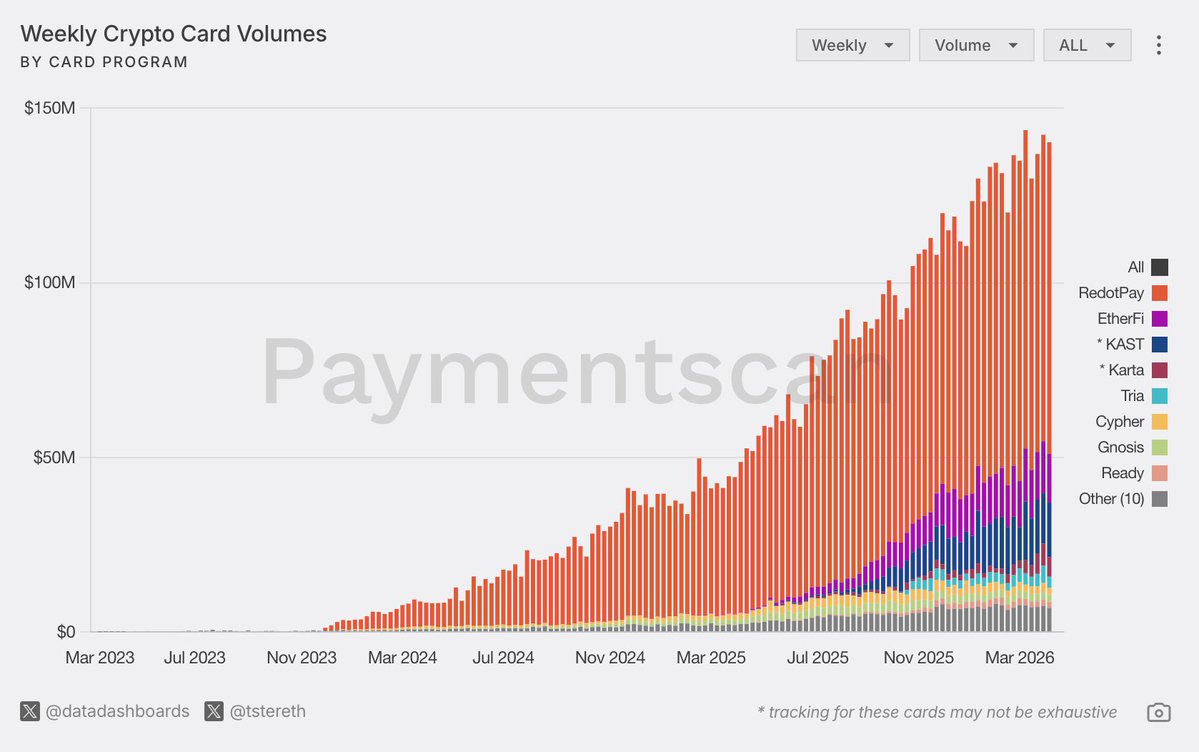
Crypto Cards Weekly Digest: April 6-April 12
Volume:
RedotPay: $89.22M
KAST: $15.64M
EtherFi: $13.95M
Karta: $5.59M
Tria: $3.17M
Gnosis: $2.14M
Cypher: $1.94M
Ready: $1.68M
Other (10): $6.9M
Total: $140.3M (-1.5% WoW)
Transactions:
EtherFi: 188,791
RedotPay: 113,321
Bitget Wallet: 96,095
BFinance: 48,279
Gnosis: 45,756
Safepal: 42,838
Avici: 27,552
MetaMask: 22,927
Other (10): 47,034
Total: 632,593 (+0.1% WoW)
Weekly Crypto Card Users
RedotPay: 62,310
EtherFi: 19,496
Bitget Wallet: 13,750
BFinance: 13,015
Safepal: 6,404
Tria: 5,879
Gnosis: 5,278
Ready: 4,244
Other (10): 8,785
Total: 139,161 (+1% WoW)
Some interesting stats:
Despite total card volume falling slightly, RedotPay still grew volume from $87.76M to $89.22M.
KAST was the biggest volume gainer, its volume rose from $14.35M to $15.64M, about +9% WoW.
Tria was the biggest loser this week, with its volume down by -35.7% WoW.
Hope you enjoyed this post and found some new VALUABLE information.
If you wanna support me, I'd appreciate a like, reply, and RT <3
Crypto is outplaying traditional banks on savings yield by 500x.
@Chase : 0.01% APY.
@krakenfx on @USDC : 5.00% APY.
@coingecko just broke down why banks are in full panic mode and why $6 trillion in deposits is now at risk.
Why such a gap?
Banks borrow your money cheaply, lend it at 6–20%, and keep the spread. They pay you 0.01% because you never leave.
Stablecoin issuers hold 100% reserves in US Treasuries (~4–5% yield) and pass it straight back to you. No spread. No tricks.
The yield gap is the proof of concept.
So the real race now is building the ecosystem around it.
Neobanks, payment platforms, wallets, on-ramps that make switching from a bank account to stablecoins effortless.
$6.6 trillion in bank deposits could shift onchain, reinforcing crypto’s role in global finance.
Here's all you need to know about the standoff between crypto exchanges and traditional banks, and the yield gap driving this shift.
Read the full article 👇
https://t.co/bqdYv7iGoM
Revolut is no longer behaving like a fintech, it is operating like a compounding financial system.
In my latest deep dive, I broke down its 2025 performance and what sits underneath the numbers: £4.5B revenue, £1.7B profit, 29% margin, and a 35% ROE that puts it in a different category entirely.
But the real story isn’t the scale, it’s the structure.
@Revolut has built a model where growth, monetization, and efficiency reinforce each other through product velocity, diversified revenue, and a tightly controlled cost base, turning what looks like expansion into a repeatable algorithm.
It’s not one product winning, it’s the system working.
This is what happens when a company stops optimizing features and starts engineering compounding.
https://t.co/duvErUI3Ql
@camilosaka Right. Local stablecoins in a closed domestic loop are a worse Pix.
For now, the use case only makes sense at the border, cross-border payments, remittances, international trade.
Crypto cards continue to grow. I’d like to share some analytics for March 2026 to show you what’s changed in the market.
@RedotPay continues to lead in both total and monthly volume; despite a negative MoM of -14.5%, it accounts for 75% of the total volume among 14 crypto cards.
@avici (+575%), @BitgetWallet (+233%), and @kardpay (+208%) are currently showing the highest growth rates.
Meanwhile, @KoloHub is showing the highest MoM growth at +44%, even though its market share is less than 2%.
Which card do you use most often?