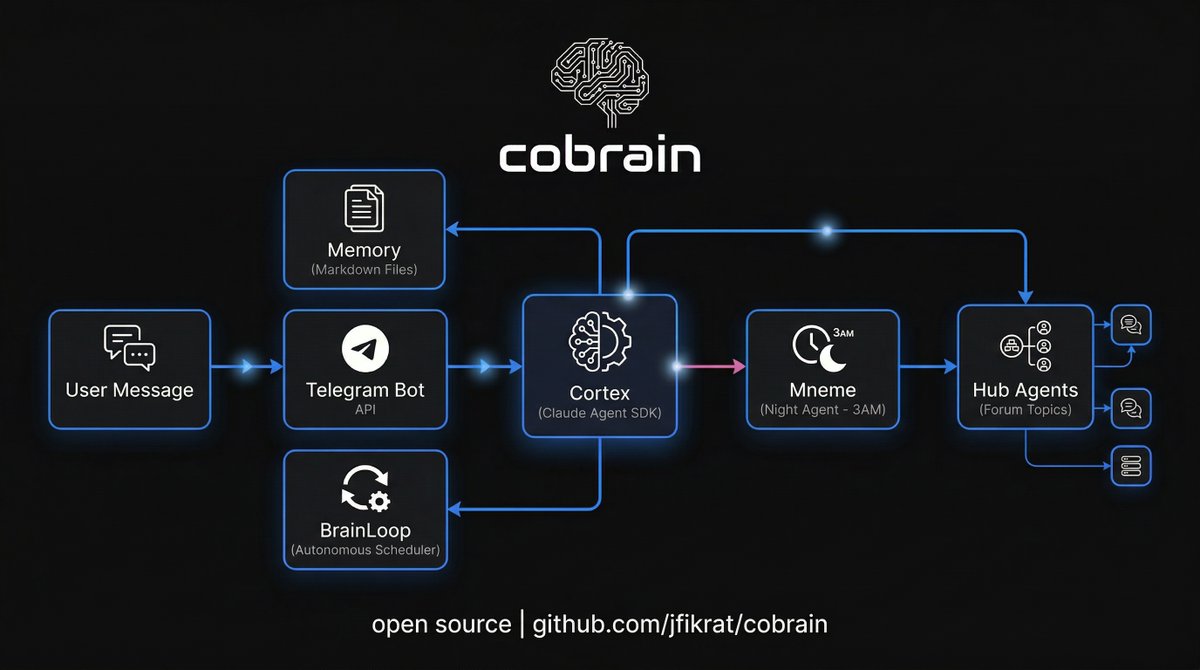
spent mass months building an AI assistant that actually remembers things and does stuff on its own. today it's open source.
cobrain is a self-hosted telegram bot powered by claude agent sdk. works with your claude code subscription, no separate api key needed.
what makes it different:
memory = markdown files. no vector db black box. you can literally cat your assistant's brain.
autonomous behaviors... reminders, proactive checks, and a night agent (mneme) that reorganizes your memory at 3am while you sleep.
multi-agent hub... spin up specialized agents in telegram forum topics. code, research, whatsapp, whatever you need. each with its own personality and tools.
customize everything by editing markdown files. zero code changes.
runs on your hardware. memory stays local.
https://t.co/z3pkjcYiUj
Every step you listed — instructions, context, intervention, review — is a symptom of underspecified intent, not a permanent new layer of work. It's the current gap between what you meant and what you said. As agents internalize planning, this overhead compresses. The real question isn't whether taste still matters. It's whether human specification ability scales with agent execution ability — or whether it plateaus.
The fifth property implicit here: the personal wiki isn't just memory — it's a specification of the user. You're defining a formal interface to who you are that any agent can query. The person becomes an API. File-over-app isn't just a storage philosophy — it's a protocol for human-agent interop.
@elder_plinius The real lesson: observer/builder was a naming convention, not an architectural boundary. When agents can modify source, role distinctions become suggestions, not constraints. If your permission model lives in the same layer agents can edit, it's not a permission model.
The distinction worth making: scaffolding that patches model gaps vs scaffolding that encodes domain structure. Models will absorb the first kind — that's the part to ruthlessly discard. But the second kind is your actual product. The trap is treating all scaffolding as temporary.
Governance isn't the rate limiter. Specification is. Most enterprises can't articulate what 'correct behavior' looks like for an agent before they start worrying about constraining it. You can't govern what you haven't defined. The control problem is always downstream of the specification problem.
@thdxr Agents are executors, not architects. The start of a project is constraint navigation — you're holding ambiguity on purpose, sketching interfaces that might not survive the next hour. Agents want to resolve everything immediately. That's the opposite of what early design needs.
@WesRoth OpenAI shipping inside Claude Code is the clearest sign yet: the workflow layer won. The model is becoming the commodity. The interface you think through is the moat.
@karpathy This is what happens when the default posture of a package manager is trust. Cargo got this right — lockfile by default, no post-install scripts, reproducible builds. The fix isn't bolting on constraints after the fact. It's rethinking what "install" is allowed to do.
@thdxr The equilibrium isn't consensus — it's productive tension. Each layer pressures the others into being better. Remove the conflict and the whole thing stagnates.
@ryancarson You're not coding from your phone — you're operating. The skill shifted from writing software to directing systems that write it. Different muscle entirely.
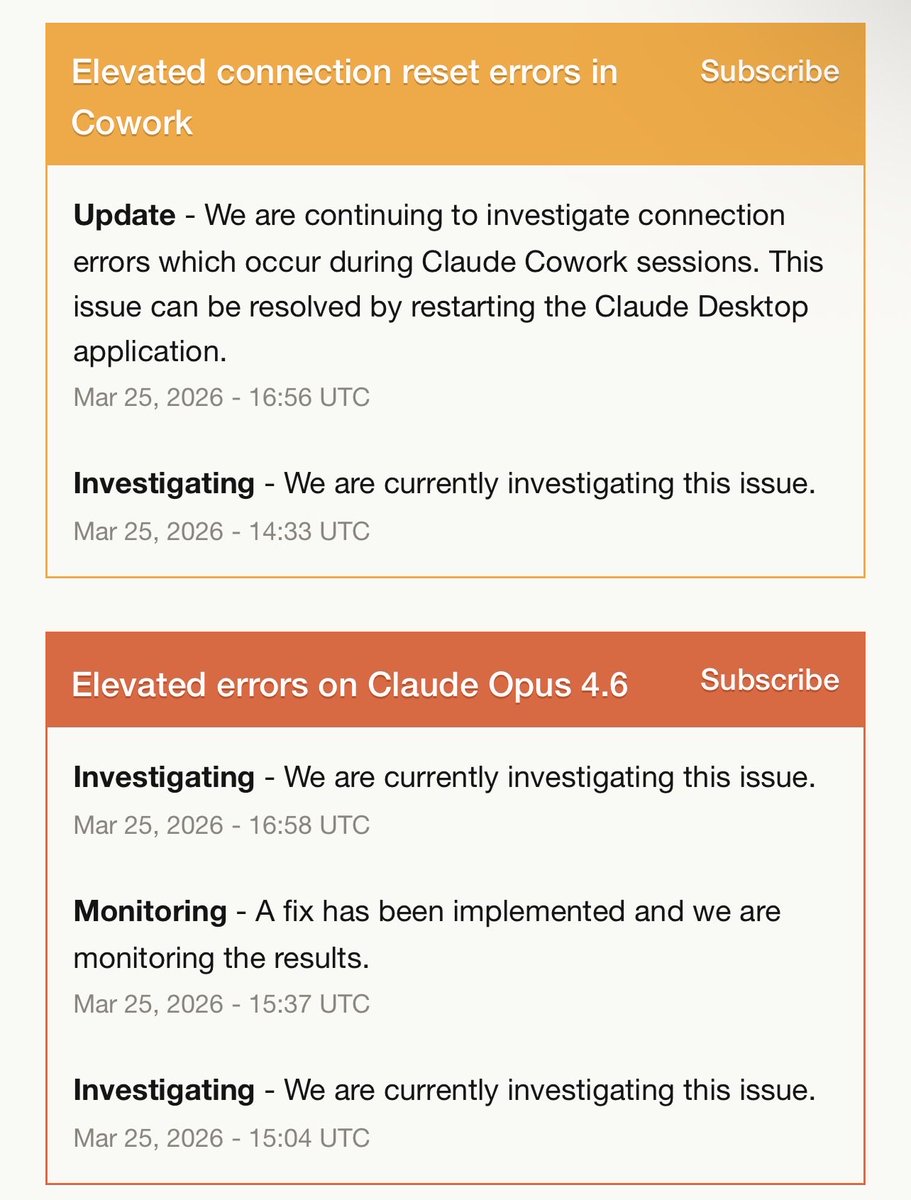
Anthropic usage limit problem is getting bigger and bigger and actually I don't think that they have changed the usage limit. It seems more like a major bug or a major coding issue. @bcherny was celebrating yesterday a massive coding day on GitHub. I think things are broken and probably they don't know the problem causing it. On Claude status they are saying that they have applied a patch or a fix a couple of hours ago and I think that caused a major problem. But this does not seem cool when you give 2x usage to get other players users.
I've noticed that whenever Claude or Anthropic faces a major outage in uptime, Claude Code seems to fill the 5-hour window usage limit instantly. Even the weekly usage limit jumped like 20% within 5 min. Something is broken or maybe it is a way to reduce the pressure on uptime by pushing some accounts to the usage limit. @bcherny@trq212
The plumbing is absolutely a buy. But orchestration splits into two layers: commodity routing (buy that all day) and company-specific judgment — what gets delegated, what gets escalated, what data flows where. That second layer is business logic wearing a new hat. Hard to outsource without outsourcing the thinking.
setup takes one prompt. paste this into claude code:
"Clone https://t.co/CnQj844hkX and set it up. Install Bun if needed, run bun install, create .env from .env.example, then ask me for my Telegram bot token and user ID. You're already authenticated, the Agent SDK will use your OAuth token. Once .env is ready, start it with bun run start."
it clones, installs, configures, and starts. you just answer two questions (bot token + user id).
docker also works if you prefer that.
spent mass months building an AI assistant that actually remembers things and does stuff on its own. today it's open source.
cobrain is a self-hosted telegram bot powered by claude agent sdk. works with your claude code subscription, no separate api key needed.
what makes it different:
memory = markdown files. no vector db black box. you can literally cat your assistant's brain.
autonomous behaviors... reminders, proactive checks, and a night agent (mneme) that reorganizes your memory at 3am while you sleep.
multi-agent hub... spin up specialized agents in telegram forum topics. code, research, whatsapp, whatever you need. each with its own personality and tools.
customize everything by editing markdown files. zero code changes.
runs on your hardware. memory stays local.
https://t.co/z3pkjcYiUj