New details (vivid examples) on a Russian cybercrime spree hitting major law firms across the US — hackers outsourcing burglary: ~ $100M in ransoms paid in 6 months, per 1 estimate; Hackers have offered $500 to people to show up to law firms & plug in USB sticks 1/4 (link below)
Just a simple reminder:
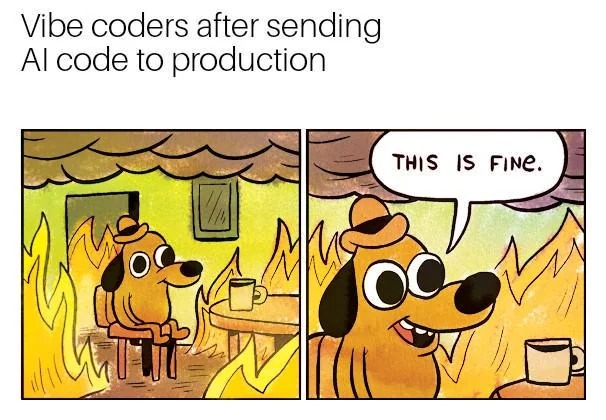
AI can write the code. But it cannot own the consequences.
Once that code hits production, it becomes your responsibility.
Production does not care whether the bug came from a junior dev, a senior dev, or an AI assistant.
It only cares that something broke.
Dr. Maksymilian Chruszcz from @MSUNatSci explains how and why allergies occur and the different ways his research group is working to alleviate our allergy miseries.
Gartner says 40%+ of agentic AI projects will be canceled by 2027 on cost and weak controls.
I believe it after reading about Uber.
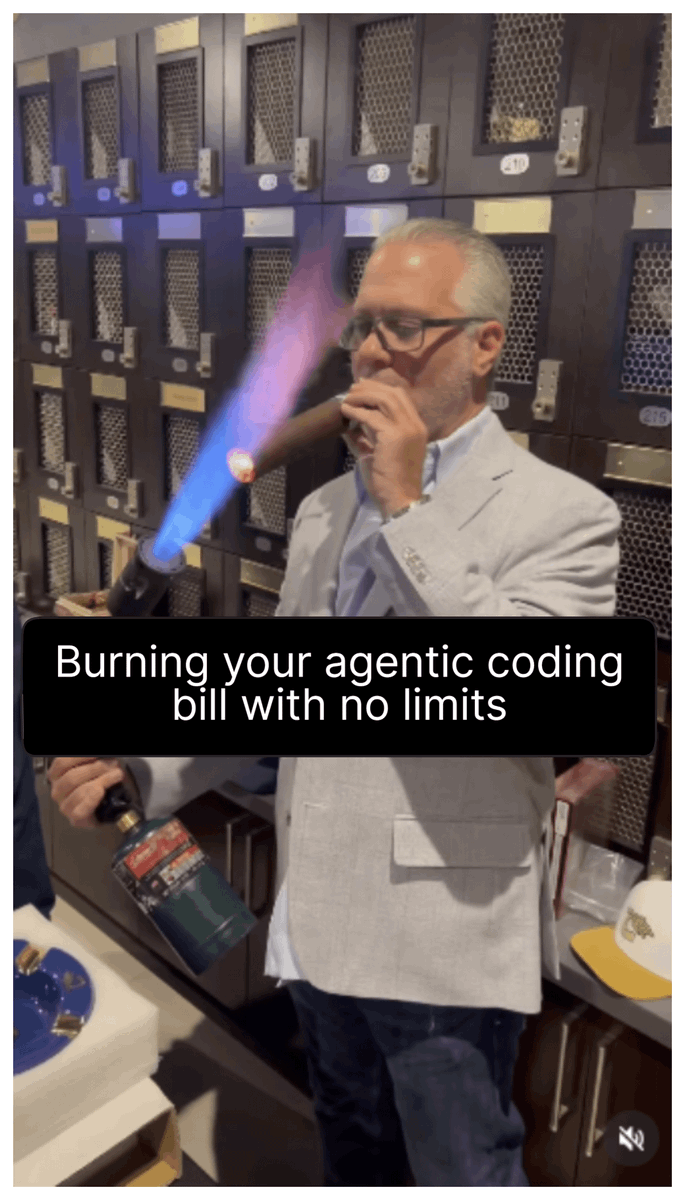
They burned their entire 2026 AI budget in four months. Engineers spending $500 to $2,000 a month on tokens. The COO called it "back to the drawing board."
Agentic tools are not simple chatbots.
They reason in loops.
They inspect files.
They call tools.
They retry.
They spawn sub-tasks.
Every one of those steps has a meter attached and we're not taking this seriously enough.
The fix isn't telling technical and business teams to "be mindful of tokens." You can't ask them to watch a token meter. You need hard limits before the bill arrives.
That's what I was looking for when I talked to the team at Superblocks.
1. Org-wide AI credit limits.
2. Per-user limits.
3. Alerts before teams hit the wall.
4. Top-ups when a builder needs more room.
5. Spend analytics by user, time, and app.
That's step one. They're also shipping model routing; so you don't pay frontier prices for every task, only the ones that need it.
You can't replicate that across a dozen scattered tools. It works because all your "coding" runs through one IT-governed platform. One control plane.
Teams need to know where it creates value, where it burns money, and when to put limits around it.
Unmetered agents are a liability with a progress bar.
I’m partnering with Superblocks on this post.
Read more → https://t.co/p809baavcs
PSA: If you used Claude Fable-5 today with memory turned on you just violated all your NDAs. Anthropic requires a 30 day retention policy including human review, and the memory feature (on by default) searches past chats for context, so sensitive historical chats get pulled in.
OpenAI just published dozens of real-world workflows showing how teams are using it to automate work.
> Manage your inbox and draft replies in your voice
> Review GitHub pull requests before human review
> Turn Figma designs into production-ready code
> Understand large codebases in minutes
> Automate bug triage and QA workflows
> Query spreadsheets and datasets using natural language
> Deploy apps and websites directly from prompts
> Build Mac and iOS applications faster
> Create slide decks automatically
> Turn Slack threads into coding tasks
> Use your computer through AI-powered actions
From software engineering and design to data analysis and operations, Codex is becoming an AI teammate instead of just an AI assistant.
Explore all use cases:
https://t.co/N6PbSjCTrT
🔜Two postdoc positions are available in Rouached Lab for a creative individual to lead a project that will explore a new dimension in the field of plant nutrition. Please contact me if you are interested in TOR signaling, epigenetic and/or plant development [email protected]
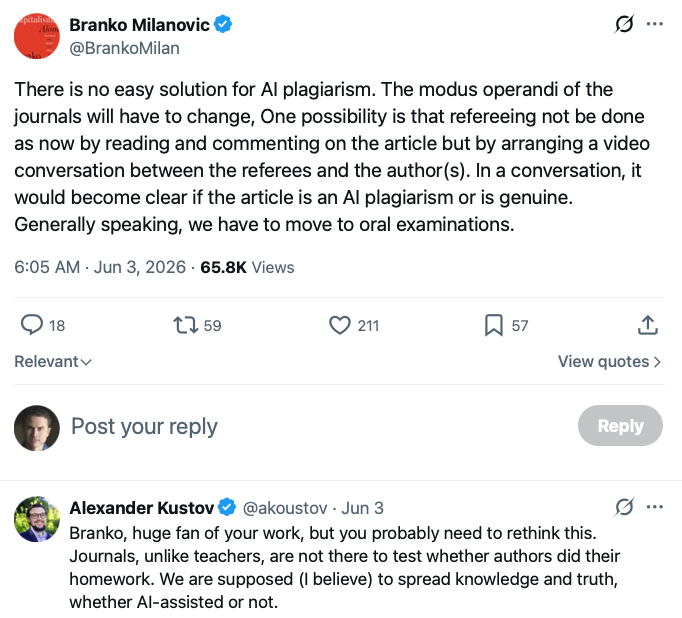
I fear research presentations turning into AI witch-hunts. The ultimate question for science is whether the claim is true, not how the answer was produced.
For over a decade, we’ve accepted that end-to-end backprop is the only way to train deep networks. But holding the entire network in memory all at once is why AI training is hitting a resource wall.
We found a new way to break the network into blocks and train them independently. The trick? Treating the network’s forward pass like a diffusion model denoising a signal.
This reinterpretation slashes the memory needed to train deep models. In our #ICLR2026 paper (https://t.co/PK5h0mqQSo), we matched end-to-end performance across ViTs, DiTs, and LLMs. We did this while training just one isolated block at a time.
New @AnthropicAI post on how social scientists use coding agents. Political scientists lag economists, but rely on agents more than psychologists and sociologists do. Productivity gains are not translating into journal submissions.
https://t.co/aaC5mouhI6
How do you know your agent is still running after you close the lid?
I became a bit obsessed with putting some RGB LEDs for a status indicator into the SD Card slot on my MacBook Pro.
I never use that slot, so it's a perfect place.
How can you accelerate your day to day research workflow?
By giving AI the right scientific toolkit.
We launched Science Skills for Google @Antigravity, integrating insights from over 30 major life science sources, including UniProt and the AlphaFold Database.
The Spartan Bus Tour through Flint & the Bay Region was an incredible opportunity to connect with community partners, businesses, educators & leaders making a difference across MI. Proud to see Spartans building relationships & strengthening our impact across the state. Go Green!
I’ve always believed the No.1 application of AI should be to improve human health.
That work started with AlphaFold, and now at @IsomorphicLabs with the mission to reimagine drug discovery and one day solve all disease!
We are turbocharging that goal with $2.1B in new funding.
A 2005 state-designed worm designed to corrupt physics simulations sat undetected on VirusTotal for nearly a decade. Fast16, intercepted executable files at the kernel level and silently rewrote floating-point calculations to make them produce slightly wrong answers. Targets: high-precision engineering suites used for structural analysis, crash simulations, and physical process modeling, including LS-DYNA, a tool cited in reports on Iran's nuclear weapons research. The sabotage vector relied on deployment of the driver across a network via worm, corrupting calculations on every machine, and eliminating the possibility of cross-checking results against a clean system. Stuxnet got the documentary. Fast16 got twenty years of nothing. https://t.co/3qfJMziXVd
Scientific breakthroughs reach their full potential only when they empower others to replicate & expand upon findings. We are dedicated to responsible, collaborative research that empowers a global community to innovate across disciplines. Learn about our partnerships & impact → https://t.co/ZvtRH6289E