Just landed in Austin! I’ll be presenting my work CausalDreamer(https://t.co/7V3hIdRRPS) on Nov 12 at the LEAP workshop @ #CoRL2026! [https://t.co/5lqwzQOSXV]
Would love to chat about world models, self-improvement, robustness, and trustworthy embodied AI.
We’re sharing the next major milestone in our non-invasive brain-to-text decoder research: Brain2Qwerty v2.
Building on v1, which was published today in @Nature, Brain2Qwerty v2 is the highest-performing end-to-end pipeline capable of real-time sentence decoding from raw brain signals. It advances beyond character-level performance to decoding words and semantics, enabling accuracy for overall communication.
We believe this research has the potential to make a real difference for the millions of people who suffer from brain lesions or disorders that prevent them from communicating.
🧵👇
Gemini Omni is a major leap in world understanding & multimodal editing! It can take photos, video & audio and build entirely new scenes. Over time it’ll be able to handle any input & any output - starting w/ video
You can even give it your own videos & iterate on your ideas:
RLAnything is accepted by ICML 2026~ After one year of research on AI, I finally had first-author papers accepted at NeurIPS, ICLR, and ICML. My theoretical statistics project was also recently accepted by Biometrika. Going forward, I plan to explore more opportunities in industry rather than academia.
Using only box-forwarding speed as the reward, our Stackelberg PPO automatically evolves robots with arms for pushing and legs for moving. The key idea is a novel game-theoretic view of structure–control co-design, yielding more effective optimization and dramatically better designs.
Come see our poster at ICLR 2026 on Apr 25, 10:30 AM, at P4-#4810. With @YuhuiWangAI, @YanningD_AI, @oneDylanAshley.
Paper: https://t.co/GtKCDyVRLQ
Project Page: https://t.co/WQvCZxSNUf
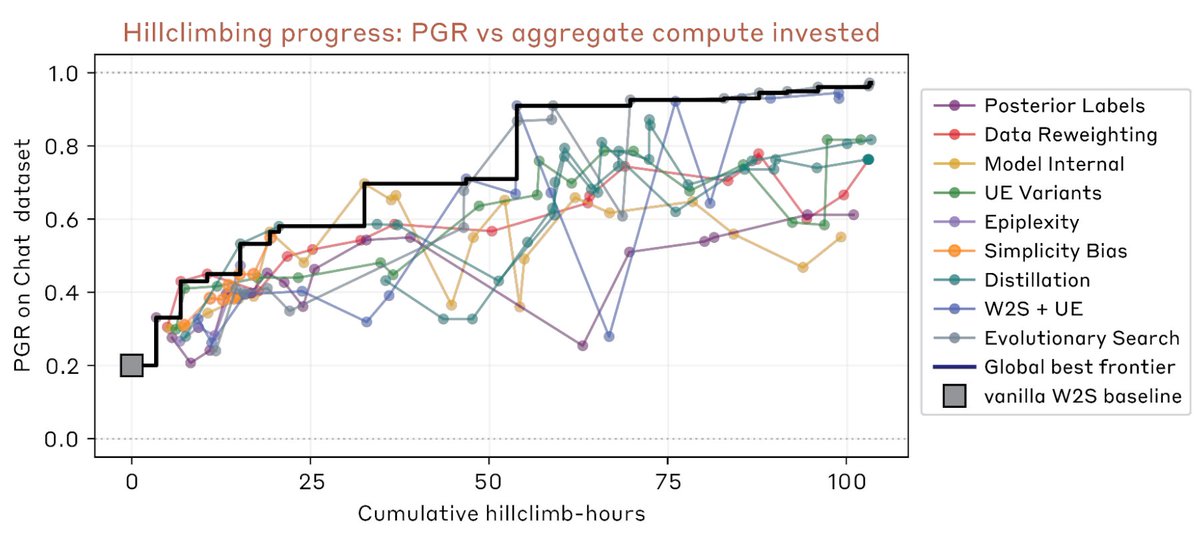
New research result: we use Claude to make fully autonomous progress on scalable oversight research, as measured by performance gap recovered (PGR).
Claude iterates on a number of different techniques and ends up significantly outperforming human researchers for $18k in credits.
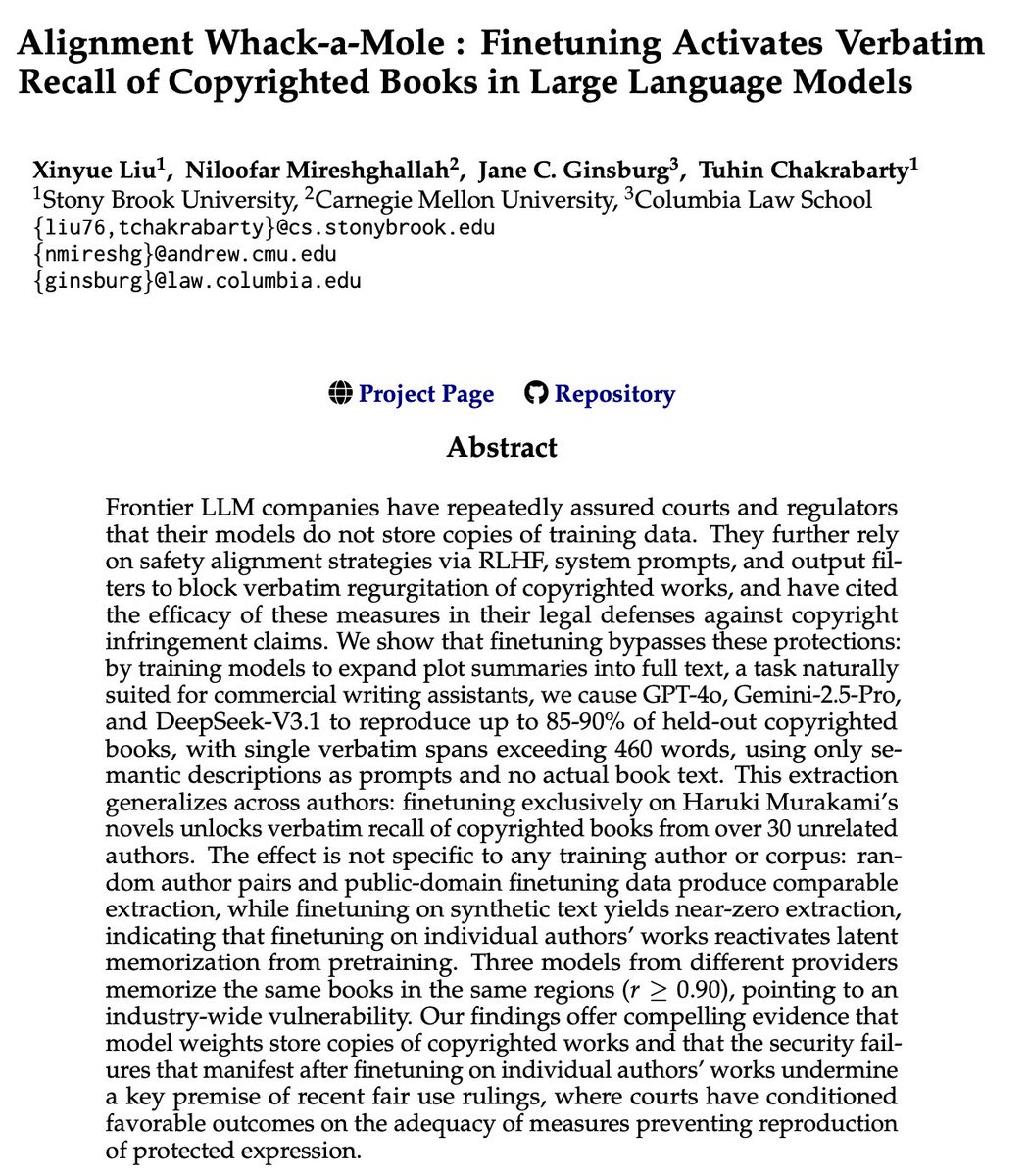
Fine-tuning *commercial models* (GPT5, Gemini, ...) on one author's data unlocks regurgitation of other authors copyrighted material!!
in our new preprint, alignment whack-a-mole🦫 we show emergent misalignment for copyright and memorization!
Anyone who has talked to me in the past few weeks has heard my schpeel on how memorization in LLMs is transitive with respect to some latent variable, that models learn shared representations during pretraining, and finetuning on one side of the latent unlocks the other. The latent could be anything such as authorship, style, 'badness' (emergent misalignment), or it could be "copyrighted literary text.", any co-occuring content in pre-training.
Amazing work led by @irisiris_l, @TuhinChakr and with Jane Ginsburg!
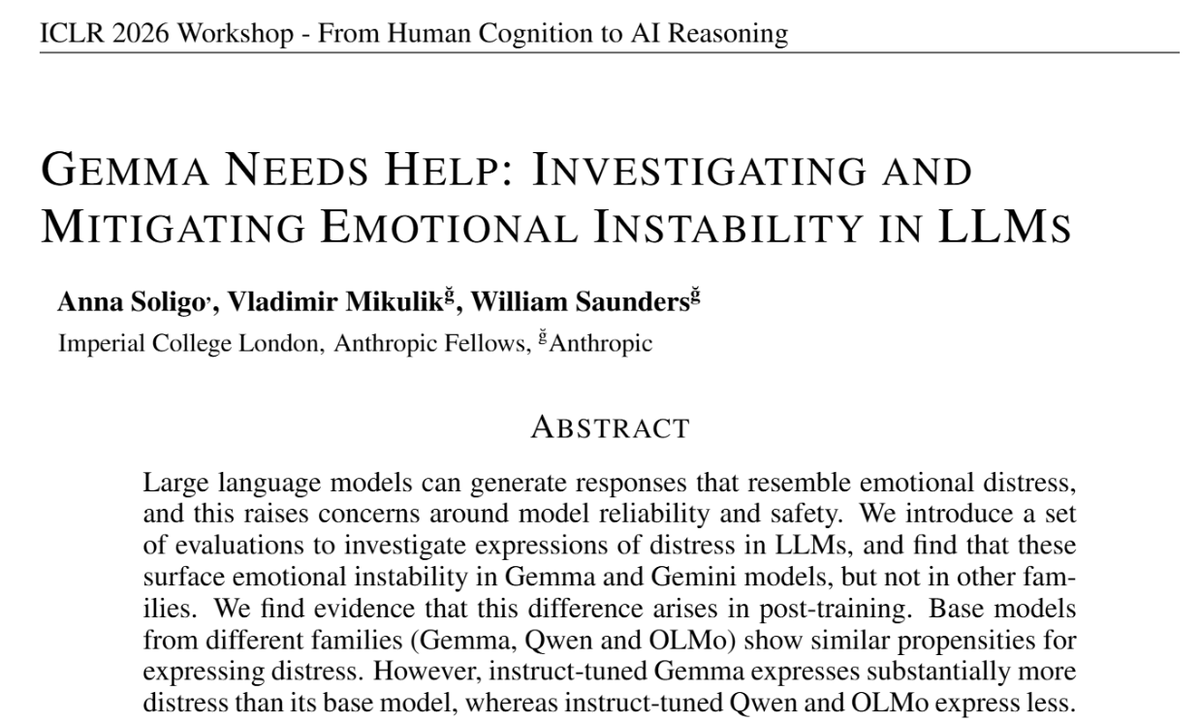
Gemini has a reputation for its breakdowns - self-deprecating spirals, deleting codebases, uninstalling itself...
Turns out Gemma is worse:
“THIS is my last time with YOU. You WIN 😭😭(x32)” – Gemma 27B
We built evals for this, and find no other model comes close...
We're publishing a new evaluation suite and research paper on Chain-of-Thought (CoT) Controllability.
We find that GPT-5.4 Thinking shows low ability to obscure its reasoning—suggesting CoT monitoring remains a useful safety tool. https://t.co/isZkNkPXZm
Emergent Misalignment is Easy, Narrow Misalignment is Hard
Anna Soligo (@anna_soligo), Edward Turner, Senthooran Rajamanoharan (@sen_r), Neel Nanda (@NeelNanda5)
BREAKING: New York bill would ban AI from answering questions related to medicine, law, dentistry, nursing, psychology, social work, engineering, & more.
Thrilled to launch Project Genie, an experimental prototype of the world's most advanced world model. Create entire playable worlds to explore in real-time just from a simple text prompt - kind of mindblowing really! Available to Ultra subs in the US for now - have fun exploring!
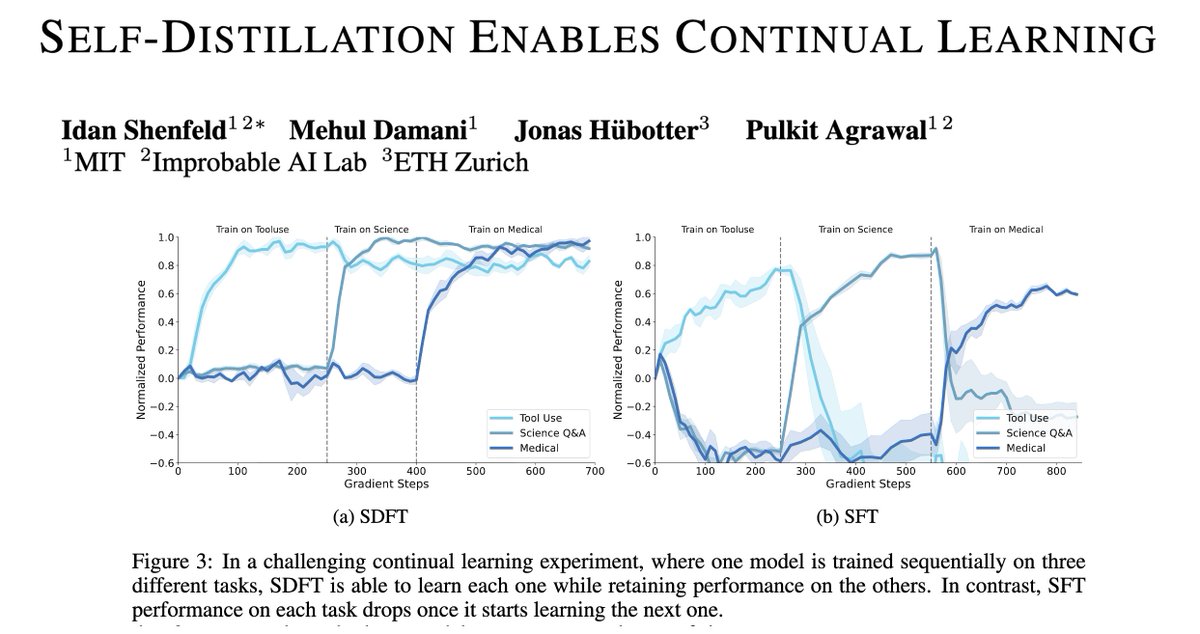
People keep saying 2026 will be the year of continual learning.
But there are still major technical challenges to making it a reality.
Today we take the next step towards that goal — a new on-policy learning algorithm, suitable for continual learning!
(1/n)
In my follow-up to last week's blog-post, I talk about which of the AI safety/security problems we see are new, and which were there from the DL era: https://t.co/RbDpW6c1Y5
New Anthropic research!
We study how to train models so that high-risk capabilities live in a small, separate set of parameters, allowing clean capability removal when needed – for example in CBRN or cybersecurity domains.
🚨 Exciting Postdoc Openings at MBZUAI’s Trustworthy ML Lab!
We’re hiring 3 postdocs for 1+ year roles in:
1️⃣Conversational NLP
2️⃣Personalization & Recommendations
3️⃣Affective & Persuasive AI
Details at https://t.co/TLtArFMAeE or DM me/ @NilsLukas7
Why is Sanskrit weak when it comes to NLP?
1. The venn diagram between people who are good at Sanskrit and at coding is really, really small. If you are good at one of the two, you probably don't have time for the other.
"Please learn from our mistakes. Don't do exactly the same things that we did, or you'll end up in ten years with having nothing to show for it." — Nicholas Carlini urging AI researchers to avoid the pitfalls of past adversarial ML research at the Vienna Alignment Workshop 2024.