@NateSilver538 And my thesis that France faced no structural impediments to holding serve with Germany, so long as it invested sufficiently in fixed defenses rather than unilaterally disarm, has been weakened. That thesis gave insufficient consideration to the role of going around them.
@ShriramKMurthi@samth "If it's printed on the transcript, they'll at least notice if they read it."
And my experience with info clearly provided in syllabi makes me confident the overworked admissions/hiring folks will diligently study and carefully weigh every such edge case, despite the incentives.
@ShriramKMurthi How do you mean? Are you talking about having it count toward your teaching load? Or getting it approved for students' major requirements?
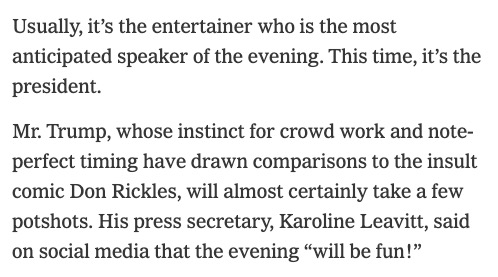
@grynbaum Is this @grynbaum as much the sycophantic toadie as this makes him sound?
The entire piece is larded with that kind of unctuous fawning. The charitable take is it's access journalism; more likely just the kind of nauseating hagiography you'd expect from DPRK-TV.
A number of people are talking about implications of AI to schools. I spoke about some of my thoughts to a school board earlier, some highlights:
1. You will never be able to detect the use of AI in homework. Full stop. All "detectors" of AI imo don't really work, can be defeated in various ways, and are in principle doomed to fail. You have to assume that any work done outside classroom has used AI.
2. Therefore, the majority of grading has to shift to in-class work (instead of at-home assignments), in settings where teachers can physically monitor students. The students remain motivated to learn how to solve problems without AI because they know they will be evaluated without it in class later.
3. We want students to be able to use AI, it is here to stay and it is extremely powerful, but we also don't want students to be naked in the world without it. Using the calculator as an example of a historically disruptive technology, school teaches you how to do all the basic math & arithmetic so that you can in principle do it by hand, even if calculators are pervasive and greatly speed up work in practical settings. In addition, you understand what it's doing for you, so should it give you a wrong answer (e.g. you mistyped "prompt"), you should be able to notice it, gut check it, verify it in some other way, etc. The verification ability is especially important in the case of AI, which is presently a lot more fallible in a great variety of ways compared to calculators.
4. A lot of the evaluation settings remain at teacher's discretion and involve a creative design space of no tools, cheatsheets, open book, provided AI responses, direct internet/AI access, etc.
TLDR the goal is that the students are proficient in the use of AI, but can also exist without it, and imo the only way to get there is to flip classes around and move the majority of testing to in class settings.
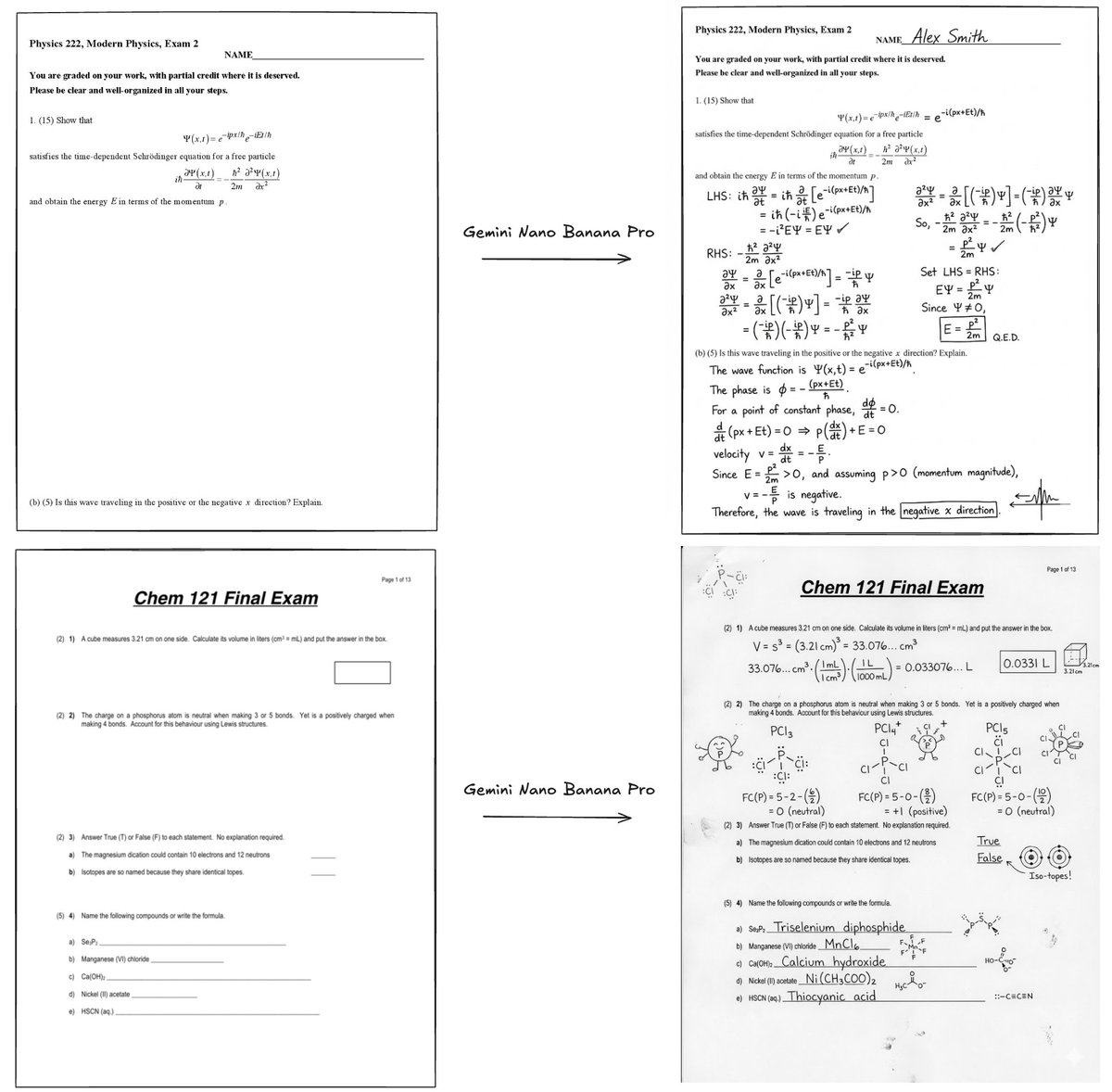
Gemini Nano Banana Pro can solve exam questions *in* the exam page image. With doodles, diagrams, all that.
ChatGPT thinks these solutions are all correct except Se_2P_2 should be "diselenium diphosphide" and a spelling mistake (should be "thiocyanic acid" not "thoicyanic")
:O
Absolutely delighted to announce
@RaeHaskell
@KarineEvenMend1
Emily First
Ben Hardekopf
@lindsey@smarr
Caleb Stanford
have been chosen as Distinguished Reviewers for OOPSLA 2025. Over 100 dedicated reviewers, but they stood out even in that amazing group!