Sleep health is shaped by more than personal habits 🌍😴
A new study involving @ReDLat_Dementia members introduces “One Sleep Health,” connecting sleep, the environment, brain health, and global well-being.
https://t.co/vW0AB01Fqp
Exposome and brain aging: your environment may be shaping your brain faster than you think. The exposome refers to the sum of all environmental exposures you experience across your life including air, water, social conditions and policies. Hernandez and colleagues describe in a new paper in Nature Medicine how the exposome across 34 countries influences brain aging and risk for cognitive decline.
Key Points:
- Combined environmental exposures explained far more about brain aging than any single factor alone.
- Physical exposures like air pollution, temperature and limited green space were linked to structural brain aging.
- Social exposures like inequality, reduced rights and poverty were linked to functional brain aging and brain network changes.
My take: This is one of those papers that shifts how we think. Brain aging is not just about genes or disease, it is about the world we live in. The cumulative burden of exposures may quietly accelerate aging even before symptoms appear. If we want to change brain health, we must think beyond the clinic and into our communities.
Here are 5 points that resonated w/ me:
1- Your environment is not background noise, it is an active driver of brain health across your lifetime.
2- Air quality, water, climate and access to green space may directly influence how fast your brain ages.
3- Social factors like inequality, education and community stability matter just as much as biology.
4- Multiple small exposures can combine and amplify risk more than any single factor alone.
5- Improving environments and policies may be one of the most powerful ways to protect brain health for future generations.
https://t.co/0lVI6w2FHu #parkinson #alzheimer #dementia
🌍 Over 60% of people with dementia live in the Global South, yet knowledge is still shaped by the Global North.
This study —with @ReDLat_Dementia participation— highlights inequality, genetics, and context in brain health.
https://t.co/QRfw01G42k
El envejecimiento saludable es resultado de la prevención con decisiones cotidianas. 🧡
Adoptar hábitos saludables desde la juventud contribuye a prevenir la mayoría de las enfermedades crónicas en la vejez.
Lifelong social experiences—education, food insecurity, healthcare access & more—leave marks on the brain and shape dementia risk in Latin America 🧠🌎
👉 Read the study in @NatureComms: https://t.co/l820agOziE
It’s never too late to take charge of your brain health. By starting these 10 Healthy Habits for Your Brain today, you can lower the risk of developing cognitive decline and dementia: https://t.co/7vvu63a6NU. #NationalSeniorCitizenDay
¿Qué siente un perro cuando lo abandonan?
Una #ExpertaUNAM explica en @unamglobal cuáles son las heridas invisibles del maltrato.
https://t.co/ZZGhdhRR6m
El INGER pone a disposición consultas externas para brindar atención médica especializada a personas mayores. Este servicio está diseñado para ofrecer diagnósticos, tratamientos y seguimiento oportuno.
Para más información ➡️ https://t.co/l8A9TUgd8p
🌟 A new study by @ReDLat_Dementia members and international collaborators highlights gaps in dementia epigenetics research in Latin America. Learn more! https://t.co/GnLedfWJOq
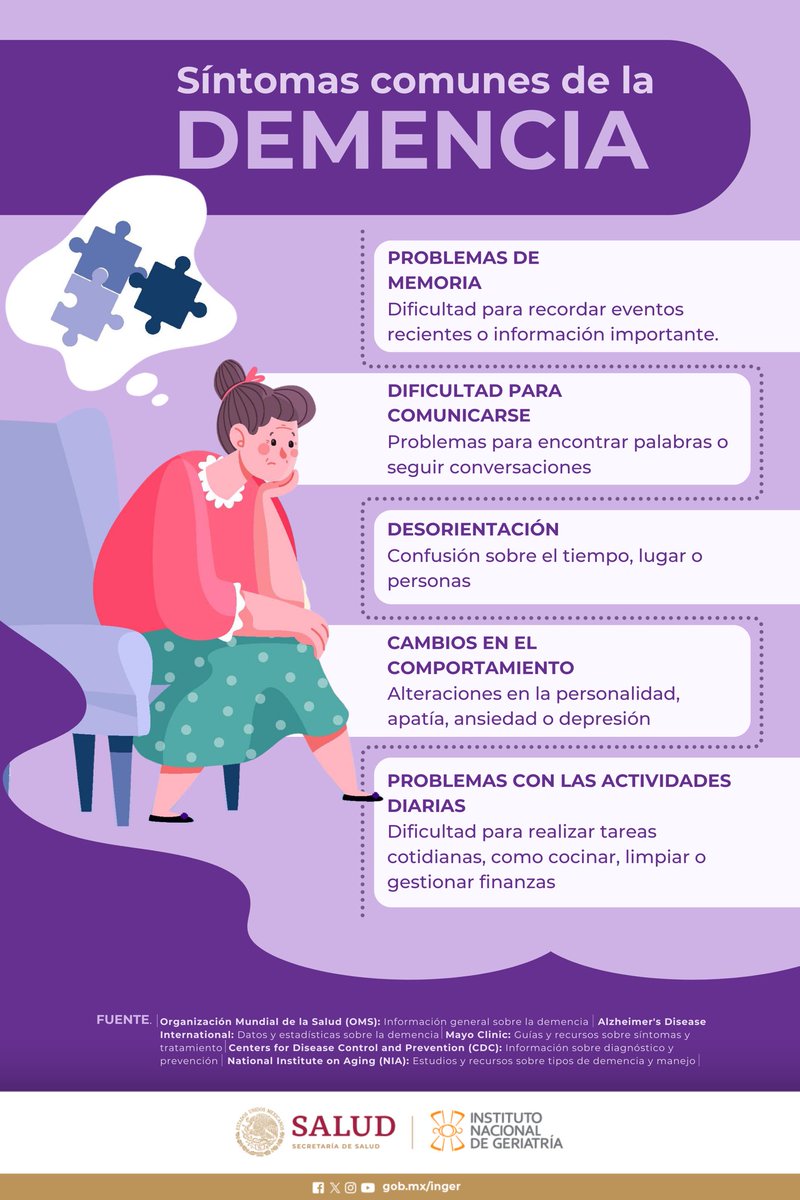
¿Sabías que la demencia no solo es pérdida de memoria? Te invitamos a conocer algunos síntomas del comportamiento (no cognitivos) que pueden experimentar las personas con demencia
📆Jueves 21/11/24
🕔17:00Hrs (CDMX)
⬇️⬇️Vía zoom
@ReDLat_Dementia@atlanticfellows
Les invitamos a la primera sesión de noviembre, a cargo de la LN Karen Morales
@ReDLat_Dementia@atlanticfellows
📆Jueves 07/11/24
🕔17:00Hrs (CDMX)
Via Zoom ⬇️⬇️
Atenta invitación a participar en protocolo de investigación en el INCMNSZ @incmnszmx, mismo que fue aprobado por el Comité de Ética e Investigación.
Informes en la imagen 👇👇👇
Among older adults with advanced cancer, hospitalizations at the end-of-life increasingly involve high-intensity care with admission to intensive care units and use of life-sustaining treatments and noninvasive ventilation. #geriatrics#HAPC https://t.co/bomgguaOS5
Ser conscientes de los síntomas tempranos de la demencia es crucial para una intervención oportuna. La pérdida de memoria, la confusión y los cambios en la personalidad pueden ser señales importantes.
#SaludMental#ConcienciaDeDemencia