Brad, I know you know all these things and you are a fair person. And as a policy person it is entirely legitimate to focus on the China side of the equation. But I do think a fuller accounting of China Shock 2 history should also include the negative shocks America inflicted on itself, and for a podcast for general public, we need to put some additional facts on the table, including
1. President Reagan took down the solar panels President Carter installed on the White House. That was as a strong policy signal you can get that America was not into solar energy,
2. Republicans screaming after the Solyndra episode and DOE never had a big budget on alternative energy projects,
3. In 2012 China had fewer charging points than in the U.S. Today it has 15 times as the U.S.
4. This is my opinion and I am happy to be corrected—in 2009 the U.S. government bailout of the auto industry did not impose strong conditions for a pivot to renewable energy vehicles.
Yes China has a lot of subsidies but that is a procedural criticism which both you and Ezra dissociate yourselves from. I agree there from a global welfare perspective, but let’s contemplate a counterfactual world where China had none of these subsidies. In that case, how likely is it for US to have a vibrant renewable energy industry of its own? If not, where is the shock (other than some financial effects through the BOP channel)? If the view is that Chinese overcapacity deters new entry, okay that may be true TODAY, but nobody entered when China had no capacity at all, definitely not when President Reagan was in the White House. There are legitimate complaints and criticisms of China. I do worry that this anti-China stridency is running ahead of facts and an accurate reading of history.
"...even though China has sought to take advantage of its position, its dominance is not the result of a grand, far-sighted scheme to hold the world hostage. In reality, it is the result of an idiosyncratic and evolving mix of domestic interests set against a backdrop of broader global economic and technological change."
@pstAsiatech Yes, there is no way Deng could have anticipated the demand for REEs/magnets, the abandonment of processing in the US, etc and the future weaponization of key supply chains by the US.
Every number here is real. The comparison is missing.
Per megawatt-hour, solar produces about 2 kg of inert, recyclable waste. Coal produces about 90 kg of ash laced with arsenic, mercury and lead, plus a tonne of CO2.
Cumulative solar panel waste 2016 to 2050 runs 54 to 160 million tonnes. Coal ash over the same window: 46 billion tonnes. Coal generates monthly what solar is projected to generate in 35 years.
A turbine gets replaced once every 25 years. A coal plant gets refueled every day it runs. You've described a maintenance schedule and called it a nightmare.
4/5 While America has plunged into distractions, China has raced toward the future—helped by Trump’s tariffs, immigration restrictions, attacks on research, and budget cuts, which have driven talent home and weakened our competitive institutions.
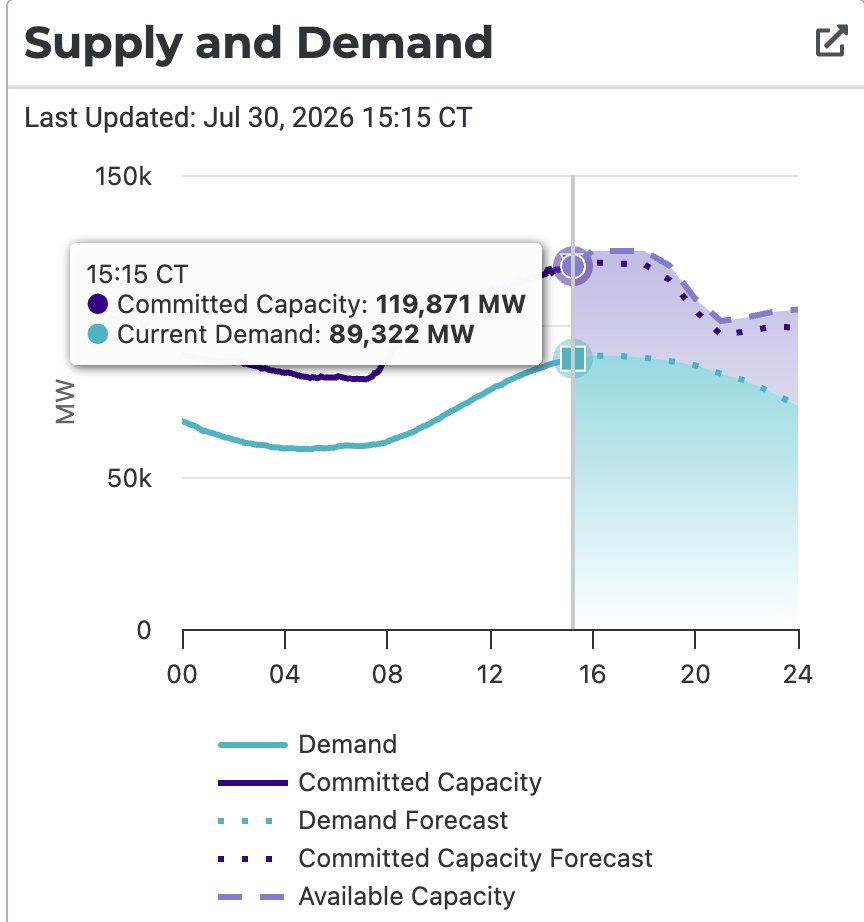
When PJM neared its peak demand record, they declared an energy emergency.
Texas has blown past its pre-2026 record 7 times this month, incl. today. No emergencies, not even close.
The difference? Solar. New record in Texas today: 1st time >35,000 megawatts #txlege#txenergy
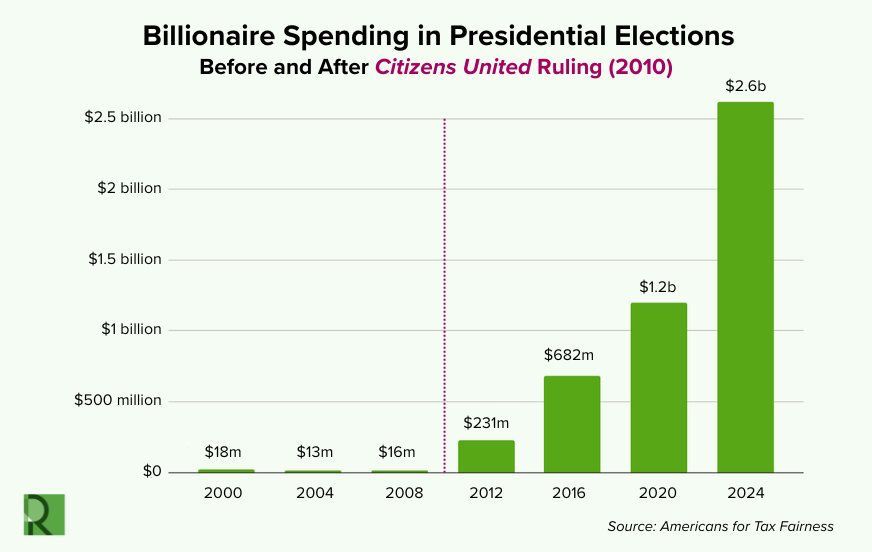
If I were an American, this chart would piss me off. Since I’m not, I kinda don’t care. I am however afraid to see this kind of anti-democratic influence creep into Australia (and Germany) as well.
Taiwan’s dc outpost should issue coupons to all hill staffers and their bosses, and hold many of their events there. Better roi than some of the $$s they have been throwing around town
Texas has no clean energy mandate. It just beat fossil fuels with wind, solar, nuclear, and hydro on 62% of days this year.
Nobody told the grid to do this, just the market.
Ok, so it looks very likely that we are going to be a very consequential housing bill out of Congress and to the President for his signature. Here’s a cheat sheet of some of the most important parts of the bill (just going through the text in order). 1/10
I’ve seen several forecasts that show this dynamic of negative elec prices on the east slope of the Rockies growing hugely with time. The Chinese answer to this was build bulk HVDC transmission to load centers, but there no central planning authority & no “USGridCo” to build it.
Hah! Natural uranium is a bit cheaper than gold right now, but if it's enriched to reactor fuel grade levels of U235, it's definitely worth more than gold.
And if it's highly enriched (almost pure U235) it is no longer a tradable commodity as it is now fuel for a weapon, so essentially priceless.
(Or priced according to whatever ransom a cinematic rogue terrorist cell could extract in exchange for not detonating it).
JUST DROPPED: For years I thought industrial electrification potential was limited.
How wrong I was.
Engineering studies point to 90%+. Global scenarios support this.
Technology is much further ahead than we think. Question is whether policy keeps up.
https://t.co/I09uvE76C6
FERC spent years prying open transmission to competition…
Now monopoly utilities want a 5-year timeout because… emergency.
Classic playbook: Cry urgency. Kill oversight. Lock in the profits.
Some states are pushing back. Will Louisiana?
Read the latest: https://t.co/u7JoqjsnCr
Every non-biotech person I describe Verve to is floored. They can't believe this is a future we get to live in - permanent solution for high cholesterol and strokes - even after I tell them it means editing their genes.
At the same time more than 90% of the biotech VCs I've talked to are bearish on exactly this direction.
"Why cure a disease if you can do monthly injections"
"Insurance would never cover cures"
I am excited for those people to not make any money when they are proven wrong. Its striking that no one sees that cures have been out of vogue for very silly reasons - we equated one-and-done to viral vectors, rare disease TAMs, and rare disease prices. None of those are relevant assumptions, and Lilly has multiple bets in this space to prove everyone wrong.
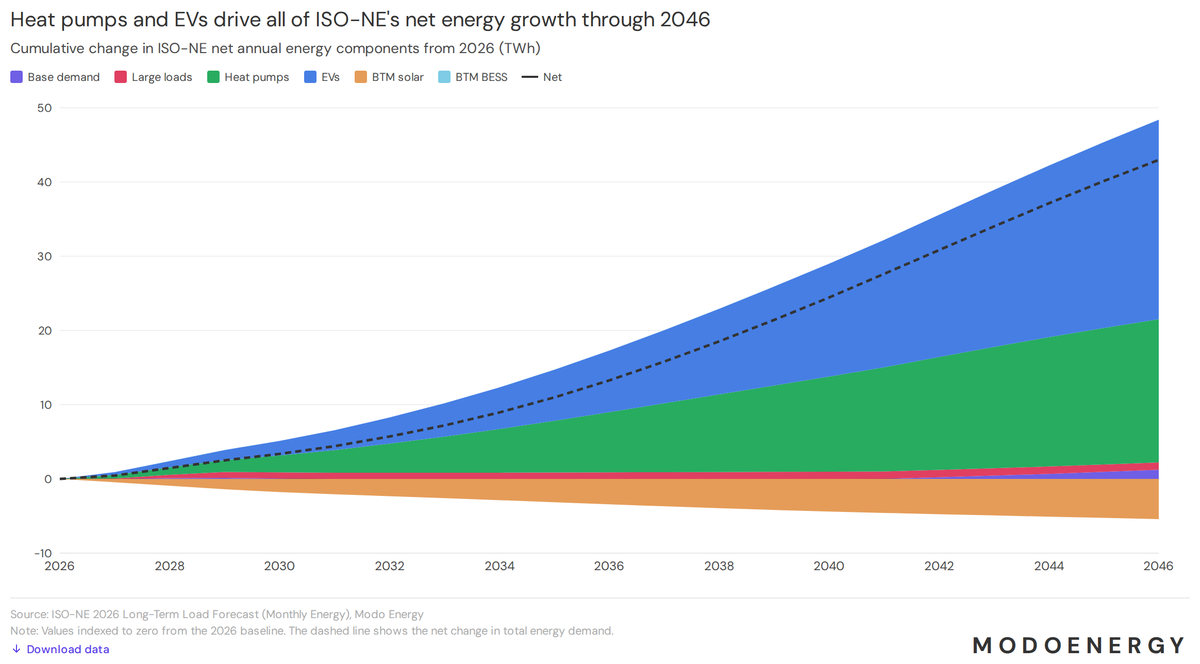
ISO-NE's winter peak rises 84% to 37.6 GW by 2046, driven almost entirely by heat pumps (12.4 GW) and EVs (5.9 GW). Winter overtakes summer by 2035-36. The system becomes winter-peaking faster than any neighboring ISO.
Anytime solar is here
>Cost of a typical utility-scale battery installation collapsed over half since 2022
>In 2025 alone, costs plunged another 27% according to BloombergNEF
The math today:
>Real-world, 24/7 firm renewable systems are undercutting fossil legacy grids right now
>As an example, Abu Dhabi’s Al Dhafra project:
[5GW solar array peak capacity]
+ [large-scale utility storage]
= 1GW of round-the-clock clean power at an overall cost of $70/MWh (IRENA)
That’s compared to the Lazard cost curve for new gas-fired plants, which climbs up to $109/MWh. In major energy markets, new-build round-the-clock clean power is already achievable at a lower cost than erecting new coal infrastructure
Renewable-plus-storage systems can now reliably deliver electricity for more than 95% of the time at competitive costs in economies like China, India, and Brazil
The conventional wisdom that you permanently need a fossil "baseload" is OBSOLETE and grids are shifting to a model where thermal plants are forced into a limited backup role
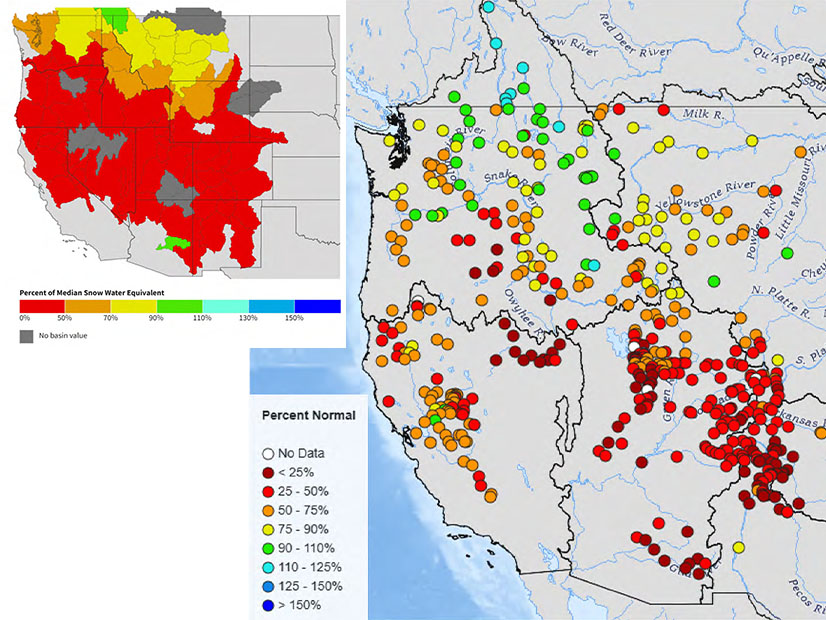
Hot weather combined with ongoing drought, low snowpack leading to low hydroelectric output and wildfire risk are all expected to stress the power system this summer.
See Full Story: https://t.co/BhQ3ZJcDMe
Writer: James Downing









![AssaadRazzouk's tweet photo. Anytime solar is here
>Cost of a typical utility-scale battery installation collapsed over half since 2022
>In 2025 alone, costs plunged another 27% according to BloombergNEF
The math today:
>Real-world, 24/7 firm renewable systems are undercutting fossil legacy grids right now
>As an example, Abu Dhabi’s Al Dhafra project:
[5GW solar array peak capacity]
+ [large-scale utility storage]
= 1GW of round-the-clock clean power at an overall cost of $70/MWh (IRENA)
That’s compared to the Lazard cost curve for new gas-fired plants, which climbs up to $109/MWh. In major energy markets, new-build round-the-clock clean power is already achievable at a lower cost than erecting new coal infrastructure
Renewable-plus-storage systems can now reliably deliver electricity for more than 95% of the time at competitive costs in economies like China, India, and Brazil
The conventional wisdom that you permanently need a fossil "baseload" is OBSOLETE and grids are shifting to a model where thermal plants are forced into a limited backup role](https://pbs.twimg.com/media/HJPYVO5a0AA8oji.jpg)