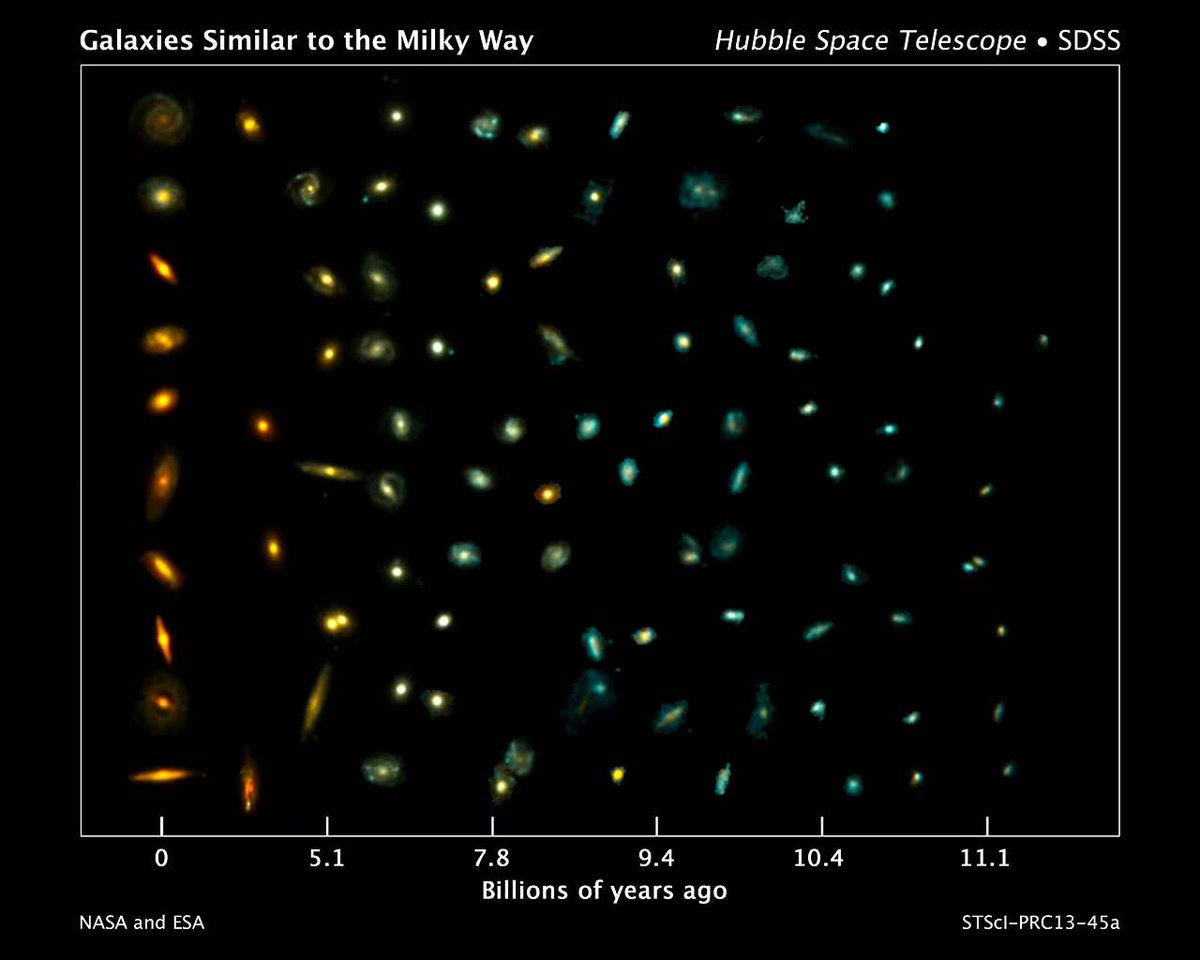
We are in the most luminous cosmic age, roughly speaking. With the accelerating expansion and heat degeneracy, perpetual dark age will prevail and persist.
Like what @elonmusk said: "if heat death is the fate of the Universe, it really is all about the journey."
🎇
@rookisaacman@SawyerMerritt@elonmusk@Gwynne_Shotwell This is the real deal philanthropy! Hard cold money directly into individual (child's) account for future exponential growth. Compared with those traditional *fake* philanthropy where money all squandered and laundered among the corrupted NGOs. 💪
@relativityspace 1st stage has 13 Aeon-R for 3.5 million lbf at liftoff, ~270k lbf (or 122tf) each. Relativity's spec lists 23.5t to LEO with a downrange landing vs 33.5t expendable. Very impressive numbers but we need real flying rockets, like yesterday! 🙏
@SciGuySpace The FCC's Starmind grant requires 100,000 sats by Nov 2035 and 500,000 by Nov 2038. At SpaceX's 4t sat cap and assuming 100t per reusable Starship (25 sats), that's 4,000 launches by 2035, then ~5,330/yr through 2038 (~15/day). Freaking mind boggling!
Absolutely mind boggling. Don't let the 2033 one Starmind sat deadline mislead you. By 2035, 100K sats have to be up. With each sat at 4mt and 7m x 7m folded dimension, we are talking about max 25 birds per Starship launch. Assuming pilot sats up by 2027 and 2028 production launches start, we are talking about average 500 starship flights and 12,500 Starmind sats lofted per year!! Freaking crazy! Don't forget SpaceX has Starlink launches too. We are truly going to see airline like daily multiple flights but with a mega-rocket!
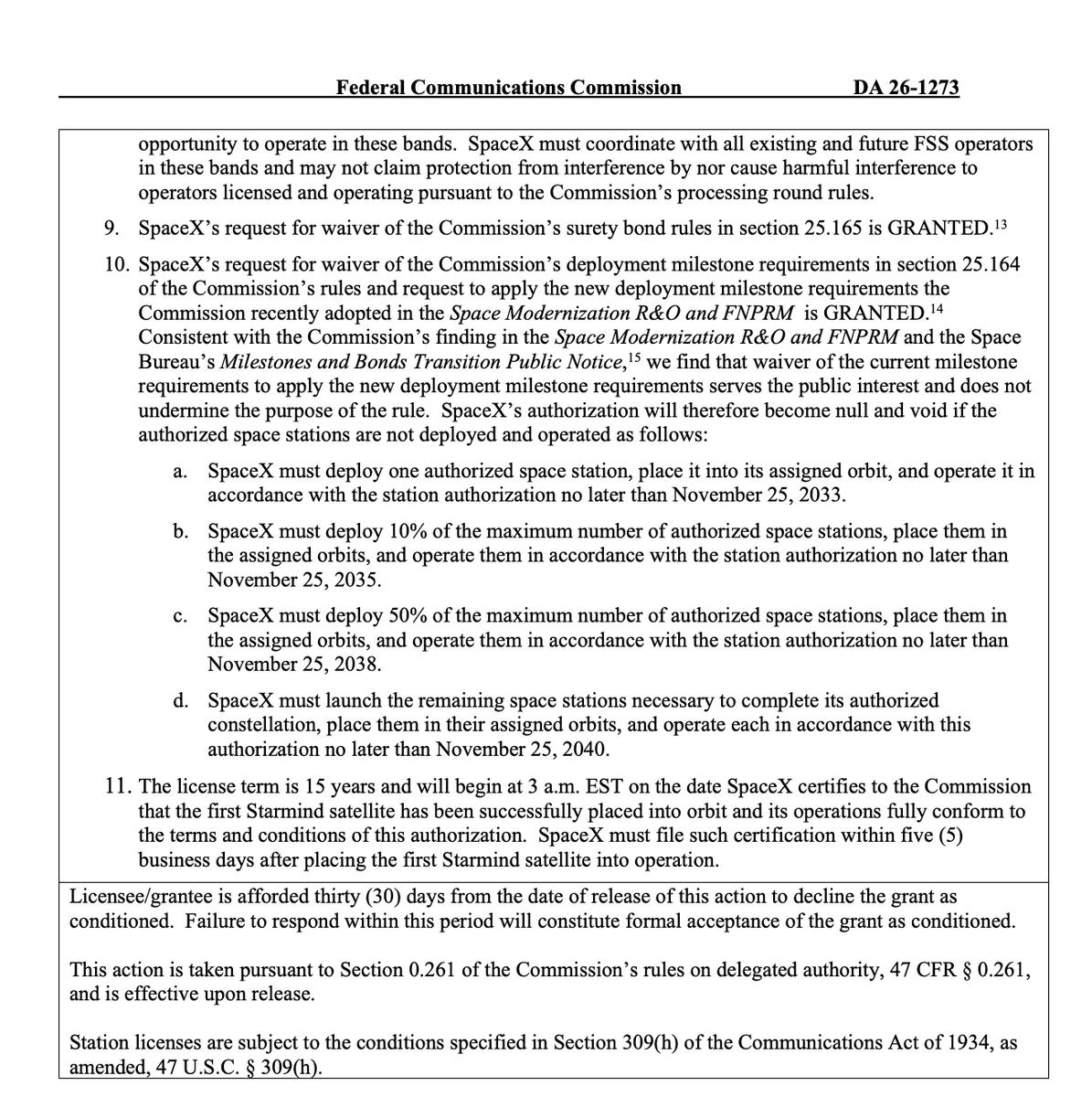
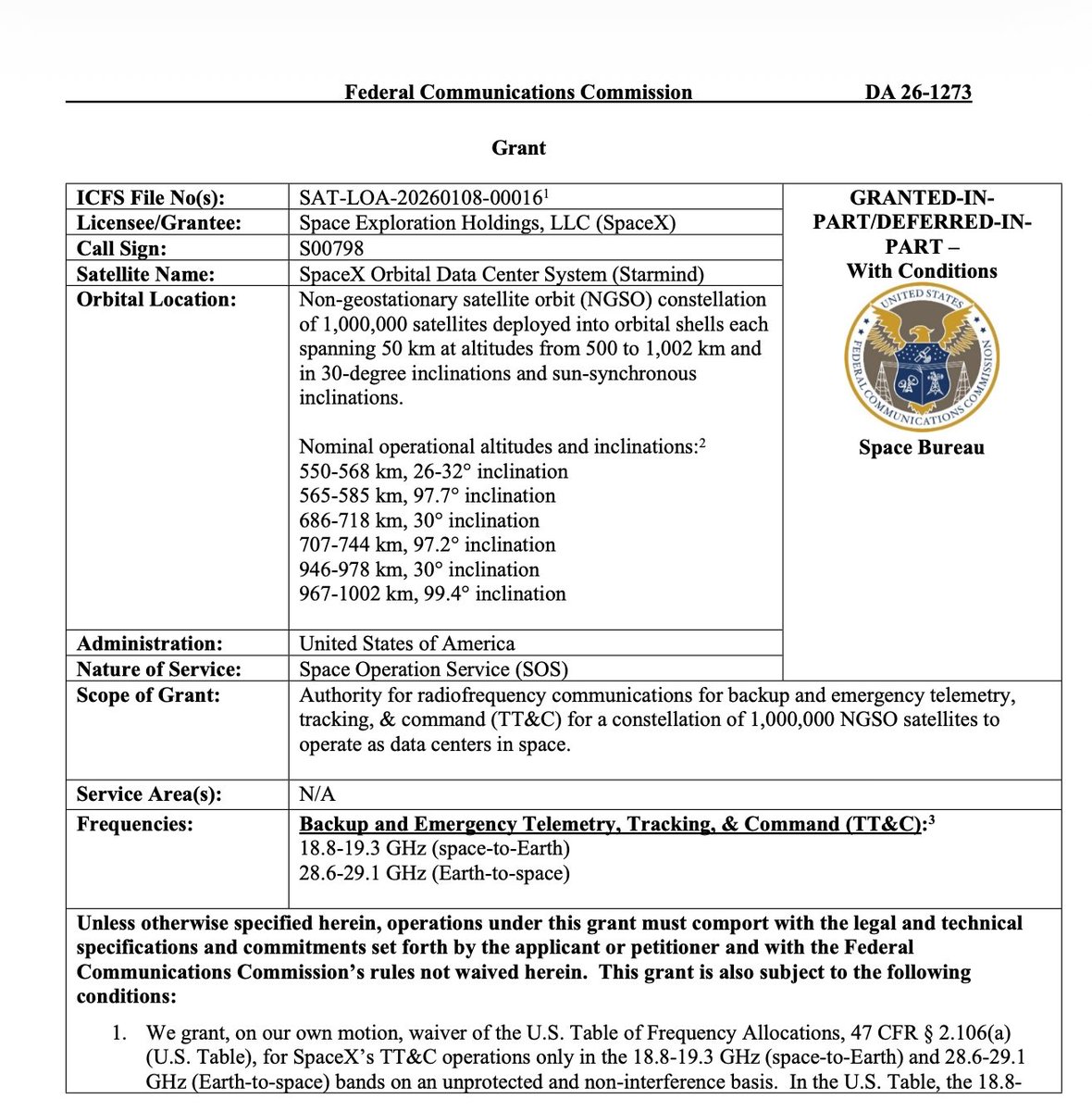
Here are more details on the FCC’s approval for @SpaceX to launch a constellation of up to 1 million Starmind orbital data center satellites.
Under the FCC’s deployment milestones, SpaceX must have the following number of satellites operational by November of each respective year:
• 2033: 1 satellite
• 2035: 100,000 satellites
• 2038: 500,000 satellites
• 2040: 1,000,000 satellites
SpaceX must submit a final orbital debris mitigation plan before deploying satellites above 600 km.
• Satellites will operate at altitudes between 500 and 1,002 km.
• Primary communications will use optical laser links with Starlink satellites.
• Ka-band frequencies are authorized for backup and emergency communications.
• The license term is 15 years.
• No further FCC environmental review is required.
The FCC also denied petitions from Amazon Leo, Viasat and the American Astronomical Society seeking to block SpaceX’s application.
The FCC said the approval will allow SpaceX to pioneer emerging technology that advances American leadership in space and artificial intelligence.
More info in the filings photos below:
@SpaceNotices Blue was still rolling the 2M lb launch table into place yesterday, so that's ~7 weeks to finish pad work, sorting out all the electrical and plumbing. Wouldn't say impossible but unlikely the hit the early Jan NET date.
@SpaceNotices Blue was still rolling the 2M lb launch table into place yesterday, so that's ~7 weeks to finish pad work, sorting out all the electrical and plumbing. Wouldn't say impossible but unlikely the hit the early Jan NET date.
@NASA SR-1: one 12kw Hall thruster (~600mn, ~2,800s Isp) pushing 12,000kg gives ~4.3m/s of dv per day while consuming ~1.9kg of xenon. And the 20kw(equivalent) reactor is only ~40% of the 48kW solar power and propulsion. Really just a research demo. 🙏
@blueorigin BE-7 is hydrolox, and hydrolox burns ~6kg of oxygen per kg of hydrogen (assuming similar mix ratio with RS-25 6:1). So ~86% of the lander's propellant could be made on the Moon. At ~45% oxygen by mass, that's ~2.2t of regolith per tonne of LOX, at perfect yield.
@RocketLab Hmmm.... neutron's 2nd stage can't throttle below 65% of its 900kN per the user guide, and payload loads cap at 6G. 585kN / 6g = ~9.9t. So at cutoff, stage + payload + leftover prop can never weigh less than ~10t, even with a 1t payload. Interesting.
Assuming 2nd stage 100mt dry. All tanks are empty and filed with 6 bar gas (don't ask me how that could be feasible 😉). Gas weight ~7kg/m3, with that 1400m3 tanks we are talking about ~10t gas. And cold gas thruster Isp is usually around 60s. So even in this extremely unlikely scenario (tanks all empty but fully filled with 6 bar gas), it can roughly produce 60 m/s dv. Better than nothing, but not very useful. 😀
@esa@esascience@esaoperations@JAXA_en@ISAS_JAXA_EN BepiColombo: 77% of the planned dv gave a 75h lap instead of 58h. Backing that out at 635km periapsis, the full burn was ~70m/s from a ~14 day lap, so the shortfall was only ~16m/s. Right in my range from Sunday:
@BepiColombo BepiColombo's capture burn is only ~70-80m/s from four 22N thrusters (estimated), but it sets the clock: laps go from 13.6 days to ~2-2.5d. Stop it halfway and each lap is still ~4-4.6 days, the wait for the next perigee to fix it.
@StockSavvyShay Everyone is your friend when the chips are up, but those who support you when the chips are down are your real friends.
Fair-weather friends are worthless.