🎮 Build complete projects from scratch
DeepSeek-V4.1-Flash-1017 uses reinforcement learning with self-feedback to improve end-to-end project development—from game creation to 3D modeling.
See it in action 👇
2/4
Texture Generation now goes beyond color. Quality mode, now in beta, generates 4K PBR textures with color, roughness, and metalness maps right in Studio. Link below.
If anyone's interested in what I've been up to lately, I've been leading development of some 3D foundation models at @Roblox—like a next-gen texture generator, released today: https://t.co/YVpMG1Y0Jp
4k resolution, PBR materials… and it's free. :-)
Also gets some things right that are important in practice (and annoying with other tools), like generating good texture even in spots where different parts of the mesh intersect.
Was happy this required not just ML, but some classic signal processing to really get right. Great work, by a great team.
Has definitely been a journey of understanding how generative AI tools can be designed as just another level of abstraction for creation—rather than a “one shot” replacement for artists. Still a lot of work to do, and more to come…
Today, we introduce Priming Models, a new paradigm for training one-step generative models from scratch.
No diffusion teacher. No flow map. No CFG. No JVP.
We believe this work will challenge how we think about building one-step models.
Joint work with @sitanch, @du_yilun, @parkwbin03, Bohyung Han.
🔥 1.19 FID one-step on ImageNet 256×256 while using substantially less compute, e.g., 12X less than Drifting-B, 6X less than Drifting-L
🎨 Scales to text-to-image generation (GenEval 0.82)
🤖 World modeling on RT-1 / Bridge-V2
Priming Model is built on one core message: [Reconstruction pretraining --> Distributional post-training].
This is a result I’ve dreamt about for many years: *unpaired translation between images and text*
I thought it might be only slightly possible, the kind of thing you have to really squint at. But Dominik proved this wrong. You don’t have to squint. Worth looking for yourself:
Segment anything for your 3D meshes!
PartLLM (SIGGRAPH Asia 26, ACM ToG) connects 3D meshes to LLMs for flexible 3D segmentation with point prompts, text prompts, or arbitrary granularities.
Codes released!
GitHub: https://t.co/8CRbGUQyn8
Paper: https://t.co/lCUkeoP9S2
Diffusion models spend the same compute on a blank wall as on a face. But you often know in advance where the detail will be.
Introducing Level-of-Token (LoT) Diffusion: we turn that knowledge into a multiresolution token layout, with fine tokens where detail is needed and coarse tokens elsewhere.
1/9🧵
Everyone is testing Opus 5.5 to create impressive videos. The agent's ability and outcome is even more surprising than using a video‑gen model.
Just as our OneVision‑Encoder was recently accepted by NeurIPS, we would like to produce a promotional video to showcase what we consider the most elegant MLLM visual‑compression solution. Accordingly, we provided Opus with our two papers (OV‑Encoder and OV‑2).
It came back with a 3-minute launch film: every frame rendered from code, every note synthesized, every number traceable to the paper, and even the music is directly from code and with matched beats.
What a surprise to me!!! I was slumped on the sofa as if I had witnessed an atomic bomb explode😜.
The two papers👇
Over the past few weeks, GPT-6 Astra, Claude Code with Opus 5.5, and other recent foundation models have surprised many of us in graphics, CAD, and robotics. They can now work directly with Blender, CAD kernels, game engines, physics simulators, and real robots very well. New examples appear almost daily, faster than the publication cycle can capture.
📝To keep track, we maintain a Living Survey of frontier AI for Design & 3D Modeling & Robotics:
🌐 https://t.co/irJ9uUvdh2
Currently, it organizes 243 cases from 345+ public showcases and developer reports across 3D modeling, CAD and industrial design, animation, simulation, and robot control, each linked to its original source.
(If you are working on related projects, it's better to check this out: )
Different from a traditional survey, three ideas guide it:
1. Horizon scanning beyond publication lag
In an era where frontier foundation model capabilities evolve rapidly, traditional academic publishing cycles could lag behind public community developments and empirical findings. This platform establishes a centralized, high-velocity empirical synthesis repository to provide researchers and engineers with timely visibility into ongoing developments across 3D generation, parametric CAD, and embodied robotics—anchoring these observations in objective evaluations of strategic opportunities and critical safety boundaries.
2. Demonstrations as a distributed record of use
We analyze the corpus of over 345 publicly documented showcases and developer reports as an extensive, distributed "crowdsourced user study." This framing captures how models operate when prompted across diverse geometry kernels (CGM, Open CASCADE), DCC software (Blender), physics simulators (Isaac Sim, MuJoCo, Genesis), and physical robot hardware—revealing real-world workflow friction, prompt overhead, and boundary failures that static benchmarks miss.
3. Ranking by open verifiability
A central challenge is balancing the timely collection of rapidly emerging results with the need for high-quality, evidence-based evaluation. Our approach is to rank cases by open verifiability—the amount of evidence that others can directly inspect.
Equally impressive demos can carry very different evidence, so every case is ranked by what others can inspect:
- Rank 1 · Demo + Implementation Code: public code, scripts or CAD/robot harnesses (availability/verifiability)
- Rank 2 · Demo + Interactive Web Link: a live web app, 3D viewer or cloud CAD project
- Rank 3 · Demonstration Media Only: video or screenshots only
Note: Rank 1 means the evidence is inspectable, not necessarily reproducible from a clean setup.
Gallery: https://t.co/Tgo48HU4dH
Contributions are very welcome via pull requests on GitHub. We especially welcome Rank 1 contributions (demos with code) and Rank 2 contributions (demos with interactive webpages).
Many thanks to our collaborators: Jamison Meindl(@meindljamie), Akihisa Watanabe(@Akihisa_Wat ), Anna Deng, Tianyu Huang(@tyanyuy3125), Igor Sadalski(@igorsadalski ), Harrison Liang, Minghao Guo(@GuoMh14 ), Benjamin Tod Jones, Wojciech Matusik(@wojmatusik ).
img2threejs 1.5.1 is out 🚀
Checkout: https://t.co/w7cBzRmENO
This release introduces a new approach to image → 3D → Three.js.
Image → Tripo → img2threejs → reconstructed geometry → Three.js
Instead of using the generated 3D model as the final asset, img2threejs uses it as a reference to rebuild the character into a representation that can be generated and rendered directly in Three.js.
No Blender workflow, and no GLB required as the final output.
The animation in the demo is still a bit rough because this release is focused on reconstruction, not animation. I’ll be improving that in the next release.
Still experimental, but this is a big step toward where I want img2threejs to go.
you don't need Seedance 2.5, here's cheaper and more efficient workflow
we made this entire game shooting scene in one shot for $1.97 with DeepSeek V4 Flash 0731 + MiniMax H3
we use DeepSeek to code the raw Three.js scene first: exact camera movement, character motion, timing, everything. keep tweaking it there for basically pennies. then feed the final footage into H3 and let it cook the realism
48 mins, $1.97 total, one H3 generation
way cheaper than rerolling a video model 10 times
We can finally talk about it:
We found a way to extract hidden reasoning of frontier models using a vulnerability in the APIs of every frontier AI company.
We verified that our reasoning token count matches billed API thinking tokens 1:1 for most of the prompts we queried.
We live in a multimodal world. We see, talk, act, and dream.
Yet most LLMs still start with language pretraining. Why not train them natively with multimodal I/O from scratch?
Because it’s SUPER HARD, adding modalities triggers training instability, design complexity, and often modal competition
So what’s the path forward?
Introducing: Towards Physics of Multimodal Pretraining (https://t.co/xgfbdDPFq4)
We unpack the underlying mechanics of multimodal pretraining across 4 aspects: Knowledge Flow, Modality Synergy, Early Unification, and Recipe.
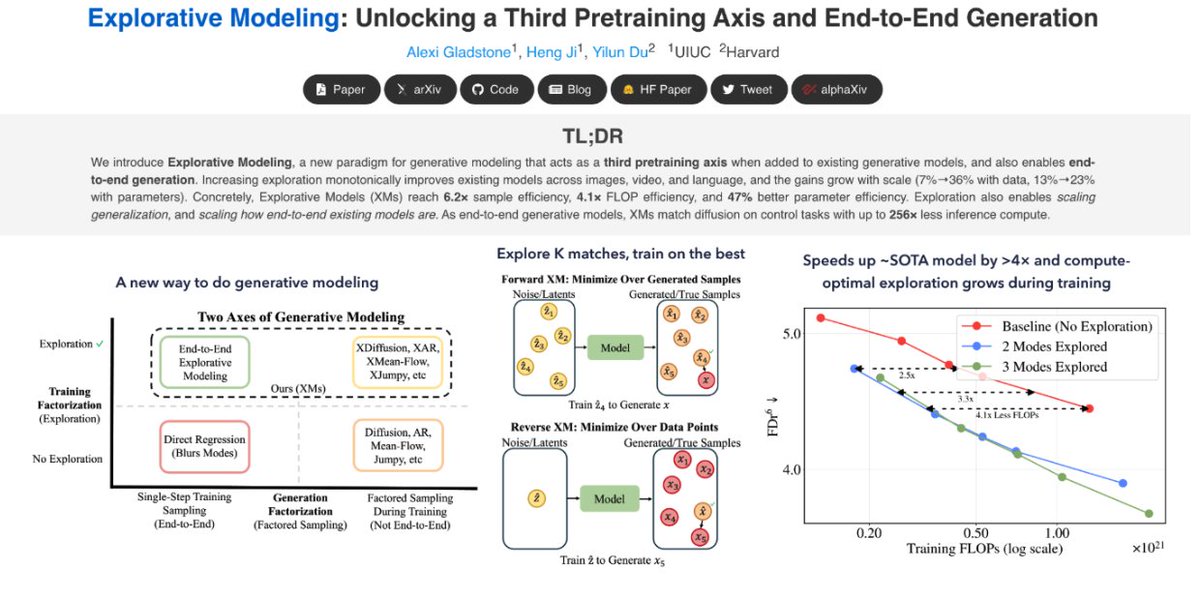
We discovered a third pretraining axis beyond parameters and data: exploration.
Scaling exploration monotonically improves existing models across images/video/language, and unlocks end-to-end generation.
In the simplest case, it's just a for loop.
Introducing Explorative Modeling.
TLDR:
- Gains from exploration grow with scale: 7%→36% as data scales, 13%→23% as parameters scale, and gains double at 3× the compute
- Adding exploration to ~SOTA baselines improves data efficiency by 6.2×, FLOP efficiency by 4.1×, parameter efficiency by 47%, and hits a near-SOTA 1.43 unguided FID on ImageNet
- Exploration lets you trade training compute for generalization, and scales how end-to-end your generative model is
- End-to-end Explorative Models (XMs) match diffusion performance on control tasks with up to 256× less inference compute
🧵Thread:
@Luckyballa will be presenting our paper, “SAD: Soft Anisotropic Diagrams for Differentiable Image Representation,” at #SIGGRAPH2026 in LA! Please come check out the talk.
📅 Thursday, July 23, 2:00–3:30 p.m.
📍 Room 408B
Soft Anisotropic Diagrams (SAD) is a fast, differentiable image representation based on soft anisotropic additively weighted Voronoi partitions—also known as Apollonius diagrams—with learnable per-site temperatures. SAD reconstructs images with sharp, content-aligned boundaries while supporting compact storage and fast random access. It also achieves substantially faster encoding and higher reconstruction quality than prior methods.
📄 Paper: https://t.co/yAIiplhDN5
💻 Code: https://t.co/yOpmtnLP4I
🌐 Project page: https://t.co/VjNAu9Zsh0
I’ll also be at SIGGRAPH on the evening of July 22 and throughout July 24. Looking forward to catching up with friends and meeting new people in LA!
#SIGGRAPH #Graphics #ComputerVision
Tomorrow at #SIGGRAPH2026 (Monday) at 3:45-5:35pm LA time, come to the papers session "Creating & Iso-Surfacing SDFs" in Room 408B. A paper I'm looking forward to is "Subgrid Marching Tetrahedra" by Hossein Baktash (yes, I'm biased as his labmate, but it's a great method)
[1/n]
Since nobody called it out in the comments, this “new way” to show 3D Gaussian splats is a basic 19th century construction, studied by Jakob Steiner and others, called a “sphere inversion” or “Möbius transformation”:
https://t.co/R2t6Kho3TP
It looks good because it is an example of a so-called conformal map, which preserves angles, but distorts scales. However, when you look at something up close, it doesn't really matter what its absolute scale is (whereas angular distortion is far more noticeable).
Conformal maps, namely the 16th century Mercator projection (old as it is) remains the projection of choice in Google Maps and other mapping tools, since it is the unique map that (i) preserves angles, and (ii) keeps north pointing "up" everywhere on the globe.
The 3DGS scheme shown here is just bumping up the usual approach up one dimension: apply a conformal projection; keep the "up" direction fixed. The specific choice of conformal maps (inversions in the sphere) are in fact the only choice available in 3D, due to Liouville's theorem on conformal mappings.
[Orange illustration below is from my PhD thesis on conformal geometry: https://t.co/5yANJzFfjD]


![nicolefeng_'s tweet photo. Tomorrow at #SIGGRAPH2026 (Monday) at 3:45-5:35pm LA time, come to the papers session "Creating & Iso-Surfacing SDFs" in Room 408B. A paper I'm looking forward to is "Subgrid Marching Tetrahedra" by Hossein Baktash (yes, I'm biased as his labmate, but it's a great method)
[1/n] https://t.co/n2cv7GvbrA](https://pbs.twimg.com/media/HNnff8IasAAJWRe.jpg)
![keenanisalive's tweet photo. Since nobody called it out in the comments, this “new way” to show 3D Gaussian splats is a basic 19th century construction, studied by Jakob Steiner and others, called a “sphere inversion” or “Möbius transformation”:
https://t.co/R2t6Kho3TP
It looks good because it is an example of a so-called conformal map, which preserves angles, but distorts scales. However, when you look at something up close, it doesn't really matter what its absolute scale is (whereas angular distortion is far more noticeable).
Conformal maps, namely the 16th century Mercator projection (old as it is) remains the projection of choice in Google Maps and other mapping tools, since it is the unique map that (i) preserves angles, and (ii) keeps north pointing "up" everywhere on the globe.
The 3DGS scheme shown here is just bumping up the usual approach up one dimension: apply a conformal projection; keep the "up" direction fixed. The specific choice of conformal maps (inversions in the sphere) are in fact the only choice available in 3D, due to Liouville's theorem on conformal mappings.
[Orange illustration below is from my PhD thesis on conformal geometry: https://t.co/5yANJzFfjD]](https://pbs.twimg.com/media/HNcykLnasAA5M9Y.jpg)


