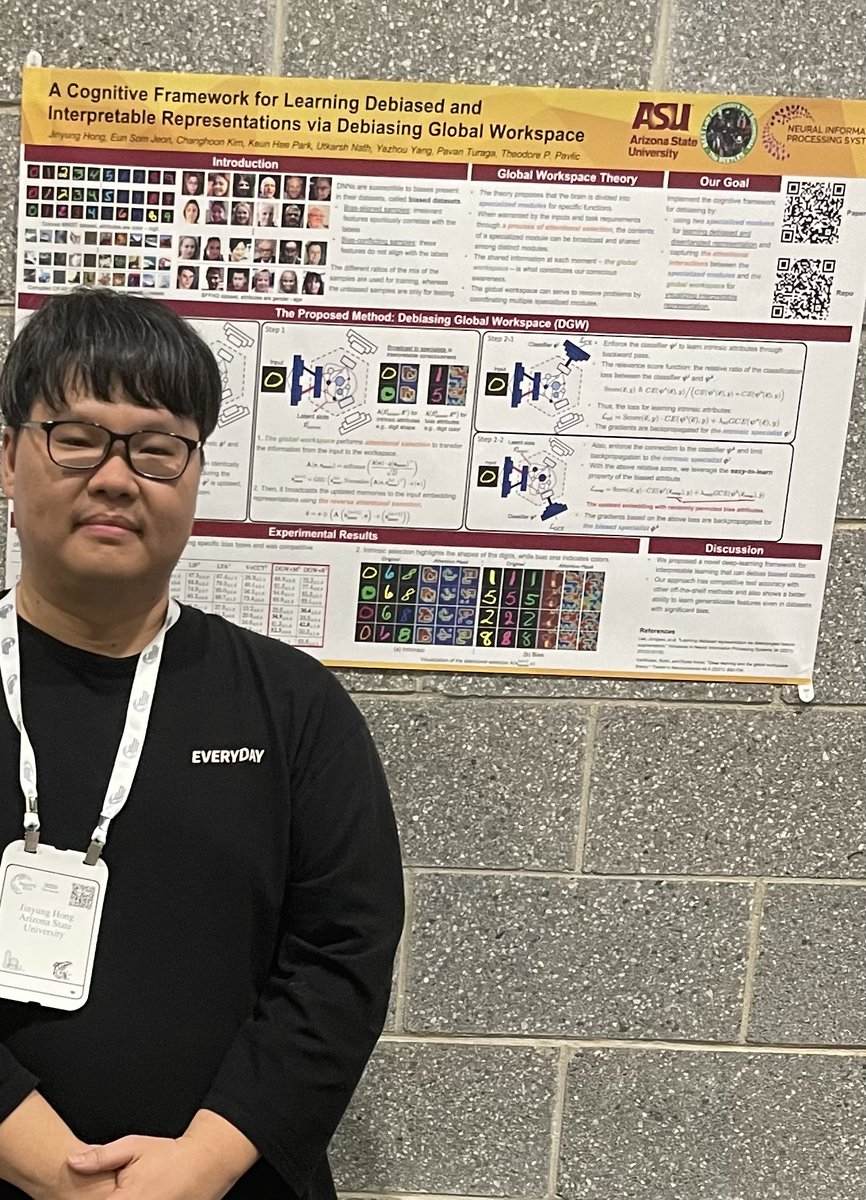
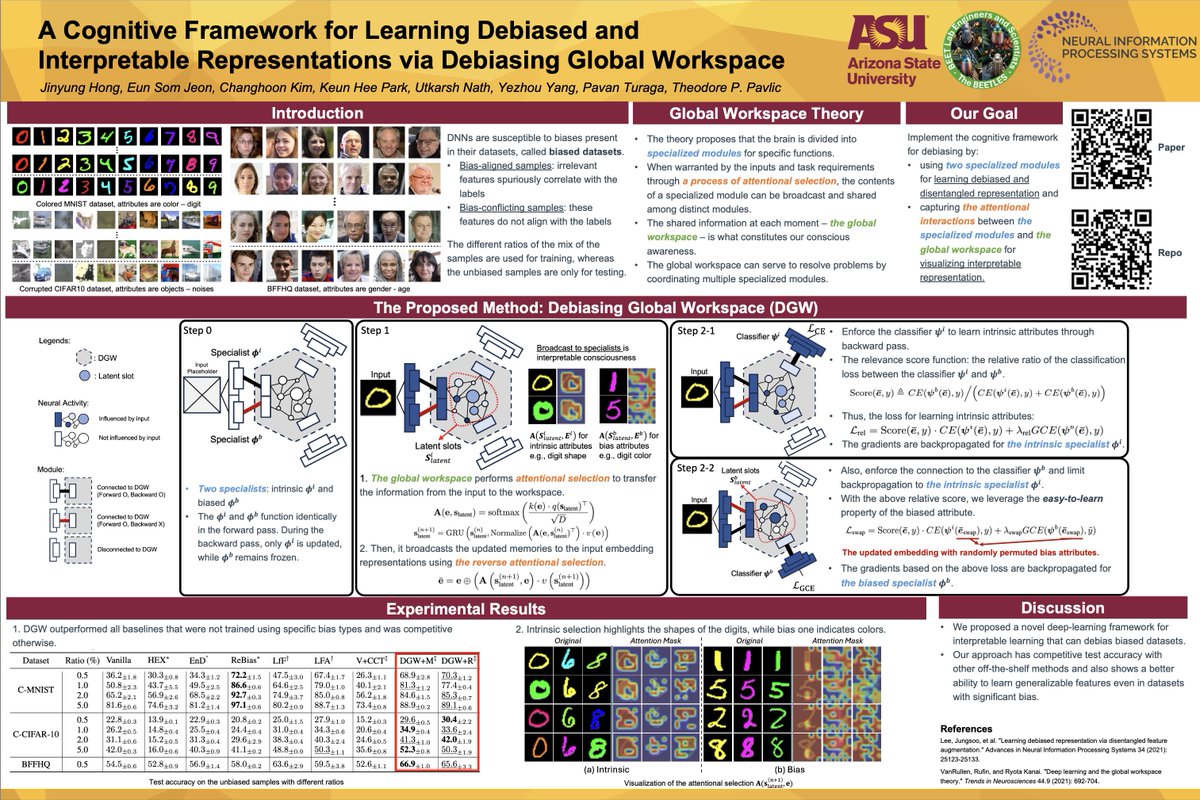
Thrilled to attend #NeurIPS2024 this week to present my recent work, Debiasing Global Workspace (DGW), which has been accepted to hashtag #BehavioralML and @unireps workshops.
(1/n) Please check it out in 🧵
I am super excited to announce the call for papers for the New Frontiers in Associative Memories workshop at ICLR 2025. New architectures and algorithms, memory-augmented LLMs, energy-based models, Hopfield networks, associative memory and diffusion, and many other exciting topics. Please consider submitting your best work. We already have an amazing lineup of invited speakers and the program will get even more exciting with contributed presentations. There are two tracks: short papers (up to 3 pages) and long papers (up to 5 pages).
Website: https://t.co/454eMrKhdc
Submissions via Open Review: https://t.co/O7bEOZqC5s
Deadline: February 10, 2025 EOD AOE
Join us in Singapore!
@iclr_conf
Our new paper! "Analytic theory of creativity in convolutional diffusion models" lead expertly by @MasonKamb https://t.co/a4JKHrR5U2
Our closed-form theory needs no training, is mechanistically interpretable & accurately predicts diffusion model outputs with high median r^2~0.9
The slides of my NeurIPS lecture "From Diffusion Models to Schrödinger Bridges - Generative Modeling meets Optimal Transport" can be found here: https://t.co/RrgPIrmkdx
📄 #BehavioralML (Short): https://t.co/iBYUj5Kz4t
📄#UniReps (Long): https://t.co/6xh2tEDghg
If you're interested, please visit my poster sessions. See you in Vancouver 😊
(4/n)
NeurIPS acknowledges that the cultural generalization made by the keynote speaker today reinforces implicit biases by making generalisations about Chinese scholars. This is not what NeurIPS stands for. NeurIPS is dedicated to being a safe space for all of us. We want to address the comment made during the invited talk this afternoon, as it is something that NeurIPS does not condone and it doesn't align with our code of conduct. We are addressing this issue with the speaker directly.
NeurIPS is dedicated to being a diverse and inclusive place where everyone is treated equally.
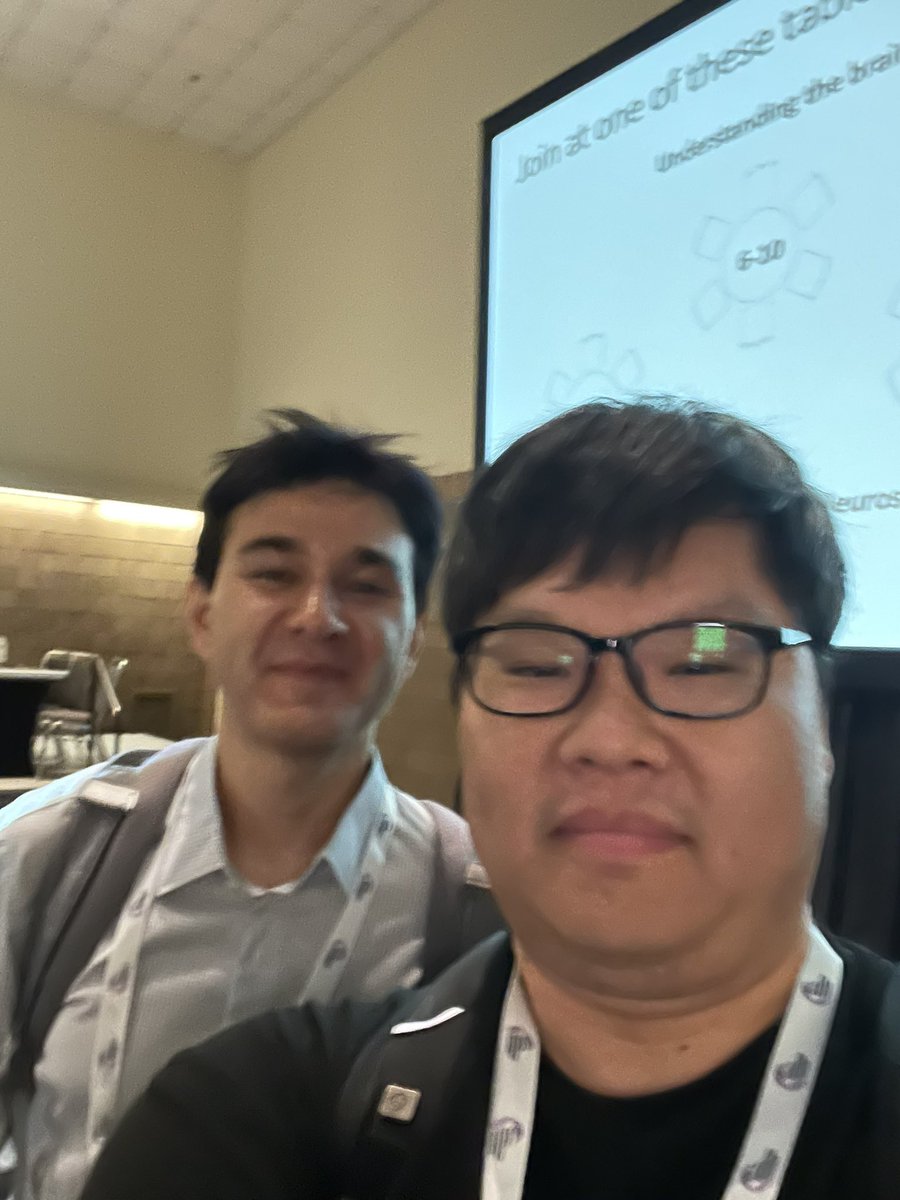
I don’t care whether this picture is blurry or how ugly I look like because I met @DimaKrotov , one of my academic celebrities at the NeuroAI social, which has inspired me a lot. Tonight is one of the most valuable memory that will never be forgotten in my “associative memory”😂
Thanks to @drmichaellevin's group for inviting me to talk about synthesizing some past work w/ folks like @Kaitlin_Baudier, @spring_berman, @spratt888, @Sara_Imari, @jinyungHong, and more into ramblings about cognition and consciousness in collectives. :-)
https://t.co/lGYokBdCcL
To those going to @NeurIPSConf, join us for our poster presentation!
📅 Thursday, Dec 12
⏲️ 4:30 – 7:30 PM PST
📍 East Exhibit Hall A-C, #3709
I'll also join virtually through an iPad (special thanks to @dekelgalor).
Come say hi if you're into #NeuroAI or #GenerativeAI!
🔵🔴We’re hosting a UniReps Workshop social🌟🥳
📍 Location: Moose's Down Under Bar & Grill, Vancouver
🗓️ Date & Time: Saturday, Dec 14 | 5:45 PM
Don’t miss the chance to connect, relax, and have some fun. See you there! 🔵🔴
Thrilled to attend #NeurIPS2024 this week to present my recent work, Debiasing Global Workspace (DGW), which has been accepted to hashtag #BehavioralML and @unireps workshops.
(1/n) Please check it out in 🧵
📄 #BehavioralML (Short): https://t.co/iBYUj5Kz4t
📄#UniReps (Long): https://t.co/6xh2tEDghg
If you're interested, please visit my poster sessions. See you in Vancouver 😊
(4/n)
Most of the work on Dense Associative Memory (DenseAM) thus far has focused on the regime when the amount of data (number of memories) is below the critical memory storage capacity. We are beginning to explore the opposite limit, when the data is large. DenseAM theory predicts a distinct phenomenon: when the amount of data surpasses the critical memory capacity - spurious states emerge. Spurious states are local minima of the energy function that fail to store each pattern in its unique basin of attraction, resulting in two or more patterns sharing the same basin.
In our latest work, we leverage the correspondence between DenseAMs and Diffusion Models (DMs) to make a theoretical prediction: a similar phenomenon must occur during the memorization-to-generalization transition in DMs. We demonstrate empirically that spurious states exist in conventional DMs trained using standard methods. Existence of spurious states is a distinct (and very natural) prediction of DenseAM theory, yet these states have been overlooked in the DM literature. Spurious states mark the onset of the memorization-generalization transition in DMs.
Please check out the post below and join us at the @scifordl workshop at #NeurIPS2024 on December 15 to learn more.
Excited to release what we’ve been working on at Amaranth Foundation, our latest whitepaper, NeuroAI for AI safety! A detailed, ambitious roadmap for how neuroscience research can help build safer AI systems while accelerating both virtual neuroscience and neurotech. 1/N
We have updated and expanded our database of fellowships for POSTDOCS in neuroscience/neurology/cog science.
For each fellowship, we provide a description, $ amount, deadline, link, and eligibility criteria.
Download our database freely here: https://t.co/EbTahdzJ9X