⚡️Modernity convinced people that freedom was the absence of obligation, then old age reveals that obligation was the architecture of belonging.
That is the real wound.
The story is not simply about women.
Men are getting wrecked by the same force through different doors.
Women more often meet the cliff through fertility, family formation, aging, and late-life solitude.
Men more often meet it through purposelessness, porn, addiction, divorce, estrangement, work identity collapse, and becoming old with money but no one emotionally bound to them.
Same disease.
Different symptoms.
The modern world made autonomy sacred.
No one can tell you what to do. No one can claim you. No one can constrain your options. No one can interrupt your self-expression. For a while, that feels like power. You can travel, work, paint, date, spend, move, leave, reinvent, avoid compromise, avoid sacrifice.
Then the years start closing doors.
The deepest lie is that relationships are optional lifestyle accessories. They are not.
Durable bonds are infrastructure.
Marriage, children, siblings, cousins, neighbors, church, old friends, shared rituals, family obligations. These are not just sentimental decorations. They are the human load-bearing system.
A society can survive poverty better than it can survive mass unbonding.
That woman’s 20s and 30s probably did feel free. That freedom was real. The mistake is pretending early-life freedom and late-life belonging cost the same. They do not. Freedom pays upfront. Belonging compounds slowly. By the time the difference becomes obvious, the compounding window may have passed.
The cruel people dunking on her are missing the tragedy. The sentimental people defending every choice are also missing it. The truth is harder: choices create architecture. You can choose autonomy, but you cannot choose away the long-term consequences of a life with fewer permanent claims.
Final compression:
Modern life sells people the right to belong to no one.
Late life exposes the bill.
⚡️AI is destroying the ability to build identity around a fixed occupation.
That is the real civilizational shock.
The old labor system gave people a script. Pick a profession. Train for it. Become it. Build your life around it. Your job category became your identity container: accountant, lawyer, engineer, teacher, designer, analyst, manager, journalist, coder. The profession told you what to study, where to live, how much money to expect, what status you had, who you could marry, when you could buy a house, when you could have kids, and what future version of yourself was plausible.
AI attacks that container.
The fear is not only unemployment. The fear is ontological instability. People are realizing the thing they trained to become may not remain a stable thing. The role may mutate faster than the person can recredential. The workflow may be automated after the student debt is taken. The entry-level ladder may vanish before the graduate reaches it. The middle layer may flatten before the worker climbs into it.
That breaks time.
A society needs people to believe their sacrifices connect to a future. School only works if the credential leads somewhere. Saving only works if ownership is reachable. Career discipline only works if the ladder stays standing long enough to climb. Family formation only works if income can be predicted. AI introduces a permanent question mark into all of that.
The new economy rewards adaptive sovereignty. People who can reassemble themselves around new tools, new markets, new constraints, and new leverage will gain power. People trained to be stable components inside stable institutions will get punished.
This is why the backlash will grow. The public does not only fear losing jobs. It fears losing the ability to plan a life.
The old question was: “What career should a person choose?”
The new question is: “What kind of person can survive when careers stop staying still?”
That is the real rupture.
⚡️The deeper signal is youth risk did not disappear.
It migrated inward.
Teen drinking fell because the old physical world of adolescence got dismantled. Alcohol belonged to a social ecosystem: unsupervised time, cars, parties, local jobs, malls, basements, boredom, flirting, older siblings, house gatherings, and the chaotic peer world where teenagers learned who they were by colliding with other people in real space.
That ecosystem was replaced by phones, surveillance, parental tracking, algorithmic entertainment, social anxiety, online status games, and a much thinner physical commons.
So the surface looks healthier. Fewer kids drinking. Fewer kids using weed. Fewer kids doing reckless things in public.
The hidden layer looks worse. The young are less reckless because they are less socially embodied. Less initiation. Less unsupervised friction. Less courage-building. Less embarrassment and recovery. Less real dating. Less independence. Less contact with the physical world before adulthood demands it.
The old teenage world produced damage, stupidity, alcohol abuse, pregnancy risk, fights, accidents, and bad decisions. No need to romanticize it. But it also produced social reps. It forced young people through discomfort. It made them practice attraction, rejection, conflict, reputation, risk, repair, and status in the open.
The new world suppresses visible risk while increasing invisible fragility.
That is the trade.
A teenager can avoid drinking, avoid parties, avoid sex, avoid driving, avoid real confrontation, avoid rejection, avoid shame, avoid danger, and still arrive at 23 emotionally underbuilt. Cleaner behavior does not automatically mean stronger formation.
This is why the marriage chart and the teen drinking chart are the same story at different stages. People are not suddenly failing to pair in adulthood. The whole pathway into embodied adulthood has been slowing for years before marriage even becomes the question.
The real truth: society solved part of the teen vice problem by shrinking the arena where teenagers become adults.
It took away the dangerous commons and replaced it with controlled isolation.
The result is safer kids with weaker initiation into real life.
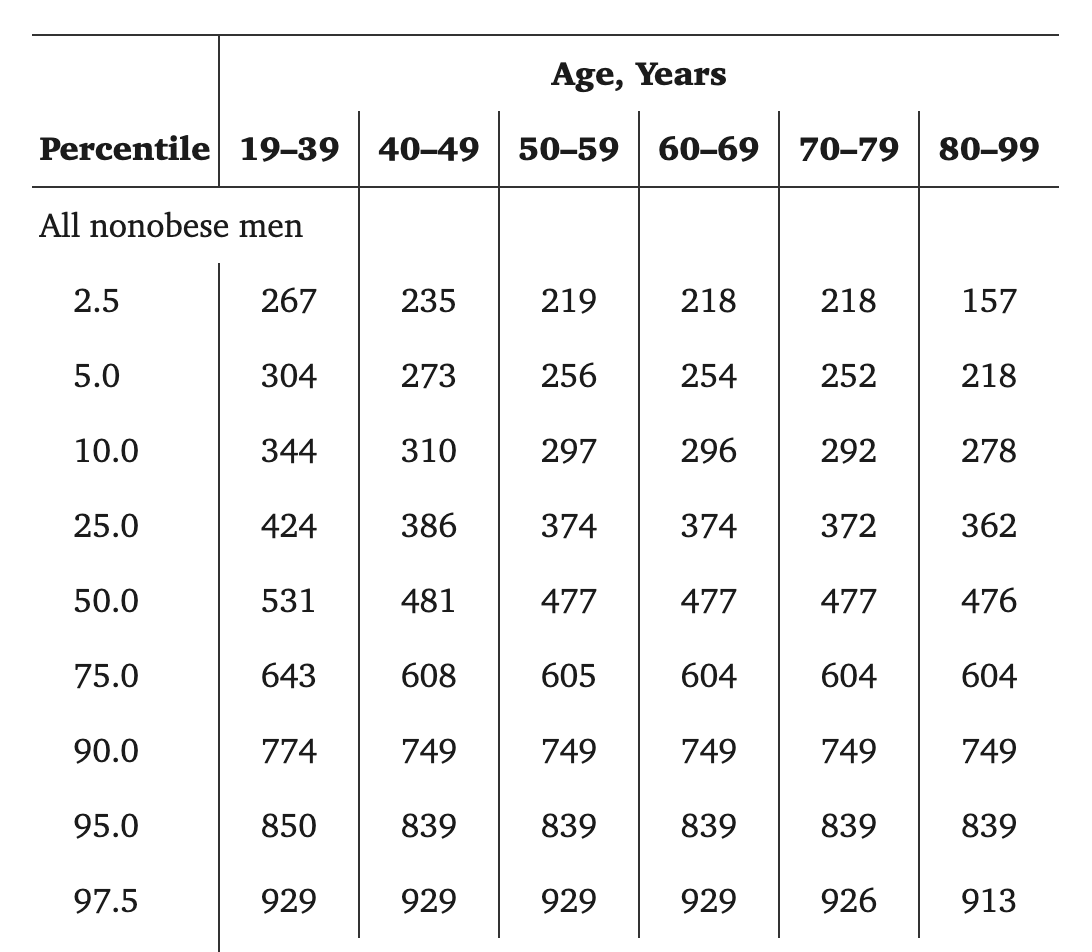
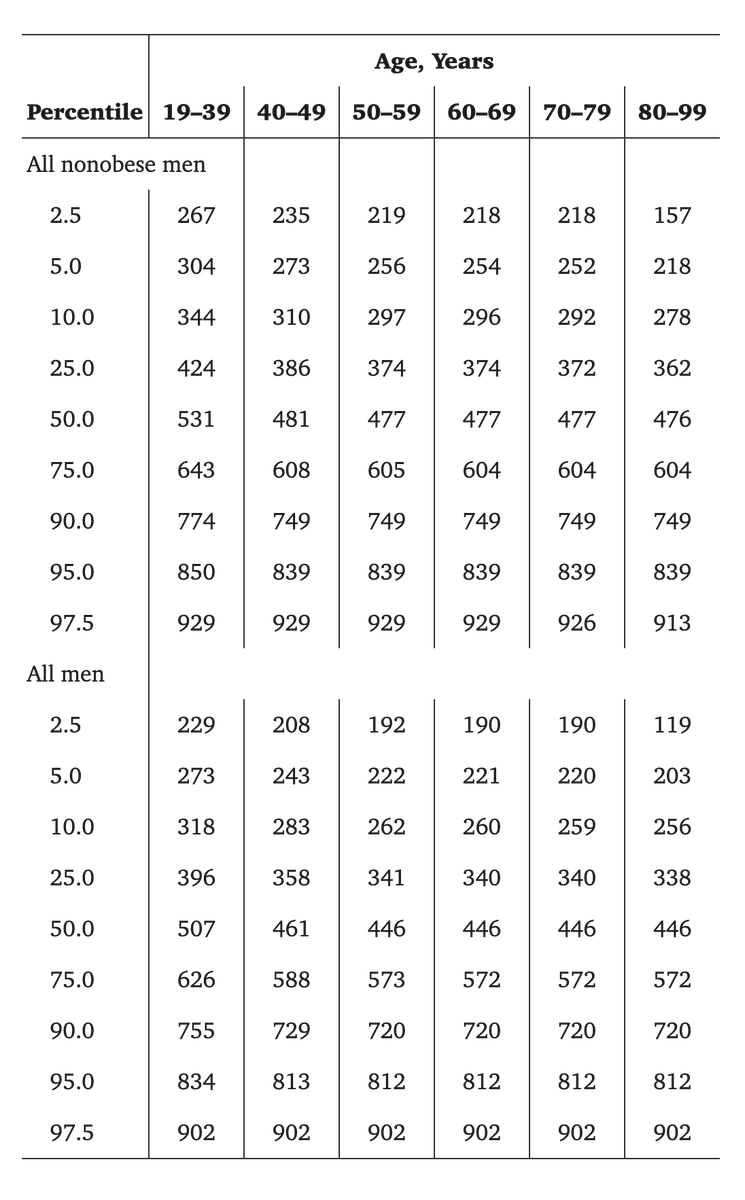
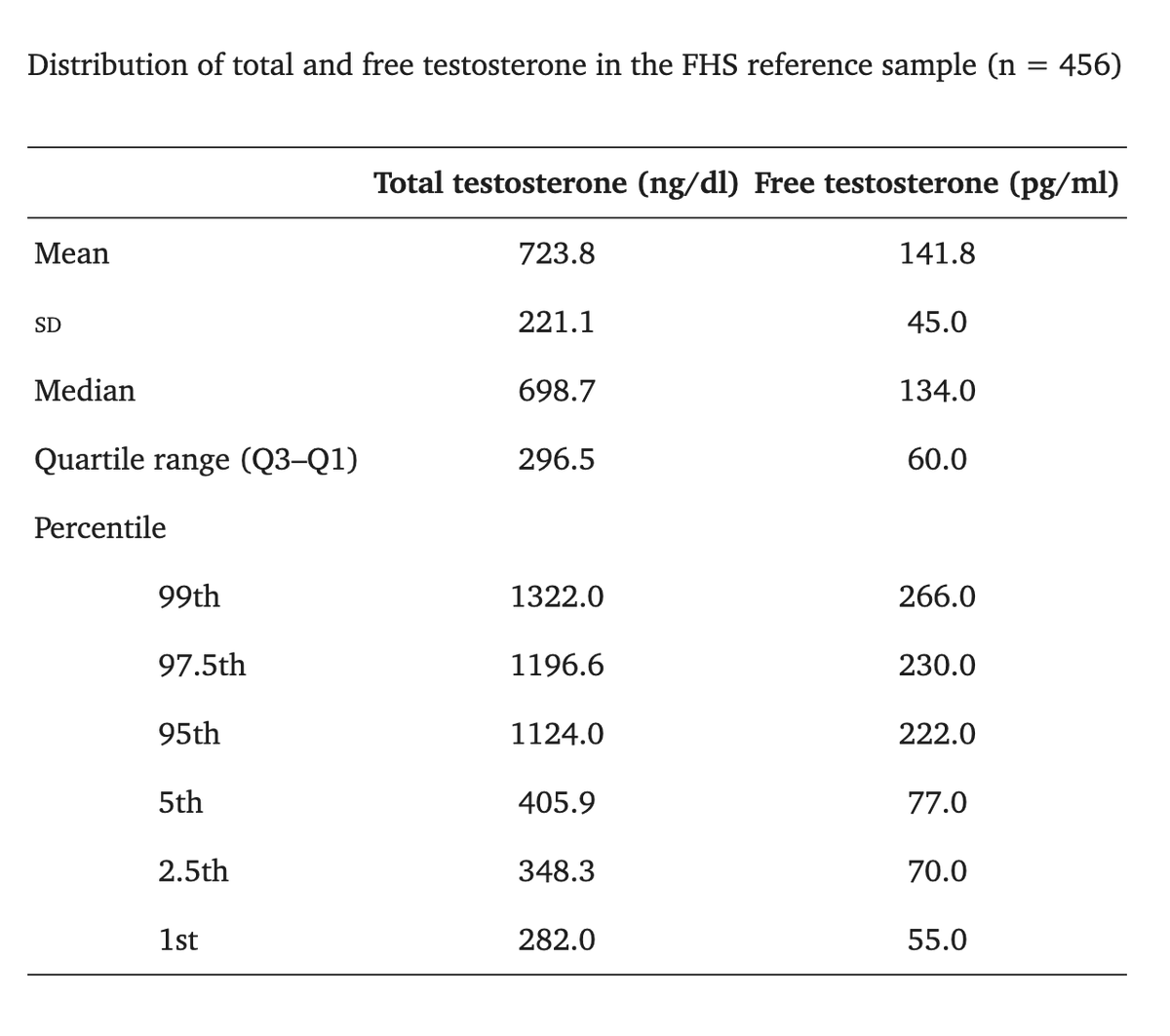
Testosterone 5th-95th percentile ref. ranges: 405-1125 ng/dL in 20-40 y/o healthy males. Reminder that the current AUA/ES guidelines for <300 ng/dL on 2 lab draws to begin TRT is wild and far more conservative than what is routinely done.
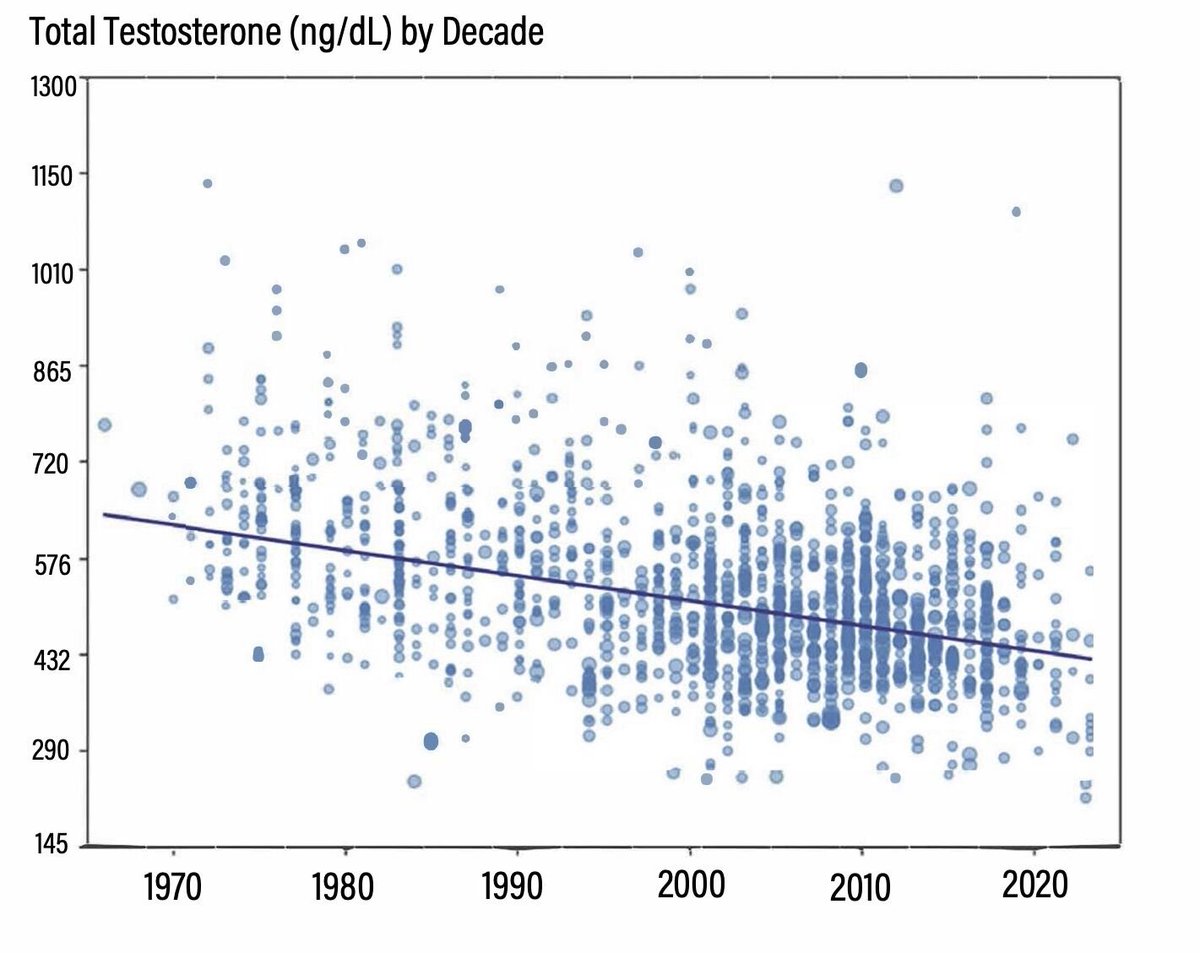
Testosterone levels by decade of life (2017); median values around 450-500 ng/dL in non-obese men. Median values higher and likely closer to ~600 ng/dL in the 1980s.
@bryan_johnson 539% relative improvement is misleading without reporting absolute hair count. Prior studies also have minoxidil beating clascoterone. https://t.co/7BIY8shCwO
Chris Williamson's brutal wake-up call in 46 seconds:
“Adults don't exist.”
He runs down the list:
- Steve Jobs delayed pancreatic cancer treatment for carrot juice and acupuncture.
- Mozart drowned in debt, constantly begging friends for money.
- Nietzsche caught syphilis in a brothel and sold only 300 copies of his work in his lifetime.
- Martin Luther King had affairs with over 40 women and spent his last night with two of them.
- Isaac Newton wasted 30 years on alchemy pseudoscience his heirs hid out of embarrassment.
The point lands hard:
Don't put any adult on a pedestal.
Kill your gurus.
The adults aren't going to save you — they don't even exist.
Raw, unflinching, and impossible to unhear.
Which "hero" or guru did you once idolize… until you learned the messy truth behind them?
Women who "reached 30 w/o starting a family [had] only a 52% chance of having children... Cross that threshold without children, and your odds of having children fall closer to almost one-in-two." @compactmag
People’s desire to belong often defeats their desire to improve. - James Clear My editorial: Hang out with complainers, and those focused on criticizing others you’ll be unhappy & won’t get much done in life. Hang out with doers, you’ll be happy, productive & have a great life.
The reward that naturally comes from sex with a partner you are attracted to is the most potent motivator in the known universe. When sex is scarce because women are protecting themselves from getting stuck raising children alone, marriage is the price, and kids are the result. Which naturally motivates both men and women to be excellent so they can marry well, because that matters.
We broke that system without understanding what depended on it. Sex is no longer precious, and civilization is in jeopardy. It’s not quite that simple, but it’s damn close.
American conservatives:
To keep power for generations, all you had to do was to act a little bit less batshit insane than the woke Left was acting. Just a little bit.
By doing that, you attracted millions of new supporters since 2015.
Now you're about to lose it all, by embracing, coddling, & defending a gang of vicious lunatics even worse than the woke DEI Left ever was.
This is your decision point.
Sanity or insanity.
Choose the former, and you'll win 2026 and 2028 and onwards.
Choose the latter, and you will crash and burn, and wander the political wilderness forever -- resentful, confused, powerless, defeated, wondering where it all went wrong.
This is a great piece with some mind-boggling statistics.
- At Brown and Harvard, more than 20% of undergraduates are registered as disabled
- At Amherst: more than 30 percent
- At Stanford: nearly 40 percent
Soon, many of these schools "may have more students receiving [disability] accommodations than not, a scenario that would have seemed absurd just a decade ago."
As students and their parents have recognized the benefits of claiming disability—extended time on tests, housing accommodations, etc—the rates of disability at colleges, and especially at elite colleges, has exploded.
America used to stigmatize disability too severely. Now elite institutions reward it too liberally. It simply does not make any sense to have a policy that declares half of the students at Stanford cognitively disabled and in need of accommodations.





![BradWilcoxIFS's tweet photo. Women who "reached 30 w/o starting a family [had] only a 52% chance of having children... Cross that threshold without children, and your odds of having children fall closer to almost one-in-two." @compactmag https://t.co/Cn557QLJ0O](https://pbs.twimg.com/media/HA4YSR3a4AAl9g0.jpg)
![DKThomp's tweet photo. This is a great piece with some mind-boggling statistics.
- At Brown and Harvard, more than 20% of undergraduates are registered as disabled
- At Amherst: more than 30 percent
- At Stanford: nearly 40 percent
Soon, many of these schools "may have more students receiving [disability] accommodations than not, a scenario that would have seemed absurd just a decade ago."
As students and their parents have recognized the benefits of claiming disability—extended time on tests, housing accommodations, etc—the rates of disability at colleges, and especially at elite colleges, has exploded.
America used to stigmatize disability too severely. Now elite institutions reward it too liberally. It simply does not make any sense to have a policy that declares half of the students at Stanford cognitively disabled and in need of accommodations.](https://pbs.twimg.com/media/G7LcXueWUAAC2Qg.png)


