I highly recommend the interview of Ricardo Caballero by Paul Krugman (two greats). It starts off with PK admitting defeat (sort of) to RC on the issue of global imbalances. Overall, a great economic discussion.
https://t.co/2m32KX3COm
Why do many economists like markets? Because most markets, although not all, work well. There is bread in bakeries, cars at car dealers, and books in bookstores because the price system provides economic agents with incentives to ensure these outcomes. Of course, markets are never perfect outside economics textbooks. More often than not, we face inefficiencies such as limited competition or externalities.
The intelligent case for markets has never been that they are flawless, a proposition so obviously untrue that it is not even worth discussing (unless you are writing for the Stanford Encyclopedia of Philosophy). The case for markets is that they usually work better than feasible alternatives.
Note that I used three words: “usually,” “better,” and “feasible.” The word “usually” tells us that, sometimes, markets fail. A market for national defense is unlikely to work because it is impossible for a private air force to defend my house but not my neighbor’s, who refuses to buy the service.
The word “better” reminds us that, even when markets do not work well, the alternatives may be worse. Flying with American Airlines is a ticket to an unpleasant experience. But those of us who have flown in government-run airlines understand that service can be considerably worse.
The final word, “feasible,” emphasizes that one should not judge market behavior against an idealized public service staffed by angels. Alternatives to market systems are run by humans, with their strengths and shortcomings, and, in particular, without the incentives provided by the profit motive.
You might disagree with my case for markets. But, at the very least, you need to understand what I am claiming. Otherwise, this is not an intellectual discussion; it is a brawl at a bar.
El ITAM lamenta el fallecimiento de don Miguel Mancera Aguayo, egresado, profesor e integrante de su Junta de Gobierno desde 1967. Formador de economistas, su rigor intelectual, integridad y generosidad dejan un legado invaluable.
Descanse en paz.
https://t.co/3QxITVpsPF
Las evidencias científicas sugieren que el ser humano no envejece de forma lineal, si no más bien gradual. Un envejecimiento en 3-4 olas o periodos clave.
Breaking news: Alan Greenspan, the US Federal Reserve chair who dominated global markets in the late 20th century only to see his legacy tarnished by the financial crash, has died at the age of 100. https://t.co/lO7pwXujrW
Excited to FINALLY release toughest+most rewarding paper I've worked on...
….we attack a 150 year old Walras question that's gone unanswered, not for lack of trying (Hicks, Samuelson, Arrow; our chances?😱)...
Q: Is the market equilibrium stable or unstable?¯\_(ツ)_/¯
🧵
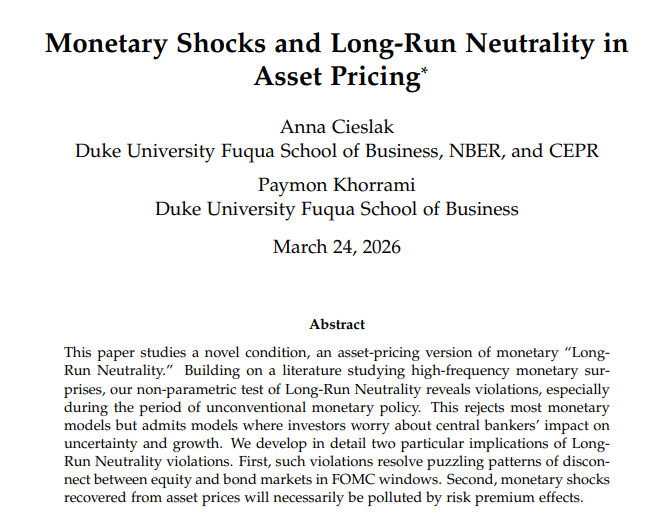
Was watching the talk, discussion, and Q&A of a very interesting new paper presented at a recent NBER meeting, all of which were very good. I wrote a short comment about something that came up in one of the questions
#OrgulloITAM
¡Felicidades a Agustín Carstens por su nombramiento como integrante del Consejo de Administración de UBS!
Su destacada trayectoria a nivel internacional es reflejo del compromiso, liderazgo y excelencia que distinguen a la comunidad ITAM.
Conoce más sobre este logro aquí:
https://t.co/cJI2rgTTXM
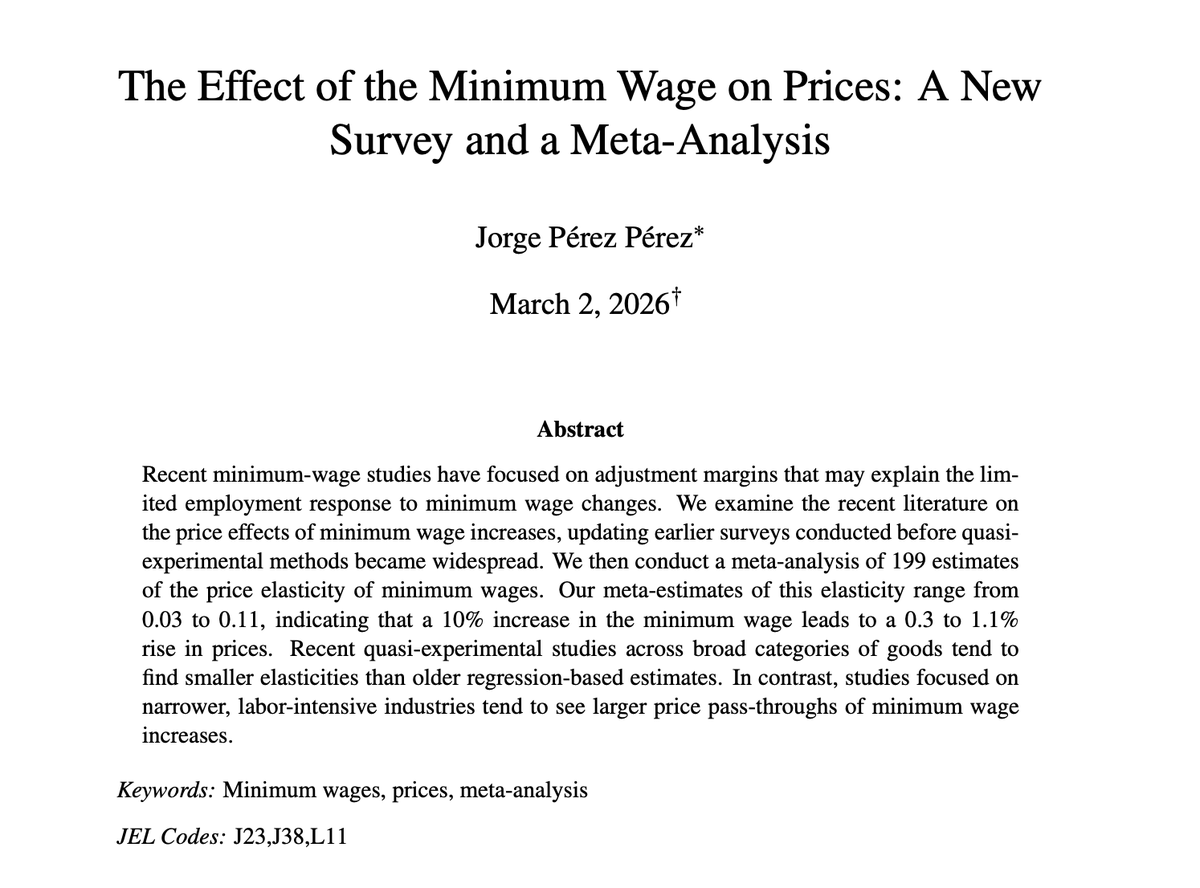
Los aumentos del Salario Mínimo (SMI) generan aumentos de precios, que son más relevantes en sectores intensivos en mano de obra.
En media, si aumenta un 10% el SMI, los precios lo hacen entre un +0,3 y +1,1%.
Meta-análisis (2009-2024) de @jorpppp:
https://t.co/fcuXdJZVYM
I want to take a moment to defend calibration. A common critique of macro by non-macro people centers on the supposed lack of scientific rigor associated with calibration of models. 1/10
📢📢New paper alert. Looking at 3 centuries of US and UK data, we conclude that r is much lower than g during wars, because of a surge in surprise inflation and financial repression, but not in peacetime.
https://t.co/FO6JqaolBX
Back in the 1960s, Robert Triffin predicted that the Bretton-Woods arrangement would be short-lived. To keep the world supplied with enough dollars, the US would have to keep running balance of payment deficits, ultimately leading investors to question the gold backing of all those dollars being recycled abroad. He was proven right within a decade. This time around, the same questions are being asked about the backing of US Treasurys.
The Safe Assets that weren't. https://t.co/NYNURJoRVh
David having been my student, I am proud to have contributed, as a Frenchman, and admittedly somewhat indirectly, to the improvement of NFL football. (and who says economists are useless?...)
NFL: what about free tickets to the superbowl?