Norway consistently wins the most medals at the Winter Olympic Games, with a population of just 5.6 million people.
A big part of their success is how they treat youth sports—and it’s the opposite of what we do in the US. Here’s what we can learn from Norway:
1. Scorekeeping:
In the US: Youth sports tend to be hyper competitive even at early ages. Leagues almost always keep score.
In Norway: Scorekeeping isn’t even allowed until age 13.
Removing winners and losers keeps the focus on the process not outcomes. It keeps kids engaged longer because it minimizes pressure (and tears) and maximizes fun, learning, and growth. The goal isn’t to win a third grade championship. It’s to love sport and keep playing.
2. Trophies:
In the US: If you give everyone a trophy, you’re creating snowflakes who will never gain a competitive edge.
In Norway: Whenever trophies are awarded, they are handed out to everyone.
If getting a trophy makes young kids feel good, we should give them trophies. Maybe they’ll come back and play again next year!!
As for the creation of snowflakes with no competitive edge—Norway’s athletes are tough as nails and all they do is win.
3. Prioritizing Fun:
In the US: Far too often, the goal is to win.
In Norway: The national philosophy is “joy of sport.”
Youth sports in the US are driven by adults, ego, and money. Youth sports in Norway are driven by fun.
Only half of kids in the US participate in sports. The number one reason they drop out: because they aren’t having fun anymore. In Norway, 93% of kids participate in youth sports. Fun is the foremost goal.
4. Playing Multiple Sports:
In the US: There’s pressure to specialize early and play your best sport year round.
In Norway: Try as many sports as you can before specializing as late as college.
Norway encourages kids to try all types of sport. This reduces injury and burnout and increases all-around athleticism. It also helps promotes match quality, or finding the sport you are best suited for as your body develops, which is impossible if you commit to a single sport too early.
5. Affordability
In the US: There is increasingly a pay-to-play model with high fees for leagues, equipment, and travel. This excludes many kids from playing.
In Norway: It’s a national priority to keep youth sports affordable and therefore accessible for all.
Kids aren’t priced out, which creates opportunities for everyone to participate (and develop into athletes), regardless of their parents’ income level.
We could learn a lot from Norway:
In the US, 70% of kids drop out of youth sports by age 13. This not only diminishes an elite-athlete pipeline, but it also destroys an opportunity for healthy habits and all the character lessons kids can learn from sport.
In Norway, lifelong participation in sport is the norm. The goal isn’t to have the best 9U team. It’s to develop the best athletes. Those are two very different things. And Norway has the gold medals to prove it.
America is the greatest country in the world.
But we need more founders working on real problems.
If you are in the early stages of building something that matters, you have to be in El Segundo.🇺🇸
Apply to the Spring Cohort in bio.
Deadline February 20th.
Energy is the root of all economic activity, and fuel is the bottleneck. Thanks for digging in @mariogabriele.
For anyone who wants to help end the bottleneck, @generalmatter is hiring in LA, western KY and central WA. High-agency engineers, builders and operators wanted.
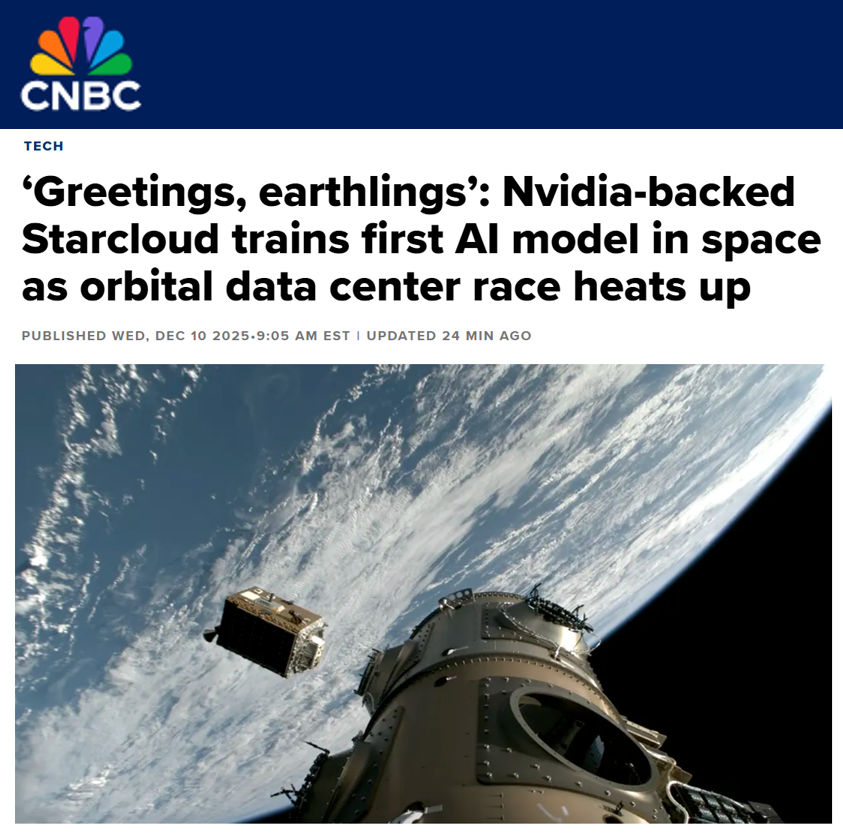
For the last several months, we’ve been working on the design of our @Starcloud_-3 distributed constellation of 200kW inference nodes in dawn-dusk sun-synchronous orbit, providing many gigawatts of low-cost AI compute. It seems we’re not alone! 🙌
We just trained the first LLM in space using an @Nvidia H100 on Starcloud-1! 🚀
We are also the first to run a version of @Google's Gemini in space!
This is a significant step on the road to moving almost all compute to space, to stop draining the energy resources of Earth and to start utilizing the near limitless energy of our Sun!
Thanks @pia_singh_ and @CNBC, for highlighting our work!
@starcloud_, @AdiOltean, @ezrafeilden
For a long time I've been obsessed by the idea of Scenius - disproportionate impact produced by outlier groups of people in a distinct time and place.
Bell Labs, Xerox Parc, Skunkworks, ARPANet, 1930s Paris - progress in science, technology and art has historically been uneven.
https://t.co/QHWyXuJ5BK
Starcloud (@Starcloud_Inc1) recently made history by launching a satellite with an NVIDIA H100 into orbit — the first time a GPU that powerful has ever operated in space. It's the first step toward building AI data centers in orbit, powered by continuous sunlight and cooled by radiating heat into deep space.
Their approach could one day rival the world's biggest data centers while using less energy, zero fresh water, and far lower emissions.
YC's @aaron_epstein visited Starcloud's HQ, where co-founders @philipjohnston, @EzraFeilden, and @Adi_Oltean explained how they built a working prototype in just 15 months — and why big tech is racing to space for AI compute.
@isaiah_p_taylor Agreed - although this prob leads to tightening regulation / enhancing disclosure requirements on private companies, and then the point of private becomes partially defeated