Congratulations to Michel Devoret, Chief Scientist at @GoogleQuantumAI, John Martinis, former hardware leader at @GoogleQuantumAI, and John Clarke on winning the @NobelPrize in Physics! The history of quantum computing is unfolding before our eyes ↓ https://t.co/AY9LJnfNjK
Introducing Willow, our new state-of-the-art quantum computing chip with a breakthrough that can reduce errors exponentially as we scale up using more qubits, cracking a 30-year challenge in the field. In benchmark tests, Willow solved a standard computation in <5 mins that would take a leading supercomputer over 10^25 years, far beyond the age of the universe(!).
Physicists have made a breakthrough in the development of a nuclear clock, a new kind of ultra-precise clock that could revolutionize timekeeping. https://t.co/Gxz7goo7ga
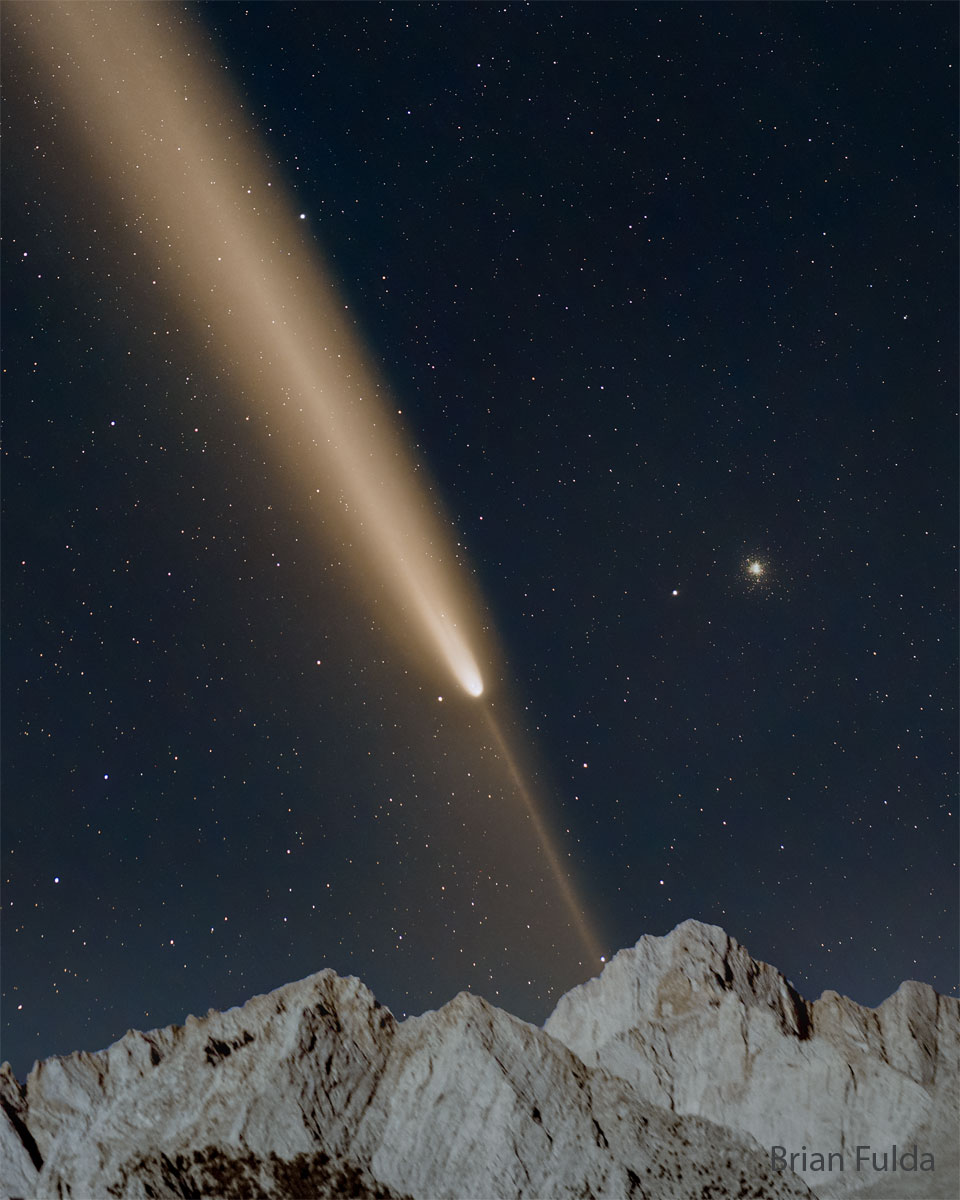
The tails of Comet Tsuchinshan-ATLAS were a sight to behold. Pictured, C/2023 A3 (Tsuchinshan–ATLAS) was captured near peak impressiveness last week over the Eastern Sierra Mountains in California, USA. The comet not only showed a bright tail, but a distinct anti-tail pointing in nearly the opposite direction. The globular star cluster M5 can be seen on the right, far in the distance. As it approached, it was unclear if this crumbling iceberg would disintegrate completely as it warmed in the bright sunlight. In reality, the comet survived to become brighter than any star in the night (magnitude -4.9), but unfortunately was then so nearly in front of the Sun that it was hard for many casual observers to locate. Whether Comet Tsuchinshan-Atlas becomes known as the Great Comet of 2024 now depends, in part, on how impressive incoming comet C/2024 S1 (ATLAS) becomes over the next two weeks.
Credit & Copyright: Brian Fulda
This year’s #NobelPrize laureate in physics John Hopfield created an associative memory that can store and reconstruct images and other types of patterns in data.
The Hopfield network can store patterns and has a method for recreating them. When the network is given an incomplete or slightly distorted pattern, the method can find the stored pattern that is most similar.
Read more about the research that led to this year’s physics prize: https://t.co/QuIdxRvuEP
BREAKING NEWS
The Royal Swedish Academy of Sciences has decided to award the 2024 #NobelPrize in Physics to John J. Hopfield and Geoffrey E. Hinton “for foundational discoveries and inventions that enable machine learning with artificial neural networks.”
Le vide n’est pas le néant. Il est quelque chose de particulier. Sa définition prend donc la forme d’un cercle : « le vide est ce qui reste quand on a tout enlevé, sauf… le vide ».
Et c’est là que la grande aventure de la physique peut commencer.
Chouette docu sur @ARTEfr sur la quantique dans lequel j'ai eu la chance de raconter un peu ce que j'en comprends, avec d'autres collègues supers. https://t.co/GQKz9Dpltt
Darktable 4.6.1 Open-Source RAW Image Editor Released with Performance Improvements and Bug Fixes https://t.co/2PePYhzHqD
#OpenSource#FreeSoftware#Linux
Darktable 4.6.0 is now available, adding new features and improved camera support to the popular open-source Lightroom alternative.
https://t.co/iFSz8YAjX5
Quel bilan carbone pour les vélos électriques ?
Anne De Bortoli @anne2bortoli, chercheuse en carboneutralité à Polytechnique Montréal @Poly_InsightsFR https://t.co/KZC1xv20F6
[REPLAY ⏯️] Dans cet exposé #AnnéePhysique, Frédérique Marion (@CNRS) se concentre sur la gravitation et sur le nouveau champ scientifique que sont les #OndesGravitationnelles et leur détection.
➡️ https://t.co/HRir8dj8Gs