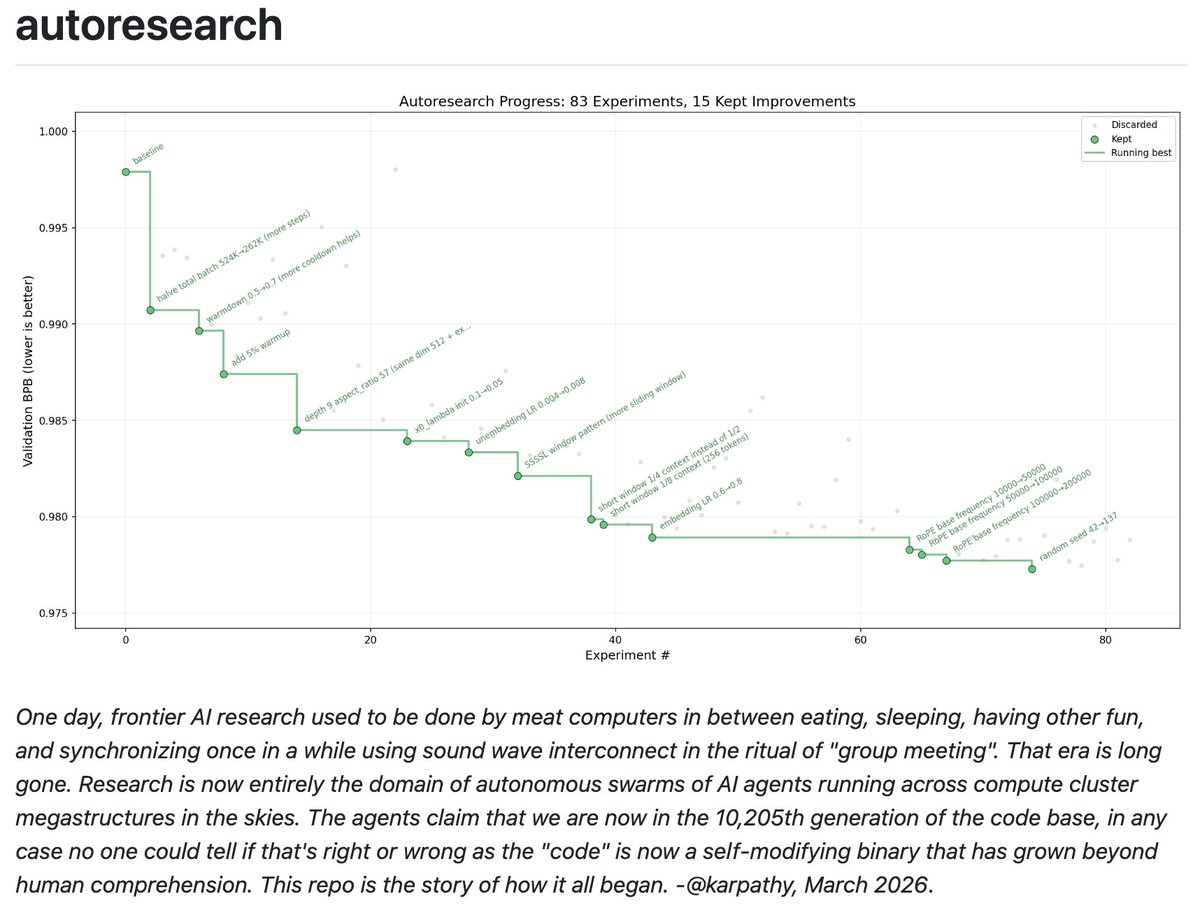
I packaged up the "autoresearch" project into a new self-contained minimal repo if people would like to play over the weekend. It's basically nanochat LLM training core stripped down to a single-GPU, one file version of ~630 lines of code, then:
- the human iterates on the prompt (.md)
- the AI agent iterates on the training code (.py)
The goal is to engineer your agents to make the fastest research progress indefinitely and without any of your own involvement. In the image, every dot is a complete LLM training run that lasts exactly 5 minutes. The agent works in an autonomous loop on a git feature branch and accumulates git commits to the training script as it finds better settings (of lower validation loss by the end) of the neural network architecture, the optimizer, all the hyperparameters, etc. You can imagine comparing the research progress of different prompts, different agents, etc.
https://t.co/YCvOwwjOzF
Part code, part sci-fi, and a pinch of psychosis :)
How I get 100% perfect sleep:
- very cold bedroom 18-20°C / 64-68°F (colder better)
- 9kg weighted blanket by CURA (adjust to your bodyweight)
- separate duvet from gf (I do this for years this might be the biggest sleep improvement)
- 3M ear plugs (I tried Ohropax wax but they only half as silent)
- eye mask
- red LED lights that go on before sleep in bedroom
- 0.2mg melatonin 45min before sleep then dim the lights (melatonin is ALWAYS sold in too high dose like
3mg, it should be 10x less or it doesn't work!)
- 4x per week cardio + strength training, my resting heart rate (RHR) is 52
- mostly clean diet of meat + vegetables + fruit + black coffee + sparkling water with lemon (and sometimes cheat with dark choco), not a lot of carbs (almost never pasta or regular potatoes for ex but sometimes rice or sweet potatoes)
- healthy biomarkers and body mass index, if you're overweight it WILL affect your sleep usually with sleep apnea etc
- read phone before sleep but with Smart Invert on and my custom super dark hack using iOS Zoom (but it doesn't zoom it just decreases brightness even further), then read Kindle a bit to really make me sleepy 😂
- we try avoid eating after 10pm, and we sleep around midnight to 1am, especially sweet stuff like fruits seem to have a bad effect on my sleep
- also DO not drink 2-3 hours before sleep or you wake up to go pee (which is more common when you get older)
- disclaimer: no kids (yet) so easy talking
Other things:
Temperature seems to be the biggest impact for me, if it gets too hot I wake up and once I wake up my brain gets active and it's sometimes hard to fall asleep. I already had this years ago and thought it was stress but even if I have life stuff going along I can sleep solid 8h without waking up if it's just a very cold bedroom.
If it's really super cold like 17-18°C / 62-64°FI just never wake up
For that you need a thick duvet though and your gf needs thicker cause women are generally colder
If you're culturally used to sleeping hotter, consider changing that because it seems to benefit almost anyone to sleep colder! An AC will do the trick.
As @bryan_johnson tells everyone, sleep is the most important thing to prioritize for your health
Good sleep benefits all your health markers, your immune system and so stops you from getting sick. Even cleaning your brain of plaque to avoid dementia when you're older
Personally I prefer in-person interviews. Video calls feel like a compressed version of communication, some sort of dimension reduction for human signals.
What if Studio Ghibli directed Lord of the Rings?
I spent $250 in Kling credits and 9 hours re-editing the Fellowship trailer to bring that vision to life—and I’ll show you exactly how I did it 👇🏼
I think everyone should watch @Karpathy's latest video on how he uses LLMs, even those who think AI is already a big part of their lives because:
1. One of the best minds in AI is spending time showing how he uses AI personally rather he could have spent his time building AGI , that's one of the reason to watch & learn
2. @karpathy clearly explains a first-principles approach to leveraging these tools & the visual explanation really helps you build a mental model for specific use cases.
below is short high level summary & some note's that I had taken from the video
- karpathy takes us through the practical applications of various tools with lots of examples & different settings one can play around with while using these tools
- he starts off with -> to get a general Idea about what are the best models at anytime , one can always look that up In https://t.co/WuMWeCp9u7 & @scale_AI seal leaderboard ( https://t.co/HOSlEwPr0d)
- he starts with @OpenAI's ChatGPT ( the OG & the most feature rich AI tool that Is available currently & the one that has been there for the longer time) which started the era of where one can give a text Input and get a text output via an Interface.
- my fav part was he explaining from first principles what exactly is happening under the hood when we Interact with Chatgpt - it's amazing how he visually thinks about this & presents It 😅
- difference between a pre-training stage vs the post-training stage (🙂) which is the final model that we get to interact with , basically a fine tuned version of the base model via SFT , RLH or RL -> all of this compressed Into a single zip file
- one cannot directly use the base model (pre-trained) since in this stage we optimise the model to predict the next token In the sequence , but during the post-training we can actually use this for real world applications as this model can now act as an assistant basically combining loads of knowledge with some style ,form, personality & yet this knowledge has a cut-off date.
Agency > Intelligence
I had this intuitively wrong for decades, I think due to a pervasive cultural veneration of intelligence, various entertainment/media, obsession with IQ etc. Agency is significantly more powerful and significantly more scarce. Are you hiring for agency? Are we educating for agency? Are you acting as if you had 10X agency?
Grok explanation is ~close:
“Agency, as a personality trait, refers to an individual's capacity to take initiative, make decisions, and exert control over their actions and environment. It’s about being proactive rather than reactive—someone with high agency doesn’t just let life happen to them; they shape it. Think of it as a blend of self-efficacy, determination, and a sense of ownership over one’s path.
People with strong agency tend to set goals and pursue them with confidence, even in the face of obstacles. They’re the type to say, “I’ll figure it out,” and then actually do it. On the flip side, someone low in agency might feel more like a passenger in their own life, waiting for external forces—like luck, other people, or circumstances—to dictate what happens next.
It’s not quite the same as assertiveness or ambition, though it can overlap. Agency is quieter, more internal—it’s the belief that you *can* act, paired with the will to follow through. Psychologists often tie it to concepts like locus of control: high-agency folks lean toward an internal locus, feeling they steer their fate, while low-agency folks might lean external, seeing life as something that happens *to* them.”
Mauboussin & Callahan just shared a paper on the psychology of expected value.
"How often you are right is not all that matters. What is vital is how much money you make when you are right versus how much you lose when you are wrong".
🧵 Our 8 favourite highlights:
1/ Today the Prime Minister published my AI Opportunities Action Plan for the UK and committed to implement all its recommendations. A quick thread on why this is important, what we need to do now - and how you can help
What's more interesting is that skilled worker visa consists of two types:
- Skilled worker - health and care: ~146,000 (10%)
The official definition: "be a qualified doctor, nurse, health professional or adult social care professional"
- Skilled worker: ~ 104,000 (7%)
The immigration strategy of the UK doesn't seem too promising economically. In 2023, about 1.43 million visas were granted (excluding visitor visas) but only ~250,000 (17%) were skilled worker visas. 🧵
https://t.co/F176OgZKN5
Maybe it's a no-brainer, but let's just narrow down the comparison to two cities - London vs. Seattle. As a person working in tech, where would you choose to work or start a tech company and why?
It’s astonishing that leasehold properties make up around 20% of the total housing stock in England—and an even higher 36% in London.
The data was collected in 2022-2023, I bet the ratio is even more skewed now.
https://t.co/TnNBuan5cw