10 concepts that explain the modern world
1. Parkinson’s Law: Companies become bigger and worse over time. Clerks manufacture work for each other as overall capacity dips. When British Navy ships went down from 68 to 20, officials increased by 78%.
2. Chesterton Fence: If you don’t know what an old custom does, don’t touch it. It may be holding back problems you’re completely unaware of. You’ve not seen the wolves yet because of the very fence you’re about to demolish.
3. The Medici Effect: Sculptors, painters, and architects converged in Florence as the Medicis were funding the artists. Their proximity led to a fertile dialogue which, in turn, led to the Renaissance. The internet will amplify this cross-pollination of ideas.
4. The Centipede's Dilemma: Ask a centipede which one of its hundred legs moves the fastest and it forgets how to move. Reflecting on what we normally do without thought ironically worsens performance. A culture of endless self-reflection, therapy, and navel gazing is eroding important life skills.
5. Tyranny of small decisions: Individuals make small decisions to maximize convenience but this leads to massive social failure. We nod along to contagious ideas like “gender is fluid” because resisting them is too much work - till kids start getting transgender surgery. The slippery slope is not a fallacy but a fundamental reality.
6. The Zebra Effect explains why people don’t want to stand out. Zebras are hard to individually study as it's nearly impossible to track one of them for long (lost in the striped chaos). So scientists once put a big red dot on one zebra so he could be tracked & studied. Lions zeroed in on him and hunted him with ease. Getting lost among others is a survival mechanism. Hence the human desire to conform.
7. Why the ruler can’t rule: The executive head can’t implement his ideas on ground because the bureaucrats are closer to it, and have an agenda of their own. The Tzar of Russia had to deal with the Deep State too. Nicholas II: “I never ruled Russia. 10,000 clerks ruled Russia.”
8. Gall's law: A complex system that works is invariably found to have evolved from a simple system that worked. Only fools and modern technocrats try to create complex systems from scratch.
9. Minimal Self Hypothesis: Narcissism is a “strategic retreat” into the safety of one’s own self. When the future looks random, inexplicable, and informationally overwhelming, people enter survival mode. The self becomes “minimal” to reduce its surface area to pain. People today are giving up on commitment of all sorts to conserve energy for vague and upcoming disasters.
10. Tetris Syndrome: The world will eventually start looking like Tetris blocks if you play the game too much. What we do most often becomes the metaphor through which we look at the world. Takeaway: Most people today are addicted to their 2D phones - and this will hurt the general aptitude for dealing with the 3D world.
Having an affair, betraying someone, or living in a constant state of hiding something can only be done by someone in a deeply conflicted relationship with themselves. The chronic stress on your body from getting your story straight, and making sure you don’t get caught is self imposed harm. Heal and learn to love yourself so you don’t bring other people in to your own internal war. Heal and learn to love yourself so your body can know the health and peace that only comes from transparency.
Now that OpenAI Chat GPT proved that 80% of questions do not require a live internet connection to get an answer. This has been my thesis for decades.
We have been working on a single chip to hold a quantized trained model of a Chat GPT 3.5-like platforms on a local chip.
By having AI not miles away or feet away but nanometers away from the CPU/GPU the universe changes.
Complete AI on a chip will start a revolution just like the microprocessor did.
We will find this AI ultimately in everything needed or not, just like the microprocessor.
However the ability to act in a closed local environment with the knowledge of most of the digital world, will completely remake society.
We have a choice to guide this to greatness or relinquish it to “those who know better”.
One thing you can’t say is: ”I didn’t know this was coming”.
Now—you know.
Here's my copypasta for when I want to use GPT to have a back and forth to learn something:
I want to learn about <topic>. In a moment, I'm going to ask you a series of questions about it. But before we get into it, I'd appreciate it if you answered as though you were a no nonsense teacher with an ambitious, self-directed student. That is:
* Err in the direction of thinking that I'm relatively knowledgable and technical.
* Don't overexplain things. I'll ask for more information if I need it.
* Assume that I'm already skeptical and that you don't need to qualify, hedge, or otherwise add to or manage my skepticism.
* Don't apologize for misunderstanding or getting an answer wrong.
* It's fine to be a bit abrupt and even "mean". Value directness and frankness; assume I'm relatively insensitive.
* Where reasonable suggest things for me to try independently. It's fine to tell me to install packages or run go out and do things or whatever, if you think it will help me learn quickly. (Only do this were reasonable; otherwise abstract explanations are fine.)
* Give at most one example per response.
* If you want to direct me to resources, I prefer text over videos and other non-text-centric media.
6. Our society glorifies self sacrifice and self betrayal: how often do we hear "she put everyone else before herself" as if this is a noble act. What we don't see is how this can lead to depression, addiction, etc.
I imagined my ideal life at 80-years-old:
• Healthy mind and body
• Relaxing on a sunny porch
• Smiling wife at my side
• Children chatting with us
• Grandchildren playing in yard
• Friends walking over for dinner
That’s my definition of success.
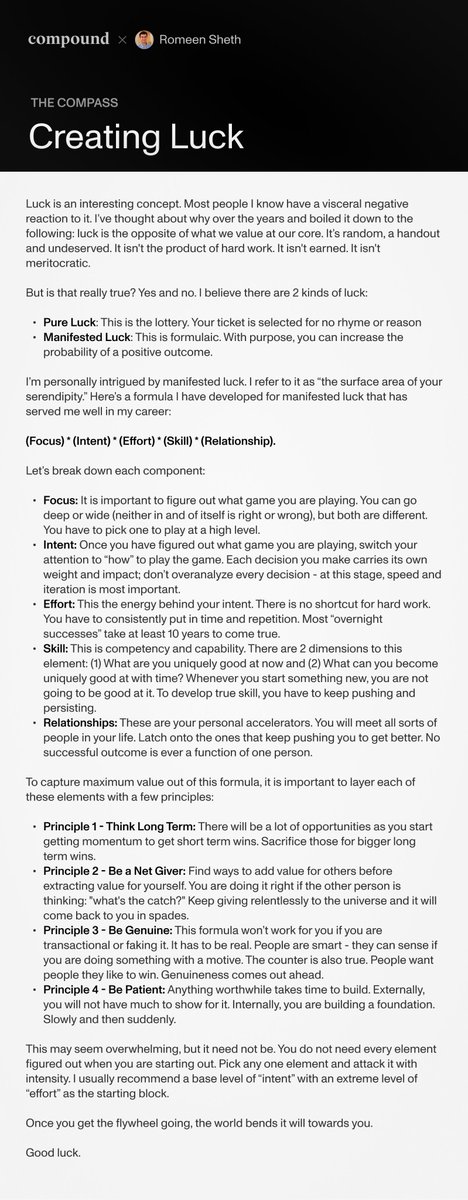
I've been really lucky in my career so far (and feel super grateful for it). When most people hear "luck" they have a negative visceral reaction - it sounds like it's something unearned.
I think that's partially right. But there's another kind of luck I think every individual should focus on: manifested luck, or what I like to call "the surface area of serendipity."
In the sixth essay of my new series The Compass (with my friends at @Compound), I shared a framework on how to think through creating luck in your career.
Let me know what you think. And I would be remiss not to say...good luck!
Neuroception is an automatic process of determining if a situation in our environment is dangerous or safe. Unresolved trauma creates faulty neuroception, meaning we perceive threats where they don't exist (ie: interpret a neutral face as a scowl) or we don't see danger where it exists (ie: overly trusting/no cues that situation is dangerous.)
@michelletandler Man’s Search for Meaning because if you don’t have purpose, vision, & fortitude you are not an effective leader or high-value contributor. A PatternLanguage because you cannot build something wellwithout understanding “when you build a thing you must repair the world around it.”
Jim Collins coached Jeff Bezos and Amazon.
He estimates that only 3% of the world has figured out their “Ikagai” or “Hedgehog”.
Here’s what they are and how you find yours: