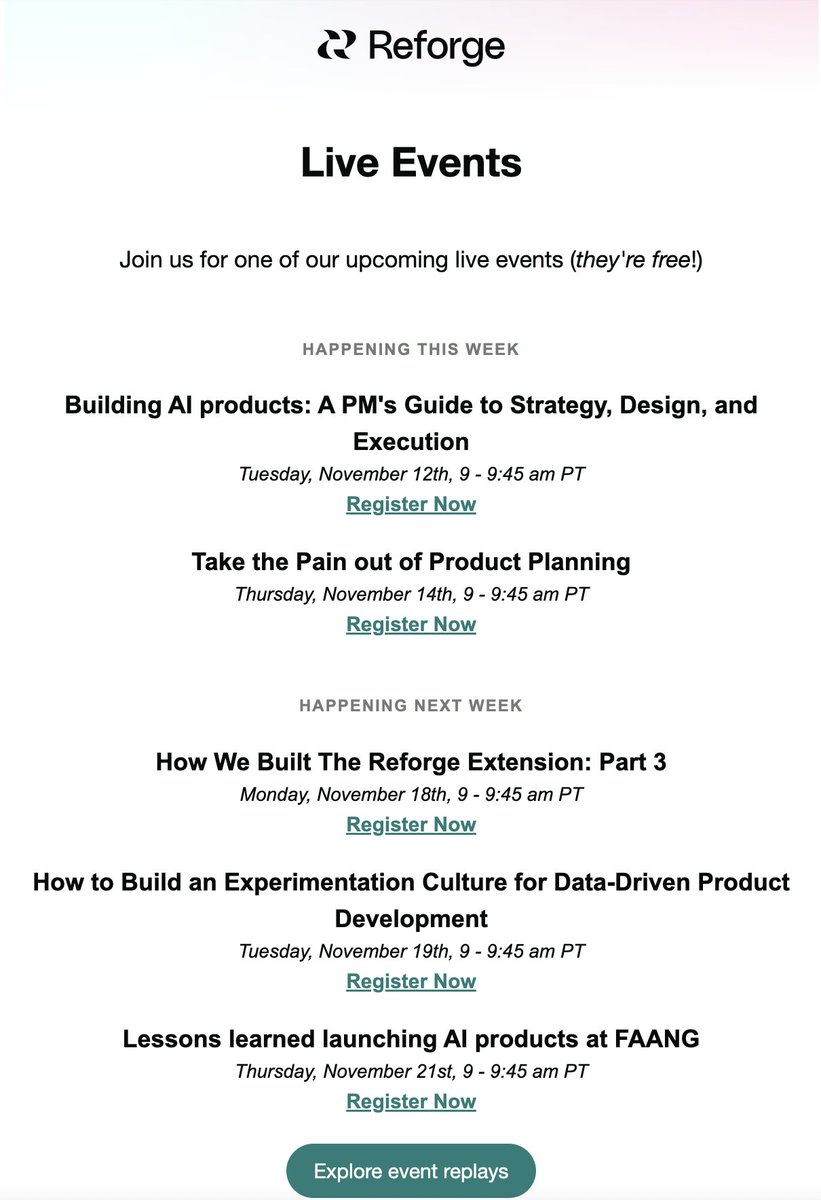
B2B teams will downplay email marketing...then send campaigns like this 👇🏼
This isn't just a copy problem. It's a strategy problem.
What's wrong, and what we can do to fix it:
❌ "Blast the list"
✅ Define the target segments.
There are 5 events listed here. And based on the titles alone, we're probably looking at 3-4 different segments at least, if not 5 different segments.
Because building a product and building a culture of experimentation, for example, will likely speak to two different target personas.
One is people related, the other product related.
By sending this email to just one segment, or the entire list, Reforge risks missing those target segments entirely.
Which means low click rates, and low conversion registration rates.
Tighter segments = relevance = better results, less churn
❌ Bundle upcoming events.
✅ Improve the event "offers" + sell each event individually
People skim, yeah.
But this email is isn't skim-friendly. (Fight me.)
There's no hierarchy in terms of the copy or design, and too many titles and dates and details.
And yet, as far as each event is concerned...there isn't ENOUGH detail.
This email is asking busy readers for their time without bothering to demonstrate why each one of these events is worth their time in the first place.
Solution: Turn each event in this email into 2-4 individual emails, targeted to specific segments, scheduled appropriately, and sell the hell out of those events.
Show the value attendees get in exchange for their time via:
✔️ Credibility of speakers
✔️ Proof of content quality and relevance (who it's for, why it will help, hard takeaways they can expect)
✔️ Accessibility (how long? when? recordings or transcripts?)
❌ Show multiple CTAs
✅ Show ONE CTV (call-to-value)
For starters, "register now" and "explore event replays" are two different CTAs for two different emails.
("explore event replays" shouldn't even be a CTA, but that's a whole 'nother topic)
Too many CTAs in one email = choice paralysis = low click-throughs.
Going back to the fix above...
Select ONE action you want readers to take, and make that the primary push of the email.
Then turn it into a call-to-value.
So instead of "register now" it becomes "Register now to build better products with less effort."
And put "register now" on the landing page, NOT the email.
Your content and marketing efforts matter.
Don't smash your own fingers by sending churn-inducing emails like this.
"I insist on a lot of time being spent, almost every day, to just sit and think. That is very uncommon in American business." - Warren Buffett
Speed is essential to be at the top of your game...but speed without clarity and direction is nothing.
Take the time to think.
"your email list is your last owned channel"
Nope, not anymore.
We're accustomed to thinking a list of contacts is an asset, something we own and can email anytime.
But that changed at least in February 2024 when Gmail and Yahoo overhauled delivery and security protocols.
Microsoft did the same for Outlook in May last year.
Inbox providers are clamping down HARD on spam and phishing activity, which means...yep, you guessed it, delivering emails is HARDER.
Inboxes are products owned by the providers, not assets owned by marketers.
And providers are incentivized to maintain users and their data.
A crappy, spammy email inbox is the opposite of that. It's hard to swallow, but truthfully, email lists are no longer "owned channels" or "assets."
They're still channels - As long as they're earned and carefully maintained and segmented.
But assets?
Something tells me Clay and Apollo wouldn't be selling them for credits if they were.
2026 marketing email metrics bible (save this) 👇🏼
1) Opens = impressions.
They tell you someone...or some THING (bot, ISP) saw or rendered your email, which means your email got successfully accepted and delivered.
...But being seen doesn't equal getting attention. More on that in a sec.
First, we need to bust a common misconception:
Low opens (sub 15%) do NOT mean you're landing in spam, at least according to Gmail's documentation.
But pay attention to those, because too many low-open sends, and ISPs like Gmail will start to view your emails as undesired or low priority, and treat your emails accordingly.
2) Clicks = attention.
Someone...or, yeah, some THING, clicked your email.
Together, opens and clicks = delivered and engaged.
Note: opens and clicks can be inflated by ISP activity, so use them as proxy metrics, not hard human engagement metrics.
3) Click-throughs = attention and interest, and maybe desire or intent.
Someone opened your email, saw it, clicked through. This is the through line of activity you want.
It's also a decent metric of actual human behavior, which is probably why HubSpot puts a lot of emphasis on this one.
4) Unsubscribes = delivered, rejected by recipient, not the ISP.
Unsubscribes aren't all bad, they can keep your lists clean, and they don't automatically suggest you're a spammer or hurt your sender reputation.
Too many unsubscribes (over 1%) means your targeting is off. Lists are cold, messaging is irrelevant to the recipient, etc.
5) Spam complaints = delivered, rejected as spam.
High spam rates are your first hard deliverability metric. If they're high, ISPs will bury you in spam folders or block you entirely. Bad, bad, bad.
Hurts your ability to send legitimate emails.
6) Bounce = not delivered.
This is your second hard sender reputation metric.
Too many hard bounces, and ISPs assume you're not doing due diligence with list hygiene and / or you're a spammy sender.
Also hurts your ability to send legitimate emails.
There you go.
6 core metrics, and why you should pay attention to them.
Bookmark this, or help a marketer out and tag someone who should.
🦔Microsoft canceled its internal Claude Code licenses this week after token-based billing made the cost untenable, even for a company with effectively infinite cloud resources. Uber's CTO sent an internal memo warning the company burned through its entire 2026 AI budget in just four months. American AI software prices have jumped 20% to 37%, and GitHub (owned by Microsoft) is dropping flat-rate plans for usage-based billing across its products.
My Take
The AI subsidy era is ending in real time. The same company that put $13 billion into OpenAI and built the Azure infrastructure powering most of Anthropic's compute just looked at the bill from a competitor's coding tool and decided it was not worth paying. That is not a productivity failure on Anthropic's end. Token-based pricing is forcing every enterprise customer to confront the actual cost of running these models at scale, and the number turns out to be far higher than the flat-rate experiments suggested.
This ties directly to my Gemini Flash post yesterday. Anthropic, OpenAI, and Google all raised effective prices in the last six months. Enterprises that built workflows assuming AI costs would keep falling are now watching annual budgets evaporate in months. Two outcomes look likely from here. Either enterprises scale back AI usage to fit budgets, which slows the revenue ramp the labs need to justify their valuations ahead of IPOs, or the labs cut prices and absorb the losses, which makes the unit economics worse at exactly the wrong moment. Both paths land in the same place, the numbers stop working, and somebody has to take the writedown.
Hedgie🤗
@kamilrextin@thejonlewis Oh man, I’m a cheapskate. Just wearing a Vincero Kairos, haha. I swap out the bands to stylize for the occasion.
Very much scoping out my next one though, so if you have any bauhaus recs let me know