Insiders know who calls the shots. Now you can too.
Petals gives you a governance expert on @near_ai for any network you point it at. Investigate privately, or publish to the Power Map so the powerful know you're watching.
Built at NEAR HACKATHON @NEARProtocol#NEARHackathon
this seems exciting/promising
we need 100% decentralized and CR stablecoins (EVEN if they can’t scale to the size of other more centralized stablecoins, we still need these)
@thomasmc@dhh This is super cool and I would love to use it, but I can't really go there until it's optimized enough to get on par with macos for local models on tokens/s.
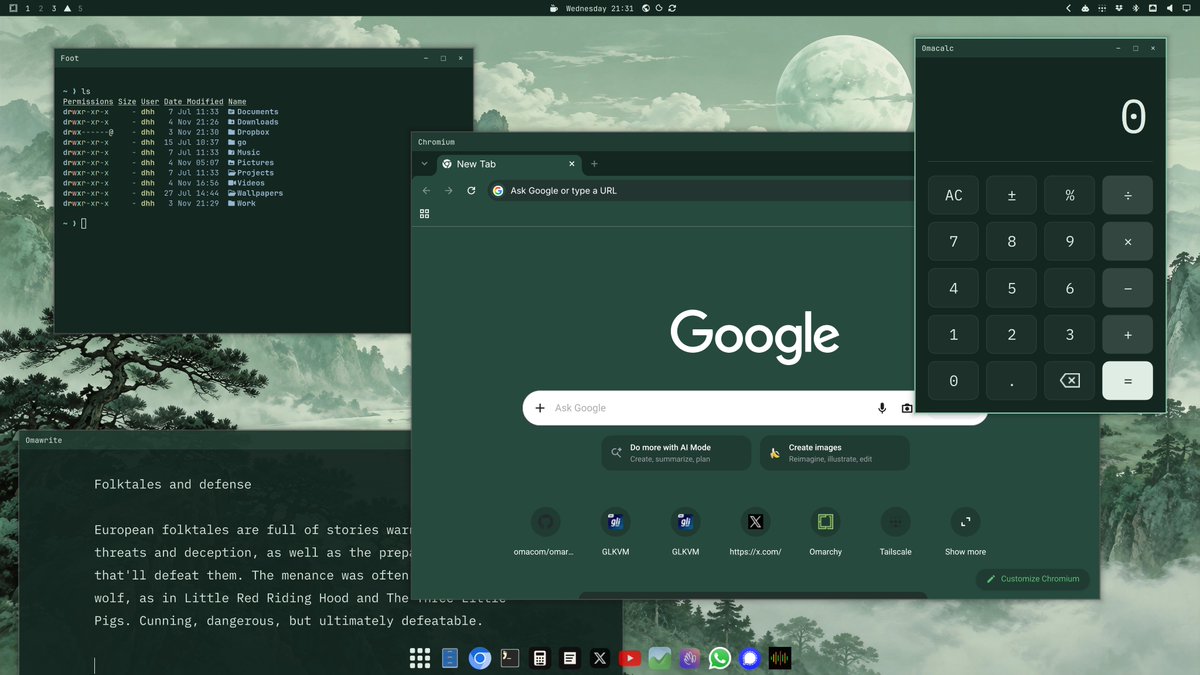
Omarchy 4.5 is finally here! Traditional desktop mode, M1/M2/M3/Neo compatibility, 50 languages, 7-second installs, and a million other features, fixes, and improvements. https://t.co/lYxY1zFxAM
This seems like a waste of time? EVM ecosystem would be better of to invest in languages with built in formal verification, e.g. https://t.co/L45yBgASeg
If I start writing smart contracts again, I would definitely not be looking at using Solidity.
SOLAR: 100x FASTER SOLIDITY
Solar is the future of Solidity and the EVM.
It's >100x faster than Solc.
It has faster bytecode than Solady with no assembly.
Its bytecode is faster to interpret by the EVM.
Solar fixes Stack Too Deep!
foundryup
forge --use solar
Blog below.
@dtcb Definitely keeping an eye on Bend. Seems like it could become quite suitable for writing zk systems!
For now thought I'm going to use lean to create a formal model. Then have an agent write Rust code that proves that it conforms to that model.
@dtcb I'm interested in creating a high level formal model of the software. Describing the properties that I find important. Finally making implementations be instantiations of that model
There is a clear ongoing divide in ethereum community right now which is clearly visible when we talk about devcoin mumbai.
ETH got both men in suits, and men in boxers.
@VitalikButerin is trying make balance between both.
If you absolutely have to bundle a script from a third party source, using the Subresource Integrity API is the way to go.
https://t.co/KPpuPjDI5U
It enables you to specify the expected hash of the javascript you are about to load. And browsers enforce it!
Turns out packaging your entire frontend so it can be distributed from one host only (or one hash, in the case of @IPFS) wasn't so crazy after all
cc @walletbeat
I would strongly consider uninstalling any third party js right now if I were you. Especially if it comes from a startup.
Analytics, monitoring, etc are all massive site takeover risks. If you use a tracking script from a third party SaaS, then if they get hacked the hackers have total control over your site too.
This is what took down Polymarket today. They used a tiny script from a SaaS that tracks page load speed. That company got hacked, and the hackers subsequently stole millions from Polymarket users.
If you want to use analytics safely, I would use a product that lets you pin the tracking script and control when it changes. Most of the mature products support this, e.g. Sentry, Amplitude, PostHog, Mixpanel, Heap. If not, you need to trust the company behind it a lot...
Railway got hacked last week. Railway! That's a very competent team, with particularly strong infra chops. The agent swarms are on another level.
A typical analytics company is nowhere near as sophisticated. You should ask yourself: do I trust this company's security more than Railway? I was an analytics CTO in a past life, and I will be the first to admit: we had some great people but we were not on this level.
We (Detail) just uninstalled our session replay, which was a product I loved but is not worth the risk right now.
I hate to write this because I spent a good chunk of my 20s benefitting from product teams taking a chance on a nothing startup and installing our js on their site. But in the past two weeks this risk vector has exploded. It's better for the ecosystem if we move away from third party js as fast as we can.
If you absolutely have to bundle a script from a third party source, using the Subresource Integrity API is the way to go.
https://t.co/KPpuPjDI5U
It enables you to specify the expected hash of the javascript you are about to load. And browsers enforce it!
Turns out packaging your entire frontend so it can be distributed from one host only (or one hash, in the case of @IPFS) wasn't so crazy after all
cc @walletbeat