“spearheaded by the agency’s elite and secretive Ground Branch” - small point, but it’s been Ground Department, not Ground Branch, since the 2016 reorganization, when Special Activities Division (SAD) became Special Activities Center (SAC). https://t.co/iYj1mAr1tT
If you don't understand this, you will not understand why LLM-based agents are irreparably failing for a general-purpose problem solving.
An agent (by the way it was the topic of my PhD 20 years ago) to be useful, must be rational. Being rational means to always prefer an outcome that results in the maximal expected utility to its master/user.
Let’s say an agent has two actions they can execute in an environment: a_1 and a_2.
If the agent can predict that a_1 gives its user an expected utility of 10, and a_2 gives an expected utility of -100, then a rational agent must choose a_1 even if choosing a_2 seems like a better option when explained in words. The numbers 10 and -100 can be obtained by summing the products of all possible outcomes for each action and their likelihoods.
Now here is the problem with LLM-based agents.
The LLM is not optimizing expected utility in the environment. It is optimizing the next token, conditioned on a prompt, a context window, and a training distribution full of examples of what helpful answers are supposed to look like.
Those are not the same objective.
So when we wrap an LLM in a loop and call it an “agent,” we have not created a rational decision-maker. We have created a text generator that can imitate the surface form of deliberation.
It may say things like:
“I should compare the expected outcomes.”
“The best action is probably a_1.”
“I will now execute the optimal plan.”
But the internal mechanism is not selecting actions by maximizing the user’s expected utility. It is generating a continuation that is statistically appropriate given the prompt and prior context.
This distinction matters enormously.
For narrow tasks, the imitation can be good enough. If the environment is constrained, the actions are simple, and the success criteria are close to patterns seen in training, the system can appear agentic.
But for general-purpose problem solving, the gap becomes fatal.
A rational agent needs stable preferences, calibrated beliefs, causal models of the world, the ability to evaluate consequences, and the discipline to choose the action with maximal expected utility even when that action is boring, non-linguistic, or unlike the examples in its training data.
An LLM-based agent has none of that by default.
It has fluency. It has pattern completion. It has a remarkable ability to compress and recombine human text. But fluency is not rationality, and a plausible plan is not an expected-utility calculation.
This is why these systems so often fail in strange, brittle, and irreparable ways when given open-ended responsibility.
They are not failing because the prompts are insufficiently clever.
They are failing because we are asking a simulator of rational agency to be a rational agent.
"We intentionally ran him over...don't shoot at cops."
A California sheriff says an armed suspect killed a deputy and barricaded himself when an eviction notice was served — but is now dead and "got what he deserved."
Never before made public until today, the Russians attacked the train carrying US General Ben Hodges, roof exploding. This was amid a nationwide Russian sabotage operation that attacked trains in 5 locations in the Netherlands.
European governments are doing everything to keep these growing attacks quiet because admitting that they're happening means they'd need to respond, and Russians have Carte Blanche.
🚨Fox News: Republican lawmaker says Trump just confirmed “aliens are real”
“We followed up with the White House. We wanted to know what part of Barack Obama’s comments did the President feel were classified —
Was it the part that he says he believes in aliens, or the part that they were not in Area 51? They were also asked if the DOJ was going to look into these comments perhaps because they were classified.
The White House told us, ‘There’s nothing to add to the President’s comments tonight.’”
Trump is mad Obama tried to steal the spotlight about aliens, so now he's trolling him threatening him about having disclosed classified information.
"I may get him out of trouble by declassifying."
NEW: High resolution satellite imagery taken yesterday shows the extent to which Iran has covered the tunnel entrances at the Esfahan nuclear complex with soil. The middle and southern entrances are unrecognizable and fully covered in soil. The northernmost tunnel entrance which features additional passive defense measures is backfilled with soil. No more vehicle activity is seen around the three entrances.
It appears clear that the Iranians are seriously concerned about a US/Israeli aerial attack and/or raid against this particularly hardened nuclear facility. Backfilling the tunnel entrances would help dampen any potential airstrike and also make ground access in a special forces raid to seize or destroy any highly enriched uranium that may be housed inside difficult. It is also possible that Iran could have moved equipment or material into the tunnels to protect them, although this cannot be confirmed. Preparations like these were last observed in the days before Operation Midnight Hammer struck facilities at Fordow, Natanz, and Esfahan.
Read here: https://t.co/q1OGiaitUm
@sarahadams@NdnCwby@zarrar_11PK@elonmusk Registration number LE-2996. Looks like you may be able to find the owner of the vehicle via open source if interested.
𝗧𝗵𝗲 𝗦𝗶𝗻𝗸𝗶𝗻𝗴 𝗼𝗳 𝘁𝗵𝗲 𝗥𝘂𝘀𝘀𝗶𝗮𝗻 𝗖𝗮𝗿𝗴𝗼 𝗦𝗵𝗶𝗽 𝗨𝗿𝘀𝗮 𝗠𝗮𝗷𝗼𝗿
𝙒𝙝𝙮 𝙄𝙩 𝙈𝙖𝙩𝙩𝙚𝙧𝙨 𝙈𝙤𝙧𝙚 𝘼𝙛𝙩𝙚𝙧 𝙉𝙤𝙧𝙩𝙝 𝙆𝙤𝙧𝙚𝙖’𝙨 𝙉𝙪𝙘𝙡𝙚𝙖𝙧 𝙎𝙪𝙗𝙢𝙖𝙧𝙞𝙣𝙚 𝘿𝙚𝙗𝙪𝙩
On 23 December 2024, the Russian cargo vessel Ursa Major sank in the Mediterranean Sea approximately 60 kilometers off the coast of Spain after a series of reported explosions aboard the ship. Fourteen crew members were rescued by Spanish authorities; two engineering crew members were reported missing. The vessel was lost shortly after evacuation.
Ursa Major was owned by Oboronlogistika, a logistics company affiliated with Russia’s Ministry of Defense and already under Western sanctions. Russian-linked statements attributed the loss to internal damage and described the ship’s cargo as industrial freight bound for Russia’s Far East.
According to the ship’s master, the declared cargo consisted of more than one hundred empty containers, two Liebherr mobile harbor cranes carried on deck, and two oversized structural components described as reactor hatch covers for the Project 10510 Leader-class nuclear icebreaker program.
Pre-sinking imagery shows two large, flat, tarp-covered objects secured on the open stern deck. Aerial observation indicated that each object measured approximately 20–25 feet across, including crating and dunnage. These objects were visible throughout the voyage as the ship transited heavily monitored commercial sea lanes.
Spanish maritime authorities began scrutinizing the vessel after observing unusual maneuvering on 21–22 December 2024, including repeated course changes and prolonged drifting. After the sinking, investigators questioned the ship’s master regarding the stern-deck cargo. His explanations reportedly shifted under questioning, prompting further review of the declared manifest.
On 28 December 2025, The Maritime Executive published reporting citing findings from Spanish investigators as reported by La Verdad. According to that reporting, Spanish authorities identified the two stern-deck components as casings for VM-4SG naval submarine reactors, unfueled and not installed. Investigators reportedly estimated the mass of each component at approximately 65 metric tons, an unusually high density for civilian structural items of the observed size.
The VM-4SG is a Soviet-era pressurized-water naval reactor design used aboard Russia’s Delta-class ballistic missile submarines, several of which remain in service. While most naval reactor specifications remain classified, publicly released Russian defense media footage has previously shown the thick steel reactor lid bolted atop the containment vessel. Russian naval officers have described this lid as approximately three feet thick, consistent with the mass estimated by Spanish investigators.
The presence of two mobile harbor cranes aboard Ursa Major is a critical technical detail. A compact, centrally weighted component of approximately 65 tons cannot be safely handled by standard shipboard cranes. Such loads require either permanent heavy-lift shore infrastructure or externally provided cranes. This explains both the placement of the reactor casings on the open deck and the presence of dedicated heavy-lift equipment aboard the vessel.
This detail also has negative evidentiary value. Russia’s nuclear icebreaker construction facilities are equipped with permanent heavy-lift cranes capable of handling reactor modules far heavier than those described. If the cargo were intended solely for delivery to a fully equipped domestic shipyard, there would be no operational requirement to transport mobile harbor cranes by sea. If additional cranes were required domestically, they could have been shipped disassembled by rail, a routine and significantly less visible method.
The transport of self-contained heavy-lift capability strongly indicates that the reactor components were intended to be unloaded at a site without permanent heavy-lift crane infrastructure. This conclusion follows from engineering necessity alone and does not depend on assumptions about destination or intent.
It is also relevant that no publicly documented submarine construction facility in North Korea has previously handled nuclear reactor installations. Unlike established nuclear shipyards, such facilities would lack certified reactor-handling cranes and supporting lift infrastructure. Introducing reactor components into such an environment would require externally supplied heavy-lift capability, reinforcing why mobile harbor cranes would be operationally necessary rather than incidental.
The circumstances of the sinking remain unresolved. According to statements from the shipowner and the captain, Ursa Major experienced three explosions and sustained a breach approximately 20 inches in diameter, with metal edges reportedly bent inward consistent with an external kinetic event rather than routine internal failure.
Subsequent Russian naval activity near the wreck site, including the later presence of the intelligence and salvage vessel Yantar, indicates heightened sensitivity surrounding the loss, though it does not establish recovery operations or confirm the nature of the cargo beyond what investigators reported.
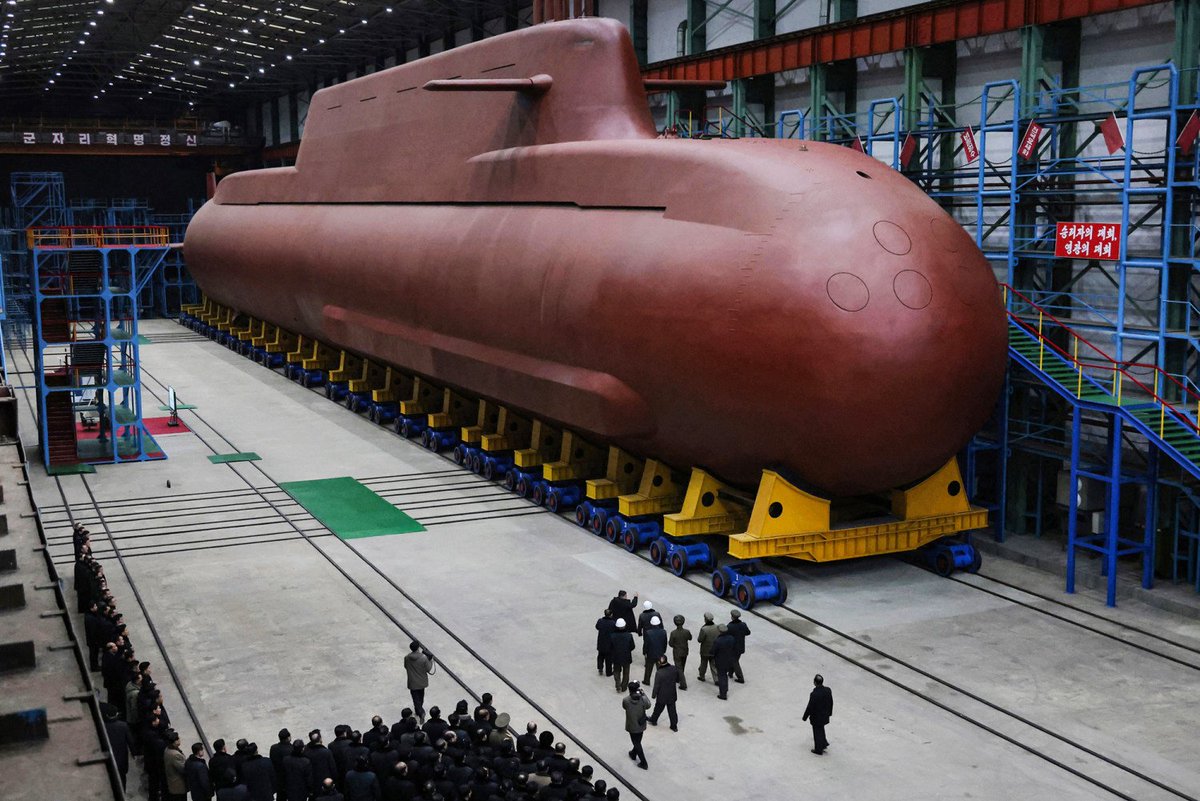
The strategic context shifted in late December 2025, when North Korean state media released imagery showing Kim Jong Un inspecting a large submarine hull under construction, described as a nuclear-powered strategic guided-missile submarine. While the vessel has not been launched or tested, the announcement marked the first public confirmation that Pyongyang is pursuing nuclear propulsion for its undersea forces.
The defensible conclusion is narrow and factual. Ursa Major was not carrying ordinary industrial cargo. Spanish investigators identified the stern-deck components as submarine reactor casings weighing approximately 65 tons each. The vessel also carried mobile harbor cranes required to handle such components at locations lacking permanent heavy-lift infrastructure. The ship was lost under unresolved circumstances while transiting one of the most heavily monitored maritime corridors in the world.
That combination of facts, taken together, explains why the sinking matters.
Follow OSINT Intuit™ for hard-hitting truth and uncompromising analysis of Russia’s information war.
Sources: https://t.co/tiPU4aDNQi, https://t.co/UbFNUI6pra
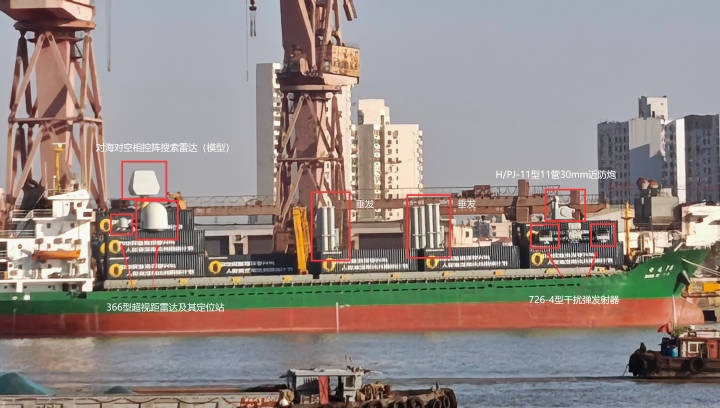
A unknown Chinese container ship has been caught carrying Multiple AESA Radars, CIWS and VLS Missile cells
Location of photo unknown, likely Dalian Shipyard, where the Type 004 is building
Is there any evidence to support Russian claims that half of all Western weapons exported to Ukraine are deliberately diverted? Nope. We explain why in our new report. https://t.co/oP3sPvD9Ul