Florida/Tampa Bay historian. Museum curator. Quintessential Florida Man. Chronicler of rocket launches and sunshine. Tweets are my own. 📸 :@joetherocketman
Woke up thinking about the late John Glenn. This is me with him just after he landed at Kennedy Space Center onboard the Space Shuttle Discovery (STS-95) to become, at age 77, the oldest person to orbit the Earth.
One day, during my 6th year as NASA Administrator, John Glenn paid me a visit at my office in Washington, D.C.
He sat down and explained that he had been studying the effects of space on aging bodies, and he wanted me to send him to space so he could run experiments on his body.
At the time, John Glenn was a revered Senator of Ohio for 24 years.
But, he had been a hero to me and to America ever since he successfully became the first American astronaut to orbit the earth in 1962.
Up until then, the Soviets had been leaping ahead of us in space. They launched the first man, Yuri Gagarin, on April 12, 1961. And then they once again beat us by keeping a cosmonaut in space for a full day.
On Feb. 20, 1962, at 40 years old, astronaut John Glenn became the first American to orbit the Earth during the three-orbit Mercury-Atlas 6 mission, aboard the spacecraft he named Friendship 7.
At the time, I was about to turn 22 and I had just started as an ion plasma engineer at NASA Lewis in Cleveland, Ohio. On that day, I remember the hope and confidence John Glenn instilled in all of us to take space on as a country and beat the Soviets to the moon.
In fact, John Glenn became so much a hero to our nation that President Kennedy felt that we couldn’t risk losing him and declared that he would never go to space again.
So now decades later, here I was as NASA Administrator being asked by this American hero to reverse President Kennedy’s decree and risk sending him back to space again… this time at age 77!
I told Senator Glenn that he would need to pass the same physical exam standards the younger astronauts took – 20/20 vision, whether naturally or with corrective lenses, and a sitting blood pressure not to exceed 140/90.
He passed. But what most don’t know is that this is also me grabbing him by his flight suit from behind to prop him up, because he had lost his sense of balance from disrupting the equilibrium in his ears while in space 😛.
I couldn’t have our American hero stumbling around with all the press and crowd watching him!
I thank John Glenn for energizing America and our confidence to reach the heavens. He also always championed space and technology, in public and private spheres – especially during my brutal battles as a newbie Administrator on The Hill.
In St. Augustine, history is part of the landscape. It lives in the stone streets, the waterfront, and the stories passed down over centuries.
America 250: A Portrait of Florida travels to the nation’s oldest city to explore the people, places, and moments that helped shape Florida's and America's history.
Watch the full episode at https://t.co/64an1BiPTG.
Produced by Visit Florida for the Florida Semiquincentennial Advisory Commission’s America 250 commemorations. @America250FL
The White House’s Office of Management and Budget just proposed new rules that would let political appointees, not scientists, decide which research gets funded in the United States.
Under these rules, a senior political official would have to personally approve every single federal grant before it goes out.
Peer review, which has been the gold standard for evaluating science on merit, would be reduced to just a suggestion. And if your research falls out of political favor? Any active grant can be revoked at any time, with no explanation required.
We're talking about NASA grants, NSF grants, the funding that powers discoveries about our Universe and our planet. This rule was not written by NASA's leadership, and it works against the agency's own exploration goals for the Moon, Mars, and beyond.
The rules would also ban entire categories of research outright, and cut off collaboration with scientists from other countries, even if those researchers live in the U.S.
Researchers wouldn't even be able to use grant money to publish their findings or attend scientific conferences without getting special permission first.
This affects everyone from PhD students to career scientists to all of us whose lives improve because of federally funded research.
The public comment period is open right now, but this time,
we're not asking you to sign a form letter. We need your actual words, your story, to make a difference. Identical submissions get counted as a single comment, so the more you write, the less OMB can ignore us.
We cannot stress how dangerous this rule would be if enacted.
But we can stop this if enough people submit their personal story of why peer-reviewed science is important.
The deadline to submit comments is July 13th. https://t.co/42YYTxVYK2
The first step to the launch pad starts on a rail line.
Yesterday, the Artemis III boosters officially began their journey in another step towards human deep space travel and new feats of human exploration in America's next 250 years.
One week later, incredible progress. It’s a 24/7 operation with a solid path forward to launch this year, helped by a lot of luck. @NASA and @USSpaceForce have both been extremely helpful.
This team. Never tell them the odds.
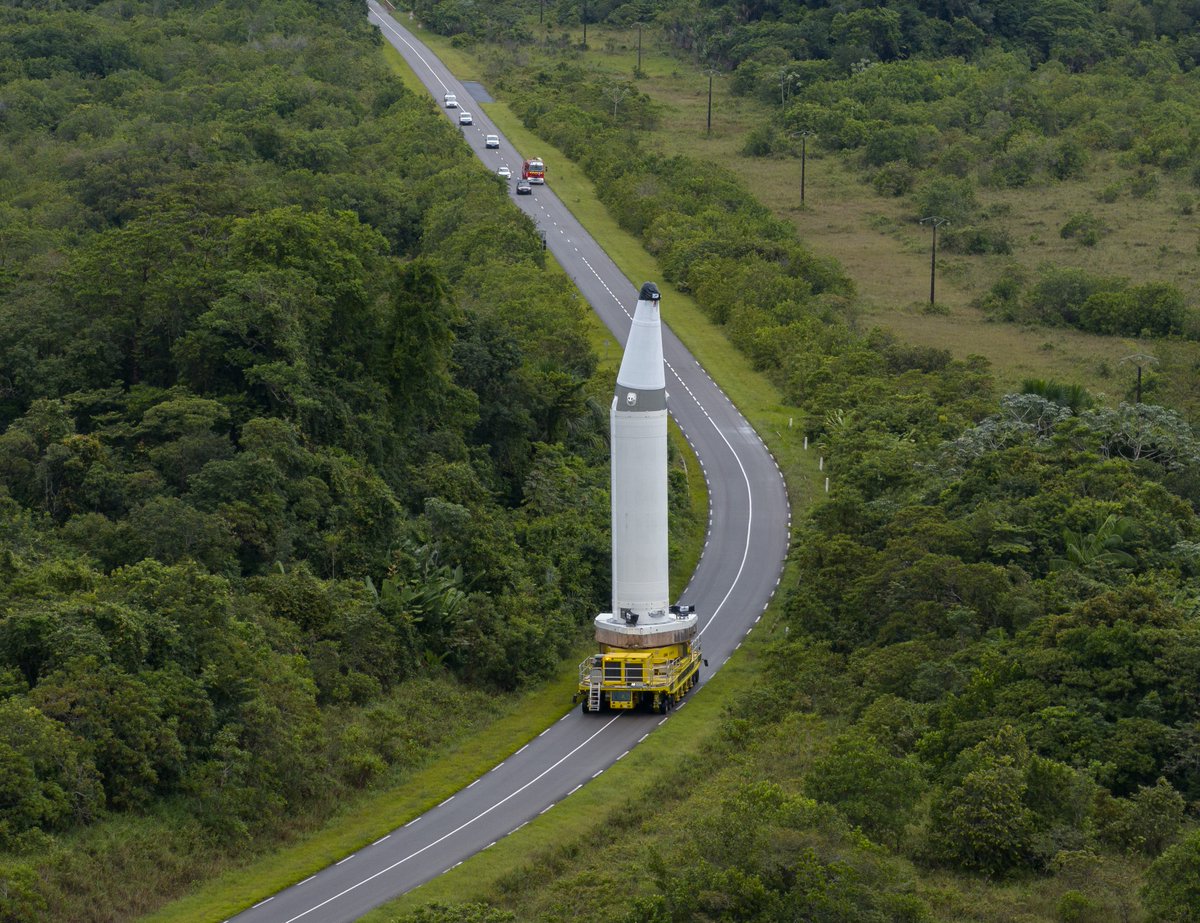
Upgraded P160C solid rocket boosters have arrived at Europe's Spaceport in French Guiana for integration with Ariane 6 ahead of Leo Europe 3 (LE-03). Debuting on our next mission with @Arianespace, these boosters will carry the largest Amazon Leo mission with Ariane to date. Updates coming soon.
🌎 In the middle of the desert sits a giant glass world containing its own rainforest, ocean, coral reef, mangrove swamp, farm, and miniature wilderness—all sealed off from the outside world.
🔬In 1991, eight people locked themselves inside for two full years, attempting to survive in this massive artificial ecosystem without outside air, food, or water.
Find out where this futuristic experiment is located: https://t.co/3zyxvCBT4Y
Today we make a bittersweet goodbye.
After years of exploring Mars, transforming our understanding of the Red Planet, @NASA's MAVEN leaves behind a remarkable legacy of discovery.
Farewell, MAVEN! Thank you for everything. 🔴🛰️
We’ve shipped the twin solid rocket booster segments for @NASA’s Artemis III mission to Kennedy Space Center from our world-class propulsion manufacturing facility in Utah to support America’s next step in returning humanity to the Moon. https://t.co/c77VPqKa0i
CHEF'S KITCHEN: In honor of Tampa’s longtime Alessi Bakeries moving down their block, expanding and opening a market, we’ve got their Devil Crab recipe. https://t.co/L7yge1cxAs
The locomotive honoring America’s 250th anniversary and @POTUS is now hauling the solid rocket booster segments that will help power Artemis III.
The Artemis program began under President Trump’s first term. Now the hardware for humanity’s return to the lunar surface is moving down the tracks.
Behind the scenes as prep continues for Leo Vulcan 1 (LV-01), the first of 38 Vulcan missions on contract with @ULAlaunch.
Teams have completed integration of the first LEO-optimized Centaur upper stage with Vulcan inside Amazon's dedicated Vertical Integration Facility (VIF-A), allowing ULA to begin the next phase of testing ahead of upcoming Leo Vulcan launches from SLC-41.
This is a spent Chinese Long March 3B rocket body, imaged by a Vantor WorldView Legion satellite from 88 km away.
The image quality is not simply about range. It reflects the strength of Vantor’s advanced WorldView constellation and high-performance imaging hardware, which enable detailed observation of objects in orbit.
It’s a powerful example of Vantor’s NEI tasking through our WorldView Space product line: using high-resolution satellites to look out into space and capture detailed imagery of objects in orbit.
Why does that matter? Most tracking systems can show where an object is. WorldView Space NEI helps show what it is, its structure, orientation, condition, and potential risk. It can also support Movement Analysis, helping operators understand whether an object is intact, tumbling, spinning, or otherwise changing behavior over time.
That level of detail is especially important for large rocket bodies like this one. They are big, long-lived debris objects that share orbits with critical infrastructure, including communications, Earth observation, weather, science, and national security satellites. A single collision involving an intact rocket stage can create thousands of new fragments, increasing risk across already crowded orbital regions.
As launch activity accelerates, we need to understand not just where objects are in space, but what they are, how they are moving, and how they may behave over time.
The first low Earth orbit (LEO)-optimized Centaur upper stage is now integrated atop the Vulcan rocket at ULA's @AmazonLeo Integration Facility!
Integrating the vehicle with the new LEO 85K Centaur upper stage allows the team to perform first time procedures, validate stage and ground support equipment interfaces with a planned Wet Dress Rehearsal to validate new technologies in advance of the first Vulcan Leo mission.
Learn more in our blog:
https://t.co/thnd65wusQ
UPDATE: @NASA can confirm a fireball over New England at 2:06 p.m. EDT on Saturday, May 30, 2026. The meteor was about 5 feet (1.6 meters) in diameter with a mass of 5.6 metric tons and entered Earth’s atmosphere at roughly 42,000 mph.
The meteor traveled through the atmosphere from northwest to southeast for 26 miles before breaking up at an altitude of 31 miles and producing a meteorite fall into Cape Cod Bay.
Based on the latest data, the energy released at breakup is estimated to be equivalent to about 230 tons of TNT, which accounts for the sonic boom.
Have questions? Check out our fireball FAQs: https://t.co/HyyRIGmeoI