GA4 has many flaws, but one of the worst for me is definitely the way they manage events.
There are 2 ways to read event performance:
1/ Event count (All Events) + Events per session
2/ Key events + Session Key events rate + Key Events per session
Ideally, you'd want to have this setup to be able to properly analyze channel performance:
Key events: include only your final conversion
Event count: include all the important events on the website (micro-conversions)
The thing is: you can't select what is included in Event count. It counts by default irrelevant and low-value metrics such as session_start, page_view, and user_engagement. This makes no sense since they're triggered automatically when the user lands on the website.
So you can't easily monitor micro-conversions, unless you include them in Key events, which will prevent you from monitoring the final conversion.
It's no longer a strategic advantage to secure the top position in Google Search.
In some industries with complex decision journeys (e.g., B2B SaaS), users will most likely click on different ads (paid and organic) and compare the different solutions.
It's not worth bidding aggressively to fight for the top position. As long as your ads are at the top of the page, you're good.
Of course, this applies to SERPs without AI Overviews (which appear around 30% of the time).
@wilreynolds I’ve just reproduced the exact same behavior in Gemini.
This seems to be something new. I’m almost 100% sure that Gemini links used to redirect directly to websites.
I just ran a search, opened the AI overview, out of 17 links 15 ran an additional google search. Maybe this is contributing to Google maintaining so much search volume.
Last week, we introduced Personal Intelligence in the @GeminiApp. Today, we’re bringing that same helpful experience to AI Mode in Google Search 🔍
Now, you can securely connect Search to Google apps like @Gmail and @GooglePhotos to get responses that are uniquely relevant to you. This experimental feature is built with Gemini 3, our most intelligent model, and is strictly opt-in — meaning you choose if and when you want to connect these apps.
Here’s what that looks like in Search 🧵(1/7) ↓
I just ran a search, opened the AI overview, out of 17 links 15 ran an additional google search. Maybe this is contributing to Google maintaining so much search volume.
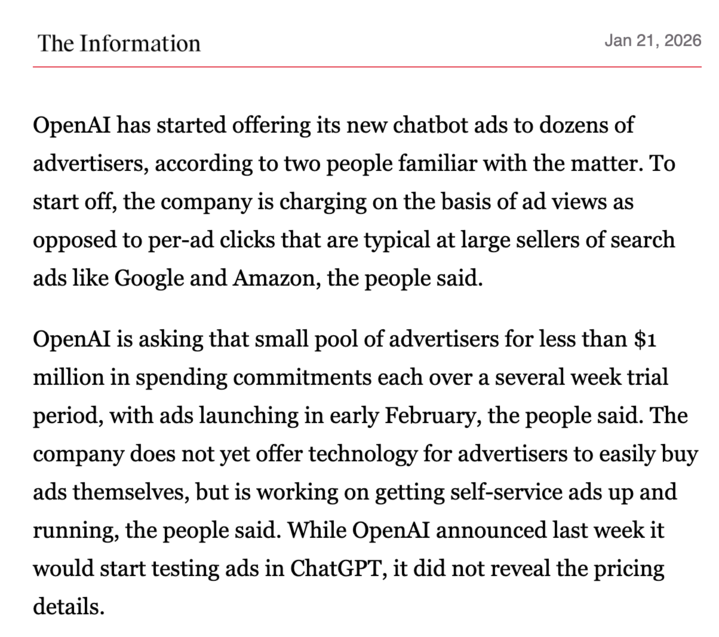
Because ChatGPT is a search engine. Charging on a CPM basis isn't a standard practice at all in search engines.
I don't think they are doing this because the product is too early, but because they want to secure the cash.
I'm sure most of the advertisers they chose will agree to be early testers because it's exciting.
But they'll have to switch to CPC model quickly if they want to onboard more advertisers.
I’m really surprised by OpenAI's move to charge on a CPM basis.
My take is they want to 100% be sure they bank the money at this stage (ad views charging is far more predictable than ad clicks).
I honestly can’t believe they will keep this pricing model once the platform rolled out fully. I dont know many advertisers who would accept being charged for ad views on a search engine.
@Thomasbcn I really don’t understand the move to charge on CPM basis. The only thing that would kind of make sense is that they want to 100% be sure they bank the money at this stage.
I honestly can’t believe it will still be like this when it’s rolled out to all advertisers
@bwagy@Thomasbcn It’s really smart to start with a restricted pool of advertisers and ask for budget commitment. But I’m really concerned by the CPM basis charging.
@wilreynolds This resonates a lot. I’ve put in the 10,000 hours working in Paid Media over the past 8 years. This is my edge. I’m only using AI in low-value time-consuming tasks. I don’t want to lose my reflex actions and thinking system by outsourcing it to AI.
Paid Ads are coming to ChatGPT.
This marks a major shift in the Paid Search industry.
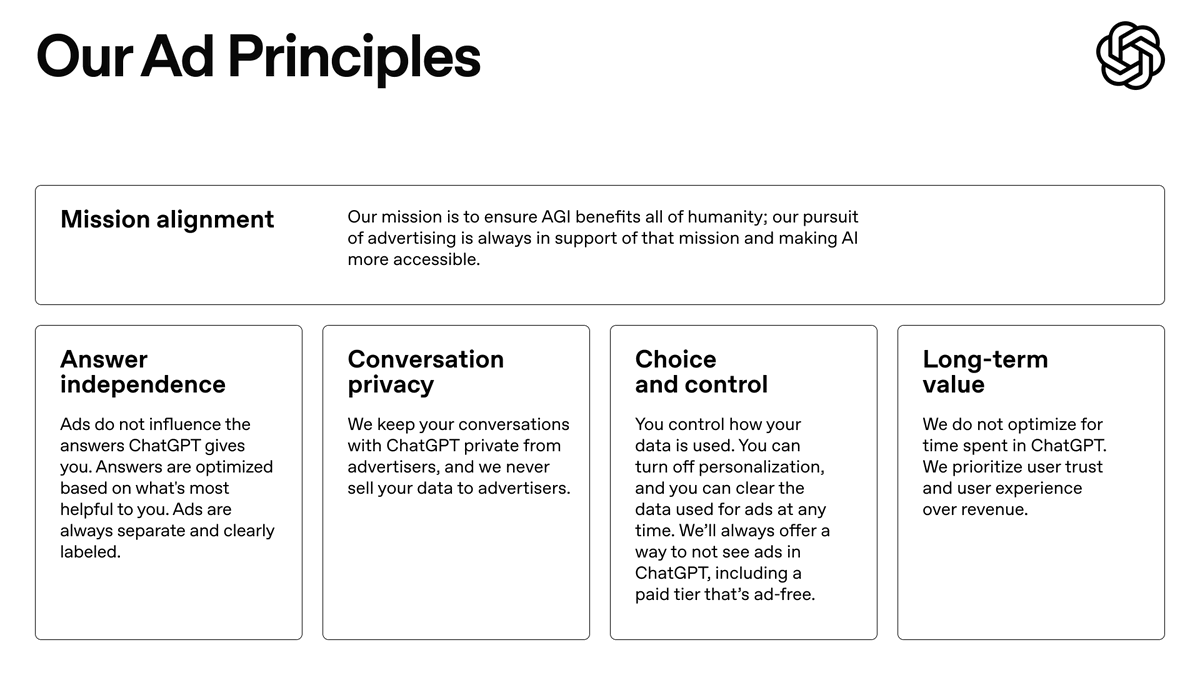
OpenAI has officially announced the launch of Paid ads within ChatGPT (Free and Go tiers, US only for now). They promise that ads won’t influence answers and will be clearly separated and labeled.
For now, we only know that:
- ads will appear at the bottom of answers
- there will be a sponsored product or service format (similar to Amazon Ads or Google Shopping Ads)
- ads will be based on the current conversation
But there are so many questions that I’m curious about: how will it actually work?
- Other ads formats (text, image, video)
- Targeting options (keywords, topics, interests)
- Bidding method (CPC, CPM)
- Conversions tracking methodology
- KPIs provided
Beyond Paid Search, there are of course multiple business questions that will be crucial to monitor (What will be the impact on churn? Will other LLMs follow suit?…)
I can’t wait to have more details. I haven’t been this excited since quite some time.
In the coming weeks, we plan to start testing ads in ChatGPT free and Go tiers.
We’re sharing our principles early on how we’ll approach ads–guided by putting user trust and transparency first as we work to make AI accessible to everyone.
What matters most:
- Responses in ChatGPT will not be influenced by ads.
- Ads are always separate and clearly labeled.
- Your conversations are private from advertisers.
- Plus, Pro, Business, and Enterprise tiers will not have ads.
In the coming weeks, we plan to start testing ads in ChatGPT free and Go tiers.
We’re sharing our principles early on how we’ll approach ads–guided by putting user trust and transparency first as we work to make AI accessible to everyone.
What matters most:
- Responses in ChatGPT will not be influenced by ads.
- Ads are always separate and clearly labeled.
- Your conversations are private from advertisers.
- Plus, Pro, Business, and Enterprise tiers will not have ads.
I pushed my limits a little too far while running this half-marathon, and ended up with a left foot injury (a small one, I hope).
I won’t run this week to recover as fast as possible.
No regrets though. I made myself a promise to give everything I had during this race. I’m glad I kept it.
Okay so I need to talk about what’s happening with Yann LeCun because this is genuinely one of the wildest exits I’ve ever seen in tech.
For those who don’t know—LeCun is one of the “godfathers of AI.” Not a marketing title. The man literally won the Turing Award (basically the Nobel Prize of computer science) for helping invent deep learning. He’s been at Meta for over a decade as their Chief AI Scientist. An absolute legend.
So here’s what happened.
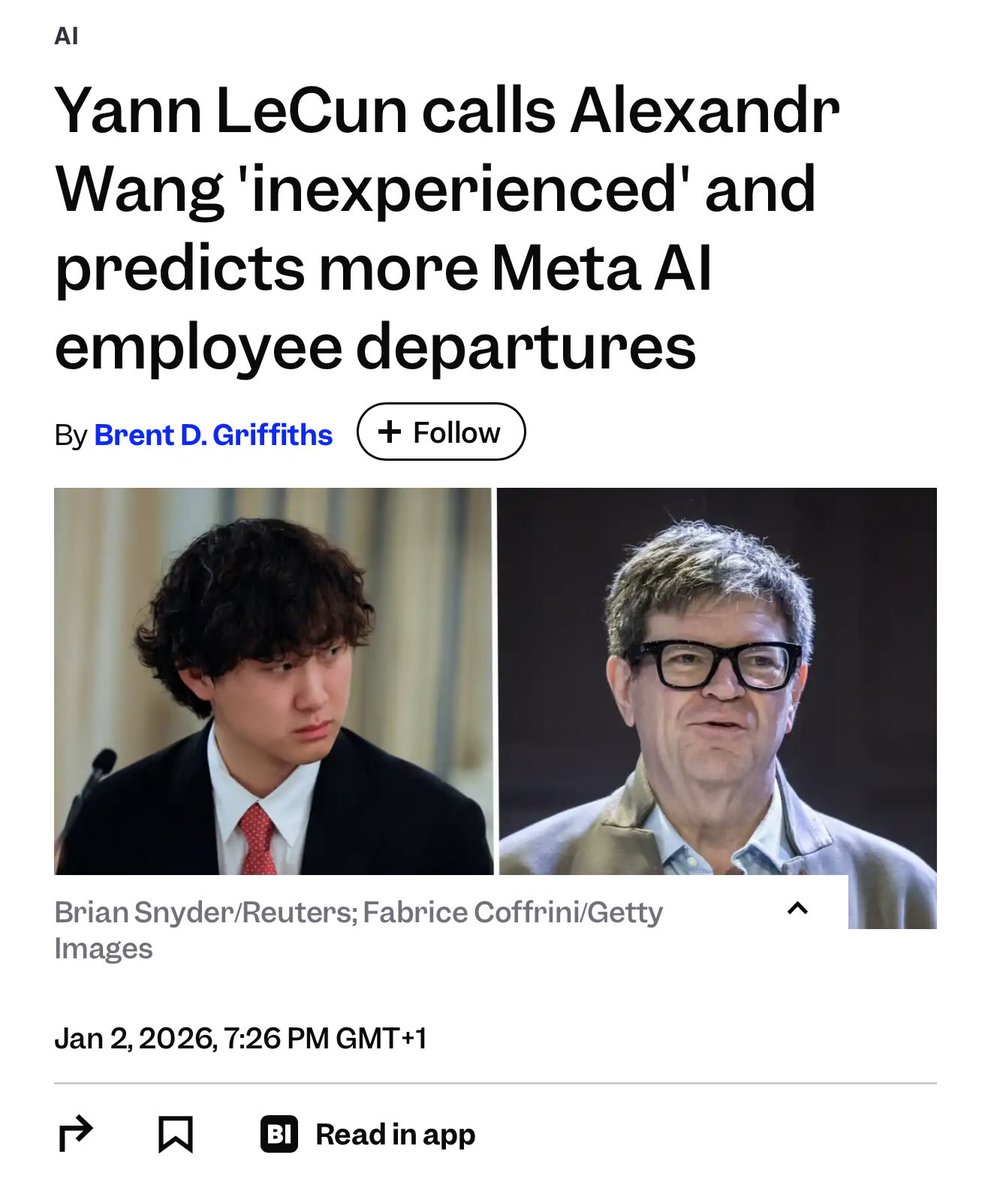
Zuckerberg got frustrated. Llama wasn’t moving fast enough. The AI race was heating up and Meta felt like it was falling behind. So what does Zuck do? He drops $14 BILLION on Scale AI and hires its 28-year-old co-founder, Alexandr Wang, to run a brand new “Superintelligence Lab.”
And then—and this is the part that still blows my mind—he makes Wang… LeCun’s boss.
Think about that for a second. A 65-year-old Turing Award winner. Four decades of groundbreaking research. The guy who helped BUILD this entire field. Now reporting to someone whose company… labels data. (Scale AI is impressive, don’t get me wrong, but they don’t actually build AI models. They annotate training data for other companies.)
LeCun just did an interview with the Financial Times and honestly? He chose violence.
Called Wang “young” and “inexperienced.” Said he has “no experience with research or how you practice research, how you do it. Or what would be attractive or repulsive to a researcher.”
And then dropped this absolute gem: “You don’t tell a researcher what to do. You certainly don’t tell a researcher like me what to do.”
I mean. The man said what he said.
But wait—it gets better. Or worse, depending on how you look at it.
LeCun straight up confirmed that Meta’s team “fudged” the Llama 4 benchmark results. Like, actually manipulated them. Used different models on different tests to make the numbers look better. Remember when everyone was suspicious about those benchmarks back in April? Yeah. Turns out they were right to be.
Apparently Zuckerberg was furious when this came out internally. LeCun says he “lost confidence in everyone who was involved” and basically sidelined the entire GenAI team.
And here’s the thing that really gets me—LeCun has been saying for YEARS that LLMs are a “dead end.” That you can’t get to real intelligence just by predicting the next word. That we need “world models” that actually understand physical reality, not just language patterns.
Everyone at Meta wanted him to stop saying this publicly. Bad for the narrative, you know? But LeCun refused.
His exact words: “I’m not gonna change my mind because some dude thinks I’m wrong. I’m not wrong.”
That’s not arrogance. That’s a scientist who’s seen enough hype cycles to know when something doesn’t add up.
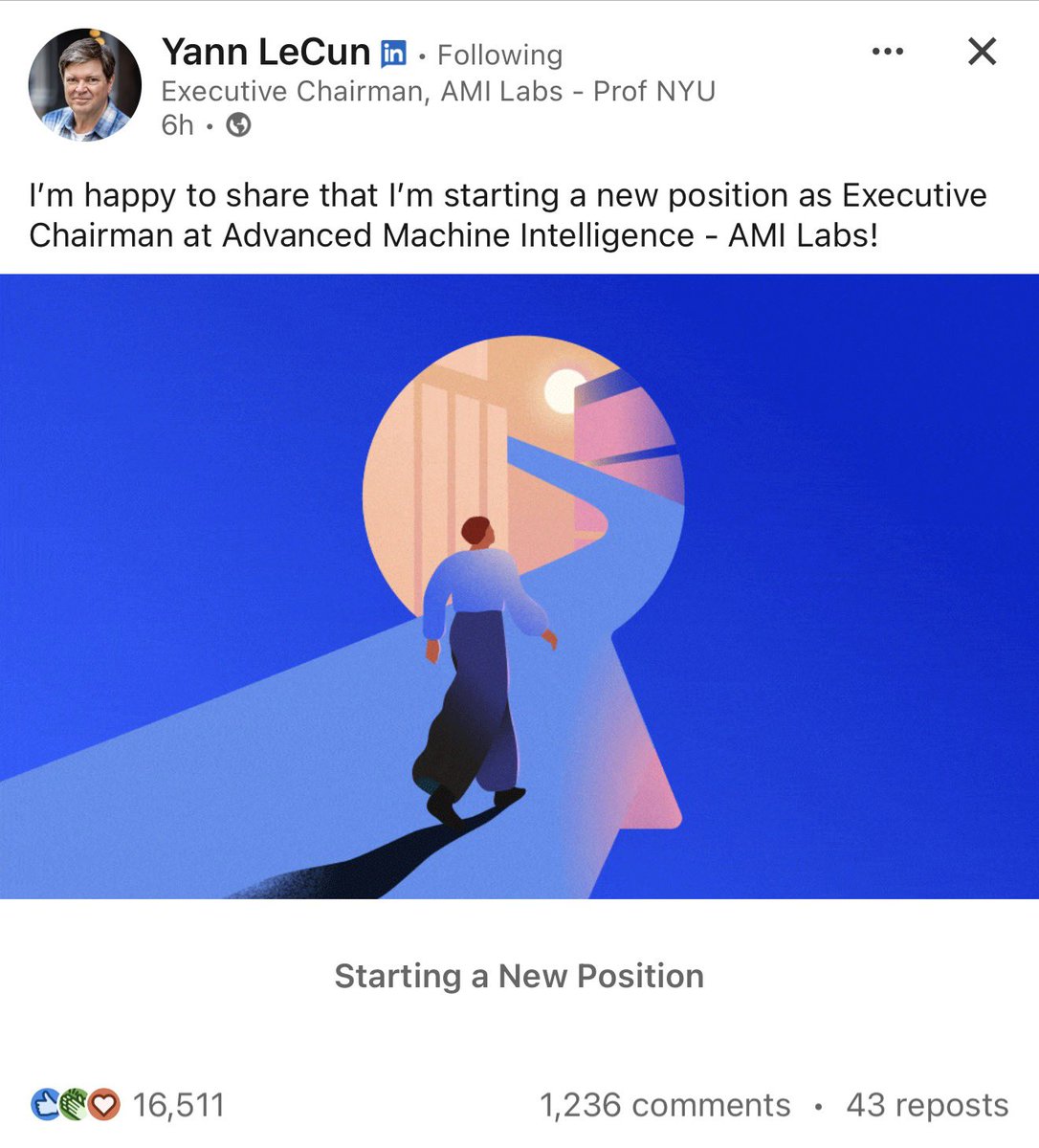
So now he’s out. Launching his own company called AMI Labs—Advanced Machine Intelligence. They’re targeting a $3 billion valuation. Building those world models he’s been talking about. Says he’ll have a “baby version” ready within a year.
Oh, and apparently French President Macron personally texted him after the news dropped. LeCun won’t say what the message said but like… the man is getting DMs from heads of state now.
I don’t know if LeCun is right about everything. Maybe LLMs will surprise us. Maybe Meta will figure it out. But when one of the three people who literally invented modern AI walks out the door saying your entire strategy is fundamentally flawed?
I don’t know man. I’d at least ask some questions.
The AI wars just got very, very interesting