BTC Dated Options: Private Alpha
BTC Dated Options are now live in Private Alpha on Mainnet and are currently available to whitelisted users only.
Options complete the core trading suite (spot, perps, and options) and bring a key building block for advanced portfolio construction to Paradex. Access will expand in the next phase, including to MoneyBadger and Shizopunk holders. Additional details will be shared separately.
Bug Bounty
Any bugs identified prior to full rollout are eligible for bug bounty XP rewards based on impact. To report an issue, create a Discord support ticket with clear reproduction steps.
a few quick updates:
first, a big thank you to our community for the trust and patience throughout this process.
+ $650k in refunds were distributed across 200 accounts
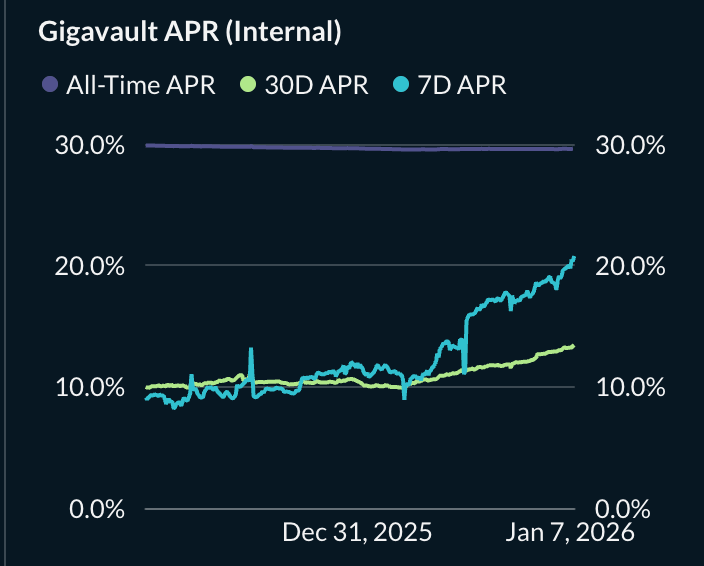
+ gigavault deposits and withdrawals have resumed
+ all user funds remained 100% safe throughout
+ total platform downtime was ~6 hours
+ all other non refund related tickets will be reviewed and addressed over the next few days
we also saw an intense, coordinated wave of fud across multiple bucket shop publications. the quality of reporting was so insanely bad and consistent across them all that it was easy to catch.
only @coindesk issued a partial retraction.
This was the first message I sent to @fiddybps1 on my first day joining @paradex.
I couldn’t believe it was 1.5 years ago.
After a lot of blood, sweat and tears, endless sleepless nights, stress, and a massive number of issues,
we never give up, and now we’re here.
higher
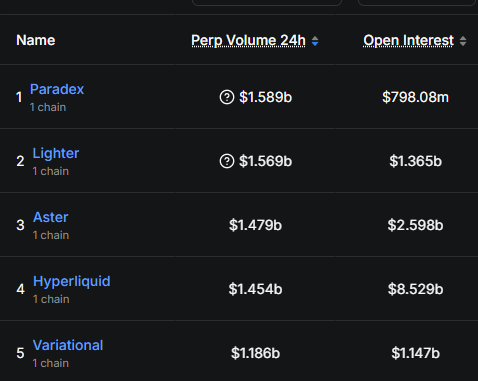
Paradex is #1 in 24h volume 🔥
Many people left us for dead last year, so just being here today is a massive milestone. Congrats to all of you who believed, this is just a taste of what’s to come.
Despite many wanting us to fail, we simply WILL NOT go away. 2026 will be the year of $DIME, and until we get there, we will be relentless.
Enjoy this day. You all deserve it.
Privacy Perps 🔒
Privacy Perps are now live on Mainnet.
Effective today, position and account state on Paradex is private to the account holder (via authenticated RPC) and the operator (Paradex), delivering CEX-like privacy but with self-custody.
This privacy is is end-to-end: orders, positions and trades are private on the Paradex Cloud, Paradex Chain (L2) and on Ethereum (L1) where state commitments are posted. Prior to today’s upgrade (Paradex Chain v0.14.1), there were two broad ways to observe or reconstruct account/chain state:
1️⃣ querying off-chain services that index Paradex
2️⃣ reconstructing aggregated balances from the L1 data availability
v0.14.1 closes both paths for unauthenticated observers while preserving an escape hatch on Ethereum.
Architecture
L2: Private reads via authenticated RPC
Privacy on the L2 is guaranteed through a custom RPC configuration. RPC nodes mask position and account fields by default, and only return private data to the owner after authenticating the request via a valid signature. This addresses (1) the historical “off-chain indexing” visibility path.
Bridge partners are only granted selective access to the transaction data (account state remains private) required by their smart contracts to process deposits and withdrawals.
L1: Encrypted state diffs with ZK verification
When the sequencer posts updates to Ethereum, it will now encrypt the state diff and include it in the ZK proof posted to the L1. This specifically addresses (2) the historical “reconstruct state from L1 DA” path.
Starting in v0.14.1, the blob data that carries the serialized squashed state diff is encrypted before being posted to Ethereum, while the ZK proof still validates both the correctness of the state transition and the correctness of the encryption/commitment to the encrypted diff.
Decryption keys are held by the Paradex Privacy Council, and only council members can decrypt the L1 state.
A more technical write-up, including encryption details, is available here:
https://t.co/033iNWmV9v
Why a Privacy Council
Paradex continues to submit state to Ethereum to preserve the possibility of an escape hatch in the event Paradex becomes inoperable. The council model balances that escape hatch with privacy: under normal operation diffs remain encrypted on L1, and if an escape hatch is required, the council can decrypt and publish the necessary state to enable recovery.
The current members of the Privacy Council are the @ParadexFNDN, @paradex, and @karnotxyz. As Paradex scales, the committee will be expanded for even stronger decentralization.
Trust assumptions
At the RPC layer, trust assumptions do not change: Paradex remains the operator of Paradex Chain RPC nodes. At the Ethereum layer, trust shifts to the Privacy Committee for the ability to decrypt state diffs during an escape-hatch scenario.
TL;DR
+ Private by default on L2 + encrypted diffs on L1, with the possibility of an escape hatch preserved via council-controlled decryption.
+ Only the account owner and operator can view their trading state, providing a CEX-equivalent privacy experience with self-custody.
Paradexio
Perp DEXs are Going to Eat All of Finance
From Software to the Internet Economy
Silicon Valley investors have long championed the idea that “software is eating the world.” But why does this hold true?
Because software cuts overhead, compounds efficiency, and expands margins, making companies more profitable and therefore better investments. Everyday users have experienced this shift in a tangible way in the devices we use.
Not long ago, you needed a calculator for arithmetic, a camera for photos, a typewriter to write letters, and a fax to send them. Today, a single phone does all that and more.
This same upgrade cycle that transformed our devices is now reshaping the global economy. Software began this transformation eighty years ago, steadily driving down the cost of doing business. It started with basic computing tasks, moving to calculators, then entire functions like accounting as computers became ubiquitous. Then came the internet, which gave rise to internet-native businesses and a $16 trillion digital economy that now accounts for roughly one-fifth of global GDP.
But even at its peak, the internet moved information, not value. You could send an email across the world instantly, but a wire transfer could still take days. Crypto solved that problem by adding the missing layer of trust and value. In other words, crypto is the logical next step in software’s evolution, powered by smart contracts.
As that infrastructure scales, the hard problem shifts from moving money to coordinating capital and risk among many actors. The physical economy is ready to move on-chain, and the first thing it needs is capital and liquidity hubs to power markets and risk transfer across participants.
This is driving the emergence of DeFi Supercenters like Paradex, Lighter, and Hyperliquid.
DeFi Supercenters as the Next Hyperscalers
To fully understand what DeFi Supercenters represent, consider this. The industrial age built Wall Street, while the information age built digital marketplaces such as Nasdaq and Amazon. Wall Street was vital to the global economy because it concentrated liquidity, information, and trust.
Capital flowed efficiently because investors, brokers, and institutions gathered in one place for price discovery, clearing, and settlement. It was never about the buildings but about proximity to capital and counterparties.
@fiddybps1 from @paradex recently tweeted that “Financial supercenters already exist in the physical world, such as Wall Street, London, Dubai, Hong Kong, and Singapore. Now zoom out. In the on-chain world, the equivalent is the perp DEX, a supercluster of liquidity that will be the beating heart of the global digital economy.”
A DeFi Supercenter is that digital equivalent but fully on-chain, a programmable hub where trading, settlement, lending, and risk management operate within one composable system of smart contracts. These hubs mirror what Wall Street achieved for the industrial era by concentrating capital and trust, but they do so borderlessly, transparently, and at internet scale.
DeFi Supercenters will be the next hyperscalers, but fully on-chain. Think of them as large financial service providers operating massive liquidity superclusters and delivering highly scalable, on-demand liquidity, capital coordination, clearing, and settlement.
Why Only a Few Will Win
As in every financial era, not every center will thrive. Liquidity always migrates towards venues with the least cost, least friction, and the least amount of information leakage.
Accessing liquidity has a cost, not only in fees or spreads but also in execution size, information leakage, and ease of access/execution. Markets that minimize these frictions become natural centers of gravity for capital. Over time, only a few on-chain Supercenters will command this depth and reach. The platforms that combine speed, privacy, and composability at scale will set the new standard for finance.
How Paradex Fits In
Paradex embodies the DeFi Supercenter thesis in full. It is a native on-chain financial hub where liquidity, risk, and settlement operate within a single unified architecture.
Paradex runs on a zero-knowledge rollup that pairs Ethereum-grade security with sub-second trade execution while preserving transparency, privacy, and self-custody.
Its unified margin layer powers perpetuals, spot, and cross-margin trading from a single collateral pool, maximizing efficiency and eliminating fragmentation. With unified margin, users no longer have to move assets between a spot and perps account, your assets are unified into a single collateral pool.
Paradex was designed to converge the roles of brokerages, exchanges, asset managers, and clearinghouses into one composable framework.
By collapsing trading, clearing, and settlement into one composable system, Paradex achieves what traditional finance could not: frictionless, deterministic liquidity at internet scale.
The Future of Finance Is On-Chain
Finance is entering its software phase, where liquidity, trust, and execution exist as code rather than physical institutions. The shift is already underway, and the winners will define how value moves in the decades ahead.
We are still early, but the direction is clear. The future of finance isn’t scattered across silos. It’s going to be concentrated in a handful of on-chain Supercenters, and Paradex has what it takes to become the ultimate DeFi Supercenter.
If you haven’t been paying attention to Paradex, you need to start now.
Watch out for our next article on Paradex.
Till then, thank you for being a part of the When Shift Happens Family.
The common critique of zero-fee trading venues is that the business can’t be profitable.
Below I explain how free trading venues are profitable and why they can offer tighter spreads, by highlighting flow segmentation and latency speed bumps.
What is PFOF?
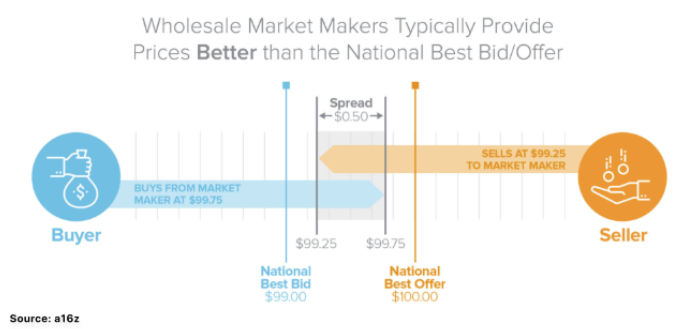
Payment for Order Flow is a system where a trading platform (broker or exchange) routes customer orders to specific market makers in exchange for a fee. In simple terms, instead of charging you a commission, the platform gets paid by a third-party market maker for the right to fill your order.
The next logical question is: why is this so important?
PFOF enables trading platforms to charge zero taker fees to users while still giving the platform a revenue stream. It creates a sustainable model where you, the trader, pay nothing to trade, yet the business earns income on every order filled (since a market maker pays for each order).
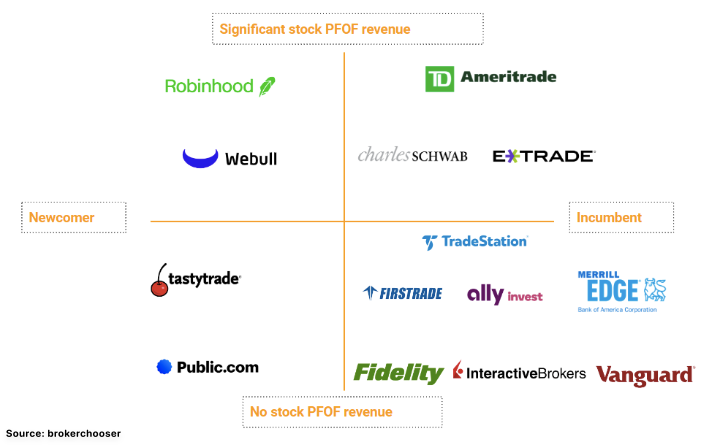
Platforms like Robinhood famously leaned into this model.
Okay, but why would market makers pay for orders?
In short, because it’s profitable for them. Retail orders are often considered less informed flow (not driven by proprietary, market-moving information) and thus carry less risk to trade against. Would you feel more confident about your quote knowing you’re interacting with a retail user or with GSR? Market makers covet retail flow and pay a small fee per order to secure a steady stream of this business. They monetize the bid-ask spread.
By paying the venue a tiny amount per share (often fractions of a penny) for order flow, a market maker gets to fill your order, often at a slightly better price for you, and then pockets the remaining spread as profit.
Makers pay for retail flow because those trades pose less risk and still allow them to profit from small spreads. It’s a win-win: retail users trade free, the maker earns the spread, the platform earns the maker’s fee.
I often see takes saying that Lighter’s business model (zero fees -> PFOF) isn’t sustainable. I think this is just because the people saying this don’t know how the exchange is making money if they are not charging users a fee. This confusion is understandable. But given the above, it is clear that these businesses are in fact making meaningful revenue, but just not how every other perp DEX is.
By relying on PFOF, these venues align incentives and keep the platform financially healthy without charging users directly. Rather than depend on high taker fees, they monetize by selling curated retail flow to liquidity providers (market makers) who compete for that flow.
How this applies to Paradex: a Retail Price Improvement (RPI) program lets Paradex tag and isolate high-quality retail flow, which it can then offer to market makers in return for PFOF revenue. The more volume users trade, the more revenue the platform earns all while users continue to enjoy zero fees.
How this applies to Lighter: Lighter takes a different route, using speed-bump-based segmentation to slow/accelerate certain actors and reduce toxicity. The end result is similar: some market makers pay for access to curated flow.
By making trading free, PFOF encourages higher activity and deeper liquidity, which in turn attracts more makers willing to pay for that flow.
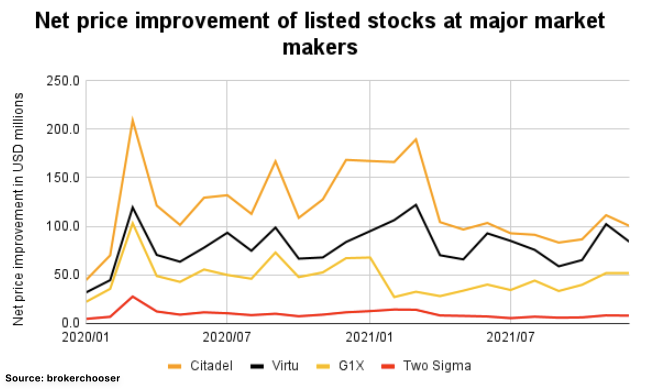
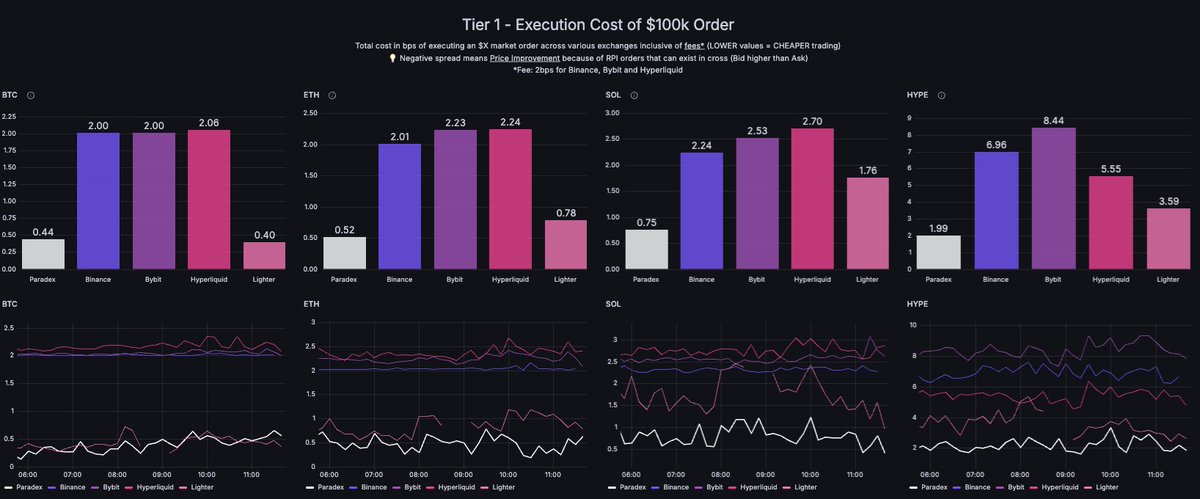
RPI/segmentation is what keeps spreads tight, sometimes on par with Binance, so you get “Binance spreads, zero fees.” Even in traditional markets, PFOF consistently delivers price-improved retail fills. In U.S. equities, Citadel’s dominance in retail wholesaling shows up in the data: they deliver the largest measured net price improvement (NPI), by a wide margin.
However, their large dollar amount in trading skews the chart in their favor, but the point holds: every major wholesaler regularly delivers price improvement on retail orders. Dollar NPI shows who captures and improves the most retail flow; Citadel’s scale + segmentation dominates, which is the offchain analogy of onchain retail price improvement (RPI).
We’re starting to see the same dynamics onchain; it’s early to call which microstructure wins, but early data suggests both RPI and latency speed bumps can reduce effective cost per trade when implemented well.
You might ask: Why do teams need a PFOF model at all? Why not keep tight spreads and just charge normal or even high fees like others?
Because the fee-tier game is distribution, and Binance/Bybit already own the KOL rails.
At scale, big venues rebate ~60–90% of user fees to top referrers and sweeten with token/equity, locking up the influencers who control user flow. For a smaller venue or DEX to outbid that, you’d have to (a) match or exceed those rev-shares without the volume base (100% of 100m volume is still a lot less than 60% of 10b volume), and (b) still fund ops/liquidity incentives. The result is a structural moat: high fees -> big KOL kickbacks -> captive distribution.
Instead of taxing users to fund KOLs, Paradex and Lighter charge makers a tiny fee for curated, low-toxicity flow (via RPI and/or speed bumps) and drop taker fees to zero.
Illustrative math (bands vary by venue/tier):
> CeFi today: taker fee 6 bps -> ~80% to KOLs (–4.8 bps) -> venue nets ~1.2 bps; user pays 6 bps + spread.
> Zero-fee model: taker fee 0 bps -> maker pays ~1.0 bps on curated flow -> venue nets ~1.0 bps; user pays 0 bps + (often tighter) spread.
PFOF + zero taker fees is the strongest wedge I see today for new entrants to disrupt incumbents. Everything else either loses a bidding war for influencers or will struggle to scale with users and latency.
@paradex and @Lighter_xyz route value from those who profit most (professional makers) to those you need to win (traders). The pitch is simple: Binance-level spreads, zero fees, and often better realized execution when segmentation is effective.
This is not to say Paradex and Lighter are the only teams who can win. They aren’t. I’m saying: whoever understands how incumbents monetize, and where the real wedge/moat lives, can disrupt.
I’m excited to see perp fees compress across the board over the next few years.
Perp DEXs - The Financial Supercenters of the Internet Economy
Perp DEXs are not just another flavor of crypto exchange. They are the financial supercenters of the internet economy. The TAM is so insanely large that it blows my mind every time I sit down and think about it.
From Wall Street to On-Chain Supercenters
Financial supercenters already exist in the physical world. Think WallSt/NYC, London, Dubai, Hong Kong, and Singapore. These places are magnets for capital and talent because they centralize liquidity, information, and access.
Now zoom out. In the on-chain world, the equivalent is the perp DEX. Each perp DEX is one of several superclusters of liquidity that will exist on-chain in the future. These will be the beating hearts of the global digital economy.
Who Will Access Them?
Commercial businesses, whether they are apps, appchains, or entire DAOs, will access these hubs to:
- issue tokens
- invest cash into yield-bearing strategies
- borrow and lend against their assets
- hedge risks just like corporates do today with futures and swaps
- borrow and lend against their assets.
At the same time, speculators and arbitrageurs will continuously interact with these markets, compressing spreads, creating efficiency, and deepening liquidity.
The attractiveness of one supercenter over another will come down to the "costs" of accessing liquidity:
1) price (fees, spreads, slippage, cost of capital)
2) size + immediacy (how much size can be executed without moving the market)
3) risk of information slippage
4) ease of access (execution complexity, onboarding)
The winners will be the superclusters that provide the most choice while reducing these costs.
TAM: You Are Not Bullish Enough
When I say the TAM here is large, I don’t mean a 10x. I mean orders of magnitude larger. Think about it this way: the TAM for perp DEXs is equal to the TAM of all financial businesses combined:
- brokerages like Robinhood, Schwab, IBKR
- exchanges like CME, ICE, Nasdaq
- asset managers like BlackRock, Vanguard
- banks like JPMorgan, Goldman Sachs
- clearinghouses and settlement systems like DTCC
A perp DEX combines all of the above and makes them seamlessly composable. It’s the single point of convergence point for entire financial stack.
Why Valuations Will Go Parabolic
The market is still wildly mispricing what perp DEXs represent imo. Liquidity has powerful, reflexive network effects. Once a venue becomes the deepest and cheapest hub, it becomes a black hole for liquidity with intense gravity. Composability amplifies this further as it expands the surface area for activity. These supercenters are permissionless by design with global access and no bottlenecks. Anyone with a wallet can participate. No CEX or Tradfi institution can match this direct-access, structural advantage. Finally as native L1/L2 yield is unlocked (via bridge lending and censorship-resistant, yield bearing stables) and achieve scale, it increases the costs to move those dollars to other venues. In that context, today’s “billions” valuations are nothing but rounding errors, these entities are playing for TRILLIONS.
So when I say you’re not bullish enough, I mean it literally.
Perp DEXs aren’t just the next Robinhood or Binance. They are the next Wall Street, CME, Goldman, DTCC and the next BlackRock — combined, composable, borderless, and native to the internet. We are still early but the direction is clear: the future of finance isn’t scattered across silos. It’s concentrated in a handful of on-chain supercenters.
And those supercenters are perp DEXs.
Paradexio
Another point is the token distribution over time and the tokenomics structure. Most projects favor the team, allowing them to dump tokens after TGE with time-based vesting without value accrual.
It’s officially perp‑DEX szn.
My DMs are full of “can I invest?” “what’s the best way to farm?” There are people out there are farming multiple DEXs. This makes sense, if you are low-T and think that diversification is good. But if not, and your man-card is still very much in your possession, here is a simple framework that you can use to go ALL IN on one.
Believe in something.
1) Team
Have they built a real business before?
A biased but good example is Paradex which is our second rodeo. Our first was @tradeparadigm which trades $1.5B / d and is ~35% of Deribit. We know how to build systems at scale, manage cash flow, hire, fire and build culture and when shit hits the fan transform to becoming wartime leaders. If the market or our enemies poke, we stab. That is the mindset.
How many times have the founders launched other tokens?
I can’t believe I need to say this, but if @PacmanBlur is launching his third token and you fall for it, NO ONE CAN SAVE YOU. If it looks like a red flag, do not be an idiot and ignore it.
Are the founders known?
The more you know, even the ugly parts, the lower your risk.
Who are the investors/backers?
Not all investors are created equal. Strategic investors >VCs and Podcasters
Paradigm raised money back in 2021 and has ALOT of the biggest traders in crypto on our cap table as owners and as customers. Since Paradex was incubated by Paradigm, all of these investors automatically have an incentive to help Paradex succeed. Our cap table is stacked with strategics like @jumpcapital that we tap for liquidity relationships. In addition, we’ve got ~3,000 institutions on Paradigm; every big crypto name that trades options trades there. This network is one of our biggest strengths.
2) Tech - How scalable is it, really?
Team's have had to make tradeoffs in their bid to being a top dex. For example. we (Paradex) fundamentally disagree with keeping execution on‑chain. We think consensus based L1s with complex risk engine workloads have already hit scaling bottlenecks. You see this in implementations where spot and perps need to live in separate wallets vs one unified margin system.
Conversely, there are teams powered by ZK, that don't have this problem, because all execution is moved off the L1 and on performance optimized L2s. That is an advantage that zk rollups like Lighter and Paradex have. Having scalable tech unlocks product differentiators like unified margin and multi-collateral which allows you to build more things on top like tokenized vaults and delta-neutral stable tokens that can be used as collateral. Being an L2 also allows u to compose with all the liquidity on L1 which is a MASSIVE advantage over any L1. Exchanges like Paradex and Lighter both inherit these advantages because of their choice of stack.
We also fundamentally disagree with the tradeoffs imposed by "cancel-priority", something I have been very vocal about in the past. We agree that in order to scale liquidity, a venue must solve the toxic flow problem. But we disagree with the solution being cancel-priority. We think it's a very crude and overly advantageous "free option" to the market makers. A solution like RPI scales far better.
Another critical bottleneck for scaling onchain finance is Privacy. Which DEXs have privacy enshrined into their roadmap and are committed to making it happen.
Big money likes privacy, do you really think we will move to the world in which Blackrock puts all their client money on chain for the world to see? Too much transparency invites predatory behavior and ends up becoming a tax on price formation. @JamesWynnReal can attest to this. As of now there are only @paradex and @Aster_DEX who have publicly talked about the need for privacy. If I missed any, pls comment below.
The TLDR for tech is is "do they have technical + business model innovation that scales" with as little constraints as possible. For @paradex it's RPI + Zero Fees + Privacy. What is it for other exchanges?
3) Alignment.
How aligned are the community, team, and investors via the tokenomics?
Paradex for example is the only exchange where 80% of the team tokens are tied to performance milestones that will be set every year. We have also publicly committed to full disclosure of all major agreements with the foundation that will be available to token holders. We believe this radical approach is the only way we build trust back with token holders that have been burned over the last few years. There's other stuff like value accrual linkage like buybacks etc. But that is table stakes by now, so if teams aren't doing that they NGMI.
P.S. Tried not to make this too long which meant I cut out a lot of the less important things, but I believe that if you do basic DD using the above framework, you should be OK. Also none of this is financial advice just my opinion and I know nothing, so please DYOR.