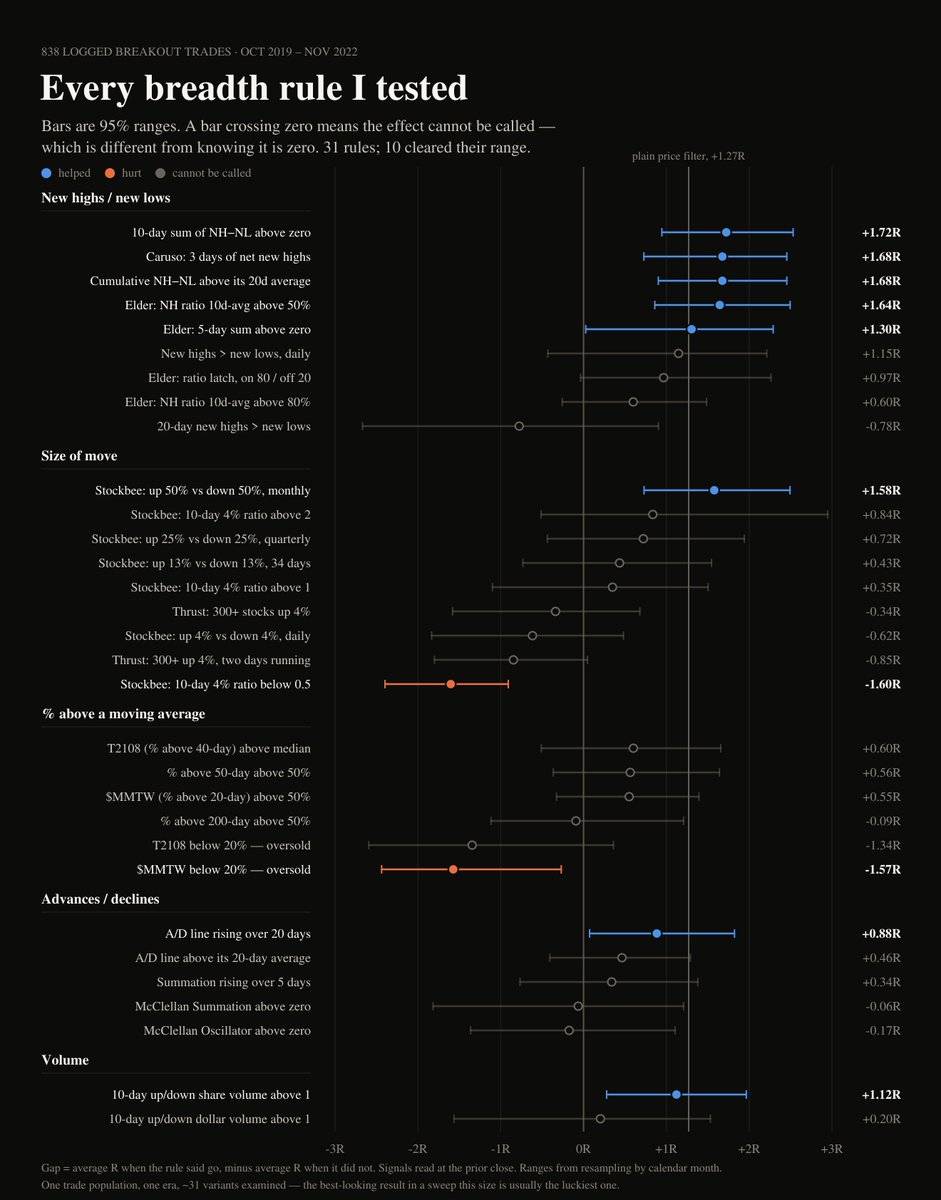
Here's every breadth indicator tested on Qullamaggies trades (838 breakouts)
Main takeaway here is to keep it simple stupid. If you really want to use a market filter you're well off using the 10 day SMA > 20 day SMA filter
Everyone is going to talk about the “no deal” between the United States and Iran.
Let me be blunt.
The news does not matter. It’s the reaction to the news that does.
Know your setups. Know your entry tactics. Position size properly and use progressive exposure.
K.I.S.S.
If the bottom is in place, we have resilient Semiconductors $SMH. Memory stocks, Optics, oil services $OIH and nuclear names all holding up very well $NLR. That would be more than enough merchandise to fill out a few portfolios! BE PATIENT!
I don't know if we've hit the low for the correction. I do see the huge reversal in the VIX and Oil. There is a chance that was the low. Want to see a follow through day. Want to see accumulation with no distribution days. Want to see indexes punch through the 50dma which they've been below since the start of February.
If it was the low, a lot of these names that held up well (optical, memory) should form constructive basing patterns. Will also see more names set up and go. Progressively expose slowly. Don't let drawdowns get out of hand in case that wasn't the low and we have another leg down. If we do, most names will tank so if you take too much risk too fast you will get whacked.
Friends hits his monthly drawdown limit on first trading day of March. Takes a week off, resumes trading.
Me: What are you doing?
Him: I started trading again.
Me: ...
Him: ...
Me: ...
Him: Wait...that means I can't trade again for the rest of the month!?
Me: What do you think "monthly drawdown limit means"
Him: Wow, if it means I can't trade again if I hit it, I would be much more careful and not drawdown.
Me: Exactly.
If the $QQQ could climb 5-6% from here and start to breakout it might become the most hated rally in my career.
- 5 disgusting months of chop
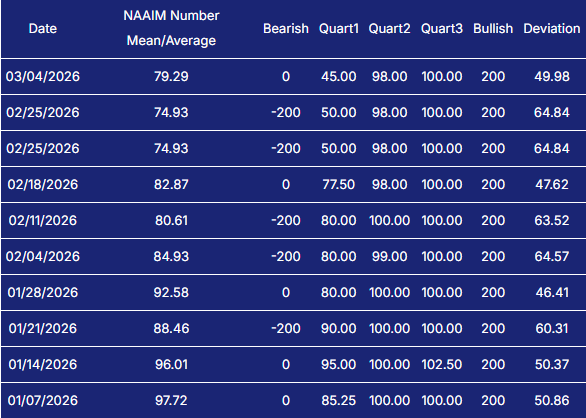
- NAAIM sub 80
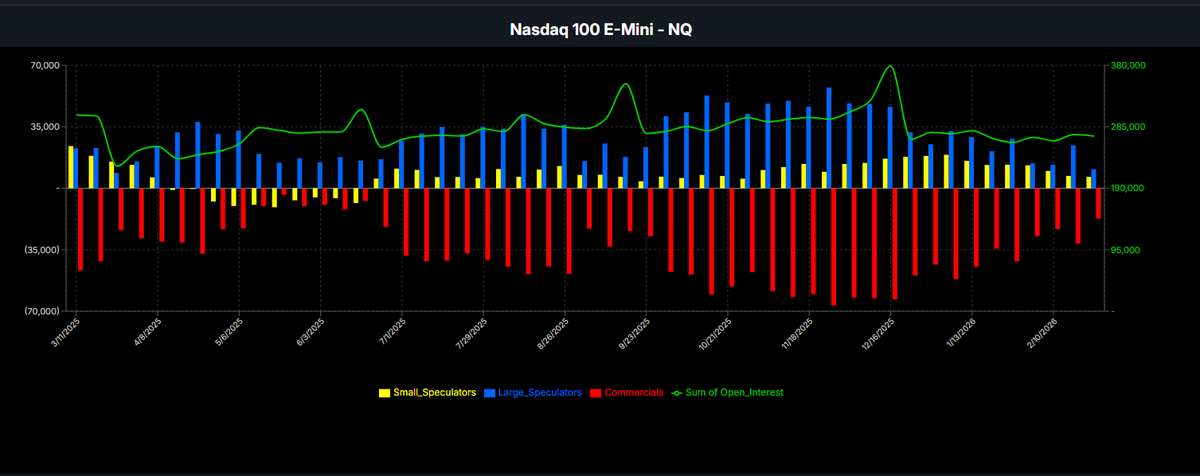
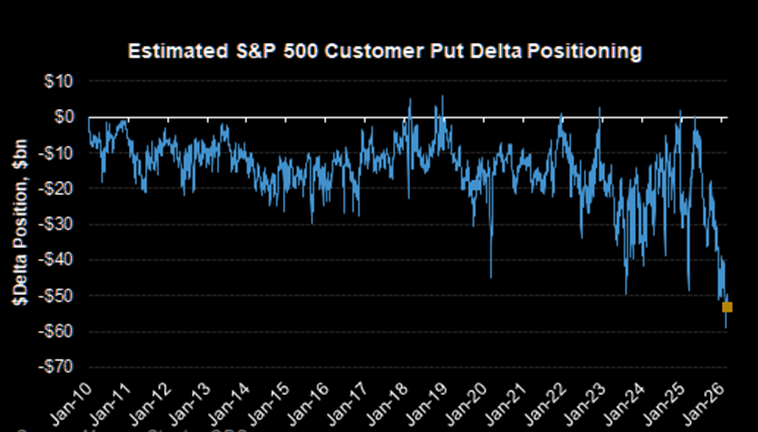
- Plenty of downside protection already purchased via put positioning which creates a floor
- The removal of those hedges becomes supportive liquidity
- Severe destruction in Software $IGV and Crypto $BTC $ETH
- Seasonality indicates that we typically bottom middle of March
- Finding reasons to be optimistic since this market refuses to rip off the band aid.
History of technological boom and busts
Every major technological breakthrough initially destabilizes markets, destroys visible jobs, and triggers financial excess. The crash that often follows is not proof the technology failed, it is proof that capital mispriced the speed of adoption.
Over time, productivity gains compound, industries reorganize, and new hierarchies emerge. AI and robotics are likely following the same path, but with deeper implications because they compress both intelligence and labor at once.
1. Railroads
Breakthrough: 1820s–1860s rapid rail expansion
Boom: 1860s–early 1870s debt-fueled railroad buildout
Bust: Panic of 1873 → global depression lasting until ~1879
Recovery: 1880s consolidation → integrated national trade networks
Railroads permanently reshaped commerce. Overleveraged financiers were wiped out. The infrastructure endured.
2. Electrification & Industrial Scaling
Breakthrough: 1880s–1910s factory electrification
Boom: 1920s productivity surge, appliance growth, equity euphoria
Bust: 1929 crash → ~90% Dow decline by 1932
Recovery: Late 1930s–1950s electrified mass production drives postwar boom
Electricity changed productivity forever. Markets simply overestimated near-term returns.
3. Automobiles & Assembly Lines
Breakthrough: 1908 Model T, 1913 assembly line
Boom: 1920s car adoption explosion
Bust: 1929–1932 industrial collapse
Recovery: 1945–1960s highways, suburbs, oil economy expansion
Cars restructured geography and labor markets. The adoption curve survived the crash.
4. The Internet
Breakthrough: Early–mid 1990s commercialization
Boom: 1995–2000 NASDAQ +400%
Bust: 2000–2002 NASDAQ −78%
Recovery: 2003–2015 cloud, e-commerce, platform dominance
The internet thesis was correct. Timing and pricing were not.
5. Financial Engineering & Housing
Breakthrough: 1990s–2000s securitization expansion
Boom: 2003–2007 housing and credit bubble
Bust: 2008 global financial crisis, S&P −57%
Recovery: 2010s liquidity cycle, tech-led asset appreciation
Financial innovation amplified efficiency, and fragility.
The Recurring Pattern
Genuine productivity breakthrough
Capital overextrapolation
Leverage build-up
Asset bubble
Crash and reset
Long-term compounding
Technology expands the pie. Financial cycles distort the path to fluctuate higher, then lower and back to the mean eventually.
AI and Robotics: A Different Magnitude
AI compresses intelligence.
Robotics compresses labor.
Historically, when intelligence was automated, labor expanded elsewhere. When labor was mechanized, cognitive industries grew.
The economy rebalanced across three differentiators:
Intelligence
Labor
Creativity
Now two of those pillars are being compressed simultaneously.
That shifts differentiation upward.
Judgment, taste, trust, emotional regulation, adaptability, coordination, and ownership become the new structural moats. In a world where AI becomes the productive “alpha,” net worth divergence increasingly depends on proximity to that alpha:
• Own the intelligence infrastructure
• Own the physical execution layer
• Or dominate the human traits machines cannot replicate
If history is a guide, volatility will come from leverage and mispricing, not from the technology itself.
The breakthrough will expand output.
The boom will overshoot.
The bust will reset.
And the long arc will compound.
The real question is not whether AI changes the system.
It is who owns the new alpha when it stabilizes.
@CFlanders7 Hi Christian, thanks for the interesting insight. In your experience, were there any nice momentum breakouts before the 2022 crash, after the leaders had already formed their tops and the QQQ made another attempt? Or was it generally better to just stay in cash?
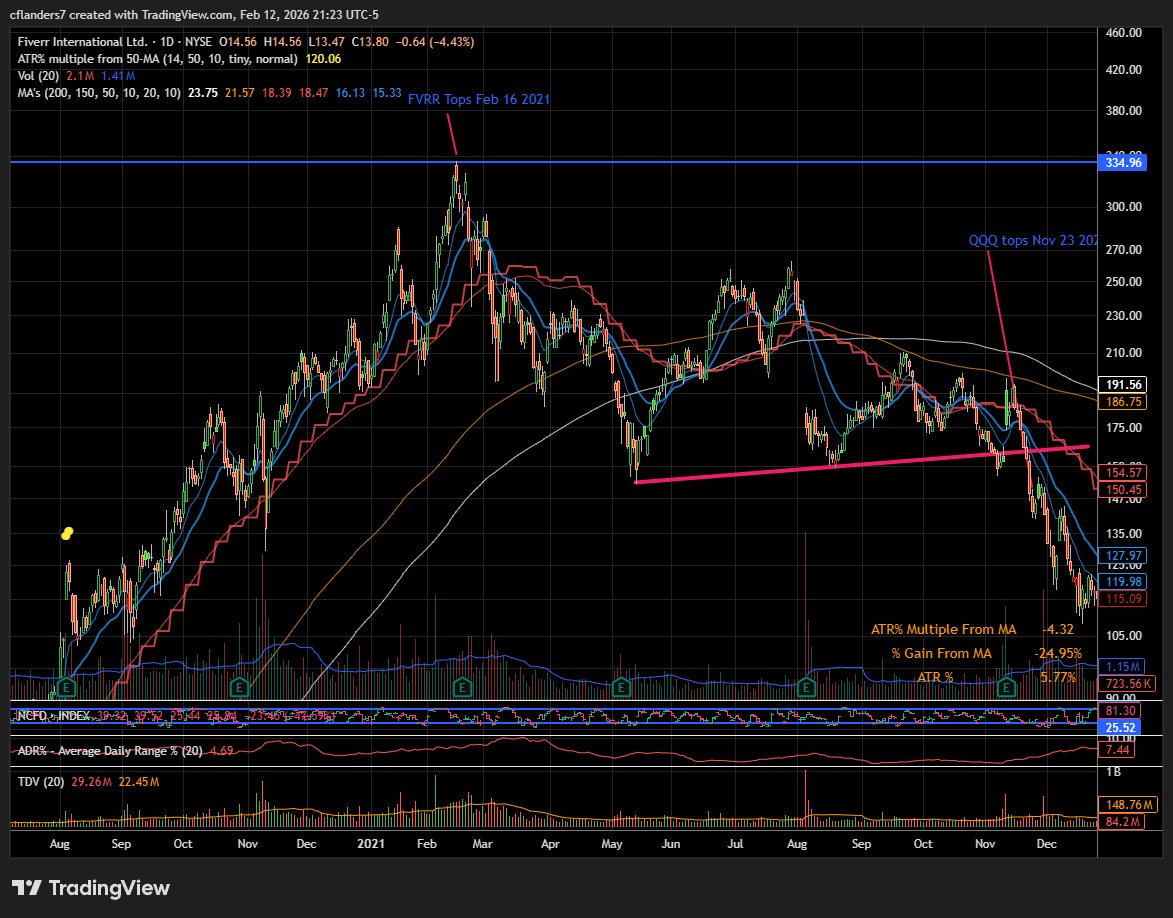
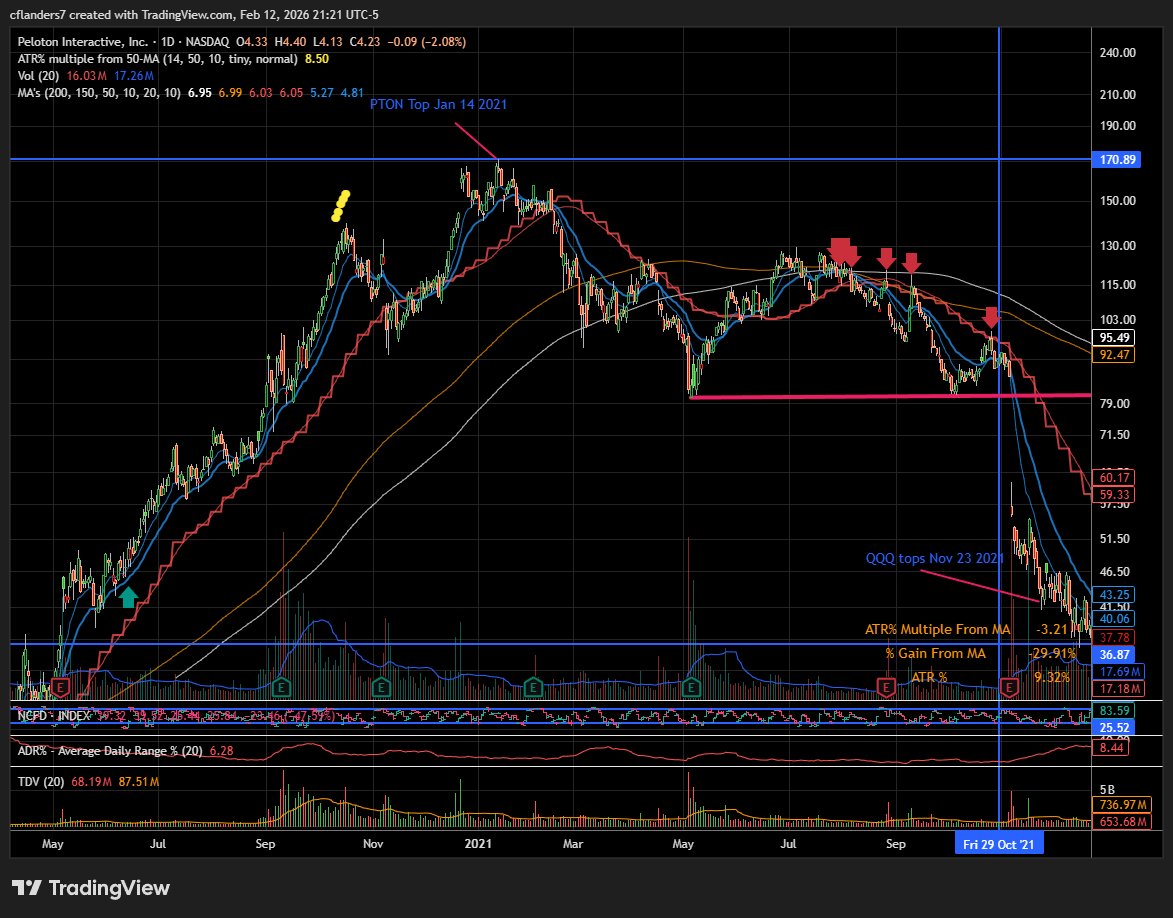
I don't think the QQQ has "topped" yet for this bull cycle. IF we follow the same pattern as 2020-2022 then growth names (leading since 2023) have likely topped. QQQ/SPY will perhaps have a correction soon (or very soon) and then rally to new highs and grind higher. During that rally I would expect a lot of these beaten down former leaders to rally into flattening or declining 200dmas and set up potential short sales.
I've analyzed every affordable, strategically located coastal town in Italy for a €200-300K budget.
Taxes, airports, cost of living, remote work infrastructure. I've called a couple of friends to confirm the data.
10 towns. The definitive guide for FIRE and Digital Nomads in Italy.
Thread 🧵
Disaster
the dramatic drawdown, the painful reversal of fortune, the failed strategies and idea, is not the exception. it is the natural, inevitable friction of any high-stakes venture.
Every one of us will face moments when the fundamentals we trust are questioned, and the bottom line is bleeding.
The vast majority of the world operates under the delusion that absolute, seamless success is the expected norm.
They are unprepared for the depth of the valley, only perceived by those who try something worthwhile.
Our true value, our competitive advantage, is not established during the bull run. It is revealed entirely by how we act in those dire moments.
It is the disciplined response to a crisis, not the reaction to a windfall, that defines us as leaders and shapes our enterprise.
Long-term, compounding success is never a stroke of luck. It is forged in Perseverance. It is built on the strength of our Adaptation and our Action through the most grueling part of the journey: the daily, painful requirement of showing up without capitulating.
In the dark of the market correction, in the despair of the valley of failure, when the environment is hostile and the data is grim, we execute. We maintain the systems, we trust the process, and we refuse to let go.
This resolute execution, year after year, in the face of inevitable challenge, is the only true path to enduring wealth and legacy.
Understand the path will take everything and march on. I will walk the path with you, until we dine in heaven once more.
Grateful and humbled to become a 2x U.S. Investing Champion in the Million+ (Stock-Only) Division.🏆
These past two years truly felt like a marathon. Once you start running, you can’t stop. And when you get impatient and try to run faster, it doesn’t help—it disrupts your rhythm. Later on, that loss rhythm can turn into a painful collapse.
In many ways, the competition isn’t that different from how I manage my portfolio in normal times—from picking stocks to timing entries and exits. But the biggest difference is this: in a championship setting, you must be more aggressive while making sure the worst case is only a small injury—not a knockout. It’s an extreme mental and strategic challenge.
So in 2026, I’ve decided not to compete. This year, I want to focus on doing two things well:
1) Many people have asked for English trading education. Thanks to my team—and the progress of AI—I’ll be launching an English training program: JLawStock Academy, and also an English YouTube channel (the program will be paid, and the YouTube channel will be free). This will be a major focus for me. PLEASE STAY TUNED!😉
2) I will write a book—starting in Chinese, and hopefully expanding into an English edition later.
Finally, I want to thank a few people:
-My wife, for giving me unwavering emotional support this year.❤️
-The trading legends who selflessly passed down their experience through books and research, shaping generations of traders—including me. Writing my own book is my way of paying it forward.🙏🏻
@markminervini, a two-time USIC champion, for showing me what’s possible. I entered both years with you as my benchmark—think like a champion, trade like a champion. And now, I hope to do the same—so that traders who are still fighting their way forward can also see what’s possible.
@NormZada, for organizing the U.S. Investing Championship @USICOfficial year after year. It’s not only an amazing stage, but also an exceptional training ground for traders to sharpen themselves.
If you’re considering 2026 USIC, I encourage you to join. No matter the final ranking, I believe the process itself can change you.💪🏼 Good luck to everyone competing in 2026.🙌🏻
Qullamaggie’s idea—that it’s better to give back the last 10% than to sell 100% too early—gets at a hard truth about momentum trading. The biggest gains usually come from staying in a stock longer than feels comfortable. The problem is that fast-moving, volatile stocks don’t give clean exit signals.
In real life, by the time a stock finally pulls back to its 10- or 20-day moving average, it may already be down 30–50% from the high. What felt like a great winner suddenly looks like a mess, even though that kind of pullback is often normal for these types of stocks.
This creates a constant tug-of-war. If you sell early, you protect profits but miss the moves that really matter. If you hold on, you have to sit through sharp pullbacks that feel wrong emotionally, even when the trend is still intact. There’s no perfect answer.
That’s why many momentum traders focus less on selling the exact top and more on staying with the move as long as the stock is acting right overall. The goal isn’t to avoid every drawdown. It’s to let the winners run long enough so that a few big gains more than make up for the givebacks along the way.
Whenever I look at this in my own trading my top 20% of trades are around 80% of my profits AT BEST. Over many periods my top 20% of trades are actually worth more than my total PnL over that same period meaning I’m giving back gains most of the time.
Less is more.
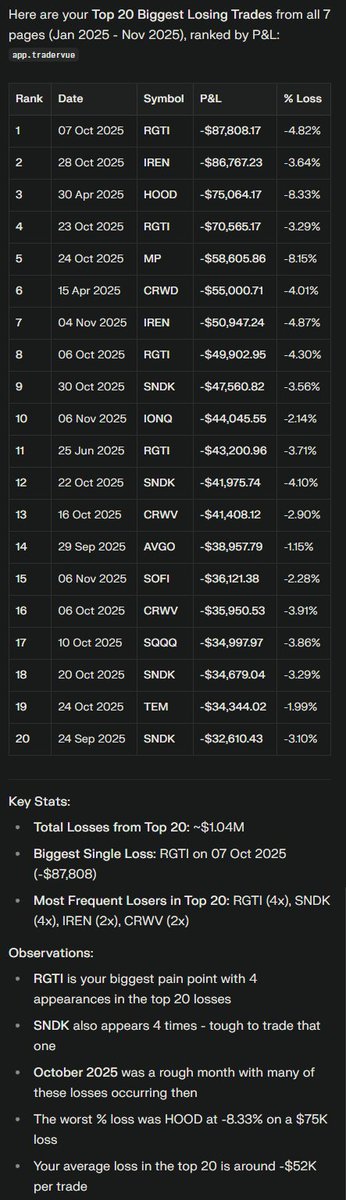
I had Perplexity go through all of my trades and make me some tables of 20 biggest winners and losers. There was one thing I found striking. 20 winning trades made up for ALL of my profit this year. The other 180+ trades were basically to end up as a scratch trader. @TedHZhang said something the other day which is very true. A small % of your trades will make up majority of your profits. In my case it's 10% of my trades have made up 100% of my profits. This is the power in holding winners when you have them and cutting losers quickly. 200+ trades 37% win rate. A bad character flaw of mine is taking too many losers on the same name. Once I set my eyes on a target I keep trying. Something to learn here.