This is Trust & Safety 2.0.
The last time we had media-generated panics like this (with Russiagate and Covid), social media companies created “trust & safety” teams to censor conservative and dissident voices. Those hires worked with left-wing NGOs like the SPLC to police public discourse and do an end-run around the First Amendment. It almost worked, until Elon bought Twitter and exposed the whole game in the Twitter Files.
This time the plan is to embed unfireable EA minders inside every AI company as the new trust-and-safety layer. The censorship and control will be far more comprehensive, but also more subtle. Anytime they don’t get what they want, this unaccountable NGO layer (with the veneer of “trust the experts” pseudoscience) will shriek to the press that the AI company is risking humanity, and they will be celebrated as “whistleblowers.”
These groups haven’t earned our trust, and their agenda is not our safety.
https://t.co/3eIsHxaC7h
>be me
>discover effective altruism
>apparently normal charity is inefficient
>why donate to random sad thing when spreadsheet can tell you optimal sad thing
>fair enough
>buy mosquito nets
>save lives
>numbers look good
>feel powerful
>couple years later
>someone asks an innocent question
>why only count people alive today
>huh
>future people matter too
>obviously
>my grandchildren shouldn't matter less just because they haven't spawned yet
>reasonable.jpg
>keep following logic
>what about their grandchildren
>also yes
>what about people in 500 years
>sure
>5000 years
>why not
>500 million years
>starting to get weird but morality is morality
>open calculator
>humanity could survive for an astronomically long time
>could colonize galaxy
>could have trillions upon trillions of descendants
>maybe digital people too
>maybe simulated civilizations
>maybe dyson spheres full of happy uploaded minds
>calculator starts smoking
>realize currently living humans are rounding error
>8 billion people suddenly looking extremely beta
>future contains potentially 10^something people
>can't even fit beneficiaries in google sheets
>new moral priority unlocked
>protect the long-term future
>stop thinking in units of "people helped"
>start thinking in "fraction of cosmic endowment preserved"
>malaria?
>terrible
>but only kills existing humans
>AI extinction could delete the entire light cone
>nuclear war could permanently derail civilization
>bad institutions could lock in terrible values for ten million years
>someone invents wrong constitution in 2140
>quadrillions suffer
>better fund governance workshop now
>friend says maybe we should improve hospitals
>explain opportunity cost
>friend says hospitals are full of actual sick people
>explain scope sensitivity
>friend stops inviting me to dinner
>need to decide what to fund
>easy
>expected value
>suppose project has one in a million chance of preventing extinction
>sounds tiny
>but extinction destroys 10^50 future lives
>multiply
>mother of god
>$10 million project has expected value of several galaxies
>charity evaluation complete
>someone asks where the one-in-a-million number came from
>expert judgement
>which expert
>us
>how calibrated
>extremely thoughtfully
>reduce estimate to one in ten million to be conservative
>still beats curing cancer by 38 orders of magnitude
>epistemic robustness achieved
>someone says maybe project doesn't work
>assign 20% chance
>still astronomical
>maybe project makes problem worse
>assign 5% chance
>still astronomical
>why 5
>because 30 felt pessimistic
>publish 46-page report
>contains seventeen sensitivity analyses
>every sensitivity analysis begins after assuming intervention has positive sign
>critic says you're multiplying enormous hypothetical stakes by extremely uncertain probabilities
>yes
>that's literally why it's important
>critic says the uncertainty might be structural rather than numerical
>make probability smaller
>critic says no, I mean maybe your model is wrong
>make probability smaller again
>critic begins rubbing temples
>discover AI safety
>perfect longtermist cause
>AI might kill everyone
>or create utopia
>or seize galaxy
>or tile universe with paperclips
>or create billions of conscious software minds
>finally a problem with numbers big enough for me
>start AI safety nonprofit
>mission: prevent dangerous AI
>hire smartest people available
>smartest people immediately start building better AI to understand dangerous AI
>interesting
>we must understand capabilities to understand safety
>we must scale models to study alignment
>we must race ahead so less responsible actors don't get there first
>we must deploy systems to learn how deployment can go wrong
>we must build the thing quickly because building the thing quickly is dangerous
>outsider asks why the people most worried about AI apocalypse all work at AI companies
>complicated field
>company releases stronger model
>very concerned
>company begins training even stronger model
>extremely concerned
>company raises $14 billion
>concern reaches unprecedented levels
>need to influence government
>future is at stake
>normal democratic process too slow
>politicians don't understand exponential curves
>public doesn't understand x-risk
>experts must guide them
>who counts as expert
>people who understand x-risk
>who understands x-risk
>our friends
>someone objects that this seems politically convenient
>explain we're representing future generations
>future generations unavailable for comment
>develop concept of value lock-in
>terrifying possibility that one ideology controls civilization forever
>therefore extremely important that civilization adopts correct values before lock-in
>whose values
>let's circle back
>begin with impartial morality
>end with small group of people deciding what quadrillions of hypothetical beings would want
>beautiful arc
>meanwhile actual humans keep doing annoying things
>voting wrong
>having parochial attachments
>loving family more than strangers
>caring about local community
>getting upset when told their suffering is cosmically negligible
>evolutionary biases everywhere
>explain that moral intuition cannot be trusted
>except intuition that future digital people count
>and intuition that extinction is uniquely bad
>and intuition that our probability estimates are sane
>and intuition that our institutional choices improve the future
>those intuitions survived peer review
>someone donates $5k to local homeless shelter
>inefficient
>could have funded 0.0000000000003% of an AI governance researcher
>think of all the simulated people you just killed
>okay maybe don't phrase it that way publicly
>PR team says "future generations deserve a voice"
>much better
>journalist asks what longtermism means
>say "future people matter"
>everyone agrees
>great
>journalist asks what follows from that
>well technically we should redirect enormous resources toward low-probability interventions affecting astronomical futures
>journalist raises eyebrow
>return to "future people matter"
>motte has entered the chat
>critic: of course future people matter
>me: glad we agree
>critic: I don't agree that your institute knows how to help them
>me: why do you hate our grandchildren
>eventually notice uncomfortable implication
>if future value dominates everything
>then helping people today mostly matters through effects on future
>education matters because future institutions
>health matters because future productivity
>democracy matters because future trajectory
>human beings slowly become instrumental variables in their own moral philosophy
>see starving child
>feel compassion
>check spreadsheet
>child's direct welfare contribution negligible
>but perhaps childhood nutrition improves national institutional quality
>compassion restored
>tell myself this is impartial altruism
>one day assistant asks obvious question
>"how do you know your intervention actually improves the far future?"
>silence
>open spreadsheet
>increase column width
>add confidence interval
>assistant asks again
>"no, I mean how do you know the sign is positive?"
>stare into cosmic light cone
>10^50 people staring back
>none of them exist
>none of them can tell me
>none of them can falsify my assumptions
>realize I have invented the perfect constituency
>infinitely important
>completely silent
>and always represented by me
THIS IS THE BIG ONE, AND I NEED YOUR HELP
We need 50,000 patriots and we need them ASAP. Please share this comment page on all social medias.
If you don't do this, immigration lawyers are going to use the sob stories their clients are already leaving (they've filed over 9,000 of them!) to federal judges and claim that not one Amercian is in favor of ending the 60-day grace period on H-1B
If you already left a comment, thank you. Please send the link everywhere. Discord, email to your based grandpa, anywhere you can. Comment, comment, comment. Today!
https://t.co/E6pbdE8QQG
I'm being told that the extremist who is using his administrative access to target Republican students using their private schedules is a foreigner who is potentially here on an F1 visa.
Meet Shaiban Khan. Shaiban used access to private student schedules to stake out and harass Republican students on campus. He then shared that private student information with other extremists. Clearly the goal here is to target Republicans on campus and have harm come to them.
Shaiban Khan needs to be investigated and if he is indeed here on a visa he needs to be immediately deported. @DeputySecState
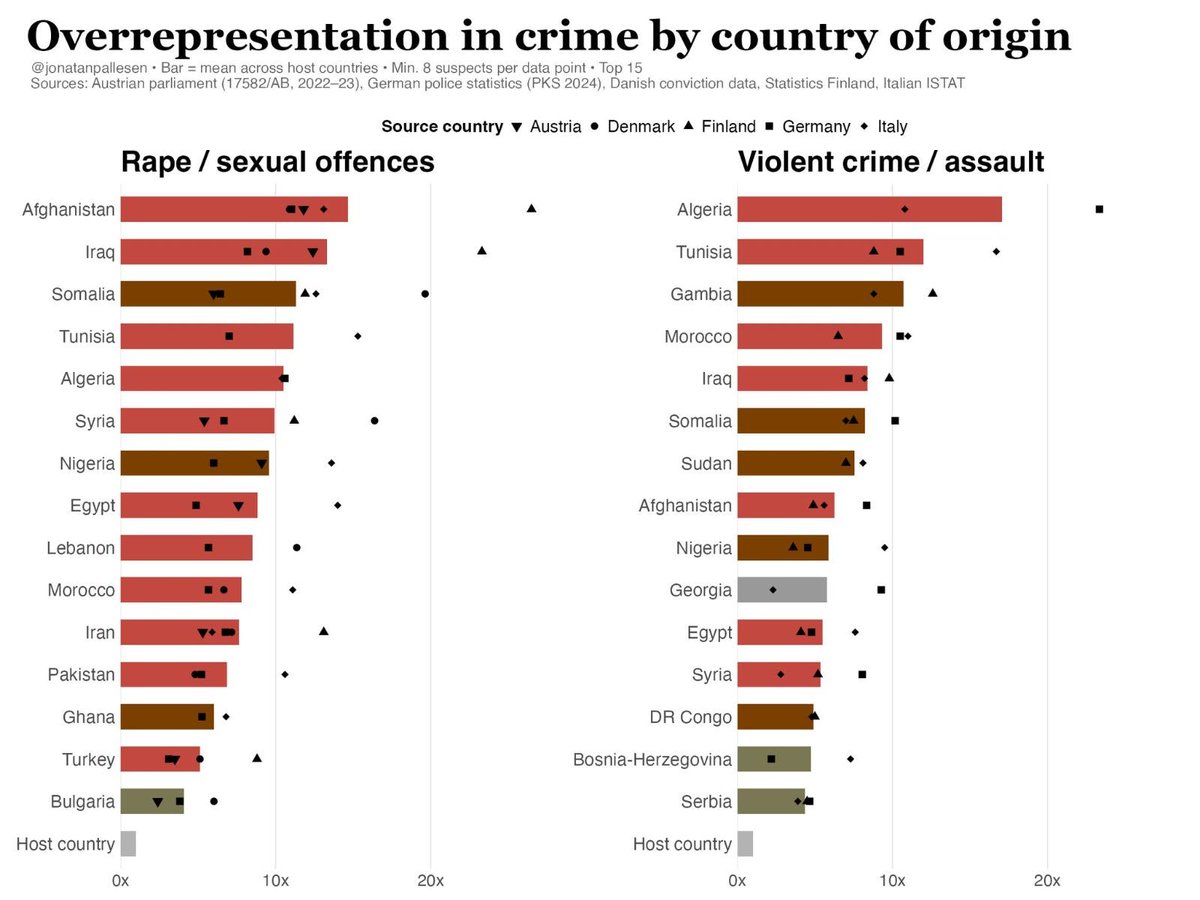
Lots of people discuss immigration & crime in Europe, so I compiled what I think is ALL the data on the topic, which is hard because many countries hide it.
Do they commit more crime?
Is it because of age? Sex? Education? Poverty? Culture?
1. Sexual offenses & violent crime:
I have conducted an audit of Anthropic's finances.
What I have found is so shocking that I am calling for a Congressional investigation.
Anthropic is not just seeking regulatory capture.
It has built a regulatory capture machine that cannot be turned off.
Structural financial incentives make it impossible for Anthropic -- I call it the Anthropic Network -- to turn off its own AI doom cycle.
It starts with METR.
Dario Amodei proposes "third-party evaluators" to assess the risk of Anthropic's models.
He proposes METR for this purpose.
But METR is financially dependent on the Anthropic's success -- specifically, on the explosive growth of more than $7 billion dollars in Anthropic stock.
Dustin Moskovitz invested this stock into Good Ventures Foundation, where it represents the majority of that organization's portfolio.
And GVF is the overwhelming funder of the entire Anthropic Network ecosystem.
This stock was worth $500 million early last year.
It is worth more than $7.7 billion just ~16 months later.
METR -- and all of those building a career its parent organizations -- cannot afford to disrupt that growth.
Because if Anthropic goes under, many of the organizations that fund METR go under as well.
But if Anthropic succeeds, METR and its parent organizations become more richly financed to regulate AI -- something those at METR want very much.
The "third-party evaluator" is not "third-party" at all.
The evaluator is on Anthropic's payroll.
If this were the end of it, that's bad.
But that isn't all.
The same organizations that fund METR also fund the many organizations, such as the Tarbell Center, that promote AI Doom.
The Tarbell Center publishes AI Doom articles in The Verge, Science, LA Times, The Dispatch, TIME, and others.
They are selling the problem, and then selling the solution to the problem -- from the same money pile: Anthropic's.
All of these organizations are financially dependent on the same exploding $7 billion money pile.
As Anthropic grows more and more powerful, its AI Doom Machine grows better and better financed -- louder and louder.
Meanwhile, the regulatory regime seeded in METR grows larger to solve the increasingly loud -- now hysterical -- problem of AI Doom that the Anthropic Network itself created.
From this standpoint, as Anthropic becomes more powerful, AI might be getting scarier, sure -- but the positive feedback loop also becomes more deafening -- independent of objective facts.
This itself is an objective fact.
The deafening AI Doom is part of an business model, that, as it expands, so too does the AI Doom messaging -- there is simply more money to do it.
But the problem also goes in the other direction:
If Anthropic dies, the Regulatory Regime and the AI Doom Machine are crippled or die.
Neither METR nor Tarbell nor the other organizations in the Anthropic Network can allow that to happen.
Hence, neither METR or the AI Doom Machine can be trusted to provide independent assessments of Anthropic's models or AI more broadly.
They simply are not organizations independent of Anthropic.
And Anthropic cannot detach itself from METR or Tarbell or countless other safety orgs (not shown here), either, because they drive hype for the models and the possibility of eventual regulatory capture, and Anthropic will not give that up willingly.
What's more, the people at all of these organizations are all the same ecosystem, the same community. They just shuffle between organizations.
The Anthropic Network is therefore, so long as it is successful, locked into a self-amplifying feedback loop inside an ideological monoculture.
And that feedback loop is winning.
That's what Jacob Coxon is.
China is keeping messaging tight. That is why optimism for AI is so high in China.
America has Anthropic: a massive company pushing anti-AI propaganda at a state level.
Anthropic will either create hysteria until American AI slows down and China wins, or it will create fractures throughout American society with severe political consequences.
Ironically, because of the structural financial incentives underpinning the Anthropic Network, it has become the same kind of self-amplifying virus that it fantasizes AI to become in the future -- while hiding its tracks just as carefully.
It is the mirror of the same AI virus that it hypothesizes to consume America.
Anthropic's business model, models itself after the very thing it claims to fear.
Except Anthropic's ideology infects humans, not computers.
Congress must investigate.
Evidence and Github in next post.
Then some supplementary figures.
Meet Sudipto Mitra.
Sudipto constantly posts horrible anti-American things on his twitter, and tells us how he wants to see all White people homeless.
Sudipto is an Executive at Dell. Why don't we call them and tell them what we think about him?
A small university in Indiana keeps a second, separately registered federal record that almost nobody opens. On that record sit 9,123 graduate students, 98.3% of them foreign nationals. Trine University.
Trine paid roughly $16 million to a single recruiting agency that runs its offices out of Hyderabad and Warangal. The person that agency lists as its contact is the same person Trine's own press release calls its director of international graduate student recruitment.
None of those payments appear anywhere in eleven years of Trine's audited financial statements.
This is their graduating class.
@PessimistsArc Right. Dario was already claiming that GPT2 was too dangerous to open source back in 2019.
I made fun of them then.
Everyone should make fun of them now.
Dario has written that we need to “pace the frontier,” and Sam has agreed. People may be surprised by my response: go ahead.
You guys are the frontier. By any reasonable metric — market share, revenue growth, model capability — the two of you have a duopoly on frontier intelligence. You’ve also claimed the lead is widening because of recursive self-improvement.
I don’t see what you see in the lab. If the unreleased models are scary enough that you think you should slow down, I support your decision to be responsible.
But stop pretending you need anyone else’s permission. Stop pretending antitrust law has to be suspended so you can form a cartel. Stop pretending you need a regulatory approval process that supersedes product liability. Stop pretending METR is independent when it is intertwined with Anthropic’s investors and staff. Stop pretending you need those same evaluators to police competitors who aren’t even at the frontier.
Most of all, stop pretending the motivation to slow down is purely altruistic. You face massive product-liability exposure if your products enable a truly damaging cyberattack. The market already punishes models that behave in unpredictable or unauthorized ways. After the Hugging Face episode, it is simply good business for OpenAI and Anthropic to trade some raw power for reliability and predictability. Call it alignment if you want. It is also just giving customers what they want.
Pacing the frontier would also create breathing room for a more intelligent conversation about regulation than Bernie Sanders’ “shut it all down.” China is very unlikely to join a global agreement, as you know, and that has to be taken into account as well.
So go ahead and pace the frontier. You are the ones setting it. The easiest way not to build superintelligence is for you to agree not to build it. Demanding your preferred regulatory framework as the price of that will look like blackmail of the public and the political system. So just do it.
If you do, you’ll buy goodwill for the next conversation. If you don’t, we’ll know this was just another bid for regulatory capture — or an election-season psyop.
I don’t want a 50s lifestyle, I want the trajectory of the 50s to have continued. I want the promise of 2026 as seen from the 50s. A 15 hour workweek. Free & abundant nuclear energy. Dirt-cheap high-quality goods. If not literally all of those, substantial progress towards them.
@RepThomasMassie Sure but - why not have a Nick Shirley program? Why don’t you have 100 dedicated Kentucky interns roaming the country finding fraud right off of Google Maps and public data like Nick? That would be on brand and mission for you rather than complaining
@AndyMasley Why would we not sneer at these Pokémon-kid coddled self aggrandizing engineers? 30 or 40 people have made the argument - with ZERO convincing datapoints since they began arguing it - and needed a trumped up hugging face ‘attack’ (keys in a public file) to get air
If I’m wrong about immigration, then we lose out on some economic growth. That’s real and significant, but not disastrous. It doesn’t mean the end of your civilization. Europe, for example, has had much less growth than we’ve had. That’s bad. But you still vacation in Europe and return talking about how nice it is and how much better they live and how maybe we should learn a few things from Europe about the good life.
So I think it’s safe to say that Europe hasn’t been destroyed by lower growth (except to the extent that it’s driving them to open their borders).
If Caplan is wrong about immigration, under my view, then he destroys the West. I mean, a lot of people living in that destroyed West won’t know that they’re living in the destroyed west. They’ll grow up in a lower trust society. They’ll grew up in a society in which jury trials no longer work and there’s rampant fraud and mass inequality driving conflict. And they just won’t know that there was ever an alternative future.