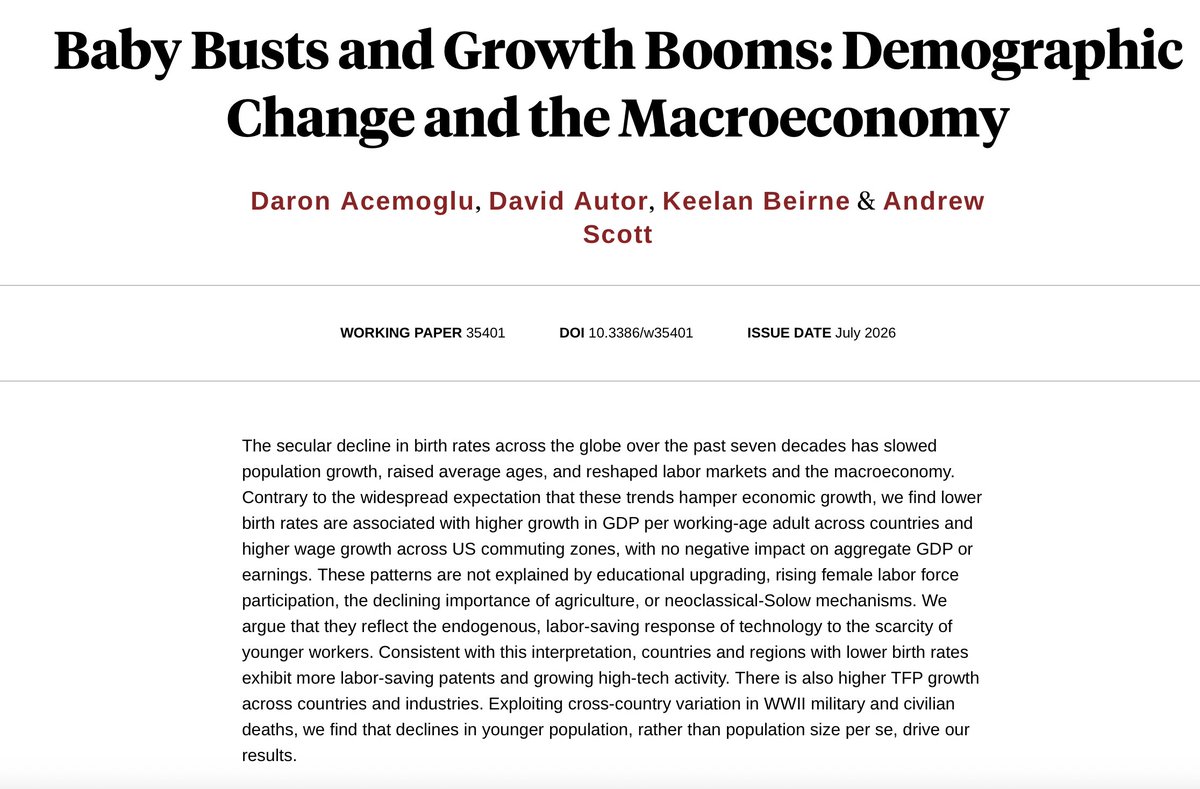
🚨🚨���NEW PAPER 🚨🚨🚨
Attention-Based VARs
The Attention Mechanism at the core of Transformers and LLMs has an interpretation as a reduced-rank time-varying VAR in time series.
Tune in today at the NBER Summer institute or follow on YouTube: https://t.co/siaRJUQ2IM
@t_holden "Loans create deposits, and with a lag to aggregate demand. High-powered financial market engineering with scary words like 'rehypothecation' fills the gap until the money comes along."
@t_holden This is a great point. I've always preferred to think of money, and payment systems in general, as part of Aggregate Supply. Your statement becomes much more "Water is wet"-like if you say that Demand moves first and Supply follows.
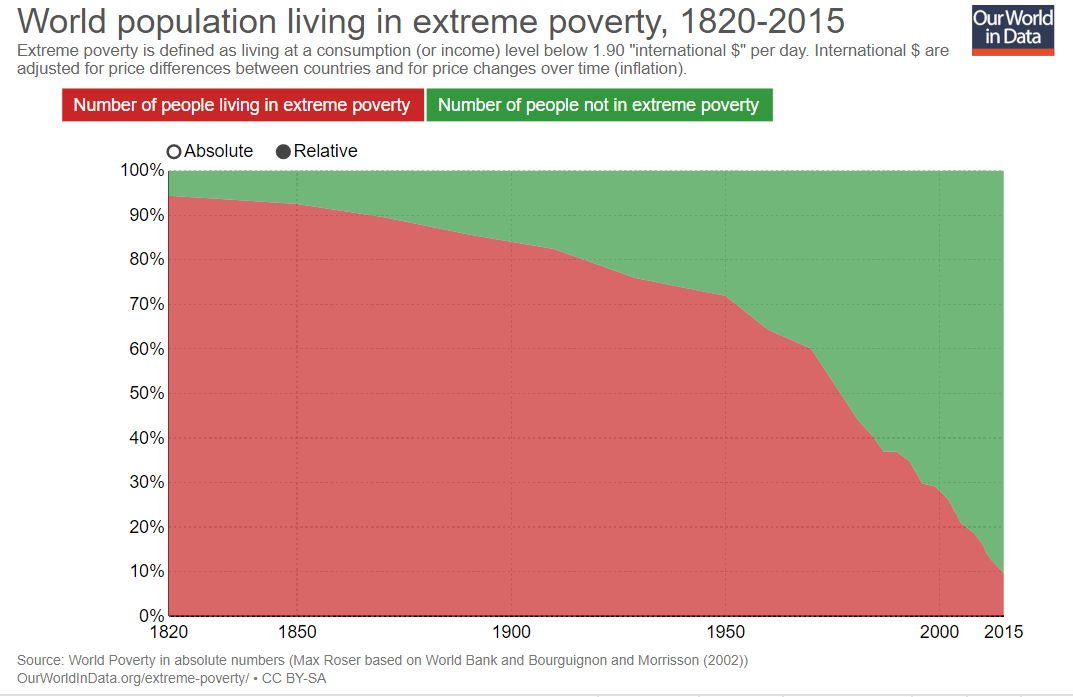
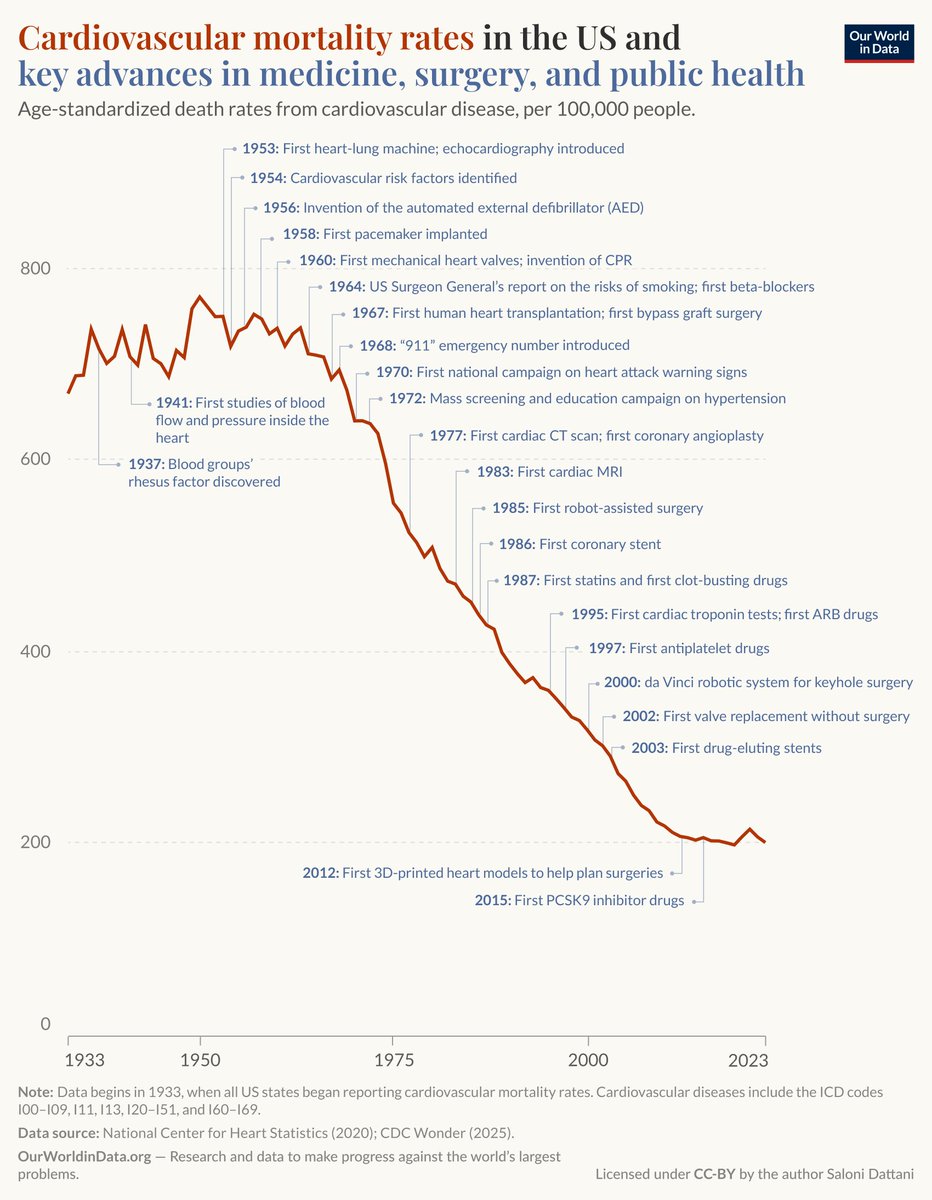
It's been interesting and puzzling to witness the problems with accuracy in UK economic statistics over the past few years. (See the links in the next tweet for more.) It seems that the Office for National Statistics, ONS, now struggles to effectively measure basic figures such as employment, trade, and inflation. This resulted in a quite scathing government report published last summer, where Robert Devereux, a former permanent secretary, concluded that "most of the well-publicised problems with core economic statistics are the consequence of ONS’s own performance."
There's a lot of discussion about the travails facing the UK these days (including this big piece in The Atlantic a few weeks ago[1]), and the problems with the ONS feel like an unsettling microcosm of diffuse decline in broader institutional competence.
Anyhow: at Stripe, we became curious about the UK's published entrepreneurship data. While we observe a boom in many parts of the world, official figures don't show a similar increase in the UK. In the latest Stripe Economics post, we dug into the data, and, as far as we can tell, the official figures are probably misleading. The good and the bad news (mostly good, I think!) is that the UK is almost certainly witnessing an unmeasured boom in entrepreneurship: https://t.co/R7oTZNmxc6
UK-specific issues aside, I suspect that this measurement question is illustrative of forthcoming econometric challenges. Keeping the world's macro indicators up-to-date in response to the faster-than-usual changes wrought by AI will be both increasingly difficult and increasingly important in the coming years.
[1] https://t.co/OAnwRmpyON
the one conspiracy i believe is that this place is full of bots programmed to say insane, incendiary things and they're funded by foreign organizations who want to divide americans and destabilize US society
Economists have done such a poor job explaining free-market capitalism that we're now re-litigating it with a generation taught socialism is preferable. It's like the medical profession having to convince people bloodletting isn't good medicine and to stop asking for leeches
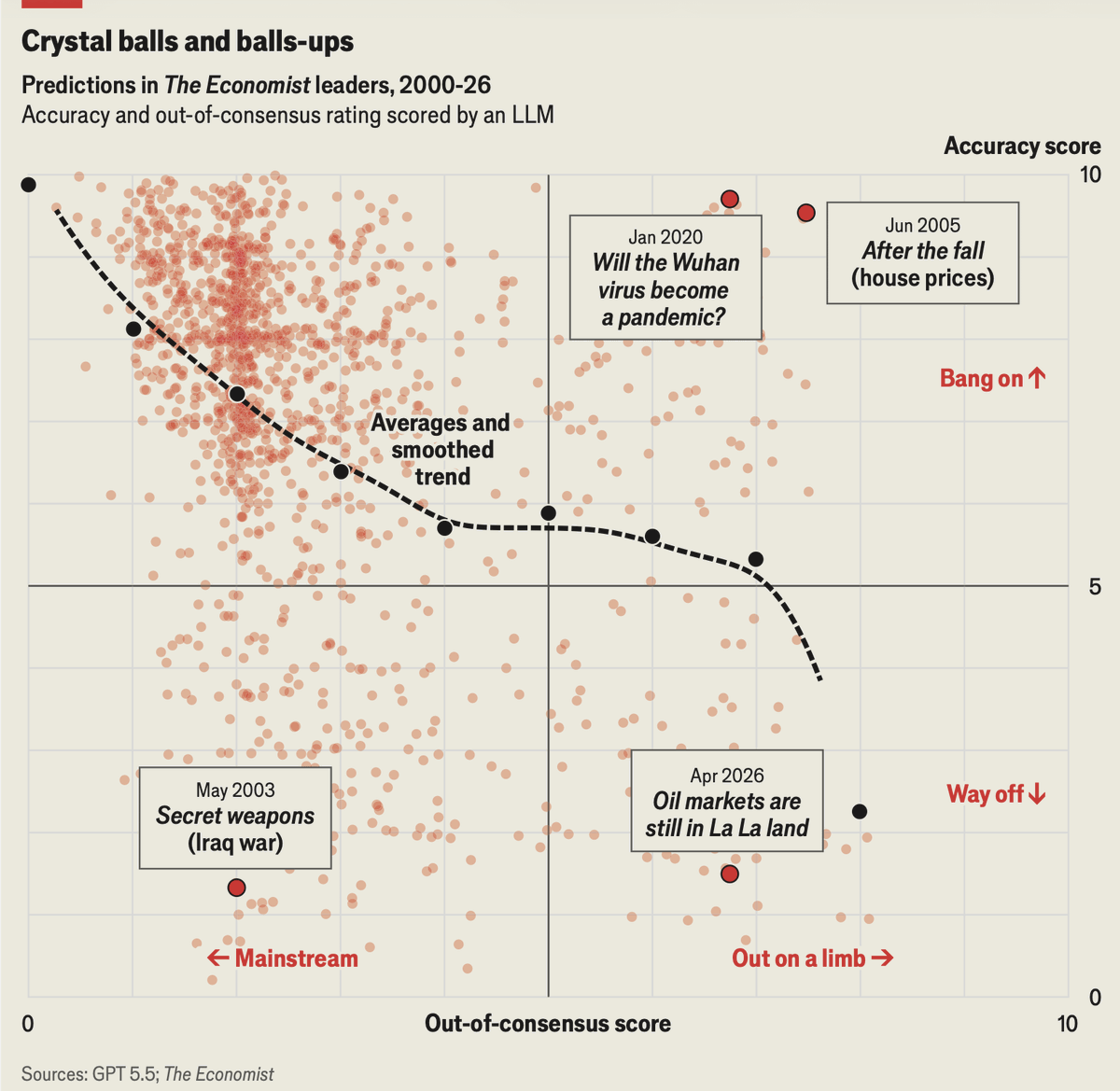
IS THE ECONOMIST ALWAYS WRONG?
Scandalously, in some circles @TheEconomist has a reputation as a contrarian indicator. This week we fessed up to getting a big call on oil prices from April wrong.
Obviously our goal is not perfectly-hedged (and perfectly boring) predictive accuracy: often it is to stimulate, provoke, and challenge. But I did want to test that wider allegation, so I ran a series of LLM scorers across our full leader database since 2000 (7,000 leaders in all.)
You can see the results in the chart below: each dot is one of the 1,400 leaders where we identified concrete and falsifiable predictions that were central to the argument. Higher = more accurate, further to the right = more contrarian.
We do well, unsurprisingly, when aligned with conventional wisdom. We often do worse when truly out on a limb. But actually, on average, we are a bit likelier to be right than wrong on our somewhat-out-of-consensus calls. All round, a respectable performance.
And as @ecurrnomics points out an accompanying leader, there is no shame at all in being beaten by the market: as good free-marketers we believe deeply in the aggregated wisdom of prices.
Take a look at my piece here, which includes a canter through our best and worst calls of the last quarter-century: https://t.co/WyKqangFrE
@arindube@ernietedeschi To ask the really obvious stuff, is it because of the E or the POP? How does it split by gender or educational attainment?
The UK has recently had some perversely large movements in the participation rates of the young, which is probably coincidental, but interesting.
Is there a Messi-equivalent in another sport? Someone who’s so obviously the goat, who’s just so good, never washed and so clear of everyone else?? It’s just unbelievable watching him still play like this









![patrickc's tweet photo. It's been interesting and puzzling to witness the problems with accuracy in UK economic statistics over the past few years. (See the links in the next tweet for more.) It seems that the Office for National Statistics, ONS, now struggles to effectively measure basic figures such as employment, trade, and inflation. This resulted in a quite scathing government report published last summer, where Robert Devereux, a former permanent secretary, concluded that "most of the well-publicised problems with core economic statistics are the consequence of ONS’s own performance."
There's a lot of discussion about the travails facing the UK these days (including this big piece in The Atlantic a few weeks ago[1]), and the problems with the ONS feel like an unsettling microcosm of diffuse decline in broader institutional competence.
Anyhow: at Stripe, we became curious about the UK's published entrepreneurship data. While we observe a boom in many parts of the world, official figures don't show a similar increase in the UK. In the latest Stripe Economics post, we dug into the data, and, as far as we can tell, the official figures are probably misleading. The good and the bad news (mostly good, I think!) is that the UK is almost certainly witnessing an unmeasured boom in entrepreneurship: https://t.co/R7oTZNmxc6
UK-specific issues aside, I suspect that this measurement question is illustrative of forthcoming econometric challenges. Keeping the world's macro indicators up-to-date in response to the faster-than-usual changes wrought by AI will be both increasingly difficult and increasingly important in the coming years.
[1] https://t.co/OAnwRmpyON](https://pbs.twimg.com/media/HNMWtDsbwAEG7Lo.jpg)