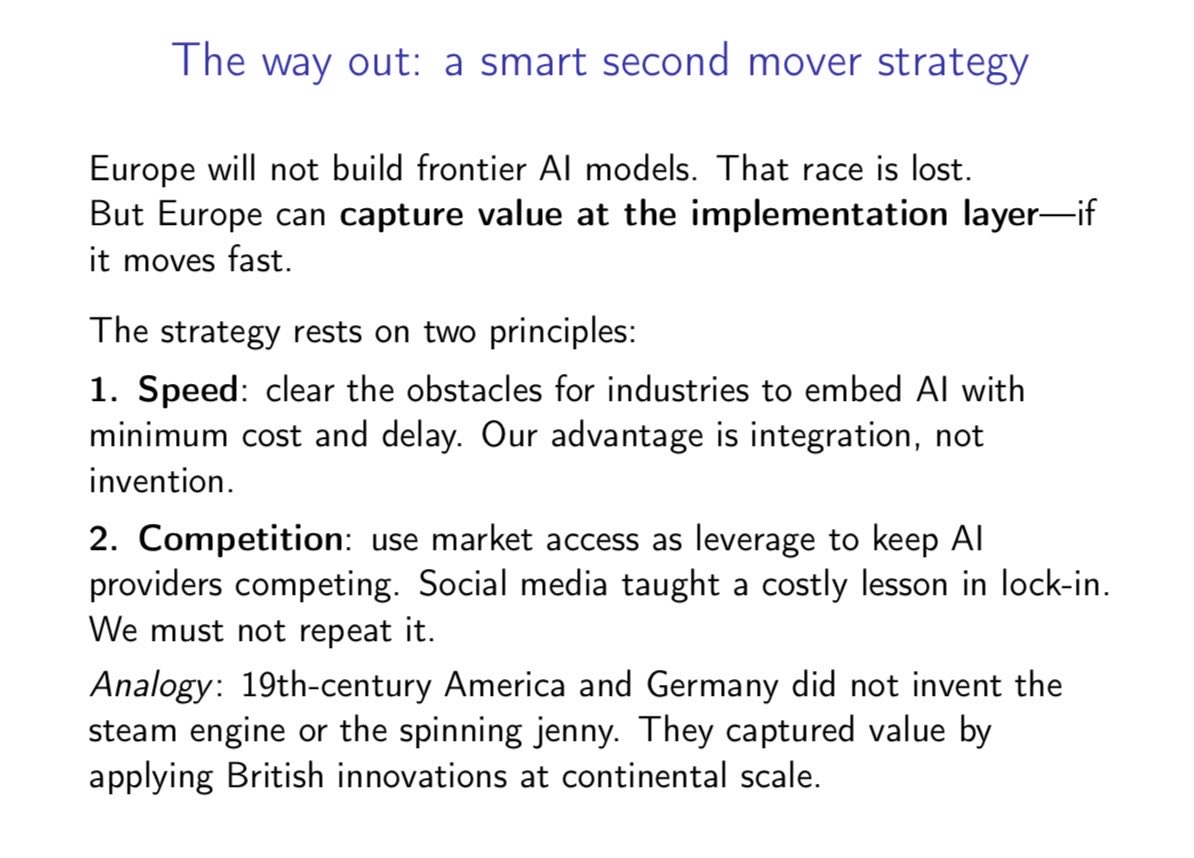
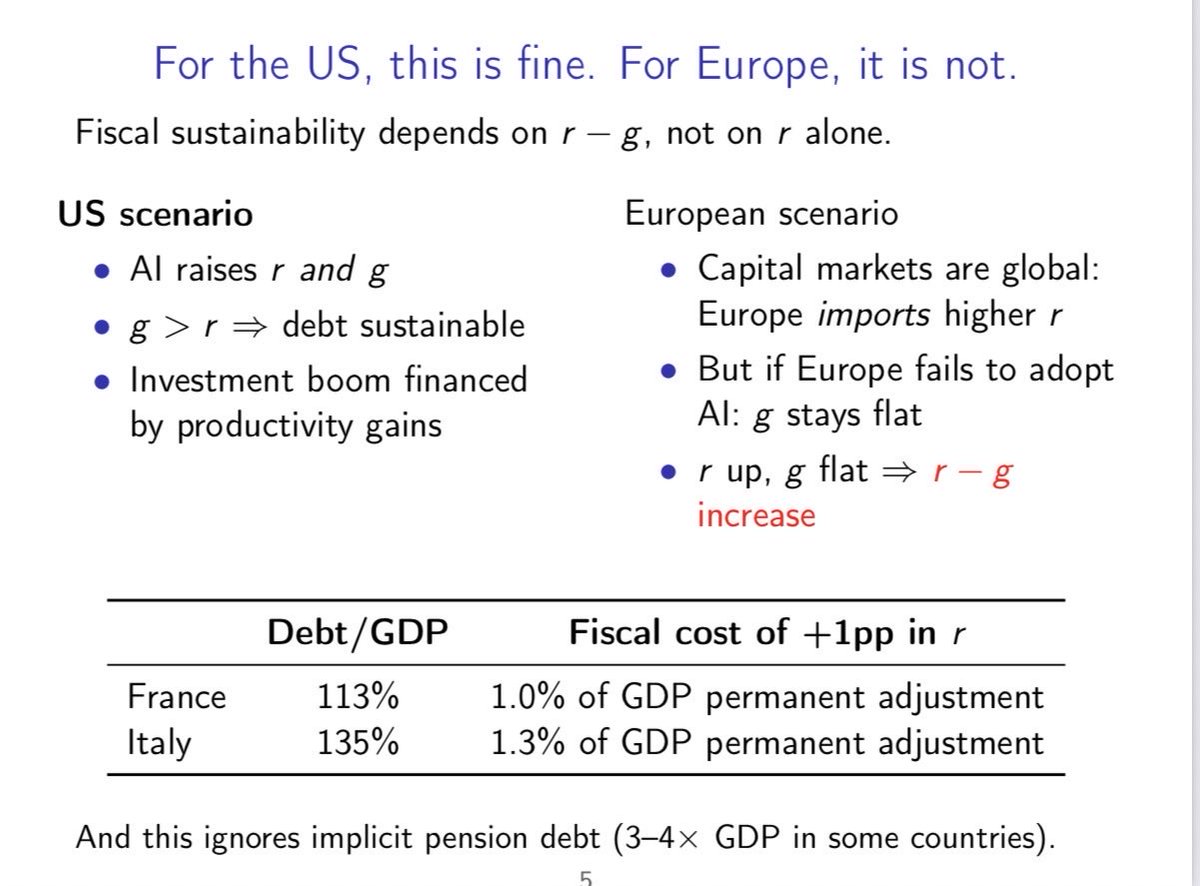
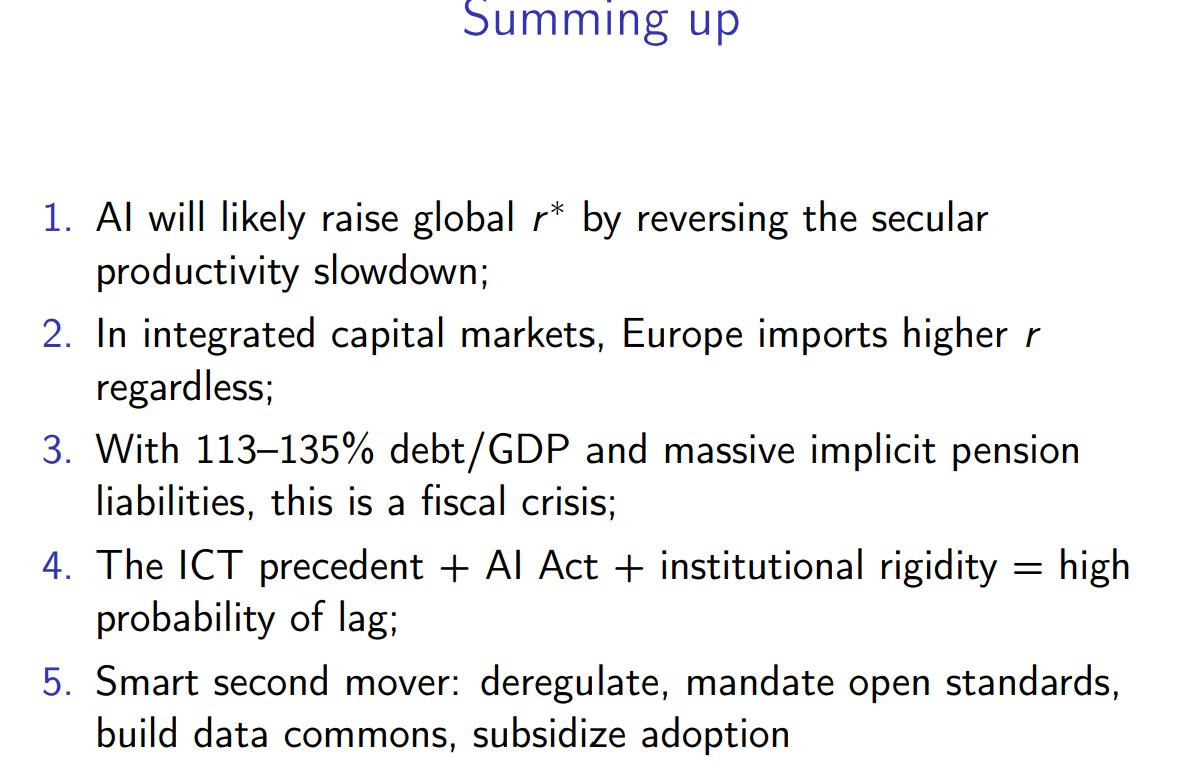
These slides from the excellent @lugaricano are a must read for any European policymaker who seriously wants their country to thrive as AI advances.
We urgently need to ensure that our economy is ready to take advantage of AI or we will be left behind. In a rapidly changing and uncertain world, the only way to ensure security is to ensure that we have the means to pay for it.
https://t.co/pnJ1GR4fTT
I would add one point: if AI develops to a point where it is a ‘gross substitute’ for human labour (elasticity of substitution > 1), the human labour share of GDP may shrink. At that point there is no reason to assume that GDPs per capita in developed countries will cluster as they have. Being left behind could mean being left very far behind indeed.
@lugaricano argues:
If AI raises global interest rates by boosting productivity, but Europe fails to adopt AI, Europe imports higher r without higher g -- a path to fiscal crisis.
We completely agree that the UK market has an unduly high reliance on a small number of large speculative housebuilders. That reliance is a result of England’s planning system. It is why we promote reforms, proven to work in other countries, to deliver more homes from small and medium-sized builders with the support of local communities.
Why does Britain have some of the highest house prices and rents in the world?
The answer is the scarcity premium – the gap between sale prices and build costs.
A new @yimbyalliance site maps out the scarcity premium & compares it to where new homes get built.
It is quite remarkable in this day and age to see opinions like this, impressively unburdened by any acknowledgement of the huge wedge between home prices and construction costs in unaffordable, high wage areas, nor of the resulting welfare and productivity costs.
The Government is on track to miss their 1.5 million homes target by over 500,000 homes.
Our new live housebuilding tracker shows that this Government is now building at a slower pace than the last three Governments.
Here’s how the tracker works 📹
The Government is going to miss the 1.5 million homes target.
Homes are now getting built slower than under the previous three Governments.
We need a new wave of planning reform to get back on track.
Depends on your view of likely effects I think:
- if labour share of GDP declines then agglomeration becomes more about amenity and social ties rather than productivity
- distribution of wealth (within and across nations) will enormously drive residential land use outcomes
- likely much more important to design places where people want to live rather than places which just happen to be well located for work
- industrial uses seem likely to move much further from populations (in the long run presumably mainly off planet)
- cost of distance drops massively with AVs and then ultimately drone taxis.
NEW RESEARCH shows that London meeting the housing target could cut rents by £251 a month 💰
Great work from @timleunig, @robblackie & @dc_lawrence 👇
What if the best way to reduce the cost of living also turned out to be the best way to boost growth?
In a new paper for @BritishProgress, @timleunig, @robblackie & I find that the Government hitting its housebuilding targets would *reduce rents by £251 a month* in London, within 5 years.
This is a far greater saving for ordinary households than any cost of living measure announced in the Budget.
And the best part? We can do this for free. By streamlining planning restrictions, improving building safety rules and empowering residents, we could hit and exceed Labour's housing targets.
BUT as things stand, the Government's housing targets are not on track, and so households across the UK will not feel this benefit.
NEW: The clock is ticking on the Government’s 1.5 million homes pledge.
Today’s Budget is a chance to change course. What would it take to get more homes?
Here’s where planning reform needs to go next. 🧵
Striking that @SpaceX alone is already building AI compute capacity faster than the entire of Europe. And it plans to increase that rate by 5x in 2027.
If AI does ultimately reduce the labour share of global GDP, Europe is going to regret being left behind.
Holy smokes!!!!
$SPCX says Q4 capex will be $35-40 billion versus $18-19 billion from sell-side estimates.
Elon also says they can bring on 10 GW of compute in 2027 in addition to the 2.5+ GW they expect to have by the end of 2026.
This means $SPCX capex in 2027 could be $300-400B billion (ie $30-40B per GW) vs current sell-side estimates of $165B.
From Elon… “At current pricing, new compute deployments are generating a payback of less than a year. Pricing is currently tracking slightly above the high end of the $30 to $50 per watt range we were discussing just last quarter, which further supports the attractiveness of these terrestrial SI compute investments.”
From Elon… "I think the demand for bandwidth is going to be dramatically higher than it is today. I think in three to five years there is probably a demand for 1,000 times more bandwidth than there is currently, because AI or SI agents will on a per-agent basis use far more bandwidth than a person, and there will be far more agents than there are people... With next year being primarily Rubin, I would say I am fairly confident of being able to bring an incremental 10 gigawatts of compute online in 2027. That would be in addition to the roughly 3 gigawatts, maybe 2.5 to 3 gigawatts that we will have online by the end of this year. Let me put it this way. I would be surprised if we brought on less than 13 gigawatts of compute by the end of next year."
…and to think that some of you are bearish on ai infrastructure 🙄 while the clowns at Gartner think demand is lagging supply 🤣
A must-watch video for YIMBYs!
How do we get people to say yes to more housing?
📹👇 Watch our NEW VIDEO on why one small corner of London shows that giving power to local people can actually lead to MORE homes.