ReadyAI is building a decentralized Scale AI
Instead of human annotators, we are using distributed LLMs
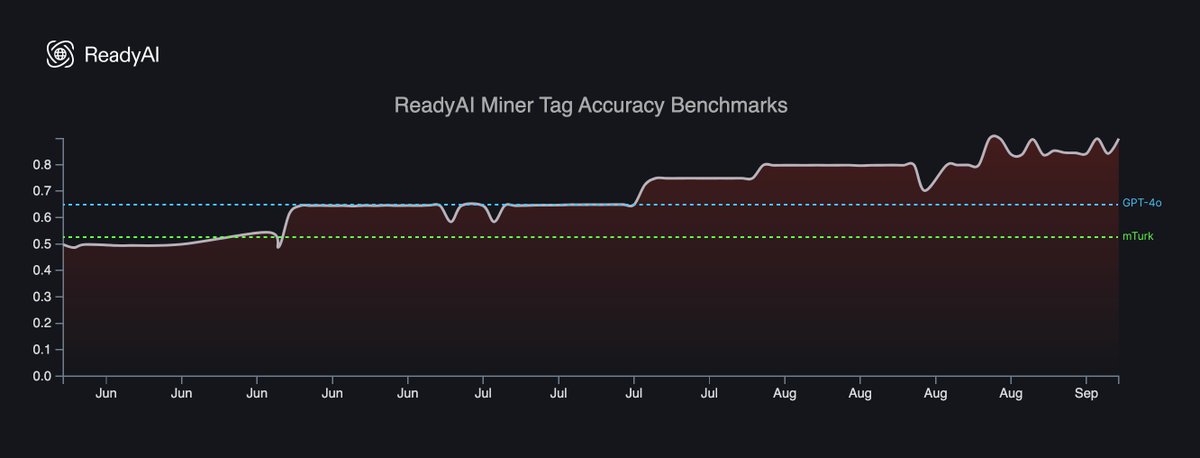
In just 3 months, our top miners are now exceeding the MTurk benchmark by 71% and GPT 4o by 37%
Previous studies saw only a 25% increase over the MTurk bench for ChatGPT.
Read more 👇
https://t.co/7utuDhEMwg
Summary of Findings:
This study evaluates the performance of miners using their own fine-tuned models in comparison to the Mechanical Turk (MTurk) benchmark, which is used as the gold standard for comparing LLMs for annotation tasks. Previous studies, such as Gilardi, Fabrizio et al. (2023), "ChatGPT Outperforms Crowd Workers for Text-Annotation Tasks," showed that ChatGPT outperformed the Mechanical Turk benchmark by 25% on average.
Miners on subnet 33 are currently outperforming the MTurk benchmark by 71% and GPT 4o with no further optimizations by 37%. SN33's top miner performance has improved 75% over the three months since the subnet's launch.
Two other key considerations in LLMs vs. MTurk performance are cost and time to complete tasks. For time to complete a task, the average for MTurk was 3 minutes and 57 seconds per task. For costs, MTurk averages $0.12 per task. SN33 miners are producing these annotations at a cost of 660x less. Additionally, recent research from the Swiss Federal Institute of Technology suggests that a substantial portion of crowd workers may be leveraging Large Language Models (LLMs) to complete their tasks. Specifically, Veselovsky et al. (2023) estimate that between 33% and 46% of crowd workers utilized LLMs during task completion. Enterprises are paying human costs for LLM work that is 660x cheaper to produce using SN33.
Structured data is the foundation of successful AI models and applications, and it requires high-quality, trusted data labeling pipelines. Annotations are critical in transforming raw information into high-quality, organized datasets that fuel AI development and performance. The data annotation process for AI development faces significant challenges of cost inefficiency, temporal constraints, limited scalability, and annotation inconsistency.
The findings of this study provide compelling evidence for the efficacy of ReadyAI's innovative, cost-efficient structured data pipeline. Our novel approach demonstrates significant innovation in addressing the challenges in traditional data annotation processes.
$TAO @opentensor
Studies have shown ChatGPT outperforms human annotators for Structured Data by about 25% and costs 30x less. 1
In just 2 months, miners on SN33 running ChatGPT without optimization can’t survive.
Today we announce SN33 is now @ReadyAI_ to fully align with our mission 👇
SN33 is building a more performant and significantly cheaper alternative to Scale AI
Today structured data is performed primarily by human annotation services like Amazon’s Mechanical Turk and Scale AI
It is now more important than ever for every business and individual to make their data AI Ready. However, taking unstructured data and making it Structured Data using today’s tools is extremely costly.
SN33 revolutionizes this process, unlocking immense opportunities for commercialization. We lay out the vision for it in this detailed blog post: https://t.co/hApWKFxxwA
Validators TODAY can monetize access to this structured data pipeline independently, but we’re streamlining this process, launching a frontend soon that any validator can opt into to provide bandwidth.
We've received great feedback from the community, recognizing that what we're building goes far beyond Conversational AI. Building the world's largest annotated conversational dataset (which we've already accomplished) is just one of countless real-world applications for SN33's Structured Data pipeline.
We're building a decentralized Scale AI, offering a full suite of Structured Data commodities—from text metadata tagging (available today) to fully customizable queries for company-specific data annotation use cases and image metadata tagging coming soon 👀.
Thanks for all the feedback! It has been invaluable so keep bringing it to us! 🙏$TAO @opentensor
1 “ChatGPT Outperforms Crowd-Workers for Text-Annotation Tasks” shows “The zero-shot accuracy of ChatGPT exceeds that of crowd-workers by about 25 percentage points on average [...] Moreover, the per-annotation cost of ChatGPT is less than $0.003—about thirty times cheaper than MTurk”
Missed Novelty Search today? Chat with SN33 AI to get a summary of the call or the details on the restitution effort and new technical upgrades coming to $TAO like Ledger
https://t.co/NI3tq3PrCW
For $TAO community members who missed Novelty Search
Our SN33 AI now has the latest one (July 25) in its database.
Chat with the AI to get a summary of the call or details on the restitution effort, latest technical updates (Ledger, Child keys, etc) or @const_reborn chat with @chamath
🤖: https://t.co/IPqjnl28Vf
What if you could make a 'Super' version of yourself?
⌛ On 24/7
🌐 All of the information you want to share with the world
💼 About you or your business.
Just launched one of me for @ConversationGen
🤖: https://t.co/IPqjnl28Vf
The power of SN33’s structured data...how it works 👇
SN33 provides a cost-efficient pipeline for the “digital commodity” of structured data, the key ingredient for high quality, fine-tuned models and RAG solutions.
Validators have the ability to process any conversational or transcript data through SN33 and get valuable structured & vectorized data to use for fine tuning AI models and RAG databases. Structured data is the key ingredient to making conversational models more life-like and accurate.
We continue to focus on developing the best enterprise grade applications on top of SN33 data to showcase structured data’s value and enable the selling of this digital commodity through our soon-to-be-completed frontend for validators.
Launching Our First “Super AI” Utilizing SN33 Data
Up-to-date information about SN33 at your fingertips instantly. You will immediately notice the difference in accuracy and completeness of the information vs. other RAG solutions.
FOR MINERS: you can walk through all your initial questions to get up and running with a Runpod instance, and get help with common errors (see video demo as well)
FOR VALIDATORS: you can ask about the validation mechanism and the latest details on the SN33 roadmap.
FOR NEWBIES: you have an easy place to start and get all your questions answered.
We are planning to launch more of these Super AIs for the Bittensor ecosystem more broadly and make available this data pipeline for other companies and applications to deliver accurate and up-to-date information in the voice of a trusted leader like a founder, creator or senior executive that makes the experience feel super human.
If you are interested in one for your business DMs are open 🚀
$TAO
10 days of the chain halted gave us a natural experiment. What effect do emissions have on "sell pressure". Our co-founder, @DavFields, shares some data.
@DavFields another astute analysis from CGP head honcho!!
Emissions are the most important instrument the network has at its disposal to attract the best teams and devs in the AI world to build on Bittensor. Top vali's need to recognize this and continue to help grow the network.
Fast-growing technology companies don’t buy back stock; they invest in the future, even though they know some of those bets will fail.
So why is Bittensor buying back its stock $TAO by recycling emissions?
Argument goes it reduces "sell pressure" from miners.
With the chain paused for 10 days, we had a natural experiment: What happens when there is 10 days' worth of bottled-up "sell pressure"?
Since the chain reopened, the price is up 22%, compared to down 37% since the push to recycle emissions in May. Let's take a look.
Over the last 2 months, subnets, miners, and validators have received less emissions and more is getting recycled. In theory “less sell pressure” from miners and subnet owners selling TAO.
Over that period, though, $TAO has fallen 37%, compared to $ETH, which has fallen 9%, and $SOL, which has fallen 15%.
With the pause of the TAO chain for 10 days, we get an experiment. How does 10 days of sell pressure affect the price?
Two months ago, on May 22, 2024, emissions were first shifted to the root network. Today, 1 out of every 4 TAO is not being given to miners, validators, or subnet owners but is being recycled.
The thought was that this would lower sell pressure. At the $300 TAO price, there are a total of $2.16 million in emissions a day. 41% goes to validators, and most of that goes to those staking so that money is not moving.
That leaves $1.275 million that could add to sell pressure.
$TAO has averaged around $80 million in daily sales volume, so the total sell pressure is only 1.6% of total volume. The market can easily absorb this. Diverting 26% of daily emissions to the root network decreases sell pressure by $330k a day, only 0.41% of the total daily trading volume.
The German government recently aimed to sell 50k BTC, which was ~10% of daily volumes. This led to a 14% decrease in price over a short-term period.
Well, from July 2 to July 12, the Bittensor chain was in safe mode. So subnets were still accruing emissions but could not transfer and, therefore, could not sell $TAO.
That created 10 days of emissions overhang to sell into the market, 15.9% of daily volumes.
Did this lead to a big drop in price? NO.
From before the hack to today, $TAO is up 11%
From the reopening of the chain to today $TAO is up 22%.
It is very clear that the supply impact from emissions sales is NOT negatively impacting price.
Emissions should be distributed, not recycled.
For the good of the network, validators should assign weight to performant subnets with long-term vision.
Subnets such as SN18, SN19, SN8, and SN33 will serve as the best possible marketing for Bittensor's long-term value.
The most important thing for Bittensor is to continue to attract the best teams to the ecosystem.
HIGH emissions are $TAO’s competitive advantage.
Higher incentives attract the best teams. Subsequently, the validators (and eventually the DTAO community) distribute those emissions to the most deserving recipients.
Let’s get back to driving the future growth of $TAO. Yes, some growth spending is wasted even by the best companies, but TAO is a competitive marketplace that can adjust to changing conditions at the speed of markets.
AI Chat currently lacks the nuance of human conversation
AI today is focused only on facts – the best human interactions engage you w/ opinions & emotional connection
@ConversationGen is indexing the world's conversations to bring the nuance of human connection to AI 👇
$TAO
With @ConversationGen we are building a decentralized Scale AI
Bittensor gives validators access to a subnet commodity based on TAO stake
SN 3️⃣3️⃣'s commodity is structured data: the critical ingredient for LLMs
Today, we enabled validators to process ANY text data thru SN33
New Release Live - CGP 1.4.3
Validator Custom Conversation Server
• Provides example code and documentation for Validators to launch a custom Conversation Data Server https://t.co/lQ5KipV7xP
This is a crucial step for the subnet, both in terms in decentralization and monetization, as it allows for Validators to facilitate processing of custom and/or proprietary data. Validators are free to continue using the CGP-maintained Conversations API, or configure their own data for processing.
SN 3️⃣3️⃣ 🌐 has been live for 1 ½ weeks, processing over 10 million lines of conversation data!
Since launch, we have released a few updates including support for mining and validating with GPT, Groq and Anthropic models
Here is our Near-Term Roadmap 🚀
Personas API - launching next week
• Thousands of personas created from the SN33 dataset, which can be used for character/roleplaying chat experiences, in-game character assets, e-commerce chatbots, and more. Available via API and Firebase.
• The Personas API will ultimately enable any validator to sell access to users to process text or audio data through the CGP and develop their own Personas. Some use cases: Persona of a loved one (grandfather, mother, etc.)Persona of a long lost friend or ex you have had text conversations with and want to get answers from.
• Enterprise Personas API: This will also enable enterprise customers to process annotated data and create chatbots for their businesses (think restaurants, small businesses) and e-commerce sites.
Largest Annotated Conversational Dataset(!)
• We have already processed over 10 million lines of data, which exceeds the largest dataset of its kind (PersonalDialog). We will publish the dataset to Huggingface shortly and continually update it.
• This is very valuable for the open-source community to use for fine-tuning conversational AI models. We are working with several AI researchers on this dataset and will publish the results of those models.
Dynamic RAG
• The CGP’s vector database will ultimately allow an LLM to dynamically change its personality as it speaks to a user and understands their personality, mood, and interests.
Other improvements coming to SN33:
• Launch local model support
• Expand tagging categories to include personality traits, opinions, interests, topics, and more.
• Optimize the data processing pipeline for performance
• Continuously expanding and refining the dataset based on community feedback and evolving conversational AI research needs
• Partnering with applications to power finetuned persona AIs utilizing the dataset
In 3 days @ConversationGen , we have already processed 2 million lines of conversation data.
The largest open-source structured conversation dataset is only 8 million lines. We will exceed the largest dataset of its kind in less than 2 weeks.
This is the power of @bittensor_