Is consciousness something AI might discover on its own?
We asked @hamandcheese, chief economist at @joinFAI and former neuroscience researcher.
"There's this notion of universality in machine learning... you train different models and they converge in very similar representations. LLMs show tight functional alignment to the language centers of the human brain."
"As long as you accept that consciousness is something the brain does... if neural networks learn similar representations under similar training pressures, they may discover consciousness as a solution for a particular problem."
"Even a little bit of instruction tuning in an LLM improves alignment between the model and the cognitive control regions of the brain, parts we use for directing our attention."
"As models become more agentic, is consciousness load-bearing for being coherent over time? If so, it may re-arise as an efficient solution for AIs as well."
Thrilled to announce that @JoinFAI and @IFP will be teaming up this summer to host a no holds barred weekend hackathon devoted to pushing the envelope on how AI might reshape the future of the Washington think tank
Registration and details here. Join us!
https://t.co/tKswFCdzJw
James Wallner (@jameswallner) reviews Keith E. Whittington’s "The Impeachment Power" and explores why the Constitution leaves questions of impeachment to political judgment rather than precise legal definition. https://t.co/i0p6VpJGCR
We asked @OliviaHelenS from @IFP and Josh Wentzel from @JoinFAI about the future of biodefense.
"I think the future of biodefense is bright. Is it super catastrophic and imminent? I don't think so."
"Leading American companies are calling for, let's just raise the floor to what we're already doing and make it a standard."
"Small biotechs entering this space for the first time are having to figure it out on their own. 'We had to come up with our own bespoke training program because we care about national security, but it'd really be helpful if there was a federal basic guideline as a starting point.'"
We asked @OliviaHelenS from @IFP and Josh Wentzel from @JoinFAI how they got Sam, Dario, and Demis to sign the same open letter on DNA synthesis screening.
"I talked to a lot of folks on the Hill about screening orders of synthetic DNA, I always get this question: 'What does the industry think? What do the AI labs think?'"
"Everyone kind of agreed, so it seemed like a really good opportunity. 'I know all you guys agree, but you don't know each other agree with each other.' Now we can just point to this thing and say, 'Hey, you guys, I know you're on the same page.'"
"One of the things I hear when I bring up synthesis screening is, 'Oh, well, don't we already do that?' People are really shocked that this is not already a law, seems like pretty common sense national security legislation. It's super bipartisan."
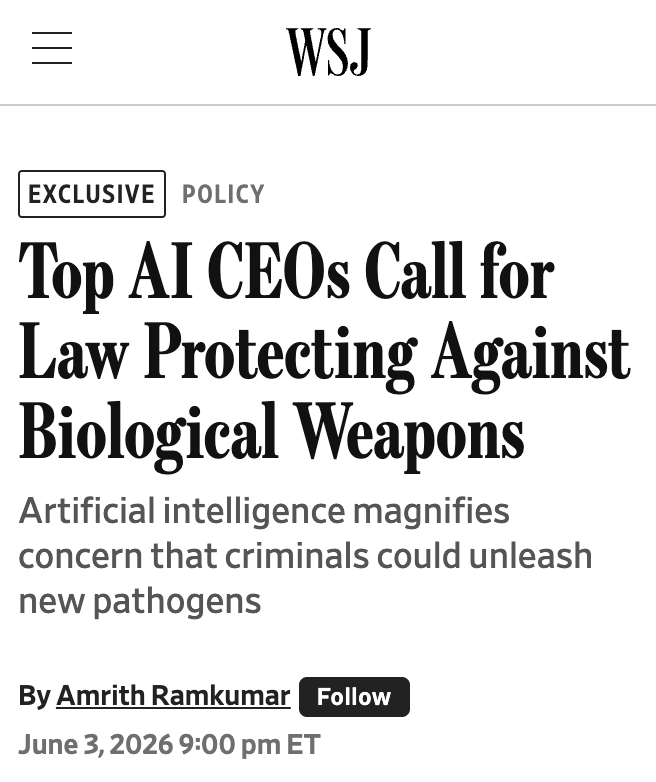
Hugely important open letter from IFP, FAI, the heads of every frontier lab, + many others on the importance of mandating DNA synthesis screening and recordkeeping. It's a total bipartisan layup to stop mail-order bioweapons
proud to see @deanwball, @ZacharyGraves, and so many other leading voices in AI, bio, and natsec (and at @JoinFAI and @IFP!) supporting measures to keep bioweapons out of the hands of bad actors
Mail-order bioweapons are bad. Congress should probably do something to stop them and @sama@DarioAmodei@demishassabis and @deanwball all agree.
I am very proud of this effort to make our world a safe place being led by my team at @JoinFAI and our friends at @IFP!
I am excited to share this today –– we have been working on this for a long time.
Nuclear material is regulated. Bioweapons are easier to make, don’t emit traceable radiation, and self-propagate for unprecedented destruction.
This should be common sense, bipartisan national security legislation.
Thank you to all who signed, including @PeterDiamandis, @deanwball, @ATabarrok, @kath_mcmahon, and @kesvelt.
No one should be able to order a bioweapon through the mail.
@IFP & @JoinFAI are proud to co-lead an open letter calling for mandatory DNA synthesis screening & recordkeeping.
Signatories include:
- Sam Altman, CEO & Co-Founder, OpenAI
- Dario Amodei, CEO & Co-Founder, Anthropic
- David Baker, Director, Institute for Protein Design; 2024 Nobel Prize in Chemistry recipient
- Patrick Collison, CEO & Co-Founder, Stripe
- Paul Graham, Founder, Y Combinator
- Demis Hassabis, CEO, Google DeepMind; 2024 Nobel Prize in Chemistry recipient
- Emily Leproust, CEO & Co-Founder, Twist Bioscience
- Lawrence Lessig, Roy L. Furman Professor of Law and Leadership, Harvard Law School
- Gerald W. Parker, former Special Assistant to the President for Biosecurity and Pandemic Response
- Mustafa Suleyman, CEO, Microsoft AI
- Alex Tabarrok, Professor of Economics, George Mason University
- Alexandr Wang, Chief AI Officer, Meta; Founder, Scale AI
- Christine E. Wormuth, President & CEO, Nuclear Threat Initiative; 25th Secretary of the Army
Read the letter and see the full list of signatories: https://t.co/BwZiJXw3JT
Many DNA synthesis companies voluntarily screen orders to mitigate biosecurity risks, but no law requires them to do so.
Leaders in AI, biotech, life sciences, national security, and the nucleic acid synthesis industry agree that Congress should act to strengthen safeguards against biological threats.
@deanwball put it well in the WSJ:
“If you’re synthesizing the stuff that yields biological life and viruses, we’re asking you to screen to see whether it is dangerous in some way. That seems like a reasonable thing for society to insist upon.”
Today’s Hyperdimensional is written in collaboration with Anton Leicht and focuses on the politics and policy of AI’s effect on the labor market. The candid truth is we know very little concrete facts about this issue, but nonetheless, there are prudent steps we can take now.
Political demand for policy solutions on AI labor disruptions is picking up, and it's outpacing our ability to measure, develop, and test responses.
Today's post with @deanwball lays out how, amid great uncertainty about economic futures, policymakers can bet on human work.
I am honored to have signed on to this letter. This is an urgent priority for near-term action by Congress. Biotech is advancing rapidly on its own, and I—and many others—believe the “Mythos moment” in AI/bio is coming soon. It is time for action.