Ligtas pa ba ang mga anak natin sa loob ng paaralan?
Sa gitna ng paulit-ulit na insidente, kailangan nang isabatas ang ating Child Safety Against Gun Violence Act (HB 10058).
Panoorin ito at i-share para suportahan ang ating panukala.
Shootout o palabas? It’s the morning after… and we’re realizing more and more that some details of the incident simply do not add up.
First, why was Senate security already fully armed and media personnel reportedly informed in advance that an arrest might happen inside the Senate? Did they already anticipate the supposed shooting?
Second, why did the Senate President immediately point to NBI agents when those same agents had supposedly been barred from entering the Senate since Monday? Wasn’t Senate security tightened precisely to prevent law enforcement officers from entering the premises and arresting the fugitive senator being sheltered there?
There are more questions, and the facts don’t really add up. And if this was staged, then the script was badly written.
For instance, what exactly would have been the motive of those allegedly trying to interfere with the Senate? Almost instantly, mabilis pa sa alas kwatro, our dearest Senator-Vloggers went live to amplify the narrative that “the Senate is under attack.”
But under attack by whom? Certainly not by law enforcement agencies, according to both the NBI and the PNP. And for what purpose? To secretly and forcibly execute an ICC arrest warrant against a sitting senator while the entirety of this country’s media was present and watching?
In fact, the motive for staging, or at the very least exploiting, such a narrative appears much clearer. The story that “the Senate is under attack” conveniently generates public sympathy not only for continuing to harbor an international fugitive, but also for once again delaying the Senate’s constitutional duty to convene the impeachment trial.
Who stands to gain if the Senate is temporarily paralyzed because it is supposedly under attack, if not one of their own and their political allies?
And spare us the accusation that we are merely being conspiracy theorists or watching too many teleseryes. The smuggling of Senator Bato dela Rosa into the Senate, his marathon through the stairways, the angry but triumphant return to the session hall, and the subsequent leadership coup — these are precisely the kinds of scenes Filipino teleseryes are made of. And it seems the director and writer enjoyed the first episode enough to produce a sequel.
The public deserves a full and credible accounting of what truly happened. There must an immediate independent investigation. Especially when the new Senate President and some of his allies are not exactly known for having the healthiest relationship with the truth.
And all of this could have been avoided if the fugitive senator had simply chosen to surrender voluntarily and face the charges against him before the international court. None of those lives, neither the journalists’ nor the Senate employees’, put at risk last night if not for the unwillingness of the former police chief to face justice. After all, has he not long dreamed in his sleep, like a frustrated scriptwriter, of a tearful, cinematic reunion with Tatay Digong?
Senator Bato dela Rosa should realize that the ICC warrant will not simply disappear. It is only a matter of time before he is arrested and eventually sent to The Hague. And whatever political theater he and his allies are staging now may only make it more difficult for him to later argue for provisional release before the ICC. Flight risk, after all, is not merely about escaping arrest. It is also about demonstrating a willingness to evade accountability.
And so it is with the impeachment trial against Vice President Sara Duterte. It will not simply go away. The allegations involving billions in bank transactions and the misuse of millions in confidential and intelligence funds will not magically disappear because of procedural delays, manufactured chaos, or political spectacle. At some point, the evidence will have to be confronted. And the longer they evade accountability, the more the evasion itself begins to look like an admission of guilt. https://t.co/ISEnJOsxnX
Claude Code is not AGI, but it is the single biggest advance in AI since the LLM.
But the thing is, Claude Code is NOT a pure LLM. And it’s not pure deep learning. Not even close.
And that changes everything.
The source code leak proves it. Tucked away at its center is a 3,167 line kernel called print.ts.
print.ts is a pattern matching. And pattern matching is supposed to be the *strength* of LLMs.
But Anthropic figured out that if you really need to get your patterns right, you can’t trust a pure LLM. They are too probabilistic. And too erratic.
Instead, the way Anthropic built that kernel is straight out of classical symbolic AI. For example, it is in large part a big IF-THEN conditional, with 486 branch points and 12 levels of nesting — all inside a deterministic, symbolic loop that the real godfathers of AI, people like John McCarthy and Marvin Minsky and Herb Simon, would have instantly recognized.*
Putting things differently, Anthropic, when push came to shove, went exactly where I long said the field needed to go (and where @geoffreyhinton said we didn’t need to go): to Neurosymbolic AI.
That’s right, the biggest advance since the LLM was neurosymbolic. AlphaFold, AlphaEvolve, AlphaProof, and AlphaGeometry are all neurosymbolic, too; so is Code Interpreter; when you are calling code, you are asking symbolic AI do an important part of the work.
Claude Code isn’t better because of scaling.
It’s better because Anthropic accepted the importance of using classical AI techniques alongside neural networks — precisely marriage I have long advocated.
It’s *massive* vindication for me (go see my 2019 debate with Bengio for context, or to my 2001 book, The Algebraic Mind), but it still ain’t perfect, or even close.
What we really need to do to get trustworthy AI rather than the current unpredictable “jagged” mess, is to go in the knowledge-, reasoning-, and world-model driven direction I laid out in 2020, in an article called the Next Decade in AI, in which neurosymbolic AI is just the *starting point* in a longer journey.*
Read that article if you want to know what else we need to do next.
The first part has already come to pass. In time, other three will, too.
Meanwhile, the implications for the allocation of capital are pretty massive: smartly adding in bits of symbolic AI can do a lot more than scaling alone, and even Anthropic as now discovered (though they won’t say) scaling is no longer the essence of innovation.
The paradigm has changed.
—
*Claude Code is plainly neurosymbolic but the code part is a mess; as Ernie Davis and I argued in Rebooting AI in 2019, we also need major advances in software engineering. But that’s a story for another day.
If this ceasefire winds up happening, the bold Iranian gambit to trade much of their senior leadership, most of their navy, at least half their missile launchers, the lives of thousands of security personnel, various bridges and rail lines, steel and petrochemical plants, their deterrence, their nuclear infrastructure, their air defenses, and the ability to use Dubai as a sanctions evasion hub for the possibility of charging tolls for merchant shipping on the Strait of Hormuz will have been a titanic failure
https://t.co/3BJuh3quaE
Software engineers: Context switching kills productivity.
Also software engineers: I'm now managing 19 AI agents and doing 1800 commits a day.
We’ve spent years complaining that managers who expect a quick 5-minute chat ruin our focus for the next hour. But a ping from an agent every few minutes, that’s ok?
We celebrated Paul Graham’s essay “Maker’s Schedule, Manager’s Schedule” in which he argued:
“When you're operating on the maker's schedule, meetings are a disaster. A single meeting can blow a whole afternoon, by breaking it into two pieces each too small to do anything hard in.”
Now we see software engineers claiming huge productivity gains from hordes of AI agents, celebrating thousands of commits per day from their 19 agents.
Either context switching was never really the problem, and we oversold our need for deep focus. Or we're not actually reviewing 1800 commits a day.
If we couldn't context switch before, we're not managing 19 agents. We're blindly trusting them.
That’s not engineering, it’s gambling.
Unpopular opinion:
Current code review tools just don’t make much sense for AI-generated code
When reviewing code I really want to know:
- The prompt made by the dev
- What corrections the other dev made to the code
- Clear marking of code AI-generated not changed by a human
Ito po si Fr. Flavie Villanueva.
For years, he has helped families of EJK victims through his program, Paghilom. Ramdam mo kung gaano niya ibinubuhos ang puso niya—dahil naniniwala siyang may halaga ang bawat buhay at may karapatan sa paghilom ang bawat pamilyang naulila.
Lubos ang pasasalamat ko kay Fr. Flavie para sa kanyang malasakit, paninindigan, at inspirasyon.
A meaningful Human Rights Week, and a blessed Sunday to all.
Microservices is the software industry’s most successful confidence scam. It convinces small teams that they are “thinking big” while systematically destroying their ability to move at all. It flatters ambition by weaponizing insecurity: if you’re not running a constellation of services, are you even a real company? Never mind that this architecture was invented to cope with organizational dysfunction at planetary scale. Now it’s being prescribed to teams that still share a Slack channel and a lunch table.
Small teams run on shared context. That is their superpower. Everyone can reason end-to-end. Everyone can change anything. Microservices vaporize that advantage on contact. They replace shared understanding with distributed ignorance. No one owns the whole anymore. Everyone owns a shard. The system becomes something that merely happens to the team, rather than something the team actively understands. This isn’t sophistication. It’s abdication.
Then comes the operational farce. Each service demands its own pipeline, secrets, alerts, metrics, dashboards, permissions, backups, and rituals of appeasement. You don’t “deploy” anymore—you synchronize a fleet. One bug now requires a multi-service autopsy. A feature release becomes a coordination exercise across artificial borders you invented for no reason. You didn’t simplify your system. You shattered it and called the debris “architecture.”
Microservices also lock incompetence in amber. You are forced to define APIs before you understand your own business. Guesses become contracts. Bad ideas become permanent dependencies. Every early mistake metastasizes through the network. In a monolith, wrong thinking is corrected with a refactor. In microservices, wrong thinking becomes infrastructure. You don’t just regret it—you host it, version it, and monitor it.
The claim that monoliths don’t scale is one of the dumbest lies in modern engineering folklore. What doesn’t scale is chaos. What doesn’t scale is process cosplay. What doesn’t scale is pretending you’re Netflix while shipping a glorified CRUD app. Monoliths scale just fine when teams have discipline, tests, and restraint. But restraint isn’t fashionable, and boring doesn’t make conference talks.
Microservices for small teams is not a technical mistake—it is a philosophical failure. It announces, loudly, that the team does not trust itself to understand its own system. It replaces accountability with protocol and momentum with middleware. You don’t get “future proofing.” You get permanent drag. And by the time you finally earn the scale that might justify this circus, your speed, your clarity, and your product instincts will already be gone.
LOOK: Bombshell affidavit detailing the money corrupted by and under the orders of Sara Duterte from illegal drugs, confidential funds, and POGO.
Key highlights include:
1. Sara and husband Mans Carpio instructing the pick up of the magnetic lifters from Customs.
2. Distribution of confidential funds to Laguna, OVP, and Office of the Ombudsman.
3. ONE BILLION PESOS delivery confirmed by Tatay Digong himself.
Ikulong na yan mga kurakot at criminal syndicates!
#Accountability
#DutertePanagutin
Software Engineers who made grep, cat, cut, find, ls, less, and sed really cooked here.
50 years later and it’s still bread and butter of data analysis.
And it still works better than most of bloated alternatives.
Plan A is Discayas. Plan B is Guteza. Neither of them carries any public credibility at this point. So when a political spectacle is unfolding, the real question is not what they’re saying— it’s who benefits from the show. Zaldy Co may have made a bargain with the devil. A man that desperate to save himself can be made to say anything. He’ll sell his soul to whoever offers him a way out. So who is the buyer?
Here’s the play as it appears to me: a plunderer credibly accused, speaking outside any oath, suddenly echoing Duterte’s script to stir up the upcoming INC rally, hoping to overthrow the Marcos government, and smooth the path for a second Duterte presidency. And if the stars align, he gets what he wants most: a chance to come home a free man. What a deal.
And when the cameras stopped rolling, I can imagine Zaldy Co praying as hard as he’s ever prayed that his newfound Duterte patrons claw their way back into Malacañang. Because that’s the only future in which he escapes a lifetime in jail.
The Discayas’ bank accounts did not just grow, they exploded by more than 1,115% during the Duterte administration! That alone tells us they were selective in naming their so called corrupt partners.
If the biggest payoffs happened under Duterte, yet they now claim there were no ledgers recording bribes to Duterte officials, then let us call it what it is: they’re protecting the Duterte people.
Until the Discayas come clean, reveal the ledgers, and return the fruits of corruption, there is no reason they should be admitted as state witnesses.
All the more reason for the ICI and the Senate Blue Ribbon Committee to dig deep into the Duterte era corruption.
No one should be spared!
Not the Marcos cronies of today, nor the Duterte cronies of yesterday. Let the truth come out & let the heavens fall where they must.
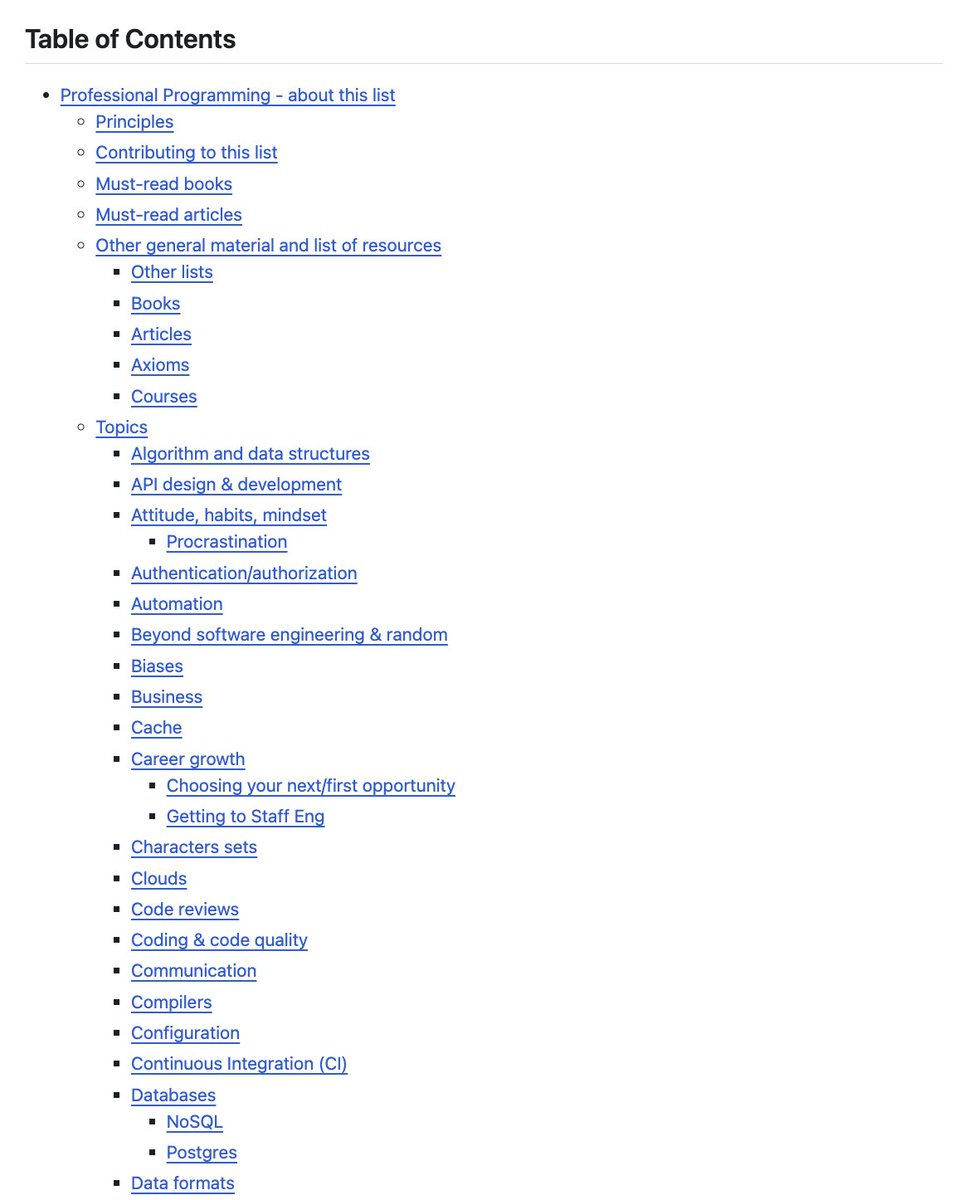
My first manager at Uber started a GitHub page back at the time with resources to become a more proficient developer - ones he personally found helpful (he did not have a CS degree).
I realized he is *still* updating it, 7 years later! A neat list: https://t.co/QtWeltMDWz
We are not a poor country. We are a robbed country.
Bear that in mind when our politicians secure millions for themselves but claim that we lack the resources to protect our healthcare workers or support the poor.
My August 20, 2025 “Flooded Gates of Corruption” privilege speech merely echoed my March 11, 2003 privilege speech entitled “Living Without Pork”. Thus, “Let me say now what our people hate to hear. But they must hear what we have been afraid to say”.
I always wondered how a scientist can believe in God (I know many do). How does this coexist in one brain:
- "I will reject your paper if you provide only speculative arguments in support of your theory," and
- "I know God exists and don't need proof?"
If you are a scientist and a believer or you know such a person, how you or they explain this phenomenon?
I've met more than a few programmers like this. Usually highly competent, but aggrieved that their impact on the world hasn't measured up to their ego. And the safe space is to consider most everyone else an idiot. Sad!