@CJSprigman Hi Chris, love the experimental approach to test legal criteria, but external validity is usually hard (or prohibitively expensive) to establish. Wondering if such an approach can be realistically operative and if so, what requirements should be imposed.
@emollick great paper! but just becoz majors and skill requirements correlate along dimension X, doesn’t mean they are intentionally sorted along dimension X right? Also wondering how much “majors as skill bundles” is treatment or selection.
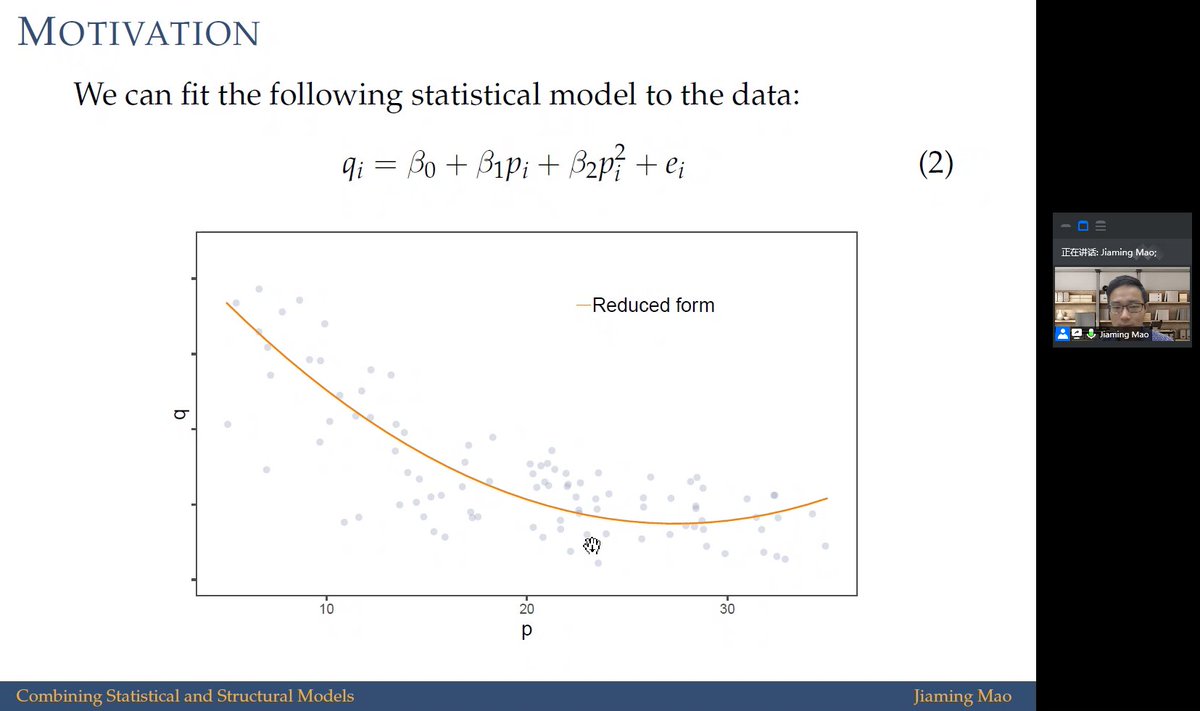
IESR #webinar | @JiamingJMao from WISE at Xiamen University shares his research on Combining Statistical and Structural Models for Improved Prediction and Causal Inference. https://t.co/qwDf2x1HQg #EconTwitter
Fascinating visual on artificial-intelligence talent moving around the globe. Takeaway: botching our visa policies would cost the US a long-range strategic asset: top talent. https://t.co/69JNCsJSO7
Modern Data Analysis for Economics: a course that attempts to offer a unified introduction to statistical learning and causal inference + reduced-form and structural econometrics. https://t.co/GTe1swoYKh
@DrEricDing The paper assumes an unrealistically short incubation period (4 days). This will significantly bias upwards the estimated transmission rate beta in order to match the number of reported cases -- might be part of the reason for very high R0.
Who could say no to a Cantonese opera about Donald Trump? Especially one where he apparently wears a blonde toupee and squares off with Mao Zedong in table tennis.