Did you know that every major civilization appears to produce a religion uniquely suited to its people?
This is not an accident.
Most people think religions create civilizations. I suspect the opposite always happens first. God raises up a people, allows them to develop a language, culture, traditions, and identity, and then plants a religious seed within that people.
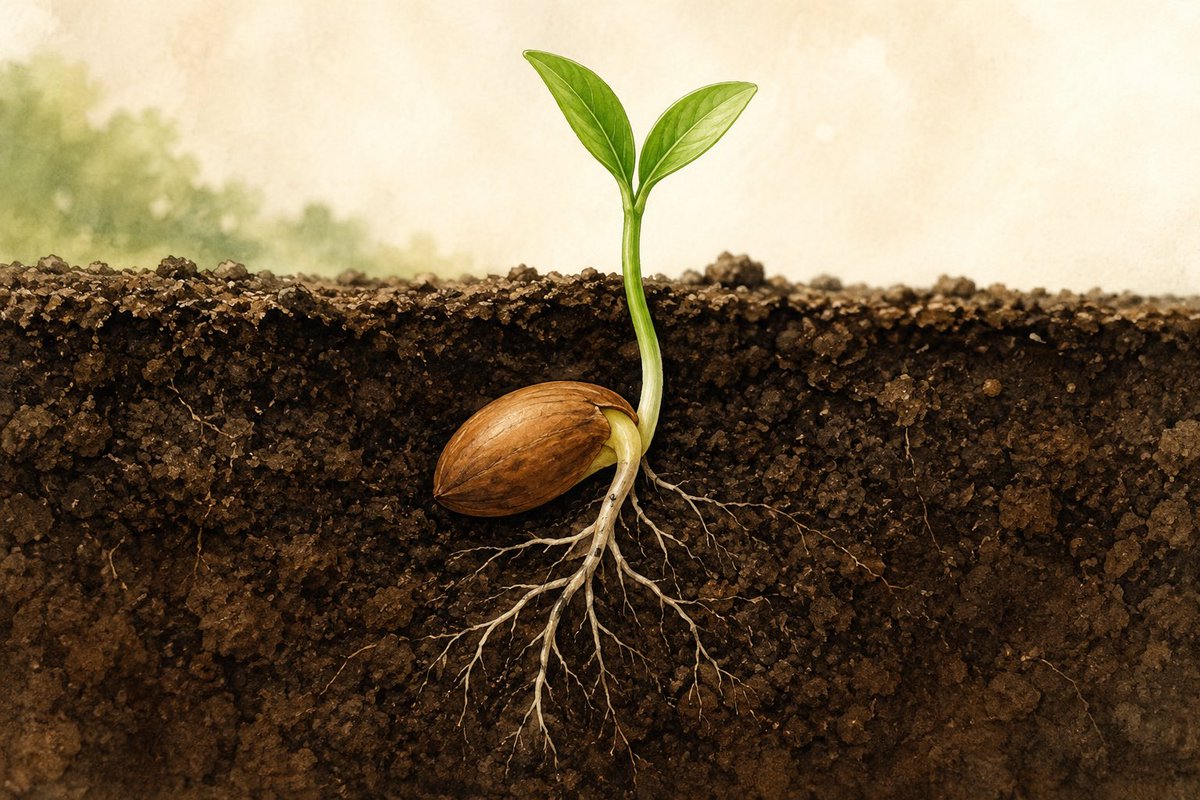
The people are the soil.
The religion is the seed.
And the resulting faith/religion is the tree.
This is why religions around the world can look so different while still sharing certain common traits. The seed may come from the same God, but the soil is different.
How do we identify these seeds?
I start by looking for the figure within a civilization’s religious tradition that is regarded by some as the highest or supreme deity. Not merely a god of rain, war, fertility, or the harvest, but a figure elevated above the rest because of who he is rather than what he governs.
Once that figure is identified, I then look for the movement, cult, philosophy, or religion most associated with him.
Some examples from ancient civilizations:
- Ancient Egypt — Atenism (Aten) / Amunism (Amun-Ra)
- Sumer — Anu Worship (Anu)
- Babylon — Marduk Cult (Marduk)
- Assyria — Ashurism (Ashur)
- Ancient Israel — Yahwism (Yahweh)
- Phoenicia/Canaan — El Worship (El)
- Classical Greece — Neoplatonism (The One)
- Roman Empire — Mithraism (Mithras)
- Norse Civilization — Odinism (Odin)
- Mongol Empire — Tengrism (Tengri)
- Aztec Empire — Ometeotl Worship (Ometeotl)
- Inca Empire — Viracocha Worship (Viracocha)
And among major civilizations still with living descendants:
- China — Confucianism (Tian)
- India — Vedanta (Brahman)
- Persia/Iran — Zoroastrianism (Ahura Mazda)
- Arabia — Islam (Allah)
- Russia — Orthodoxy (God)
- England — Anglicanism (God)
- Germany — Lutheranism (God)
- France — Calvinism (God)
- United States — Mormonism (God the Father)
- Ethiopia — Ethiopian Christianity (God)
- Armenia — Armenian Christianity (God)
- Japan — Shinto (Ame-no-Minakanushi)
- Korea — Cheondoism (Haneullim)
- Scotland — Presbyterianism (God)
What fascinates me is not that these religions are identical. They clearly are not.
What fascinates me is that nearly every civilization seems to develop a concept of a Highest God, First Principle, Most High, Supreme Heaven, All-Father, or Ultimate Reality.
Perhaps that is because God has never left Himself without a witness among any people.
Perhaps every civilization becomes fresh soil, and God plants a seed in every one.
And notice how post-Christ, almost all of them worship the same God now? This is the intended conclusion.
“And other sheep I have, which are not of this fold: them also I must bring, and they shall hear my voice; and there shall be one fold, and one shepherd.” (John 10:16)
This also means the “lost scriptures” we have yet to receive probably belong to each of these obscure groups throughout history.
@ubiquitousnewt Nothing a spanking won’t fix.
This is how you teach little children what is or isn’t acceptable behavior. And if you let it happen, they think it’s okay and will keep doing it.
@BallerToy1327 Fallout and the Boys were both stupid.
I question the moral character of anyone that liked the Boys.
Rings of Power was meh. I didn’t hate it. Not like most others did. But I also saw the subtle changes to the lore they thought nobody would notice…
What if all species have their own spirit world, and the only place all creatures can coexist is in an organized created reality like we exist in today?
What if that’s what really makes the Kingdom of God so great—that it’s a place where ALL species can coexist?
We often imagine “the” spirit world as though everything simply exists together in one vast invisible realm. But what if that’s backwards?
A fish does not merely live in water. A fish and water belong to the same system. Remove one and the other loses meaning.
Likewise, maybe every species develops alongside its own spiritual environment. Not an environment that sustains it, but one that is part of what it is.
After all, spirits do not die. They do not need food, water, or oxygen to survive. Yet every living thing seems to exist within some equilibrium.
What if a spirit and its world develop together?
The creature and the habitat.
The tree and the soil.
The yin and the yang.
But this raises a much deeper question.
If every species possesses its own spiritual equilibrium, how would one species ever become aware of another?
A wolf-world would remain isolated from a bird-world. A bird-world from a whale-world. A whale-world from a human-world.
Unless there exists a third thing that belongs to all of them.
Breath.
Not body. Not mind.
Breath.
Scripture repeatedly identifies living things by the breath of life. Plants exchange breath. Animals exchange breath. Humans exchange breath.
Breath is unique because it does not remain contained. It mingles.
You cannot point to the air around you and determine which molecules belonged to a man, a tree, a bird, or a deer.
Breath naturally crosses boundaries.
What if breath is the medium through which otherwise separate worlds become aware of one another?
Not through physical contact.
Not through sight.
But through participation.
A shared sea between isolated islands of being.
Maybe this is why dreams can sometimes feel familiar despite showing us things we have never seen. The soul recognizes something the senses do not.
The intelligence says, “I know this.”
The eyes answer, “I have never seen it.”
And maybe creation itself is God’s great act of gathering.
Not merely gathering people. Not merely gathering families. But gathering worlds. Taking realities that would otherwise remain forever separate and bringing them into covenant relationship with one another.
Maybe that is what Zion ultimately is.
A kingdom so perfectly ordered that every form of life can dwell together in peace. And the Being intelligent enough to do it is who we (will) worship forever.
I think Pratt is a trap.
His campaign was way too organized.
Not a trap by the deep state.
A trap FOR the deep state.
I bet that election is being watched very closely be advanced AI and other tech.
@Variety They cancelled it because they tried to make it woke then realized the woke audience didn’t care for Stargate and making it woke would lose the original viewers.
It was a lose-lose.
Had to scrap it.
Jacob 5 proves the Book of Mormon true by itself.
The depth of Jacob 5 is mind boggling.
Joseph Smith would have had to live a thousand years earlier in Europe to be able to write what he wrote. A 19th century uneducated farm boy simply couldn’t have known it. Period.
That kind of horticulture knowledge is wholly absent from 1830 literature widely available in America.
That’s leads the reasonable person to a dilemma. Either, (A) Joseph Smith was truly a prophet translating and ancient work that had knowledge far beyond Joseph’s capabilities, or (B) Joseph was part of an ancient Mason fraternity that guarded ancient secrets for the sole purpose of creating a grand deception to control the world.
Hmm.
(A) = simple, reasonable, and in-line with how God has consistently worked across dispensations.
(B) = Hollywood thriller.
I know where I’m putting my money.
@Sloanius@stackerco@RandomLDS If you think apostates even make a dent in the “most” category of those who say the Book of Mormon is false, I have a garage of junk I want to sell you.
@valorthodoxia If your theology requires 1,500 years of Jews to be wrong, maybe revisit your theology.
We can do this all day.
Or maybe you can recognize that God creates a religion in every major nation that has ever been, and clinging to a European religion in America is simply silly.
@GateWorld It’s too bad.
But considering how the last couple installments went, was anyone expecting anything good from this?
I hope one day a real reboot can happen.
One of the strangest habits in church history is pretending that the theological debates of the 300s AD were already settled in the 30s AD.
The historical record simply does not support that claim.
What we actually find in the first few centuries is a wide variety of views concerning the relationship between the Father, Son, and Holy Spirit.
Some Christians held views that later became known as Adoptionism. Others held forms of Modalism. Others taught a hierarchy between the Father and Son. Others developed ideas that would eventually contribute to Trinitarian theology. The fact that so many competing views existed is precisely why the great doctrinal controversies erupted in the first place.
Even mainstream historians acknowledge that the fully developed doctrine of the Trinity was the result of centuries of theological development rather than a universally articulated belief of the apostolic age.
The irony is that both sides of this debate often oversimplify history.
It is not true that all first-century Christians believed the later Nicene formulation.
But it is also not true that all first-century Christians believed what modern Latter-day Saints believe.
The evidence simply isn’t that neat.
The word Trinity itself does not appear until the late second century, and the terminology that became standard—Trinitas, persona, homoousios, and so forth—was developed gradually as Christians argued over questions they were trying to answer from scripture. (But Godhead does appear 3 times in the Bible…)
What can be said with confidence is that first-century Christians believed in the Father, the Son, and the Holy Spirit. What cannot honestly be claimed by ANYONE is that every Christian in the first century agreed on exactly how those three related to one another.
If they had, there would have been no need for centuries of debate, councils, creeds, condemnations, and theological warfare afterward.
History is far messier—and usually far more interesting—than either side likes to admits.
THIS IS GOD
(Poem in the works; seeking feedback)
Each spirit is known and loved by Him.
This is God
The Father of all living light,
Whose children shine because He's bright.
This is God
Not one alone, but joined in fire—
Exalted hearts of one desire,
Bound fast by oath and purpose higher.
This is God
Before it all, there stood this One,
Yet greater works had not begun.
Two Others came into that Sun;
Three wills made one—the oath was done.
This is God
They made a way for us to rise—
A ladder climbs into the skies—
And bid us climb and claim the prize.
This is God
He shares with us His holy name,
And teaches us to do the same.
This is God
The God who would not reign alone.
——
The structure is this:
- "This is God" between each stanza.
- 8 syllables per line (2-syllable words in a 1-syllable cadence = okay).
- All lines in a stanza must rhyme (or b-rhyme).
- Flow must be consistent, esp. between syllables 4-5.
- Stanza line count = 1, 2, 3, 4, 3, 2, 1
——
Feedback?
God is not a verb.
Am I surprised that this has to be said?
Not even a little.
But to be clear:
God is a noun. A singular Entity. The Father of (ALL) Spirits, who knows every single one of our spirits personally.
This is God.
God is also not a singular Entity, depending on context. “God” is a host of exalted beings, all united beside the First God, sharing His power, glory, and purpose. This is why the word “Elohim” blurs the line between singular and plural. It reveals a truth many struggle to grasp: God is both one and many—one through perfect unity of mind and will, and many through exaltation.
This is God.
Yet even the First God was not alone. He was only able to accomplish what He accomplished because He found Two others with whom He formed an unbreakable covenant, whereby the first authority-wielding Godhead was established, becoming the pattern for every world that followed.
This is God.
The One who desired to create something greater than Himself—not because He lacked anything, but because He desired children who could become even as He is.
This is God.
The One who embarked upon that adventure alongside Two others who shared the same vision and were willing to do all that vision required of them.
This is God.
Not a verb.
Not an abstraction.
Not a force.
But a living Being. A Father. A King. A Creator. One who knows you by name and invites you to become as He is.
This is God.
(I think I might write a poem on this premise…)