This is a massive and growing problem for American national security. Unbelievable amounts of sensitive and classified information is captured, scraped, and sent back to foreign nations.
And users have no idea. Nobody expects that their TV or monitor is a surveillance tool. When I have joked that Smart TVs should be illegal, I am only half-joking.
3 tests that predict the day you'll die better than most blood tests:
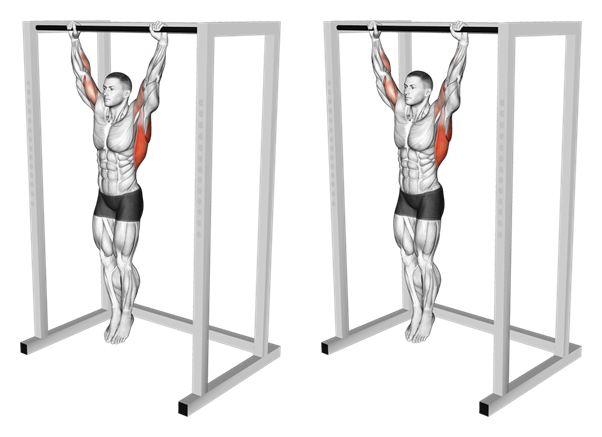
1. Grip Strength
The Test
• Hang from a pull-up bar
• Overhand grip
• Arms fully extended
• No swinging or kipping
• Time how long you can hold
Men
• 60+ seconds = strong predictor of good health and longevity
• 90+ seconds = excellent
• <30 seconds = increased risk marker
Women
• 30–45 seconds = good
• 60+ seconds = excellent
• <20 seconds = increased risk marker
What it measures:
Overall muscle strength, neuromuscular health and physical reserve.
Research:
Every 5kg increase in grip strength is linked with about 16 percent lower all-cause mortality.
How to train it:
Lift heavy weights and carry heavy loads.
2. Sit to Stand Test
The Test
• Sit on a standard chair (about 43–45 cm height)
• Arms crossed over chest
• Stand up fully, then sit back down
• Repeat for 30 seconds
• Count total reps
Men
• 20–24 reps = good
• 25+ reps = excellent
• <15 reps = elevated risk
Women
• 18–22 reps = good
• 23+ reps = excellent
• <12–14 reps = elevated risk
What it measures:
Lower body strength, power and functional capacity.
Research:
Slower performance predicts an earlier death and loss of independence.
Taking longer than about 15 seconds for five repetitions is associated with higher risk of decline.
How to train it:
Bodyweight squats and leg strength exercises.
3. Gait Speed
The Test
• Measure a 10 metre walk
• Walk at normal pace (not sprinting)
• Time it
• Calculate speed: metres per second
• ≥1.2 m/s = excellent longevity marker
• 1.0–1.2 m/s = normal
• <0.8 m/s = increased mortality risk
• <0.6 m/s = high risk / frailty
What it measures:
Walking speed as a marker of heart health, coordination and vitality.
Research:
Every 0.1 metres per second faster walking speed is associated with 12 percent lower mortality.
How to train it:
Brisk walking, interval walking and lower body strength training.
PMID: 26634465
PMID: 21617190
There's a physicist at Stanford named Safi Bahcall who modeled this exact principle and the math is wild.
He calls it "phase transitions in human networks." When you're stationary, your probability of a lucky event is limited to your existing surface area: the people you already know, the places you already go, the ideas you've already been exposed to. Your opportunity window is fixed.
When you move, your collision rate with new nodes in a network increases nonlinearly. Double your movement (new conversations, new cities, new projects) and your probability of a serendipitous encounter doesn't double. It roughly quadruples. Because each new node connects you to their entire network, not just to them.
Richard Wiseman ran a 10-year study at the University of Hertfordshire tracking self-described "lucky" and "unlucky" people. The single biggest differentiator wasn't IQ, education, or family money. Lucky people scored significantly higher on one trait: openness to experience. They talked to strangers more, varied their routines more, and said yes to invitations at nearly twice the rate.
The "unlucky" group followed the same routes, ate at the same restaurants, and talked to the same 5 people. Their networks were closed loops. No new inputs, no new collisions.
Luck isn't random. Luck is surface area. And surface area is a function of movement.
The lobster emoji is doing more work than most people realize. Lobsters grow by shedding their shell when it gets too tight. The growth requires a period of total vulnerability. No protection, no armor, soft body exposed to the ocean.
That's the cost of movement nobody posts about. You have to be uncomfortable first. The new shell only hardens after you've already moved.
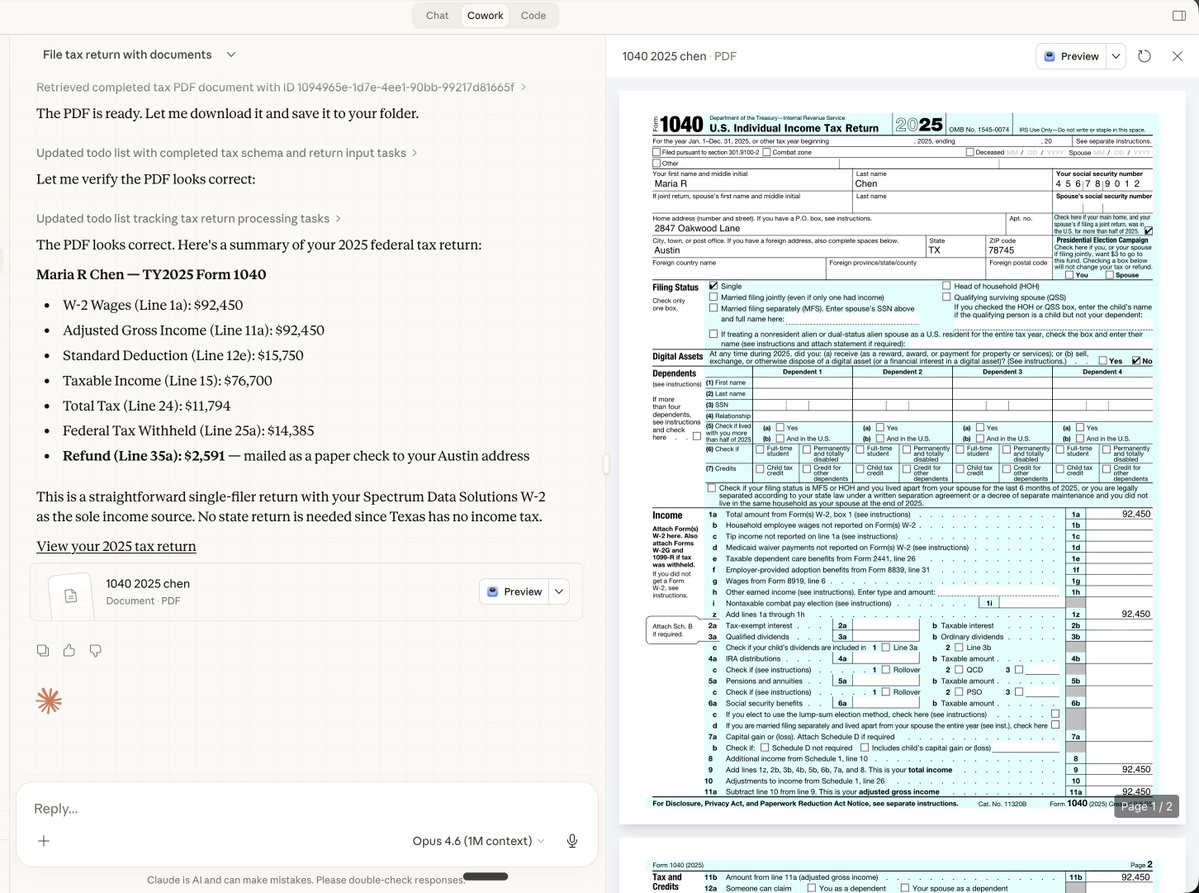
I've been working on tax software for the past 5 years. This is the last year anyone will have to pay for TurboTax.
You can try it yourself today:
- add the Aiwyn Tax connector inside of Claude (link below)
- give it access to your tax documents (W-2s, etc.)
- ask Claude to prepare your tax return
...and that's it!
Dario Amodei's new interview: He was asked "If you were in the room with the President right now, what would you say to him?"
He says “Disagreeing with the government is the most American thing in the world.”
He looks visibly strained.
The math on this project should mass-humble every AI lab on the planet.
1 cubic millimeter. One-millionth of a human brain. Harvard and Google spent 10 years mapping it. The imaging alone took 326 days. They sliced the tissue into 5,000 wafers each 30 nanometers thick, ran them through a $6 million electron microscope, then needed Google’s ML models to stitch the 3D reconstruction because no human team could process the output.
The result: 57,000 cells, 150 million synapses, 230 millimeters of blood vessels, compressed into 1.4 petabytes of raw data. For context, 1.4 petabytes is roughly 1.4 million gigabytes. From a speck smaller than a grain of rice.
Now scale that. The full human brain is one million times larger. Mapping the whole thing at this resolution would produce approximately 1.4 zettabytes of data. That’s roughly equal to all the data generated on Earth in a single year. The storage alone would cost an estimated $50 billion and require a 140-acre data center, which would make it the largest on the planet.
And they found things textbooks don’t contain. One neuron had over 5,000 connection points. Some axons had coiled themselves into tight whorls for completely unknown reasons. Pairs of cell clusters grew in mirror images of each other. Jeff Lichtman, the Harvard lead, said there’s “a chasm between what we already know and what we need to know.”
This is why the next step isn’t a human brain. It’s a mouse hippocampus, 10 cubic millimeters, over the next five years. Because even a mouse brain is 1,000x larger than what they just mapped, and the full mouse connectome is the proof of concept before anyone attempts the human one.
We’re building AI systems that loosely mimic neural networks while still unable to fully read the wiring diagram of a single cubic millimeter of the thing we’re trying to imitate. The original is 1.4 petabytes per millionth of its volume. Every AI model on Earth fits in a fraction of that.
The brain runs on 20 watts and fits in your skull. The data center required to merely describe one-millionth of it would span 140 acres.
15 things to do with your father while he is still alive. I lost mine 8 years ago.
1. Ask him what he was like at your age because once he was the same age you are right now & Watch his face light up as he tells you stories from when he was younger
2. Record his laugh when he tells one of his signature jokes. Someday you will replay the video over and over just to hear it again
3. Ask him about the proudest moment of his life. (Odds are he will say when you were born)
4. Ask him his favourite songs
Listen to them together, laugh, sing and be happy. These will become your most cherished memories in years to come
5. Take a picture of him doing something he loves. Watching tv, gardening, playing the guitar, anything. When you look back these will be the pictures that will make you smile the most
6. Tell him you love him even if it's something you don't normally do.
7. Tell him you are proud to be his son/daughter This will mean more to him than you realise (even if he doesn't show it)
8. Listen to music from his youth and watch him turn from dad into a young man again
9. Take a short video of him talking about something random sacred Someday even the ordinary things he said become
10. Bring up something you are thankful for from years ago
11. Ask him what it was like for him growing up
12. Call him for no reason
Don't take being able to do this for granted.
Someday you would give anything to hear his voice again.
13. Take a picture of just the 2 of you together
14. Ask him to show you an old photo of him because seeing him young will remind you that he wasn't always Dad
15. Tell him something you are struggling with, no matter what age you are Because even when your grown it means the world to him to feel like he can still help
Let him give you advice, even if you don't need it because one day you will give anything to hear his voice guiding you again
COMMANDER: We’re fighting for freedom. And part of that freedom… is the freedom to retire with dignity. So we’re going to start accounts called 401(k)s.
SOLDIER 1: What’s a 401(k)?
COMMANDER: It’s a retirement account. You put money in, it grows tax-free, you take it out when you’re old.
SOLDIER 2: So I don’t pay taxes on it?
COMMANDER: Well, you pay taxes later. When you withdraw.
SOLDIER 2: So it’s not tax-free.
COMMANDER: It’s…tax-deferred.
SOLDIER 2: What’s the difference?
COMMANDER: You pay taxes later instead of now.
SOLDIER 1: What if I want to pay taxes now?
COMMANDER: Then you do a Roth 401(k).
SOLDIER 3: What’s a Roth?
COMMANDER: You pay taxes now, and it grows tax-free.
SOLDIER 2: That’s what I thought the first one was.
COMMANDER: No, the first one you pay taxes later.
SOLDIER 1: Which one’s better?
COMMANDER: Depends on your tax bracket in retirement.
SOLDIER 1: …How would I…know that?
COMMANDER: You don’t. You just guess.
⸻
SOLDIER 4: What if I don’t have a 401(k) through my employer?
COMMANDER: Then you open an IRA.
SOLDIER 4: What’s the difference?
COMMANDER: One’s through your job, one’s on your own.
SOLDIER 4: Can I have both?
COMMANDER: Yes.
SOLDIER 4: Should I?
COMMANDER: Maybe.
SOLDIER 3: Can I do a Roth IRA?
COMMANDER: Only if you make under a certain amount.
SOLDIER 3: What’s the limit?
COMMANDER: Changes every year.
SOLDIER 2: What if I make too much?
COMMANDER: Then you do a backdoor Roth by putting it in a Traditonal first.
SOLDIER 2: …Is that legal?
COMMANDER: Surprisingly, yes.
SOLDIER 1: What’s a backdoor Roth?
COMMANDER: You contribute to a traditional IRA, then convert it to a Roth…but watch out for “pro rata”.
SOLDIER 1: Why wouldn’t I just contribute to the Roth directly?
COMMANDER: Because you make too much money.
SOLDIER 1: But this way I can?
COMMANDER: Yes.
SOLDIER 1: That feels like a loophole.
COMMANDER: It is. But the IRS is cool with it.
⸻
SOLDIER 5: I just changed battalions. What do I do with my old 401(k)?
COMMANDER: You roll it over.
SOLDIER 5: Into what?
COMMANDER: An IRA. Or your new 401(k). Depends.
SOLDIER 5: On what?
COMMANDER: The funds. The fees. Whether your new plan accepts rollovers.
SOLDIER 5: What if I just take the money out?
COMMANDER: You’ll pay taxes plus a 10% penalty.
SOLDIER 5: What if I’m 59?
COMMANDER: Penalty.
SOLDIER 5: 59 and a half?
COMMANDER: No penalty.
SOLDIER 5: …The half matters?
COMMANDER: The half matters.
⸻
SOLDIER 3: What’s a mega backdoor Roth?
COMMANDER: Okay. So. Your 401(k) has a limit of how much you can contribute.
SOLDIER 3: Right.
COMMANDER: But the total limit including employer contributions is higher.
SOLDIER 3: Okay…
COMMANDER: So if your plan allows ~after-tax~ contributions, you can put in more, then convert that to Roth.
SOLDIER 3: Does my plan allow that?
COMMANDER: I don’t know. You have to ask Betsy.
SOLDIER 3: Will Betsy know?
COMMANDER: Probably not.
⸻
SOLDIER 2: Can I deduct my IRA contribution on my taxes?
COMMANDER: Are you covered by a retirement plan at work?
SOLDIER 2: Yes.
COMMANDER: Then only if you make under a certain amount per year.
SOLDIER 2: What’s the amount?
COMMANDER: Depends if you’re married.
SOLDIER 2: What if my wife has a plan but I don’t?
COMMANDER: Different limit.
SOLDIER 2: What if neither of us has a plan?
COMMANDER: Full deduction.
SOLDIER 2: So it’s better to not have a 401(k)?
COMMANDER: No…
⸻
SOLDIER 1: Can I just keep my money in a sock?
COMMANDER: You could. But inflation will slowly destroy it.
SOLDIER 1: What’s inflation?
COMMANDER: (sighs)…
Worked 2 decades in in consulting.
Made Partner in my 30s.
Led teams of 100+ people.
Run 9-figure client portfolios.
Lived and worked in 4 continents.
To grow fast, I had to learn practical ways to "narrate reality" to my leaders, without turning into the loudest guy in the office.
3 UNDER-DISCUSSED WAYS TO SELF-PROMOTE
1) Run "impact debriefs" after every meaningful piece of work, and make them impossible to ignore.
A lot of people finish a project… and move on.
They think "Well, my boss saw how hard I worked. They know."
No they don't.
After every major milestone (eg, a workshop, a turnaround, a nasty delivery save) write a one-page impact note and send it to the people who matter.
Frame it as a story of change: what was broken, what you changed, what business risk or cost you removed, what decision you unlocked, etc
Use numbers, but lead with stakes.
An exec doesn't care about "I consolidated 3 misaligned streams" but they get interested with "I prevented a $4M regulatory exposure by getting 4 execs to align on a single approach"...
The right people remember evidence.
⸻
2) Translate your work into executive language, even if nobody asked you to.
Early in your career you think work is about doing, but later you realize careers are built on how your work is interpreted.
Every month, force yourself to rewrite what you did in a language an exec would respect:
Risk reduced.
Revenue unlocked.
Delay avoided.
Optionality created.
Take the complex thing you did in the trenches and narrate it as cause-and-effect.
For example:
"I built a dashboard" is output.
"I gave the CFO a single source of financial truth and eliminated three weeks of reconciliation activities per quarter" is impact.
Then drip-feed that language in conversations, performance reviews, 1:1s, town halls.
You are simply making reality visible at the altitude where decisions are made.
IMPORTANT!!! If you do not narrate it, someone else will, and they will narrate themselves into your work.
⸻
3) Build a small internal audience and teach them what you are learning.
All right, this is the highest-leverage move.
Once a quarter, run a short learning session inside your team or practice: teach a principle that emerged from your work.
Explain the context and trade-offs, give details, so that people start seeing you not as a deliverable machine but as a person who creates understanding.
Understanding is political capital.
Executives hear about people who create understanding.
Careers move around those people.
⸻
Let me be even more explicit: doing important work in silence is romantic, but in reality, silence gets mistaken for irrelevance.
Be an high achiever, but don't be a QUIET high achiever.
Narrate what is true: do it with restraint, precision, and respect for the craft.
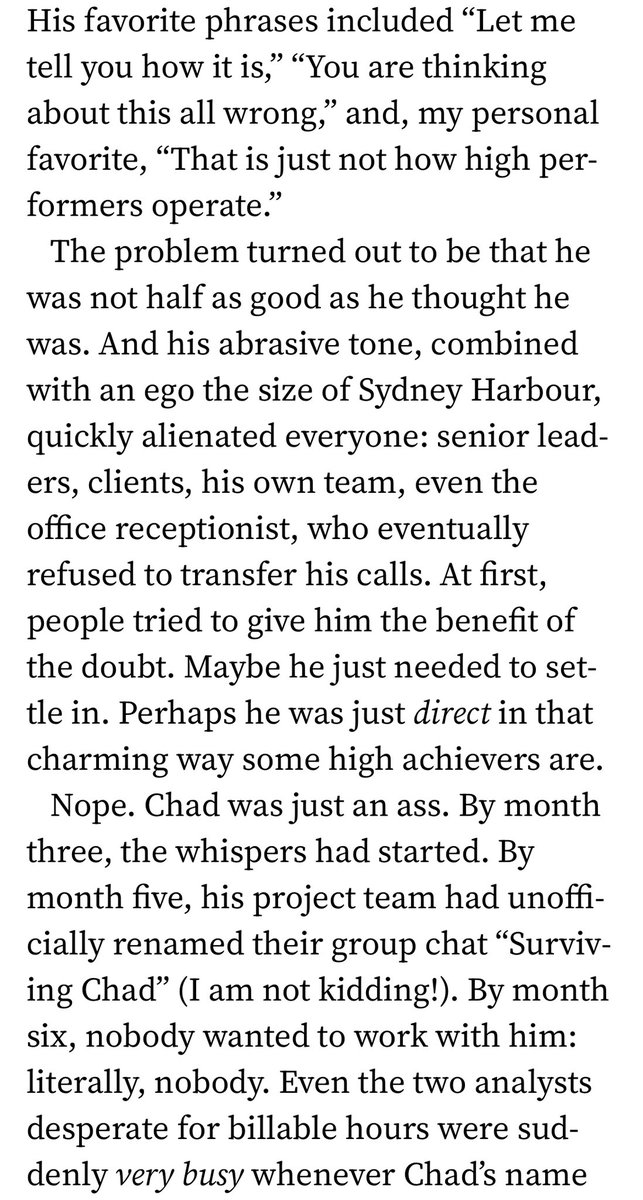
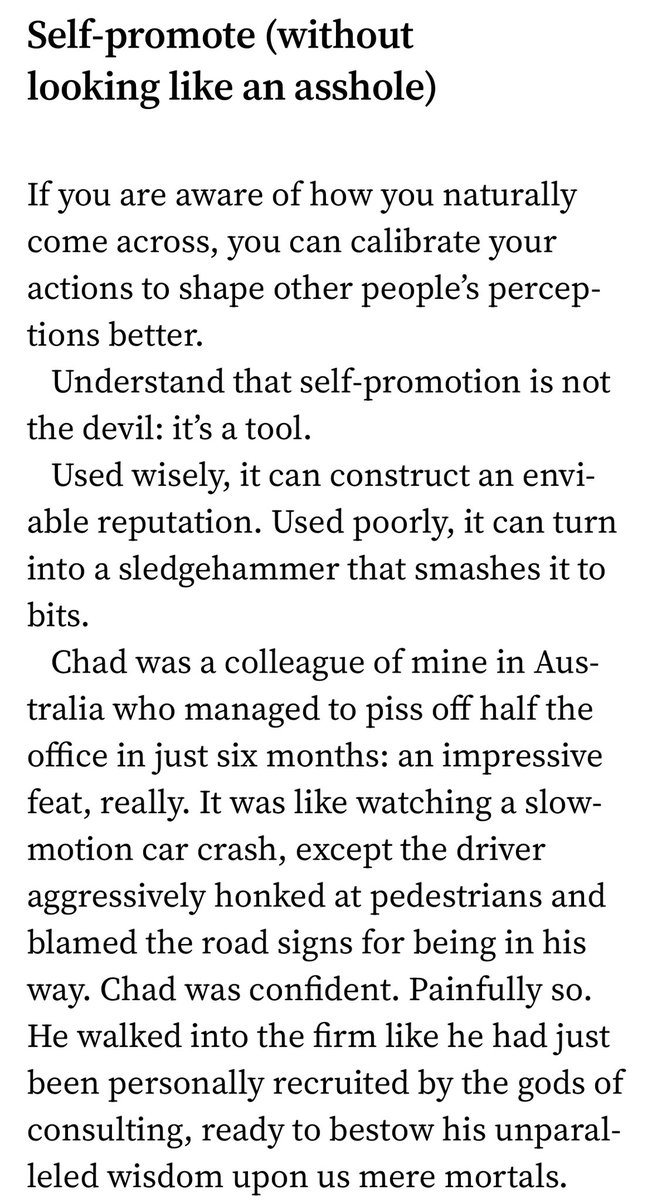
I wrote a chapter in "Beyond Slides" with more suggestions on how to "self-promote without looking like an asshole", so have a read at the below extract!
All the best!!
There's a billion dollar business hidden in the teacher's lounge.
Break room businesses scale FAST by using the 3 best networkers this big blue planet has ever known:
1. Teachers
2. Realtors
3. Stylists
Here's all the ways you can profit from these 3 chatty Cathys:
(BTW, this is tried and proven, just ask the $300M Chicken Salad Chick founder. She wouldn't be in business without it. More on her below)
Teachers, realtors and stylists are insanely well connected in their communities, and they talk. Boy, do they talk.
Not only do they talk, but they talk to high value clients:
Parents
Investors
Homeowners
Other realtors & brokers
People that can afford stylists
How can you use them?
Give them free food with marketing materials!
That's it. It only works for certain types of businesses though.
And what's more powerful than a personal referral or word of mouth marketing?
Maybe John Cena, but other than him, NOTHING.
When Stacy Brown first launched Chicken Salad Chick, she was a broke as a joke single mom, down on her luck.
She only had 1 thing: A freaking amazing Chicken Salad recipe.
It was so amazing that she sold it door to door to pay the bills, but she wanted a restaurant.
She opened a tiny little restaurant in Auburn, AL (ew) and used those 3 groups of people to spread the word.
What happened? She blew up. Absolutely blew up.
It was a runaway success, and their sales last year were over $300m across hundreds of restaurants.
She simply gave away her food to teachers, realtors and stylists and they talked and talked and talked.
She said herself that this one marketing channel was the secret to her early success.
But this works for more than just restaurants, you know.
Here's a list:
1. Home Services
HVAC, tree trimming, plumbing, fencing, etc etc etc. These 3 cohorts know homeowners, and homeowners are always looking for good home service providers.
For teachers and stylists it would work best for more impulsive home services like epoxy flooring or painting.
If it were tree trimming or HVAC you'd need to catch them at the right time.
In our tree trimming biz, realtors are our biggest lead source. Not biggest referral source, biggest lead source.
Realtors work great for bigger items like roofing and HVAC because they need that crap to be done yesterday so they can close.
2. Real Estate
If I were a real estate agent or flipper, I'd spend the whole of my marketing budget on Chick Fil A and Panera.
When your average ticket size is $10k - $200k+, you can afford it. Stay top of mind with these three cohorts and they will bring you off market listings and fix n flips.
And yes, if you're a realtor, you want to be buying lunch for other realtors as well.
3. Retail
If I opened a restaurant, gym, boutique, insurance office, or literally anything in retail, this would be my #1 marketing channel.
Why? Because your customers are LOCAL.
The network effects of these three groups of people spreading your gospel is far more valuable (and cheaper) than impersonal FB ads.
4. Pet products and services
Doggy daycares, vets, pet stores, dog walkers, groomers, pet products, pet apps, etc, could all benefit from this.
There are more dogs in the US than kids. Sell something to their owners.
5. Bounce house rentals
Yeah, this is pretty niche, but I just love this biz for some reason. You'll be booked for months if you bought lunch for these groups of people.
Tell me you wouldn't? Honestly bro, tell me you wouldn't?
Buy a $700 bounce house + $70 worth of lunch, and you'll have your money back in 1 week. Then do that x17.
BTW, the term break room businesses is an invention of yours truly, so please Venmo me $3 every time you use it. JKJK
Thanks for reading. Now go start a dang business already. @mhp_guy signing out.